Obituary in the Daily Telegraph, Friday 22 March 2024.

Obituary in the Daily Telegraph, Friday 22 March 2024.

From left: Sqn Ldr Benny Goodman (24 September 1920-18 July 2021, Wg Cdr John Bell (25 March 1923-18 March 2024, Sqn Ldr Johnny Johnson (25 November 1921-7 December 2022). Photograph of the three centurions, taken while all were still in their late nineties, at the BBMF End of Season Dinner in October 2019. [Pic: Cherry Greveson.]
Edited version of earlier guest post by Dr Robert Owen, official historian, 617 Squadron Association.
Sadly, Wing Commander John Bell died yesterday, Monday 18 March, a week before his 101st birthday. He leaves a younger sister, Evelyn, a daughter, Sue and his granddaughters.
Wing Commander John Bell MBE, DFC, L d’H, the last British wartime aircrew member of No. 617 Squadron, will be 100 on Saturday 25 March 2023. As a bomb aimer, serving initially with No. 619 Sqn and then No. 617 Sqn, John is a veteran of 50 operations over enemy territory.
He was born on 25 March 1923 and left school in the summer of 1939, aged 16, just before war was declared. He then went to work for a firm of chartered accountants in the City of London. Soon, his evenings and weekends were occupied as a member of the local Home Guard platoon. Seeing the Battle of Britain being fought overhead during work visits to Kent, he determined to join the Royal Air Force as soon as he was able, and like many saw himself as a dashing young pilot.
Rather than wait to be called up, in June 1941 he presented himself as a volunteer at the recruiting office in Worcester Park. Sent to a medical board in Oxford he found his hopes of becoming a pilot dashed. At 6 ft 4 ins, he was too tall. Instead, he was offered an alternative which to him “sounded interesting” of being trained as an observer and air gunner. Accepting this, he was called up in September 1941.
After the usual spell at the Aircrew Reception Centre, Regents Park (Lord’s cricket ground) and several months in Torquay with No. 13 Initial Training Wing, he was sent to Eastbourne to learn the basics of navigation. The next stage of his training would take him farther afield.
In May 1942 he boarded a troopship bound for South Africa, to continue his navigation and bomb aiming training as an observer at No 45 Air School, Oudstshoorn, followed by a gunnery course in Airspeed Oxfords. In early 1943 he returned to the UK via New York.
Destined for Bomber Command, his next stage was with No. 14 Operational Training Unit (OTU) at Cottesmore where he was to first meet members of his future crew, captained by Bob Knights. Crewing up was a seemingly haphazard affair, sufficient trainee aircrew of the relevant trades were assembled in a hangar and told to sort themselves into crews.
John recalls: ‘I remember standing there with a Canadian navigator, probably looking a bit lost, both of us thinking, “How do we find a good pilot?” Then a rear gunner came up and said to us, “I’ve got a pilot, come with me.”’
Although flying training at the OTU was conducted using Vickers Wellingtons, by this stage Bomber Command was building up its might with the new four engined Lancaster and had introduced the “pilot, bomb aimer, navigator (PNB) scheme”. Observers now had to choose between the latter two trades. Since his bomb aiming was better than his navigation, the decision was made for him, which meant additional training, since the Mark IX on which John had trained was now being replaced by the Mark XIV sight which was not only easier to set but also allowed greater tactical freedom.
From OTU the crew transferred to No. 1660 Conversion Unit at Swinderby, in June 1943, converting initially to the twin engine Avro Manchester, before transferring to the superlative Lancaster. Here they also acquired the final member of their crew, flight engineer Ernie Twells. After a month’s conversion they were declared operational and on 30 June posted to the recently formed No. 619 Squadron, based at Woodhall Spa.
After three weeks further training, during which Bob Knights flew his initial “dicky mission” with another crew, on 24 July they were detailed to attack Hamburg. The next night saw them out again, against Essen and then on 27 July it was back to Hamburg to continue Bomber Command’s major onslaught against this German port. On this occasion the port inner engine burst into flames on the outward journey. Knights extinguished the fire, but the aircraft would not maintain height. Undeterred, they pressed on to the target, bombing from 10,000 feet, with the main force twice that height above. Two nights later they were back over Hamburg again, such was the pace of operations.
Between August 1943 and January 1944, the period of the Battle of Berlin, the crew flew to the ‘Big City’ no fewer than eight times. On 20 October, during a trip to Leipzig their two inboard engines cut owing to icing.
“We were plunging down towards the earth with a full bomb load. We had to release the bombs to release the weight on the aircraft and the flight engineer managed to get the engines working at a height of 10,000ft so we were down pretty low.”
Now, with no bomb load and the rear turret unserviceable they had no option but to turn for home.
Other targets during this period included Munich, Kassel, Hannover, and a trip to Frankfurt when they also carried Army War Correspondent Anthony Cotterell.
By January 1944, Knights had completed his tour although the others needed to fly on more trips to complete. Rather than remain with No. 619 Sqn and fly with a different captain, they decided that it was better to stay together, and opted to volunteer to join No. 617 Sqn. It would mean going straight into a second tour of 20 operations without the usual respite of a period instructing at an OTU, but it seemed the best thing to do.
After an interview with Leonard Cheshire, the crew were accepted and after a brief leave arrived at Coningsby on 29 January 1944. Within a fortnight they found themselves back at Woodhall Spa, as 617 and 619 swapped airfields to give the former more security and more dispersals.
At this time 617 were using the 12,000lb HC blast bomb (not to be confused with the later ‘Tallboy’) and were about to embark on precision attacks against factory targets in occupied France and Belgium. The attacks required extreme accuracy in order to prevent unacceptable casualties to civilians. To achieve this, 617 were equipped with the Stabilised Automatic Bomb Sight (SABS) and Leonard Cheshire and Mick Martin would pioneer a low level marking technique to provide bomb aimers like John with a small and precise aiming point. The SABS could produce remarkable results, but it required very precise flying and close-knit teamwork amongst the crew.
After a week of practice, the crew were ready for their first operation with 617, an attack on the Gnome-Rhone aero engine factory at Limoges, on 8/9 February, which was a spectacular success. At the end of the month John was commissioned.
Further factory targets followed. Inevitably there were a few failures, mainly due to weather and visibility, but the technique was proven, and Leonard Cheshire and three other selected pilots were given Mosquitoes with which to place the markers. The Squadron began to lead other No. 5 Group attacks against targets such as the Paris rail yards at La Chapelle and Juvisy, and even heavily defended German targets such as Munich.
Then suddenly, at the beginning of May 1944, the Squadron was stood down for a month to practice for a special operation to be conducted on the eve of D-Day. Operation “Taxable” involved precise flying and navigation carefully calculated tracks over the Channel between Newhaven and Cap d’Antifer, while other crew members, including John, despatched bundles of “Window” (strips of aluminium foil) at exactly timed intervals. The purpose of the operation was to create the impression on German coast-watching radar, of an invasion force of ships approaching the coast, while the real invasion force, employing counter-measures to mask its presence, approached the landing beaches of Normandy.
The operation was a success, but within two nights, the Squadron was called upon to make a precision attack against a railway tunnel at Saumur. The operation would also be the baptism of fire for the Squadron’s latest weapon, Barnes Wallis’s 12,000 lb ‘Tallboy’ deep penetration bomb. Given that the Squadron had done no bombing practice for over a month the results achieved by John and his colleagues were remarkable. One Tallboy was a direct hit on the hillside directly above the entrance, bringing down tons of earth and rock into the tunnel, others severed the rail tracks and blocked the cutting leading to the entrance. By doing so, they severely restricted the movement of reinforcements to the Normandy battlefront.
Wallis’s intention had been for his bomb to be dropped alongside structures such as the massive concrete blockhouses constructed by the Germans as part of their V-weapon campaign. Damage would be caused by the shockwaves transmitted through the earth. This was achieved to great effect by a Tallboy released by John on 17 July 1944, against the potential V-2 launch site at Wizernes in the Pas de Calais. The target was a large concrete dome on the top of a quarry face, protecting underground workings. John’s Tallboy struck the edge of the dome, causing part of the quarry to fall away, undermining the structure.
Although ‘Tallboy’ had not been developed to penetrate concrete, it was the only weapon in the RAF’s armoury capable of damaging the substantial E- and U-boat pens that were bases for naval forces which could disrupt the Allied convoys supplying the invasion forces. By August 1944 the Squadron’s attention was focused on these structures. But by this time John had completed 50 operations, (for which he would be awarded the DFC) and it was again time to consider coming off operations. Knights wanted to continue, but John was engaged to be married and felt it was time to go.
On 24 August John said farewell to the crew he had known for nearly 18 months and was posted as an instructor at No. 12 OTU, Chipping Campden. It was a different world to that of operations and heralded the start of a period of readjustment. After a spell at the Officer’s School, Hereford, John was sent to Catterick for redeployment. There his pre-war experience in accounting caught up with him and he was sent on an Accounting Officers course.
After the end of the war, in 1947 he applied for, and was granted, a short service commission and transferred to the Secretarial Branch. Posted to Fighter Command at Tangmere he was sent to Gatow, Berlin, to assist with airlift. On his return to Britain in 1951 he was sent to Shepherd’s Grove in Suffolk to reactivate a former airfield for use by the USAF. While there he learned of openings to train as a photographic interpreter and then, after completion of a PI course, he entered the world of Intelligence. For the next twenty-five years he served at Nuneham Park, in Singapore and Washington, with a period working with the USAF at Kimpo Air Base, Seoul during the Korean War when the Americans were short of specialist personnel.
Awarded the MBE in the 1970 New Year Honours List, he finally retired from the RAF in March 1977 holding the rank of Wing Commander. In March 2016 he received the Legion d’Honneur from the French Consul.
In retirement John has worked hard for charity, being a stalwart campaigner for the RAF Benevolent Fund. As a member of the Committee of the 617 Squadron Association, and latterly its President, he has played a significant role in championing the commemoration of wartime Bomber Command, raising funds for the Bomber Command Memorial in Hyde Park and working to ensure that the story of Bomber Command is passed on to future generations.
Salisbury Journal post about John Bell from 2021

I am glad to say that my new book Guy Gibson and his Dambuster crew has now been published by The History Press, and should now be available in all good bookshops. The ISBN is 978 1 80399 213 6. You can also go to one of the many big mail-order booksellers, such as Waterstones, or specialist booksellers, such as Aviation Bookshop.
My new book is the only one which contains biographies of both Gibson and the six men who comprised his Lancaster crew on the Dams Raid (the only time all seven men flew together on an operation). Between them, however, they had already amassed more than 180 operations in their previous service. Sadly, they would all die within a year of the Dams Raid, and Gibson himself was killed on 19 September 1944.
The whole crew were decorated for their part in the Dams Raid, and the book goes on to describe their activities after 17 May 1943, and their return to operational duties.
Wg Cdr Guy Gibson VC, DSO and Bar, DFC and Bar
Sgt John Pulford DFM
Plt Off Harlo Taerum DFC
Flt Lt Robert Hutchison DFC and Bar
Plt Off Frederick Spafford DFC, DFM
Flg Off George Deering DFC
Flt Lt Richard Trevor-Roper DFC, DFM
If you want a signed copy of the book for yourself or as a Christmas present (hint, hint!), then email me at charles@charlesjfoster.com with your address and I will send you instructions on how to send payment. Payment by PayPal is easy, as I have an account there. Other options may be available.

This year marks the first anniversary of the Dams Raid to take place after the death on 7 December 2022 of Sqn Ldr George ‘Johnny’ Johnson, aged 101, the last survivor of the 133 men from the Allied forces who took part in it.
A complete list of these men from British, Canadian, Australian, New Zealand and American air crew is shown below. The raid was undertaken by 617 Squadron of the RAF, specially formed for the operation and took place on 16 and 17 May 1943, eighty years ago this week. Eight of the nineteen Lancaster aircraft which carried out the raid, taking off from RAF Scampton in Lincolnshire, were destroyed, resulting in the loss of 53 crew men. Three more men were captured and remained prisoners of war until 1945.
The Dams Raid caused the collapse of two significant dams in the Möhne and Eder valleys, resulting in a large loss of life. These should not be ignored on this anniversary. The official records show that 1,294 people died as the result of the breach of the Möhne Dam, with 794 listed as ‘foreigners’ of whom 493 were Ukranian women labourers, ordered back to their camp for safety when the air raid warnings were sounded. A further 47 lives were lost in the Eder valley.
The names of the aircrew appear below in the order of the three designated ‘waves’: the first tasked to attack the Möhne and Eder dams, the second to attack the Sorpe, and the third flying as a mobile reserve. Each aircraft is listed in the order in which they took off.
Each man has an individual entry on this blog, and the link to his page appears under his name here.
Wg Cdr G P Gibson DSO & Bar DFC & Bar
Pilot AJ-G
Survived Dams Raid
Awarded VC
Born Simla, India, 12 August 1918
KIA 20 September 1944 [Read more]
Sgt J Pulford
Flight engineer AJ-G
Survived Dams Raid
Awarded DFM
Born Hull, 24 December 1919
KIA 13 February 1944 [Read more]
Plt Off H T Taerum
Navigator AJ-G
Survived Dams Raid
Awarded DFC
Born Milo, Alberta, Canada, 22 May 1920
KIA 16 September 1943 [Read more]
Flt Lt R E G Hutchison DFC
Wireless operator AJ-G
Survived Dams Raid
Awarded Bar to DFC
Born Liverpool, 26 April 1918
KIA 16 September 1943 [Read more]
Plt Off F M Spafford DFM
Bomb aimer AJ-G
Survived Dams Raid
Awarded DFC
Born Adelaide, South Australia, 16 June 1918
KIA 16 September 1943 [Read more]
Flt Sgt G A Deering
Front gunner AJ-G
Survived Dams Raid
Awarded DFC
Born Kirkintilloch, Scotland, 23 July 1919
KIA 16 September 1943 [Read more]
Flt Lt R D Trevor-Roper DFM
Rear gunner AJ-G
Survived Dams Raid
Awarded DFC
Born, Shanklin, Isle of Wight, 19 May 1915
KIA 31 March 1944 [Read more]
Flt Lt J V Hopgood DFC & Bar
Pilot
Killed on Dams Raid
Born Hurst, Berkshire, 29 August 1921 [Read more]
Sgt C C Brennan
Flight engineer
Killed on Dams Raid
Born 22 February 1916, Calgary, Alberta, Canada [Read more]
Flg Off K Earnshaw
Navigator
Killed on Dams Raid
Born Bridlington, Yorkshire, 23 June 1918 [Read more]
Sgt J W Minchin
Wireless operator
Killed on Dams Raid
Born 29 November 1915, Bourton on the Water, Gloucestershire [Read more]
Flt Sgt J W Fraser
Bomb aimer
Survived Dams Raid. PoW.
Born 22 September 1922, Nanaimo, British Columbia, Canada
Died Saltery Bay, British Columbia, Canada, 2 June 1962 [Read more]
Plt Off G H F G Gregory DFM
Front gunner
Killed on Dams Raid
Born Govan, Glasgow, 24 June 1917 [Read more]
Plt Off A F Burcher DFM
Rear gunner
Survived Dams Raid. PoW.
Born Vaucluse, Sydney, Australia, 15 March 1922
Died Hobart, Tasmania, Australia, 9 August 1995 [Read more]
Flt Lt H B Martin DFC
Pilot
Survived Dams Raid
Awarded DSO
Born Edgecliffe, Sydney, Australia, 27 February 1918
Died London, 3 November 1988 [Read more]
Plt Off I Whittaker
Flight engineer
Survived Dams Raid
Born Newcastle on Tyne, 9 September 1921
Died Wendover, Buckinghamshire, 22 August 1979 [Read more]
Flt Lt J F Leggo DFC
Navigator
Survived Dams Raid
Awarded Bar to DFC
Born Sydney, Australia, 21 April 1916
Died Brisbane, Australia, 11 November 1983 [Read more]
Flg Off L Chambers
Wireless operator
Survived Dams Raid
Awarded DFC
Born Karamea, New Zealand, 18 February 1919
Died Karamea, New Zealand, 1 March 1985 [Read more]
Flt Lt R C Hay DFC
Bomb aimer
Survived Dams Raid
Awarded Bar to DFC
Born Renmark, South Australia, 4 November 1913
KIA 13 February 1944 [Read more]
Plt Off B T Foxlee DFM
Front gunner
Survived Dams Raid
Born Queensland, Australia, 7 March 1920
Died Nottingham, 6 March 1985 [Read more]
Flt Sgt T D Simpson
Rear gunner
Survived Dams Raid
Awarded DFM
Born Hobart, Tasmania, Australia, 23 November 1917
Died Hobart, Tasmania, Australia, 2 April 1998 [Read more]
Sqn Ldr H M Young DFC & Bar
Pilot
Killed on Dams Raid
Born London, 20 May 1915 [Read more]
Sgt D T Horsfall
Flight engineer
Killed on Dams Raid
Born Bramley, Yorkshire, 16 April 1920 [Read more]
Flt Sgt C W Roberts
Navigator
Killed on Dams Raid
Born 19 January 1921, Cromer, Norfolk [Read more]
Sgt L W Nichols
Wireless operator
Killed on Dams Raid
Born 17 May 1910, Northwood, Middlesex [Read more]
Flg Off V S MacCausland
Bomb aimer
Killed on Dams Raid
Born 1 February 1913, Tyne Valley, Prince Edward Island, Canada [Read more]
Sgt G A Yeo
Front gunner
Killed on Dams Raid
Born 9 July 1922, Barry Dock, Glamorgan [Read more]
Sgt W Ibbotson
Rear gunner
Killed on Dams Raid
Born 18 September 1913, Netherton, Wakefield, Yorkshire [Read more]
Flt Lt D J H Maltby DFC
Pilot
Survived Dams Raid
Awarded DSO
Born 10 May 1920, Baldslow, Sussex
KIA 15 September 1943 [Read more]
Sgt W Hatton
Flight engineer
Survived Dams Raid
Born 24 March 1920, Wakefield, Yorkshire
KIA 15 September 1943 [Read more]
Sgt V Nicholson
Navigator
Survived Dams Raid
Awarded DFM
Born 15 February 1923, Newcastle on Tyne
KIA 15 September 1943 [Read more]
Sgt A J B Stone
Wireless operator
Survived Dams Raid
Born 5 December 1920 Winchester, Hampshire
KIA 15 September 1943 [Read more]
Plt Off J Fort
Bomb aimer
Survived Dams Raid
Awarded DFC
Born 14 January 1912, Colne, Lancashire
KIA 15 September 1943 [Read more]
Sgt V Hill
Front gunner
Survived Dams Raid
Born 6 December 1921, Berkeley, Gloucestershire
KIA 15 September 1943 [Read more]
Sgt H T Simmonds
Rear gunner
Survived Dams Raid
Born 25 December 1921, Burgess Hill, Sussex
KIA 15 September 1943 [Read more]
Flt Lt D J Shannon DFC
Pilot
Survived Dams Raid
Awarded DSO
Born 27 May 1922, Unley Park, South Australia
Died 8 April 1993, London [Read more]
Sgt R J Henderson
Flight engineer
Survived Dams Raid
Born 17 June 1920, Tarbrax, Lanarkshire
Died 18 February 1961, Limassol, Cyprus [Read more]
Flg Off D R Walker DFC
Navigator
Survived Dams Raid
Awarded Bar to DFC
Born 20 November 1917, Blairmore, Alberta, Canada
Died 17 November 2001, Blairmore, Alberta, Canada [Read more]
Flg Off B Goodale DFC
Wireless operator
Survived Dams Raid
Born 12 June 1919, Addington, Kent
Died 16 December 1977, Bury St Edmunds, Suffolk [Read more]
Flt Sgt L J Sumpter
Bomb aimer
Survived Dams Raid
Awarded DFM
Born 20 September 1911, Kettering, Northamptonshire
Died 30 November 1993, Luton, Bedfordshire [Read more]
Sgt B Jagger
Front gunner
Survived Dams Raid
Born 9 November 1921, London
KIA 30 April 1944 [Read more]
Flg Off J Buckley
Rear gunner
Survived Dams Raid
Born 1 May 1919, Bradford, Yorkshire
Died 6 May 1990, Bradford, Yorkshire [Read more]
Sqn Ldr H E Maudslay DFC
Pilot
Killed on Dams Raid
Born 21 July 1921, Leamington Spa, Warwickshire [Read more]
Sgt J Marriott DFM
Flight engineer
Killed on Dams Raid
Born 19 January 1920, New Smithy, Derbyshire [Read more]
Flg Off R A Urquhart DFC
Navigator
Killed on Dams Raid
Born 2 August 1919, Moose Jaw, Saskatchewan, Canada [Read more]
WO A P Cottam
Wireless operator
Killed on Dams Raid
Born 29 August 1912, Jasper, Alberta, Canada [Read more]
Plt Off M J D Fuller
Bomb aimer
Killed on Dams Raid
Born 28 April 1920, Reigate, Surrey [Read more]
Flg Off W J Tytherleigh DFC
Front gunner
Killed on Dams Raid
Born 8 November 1921, Cambridge [Read more]
Sgt N R Burrows
Rear gunner
Killed on Dams Raid
Born 31 August 1914, Liverpool [Read more]
Flt Lt W Astell DFC
Pilot
Killed on Dams Raid
Born 1 April 1920, Knutsford, Cheshire [Read more]
Sgt J Kinnear
Flight engineer
Killed on Dams Raid
Born 6 November 1921, Newport, Fife [Read more]
Plt Off F A Wile
Navigator
Killed on Dams Raid
Born 17 April 1919, Scotch Village, Nova Scotia, Canada [Read more]
Flg Off D Hopkinson
Bomb aimer
Killed on Dams Raid
Born 19 September 1920, Royton, Lancashire [Read more]
Wrt Off A A Garshowitz
Wireless operator
Killed on Dams Raid
Born 11 December 1920, Hamilton, Ontario, Canada [Read more]
Flt Sgt F A Garbas
Front gunner
Killed on Dams Raid
Born 13 July 1922, Hamilton, Ontario, Canada [Read more]
Sgt R Bolitho
Rear gunner
Killed on Dams Raid
Born 19 January 1920, Derry, Ireland [Read more]
Plt Off L G Knight
Pilot
Survived Dams Raid
Awarded DSO
Born 7 March 1921, Camberwell, Victoria, Australia
KIA 16 September 1943 [Read more]
Sgt R E Grayston
Flight engineer
Survived Dams Raid
Born 13 October 1918, Dunsfold, Surrey
Died 15 April 2010, Woodhall Spa, Lincolnshire [Read more]
Flg Off H S Hobday
Navigator
Survived Dams Raid
Awarded DFC
Born 28 January 1912, Croydon, Surrey
Died 24 February 2000, Hindolveston, Norfolk [Read more]
Flt Sgt R G T Kellow
Wireless operator
Survived Dams Raid
Born 13 December 1916, Newcastle, New South Wales, Australia
Died 12 February 1988, Winnipeg, Manitoba, Canada [Read more]
Flg Off E C Johnson
Bomb aimer
Survived Dams Raid
Awarded DFC
Born 3 May 1912, Lincoln
Died 1 October 2002, Blackpool, Lancashire [Read more]
Sgt F E Sutherland
Front gunner
Survived Dams Raid
Born 26 February 1923, Peace River, Alberta, Canada
Died 21 January 2019, Rocky Mountain House, Alberta, Canada [Read more]
Sgt H E O’Brien
Rear gunner
Survived Dams Raid
Born 15 August 1922, Regina, Saskatchewan, Canada
Died 12 September 1985, Edmonton, Alberta, Canada [Read more]
Flt Lt R N G Barlow DFC
Pilot
Killed on Dams Raid
Born 22 April 1911, Carlton, Victoria, Australia [Read more]
Plt Off S L Whillis
Flight engineer
Killed on Dams Raid
Born 18 October 1912, Newcastle on Tyne [Read more]
Flg Off P S Burgess
Navigator
Killed on Dams Raid
Born 19 September 1922, Portsmouth, Hampshire [Read more]
Flg Off C R Williams DFC
Wireless operator
Killed on Dams Raid
Born 19 March 1909, Townsville, Queensland, Australia [Read more]
Plt Off A Gillespie
Bomb aimer
Killed on Dams Raid
Born 16 November 1922, Hesket, Westmorland [Read more]
Flg Off H S Glinz
Front gunner
Killed on Dams Raid
Born 2 March 1922, Winnipeg, Manitoba, Canada [Read more]
Sgt J R G Liddell
Rear gunner
Killed on Dams Raid
Born 22 June 1924, Weston-super-Mare, Somerset [Read more]
<Flt Lt J L Munro
Pilot
Survived Dams Raid
Born 5 April 1919, Gisborne, North Island, New Zealand
Died 4 August 2015, Tauranga, North Island, New Zealand [Read more]
Sgt F E Appleby
Flight engineer
Survived Dams Raid
Born 3 November 1921, Eastbourne, Sussex
Died 15 September 1996, Eastbourne, Sussex [Read more]
Flg Off F G Rumbles
Navigator
Survived Dams Raid
Born 14 September 1920, Kirtlebridge, Dumfriesshire
Died 26 February 1988, Port Elizabeth, South Africa [Read more]
Wrt Off P E Pigeon
Wireless operator
Survived Dams Raid
Born 3 June 1917, Williams Lake, British Columbia, Canada
Died 25 March 1967, Williams Lake, British Columbia, Canada [Read more]
Sgt J H Clay
Bomb aimer
Survived Dams Raid
Born 2 February 1911, North Shields, Tyne and Wear
Died 6 August 1995, Gosforth, Tyne and Wear [Read more]
Sgt W Howarth
Front gunner
Survived Dams Raid
Born 29 August 1921, Oldham, Lancashire
Died 12 January 1990, Oldham, Lancashire [Read more]
Flt Sgt H A Weeks
Rear gunner
Survived Dams Raid
Born 10 December 1919, Chilliwack, British Columbia, Canada
Died 22 March 1992, Chilliwack, British Columbia, Canada [Read more]
Plt Off V W Byers
Pilot
Killed on Dams Raid
Born 24 September 1919, Star City, Saskatchewan, Canada [Read more]
Sgt A J Taylor
Flight engineer
Killed on Dams Raid
Born 19 December 1922, Alves, Morayshire [Read more]
Flg Off J H Warner
Navigator
Killed on Dams Raid
Born 19 May 1914, Horncastle, Lincolnshire [Read more]
Sgt J Wilkinson
Wireless operator
Killed on Dams Raid
Born 2 March 1922, Antrobus, Cheshire [Read more]
Plt Off A N Whitaker
Bomb aimer
Killed on Dams Raid
Born 8 September 1909, Blackburn, Lancashire [Read more]
Sgt C McA Jarvie
Front gunner
Killed on Dams Raid
Born 9 May 1922, Glasgow [Read more]
Flt Sgt J McDowell
Rear gunner
Killed on Dams Raid
Born 13 August 1910, Glasgow [Read more]
Plt Off G Rice
Pilot
Survived Dams Raid
Born 4 January 1917, Hinckley, Leicestershire
Died 24 November 1981, Taunton, Somerset [Read more]
Sgt E C Smith
Flight engineer
Survived Dams Raid
Born 26 August 1919, Cambridge
KIA 16 September 1943 [Read more]
Flg Off R Macfarlane
Navigator
Survived Dams Raid
Born 12 December 1921, Glasgow
KIA 20 December 1943 [Read more]
Wrt Off C B Gowrie
Wireless operator
Survived Dams Raid
Born 14 April 1918, Tramping Lake, Saskatchewan, Canada
KIA 20 December 1943 [Read more]
Wrt Off J W Thrasher
Bomb aimer
Survived Dams Raid
Born 30 July 1920, Amherstburg, Ontario, Canada
KIA 20 December 1943 [Read more]
Sgt T W Maynard
Front gunner
Survived Dams Raid
Born 6 September 1923, London
KIA 20 December 1943 [Read more]
Sgt S Burns
Rear gunner
Survived Dams Raid
Born 27 December 1920, Dudley, Worcestershire
KIA 21 December 1943 [Read more]
Flt Lt J C McCarthy DFC
Pilot
Survived Dams Raid
Awarded DSO
Born 31 August 1919, Long Island, New York, USA
Died 6 September 1998, Virginia Beach, Virginia, USA [Read more]
Sgt W G Radcliffe
Flight engineer
Survived Dams Raid
Born 24 September 1919, New Westminster, British Columbia, Canada
Died 5 July 1952, British Columbia, Canada [Read more]
Flt Sgt D A MacLean
Navigator
Survived Dams Raid
Awarded DFM
Born 2 April 1916, Toronto, Canada
Died 16 July 1992, Toronto, Canada [Read more]
Flt Sgt L Eaton
Wireless operator
Survived Dams Raid
Born 16 March 1906, Manchester
Died 22 March 1974, Manchester [Read more]
Sgt G L Johnson
Bomb aimer
Survived Dams Raid
Awarded DFM
Born 25 November 1921, Hameringham, Lincolnshire
Died 7 December 2022, Bristol [Read more]
Sgt R Batson
Front gunner
Survived Dams Raid
Born 5 December 1920, Ferryhill, Co Durham
Died 25 November 2006, Leeholme, Co Durham [Read more]
Flg Off D Rodger
Rear gunner
Survived Dams Raid
Born 23 February 1918, Sault Ste Marie, Ontario, Canada
Died 1 September 2004, Sault Ste Marie, Ontario, Canada [Read more]
Plt Off W Ottley DFC
Pilot
Killed on Dams Raid
Born 4 March 1922, London [Read more]
Sgt R Marsden
Flight engineer
Killed on Dams Raid
Born 8 May 1920, Scarborough, Yorkshire [Read more]
Flg Off J K Barrett DFC
Navigator
Killed on Dams Raid
Born 9 September 1920, London [Read more]
Sgt J Guterman DFM
Wireless operator
Killed on Dams Raid
Born 1 August 1920, Ramsgate, Kent [Read more]
Flt Sgt T B Johnston
Bomb aimer
Killed on Dams Raid
Born 19 July 1921, Bellshill, Lanarkshire [Read more]
Sgt H J Strange
Front gunner
Killed on Dams Raid
Born 25 April 1923, Birkenhead [Read more]
Sgt F Tees
Rear gunner
Survived Dams Raid. PoW
Born 16 June 1922, Chichester, Sussex
Died 15 March 1982, Letchworth, Hertfordshire [Read more]
Plt Off L J Burpee DFM
Pilot
Killed on Dams Raid
Born 5 March 1918, Ottawa, Canada [Read more]
Sgt G Pegler
Flight engineer
Killed on Dams Raid
Born 27 September 1921, Ringwood, Hampshire [Read more]
Sgt T Jaye
Navigator
Killed on Dams Raid
Born 3 October 1922, Crook, Co Durham [Read more]
Plt Off L G Weller
Wireless operator
Killed on Dams Raid
Born 1 September 1915, London [Read more]
Flt Sgt J L Arthur
Bomb aimer
Killed on Dams Raid
Born 3 July 1917, Toronto, Canada [Read more]
Sgt W C A Long
Front gunner
Killed on Dams Raid
Born 11 September 1923, Eastleigh, Hampshire [Read more]
Wrt Off J G Brady
Rear gunner
Killed on Dams Raid
Born 16 April 1916, Ponoka, Alberta, Canada [Read more]
Flt Sgt K W Brown
Pilot
Survived Dams Raid
Awarded CGM
Born 20 August 1920, Moose Jaw, Saskatchewan, Canada
Died 23 December 2002, White Rock, British Columbia, Canada [Read more]
Sgt H B Feneron
Flight engineer
Survived Dams Raid
Born 14 May 1920, London
Died 18 November 1993, Gerrards Cross, Buckinghamshire [Read more]
Sgt D P Heal
Navigator
Survived Dams Raid
Awarded DFM
Born 5 August 1916, Portsmouth, Hampshire
Died 7 February 1999, Southampton, Hampshire [Read more]
Sgt H J Hewstone
Wireless operator
Survived Dams Raid
Born 24 July 1909, London
Died 28 May 1980, Havering, Essex [Read more]
Sgt S Oancia
Bomb aimer
Survived Dams Raid
Awarded DFM
Born 5 March 1923, Stonehenge, Saskatchewan, Canada
Died 6 May 1999, Carleton, Ontario, Canada [Read more]
Sgt D Allatson
Front gunner
Survived Dams Raid
Born 7 November 1923, Eastwood, Essex
KIA 16 September 1943 [Read more]
Flt Sgt G S McDonald
Rear gunner
Survived Dams Raid
Born 20 July 1921, Grand Forks, British Columbia, Canada
Died 13 May 2012, Vancouver, British Columbia, Canada [Read more]
Flt Sgt W C Townsend DFM
Pilot
Survived Dams Raid
Awarded CGM
Born 12 January 1921, Gloucestershire
Died 9 April 1991, Bromsgrove, Worcestershire [Read more]
Sgt D J D Powell
Flight engineer
Survived Dams Raid
Born 21 January 1922, Birmingham
KIA 16 September 1943 [Read more]
Plt Off C L Howard
Navigator
Survived Dams Raid
Awarded DFC
Born 12 January 1913, Freemantle, Western Australia
Died 26 December 1989, Perth, Western Australia [Read more]
Flt Sgt G A Chalmers
Wireless operator
Survived Dams Raid
Awarded DFM
Born 12 February 1921, Peterhead, Aberdeenshire
Died 6 August 2002, Harrogate, Yorkshire [Read more]
Sgt C E Franklin DFM
Bomb aimer
Survived Dams Raid
Awarded Bar to DFM
Born 12 November 1915, London
Died 25 January 1975, Birmingham [Read more]
Sgt D E Webb
Front gunner
Survived Dams Raid
Awarded DFM
Born 12 September 1922, London
Died 8 December 1996, Yarmouth, Isle of Wight [Read more]
Sgt R Wilkinson
Rear gunner
Survived Dams Raid
Awarded DFM
Born 1 September 1922, South Shields, Tyne and Wear
Died 27 July 1980, Noble Park, Victoria, Australia [Read more]
Flt Sgt C T Anderson
Pilot
Survived Dams Raid
Born 9 December 1913, Wakefield, Yorkshire
KIA 23 September 1943 [Read more]
Sgt R C Paterson
Flight engineer
Survived Dams Raid
Born 20 September 1907, Edinburgh
KIA 23 September 1943 [Read more]
Sgt J P Nugent
Navigator
Survived Dams Raid
Born 9 August 1914, Stoney Middleton, Derbyshire
KIA 23 September 1943 [Read more]
Sgt W D Bickle
Wireless operator
Survived Dams Raid
Born 6 March 1922, St Ann’s Chapel, Calstock, Cornwall
KIA 23 September 1943 [Read more]
Sgt G J Green
Bomb aimer
Survived Dams Raid
Born 13 April 1922, Malling, Kent
KIA 23 September 1943 [Read more]
Sgt E Ewan
Front gunner
Survived Dams Raid
Born 3 January 1922, Wolverhampton
KIA 23 September 1943 [Read more]
Sgt A W Buck
Rear gunner
Survived Dams Raid
Born 30 November 1914, London
KIA 23 September 1943 [Read more]

A new film featuring George “Johnny” Johnson’s Dambuster crew has recently made its UK film premiere, in the run up to the 80th anniversary of the Dams Raid this week. The film is now on a UK tour and venues can be found on the film’s website attackonsorpedam.com The site also has trailers and further information.
The Attack on Sorpe Dam film follows the story of Johnson, the bomb aimer in the crew piloted by Flt Lt Joe McCarthy. In March 1943, after a tour of operations in 97 Squadron, they joined a newly formed squadron for a top secret, special operation that had the potential to shorten the war in Europe. Johnny describes the dangerous low flying training, the events leading up to the operational briefing on 16 May 1943 and then the attack on the Sorpe dam and the aftermath of the Dambusters operation.
The film has been directed by Andrew Panton, who commented: ‘For people who are looking for a historically accurate first-hand account, of what it was like to be a part of one of the most famous RAF’s bombing operations of World War 2, the Dambusters raid, this film is for them.’
Future showings are:
May 16 and 17 – Lincolnshire Premiere, Kinema in the Woods, Woodhall Spa
May 18 – Lincolnshire Aviation Heritage Centre, East Kirkby
May 20 – Duxford Air Museum
June 11 – Poynton Club Cheshire
June 18 – Stratford Manor Hotel
July 22 – Brooklands Museum
July 29 – Boscombe Down Aviation Collection Museum near Salisbury.
Further dates will follow. Check the film website.
Guest post by Michael Richter
[Michael Richter, a German reader of this blog living near the Sorpe Dam, has written to me about recent work carried out in Germany. This is at the crash site of the 617 Squadron Dams Raid crew of AJ-M, piloted by Flt Lt John Hopgood, near the RAF’s primary target, the Möhne Dam. I noticed that the work has been done by local people from the town of Soest, and I therefore suggested that Michael write an article himself, from the local perspective of the 1943 events. He suggested that he also write about a second memorial nearby, that at Himmelpforten, which concerns a local pastor who, on the night of the bombing, tried to warn the community of the forthcoming disaster. CF.]
Recently I visited the AJ-M crash site. I was pleased to see that there had been some renovation work and the visual impression was much better than in the photos of the route description shown in this blog. There is now a small, paved pedestal and the slab bears an engraved plaque.
Doing some research, I found out that the significant improvement was carried out by construction workers of the city of Soest, but the initiative came from a nearby school. Unfortunately, the employee of the city of Soest could not tell me which school this was. I will keep up my research, but I am thankful for the information given by a very friendly person at the Soest municipality.
Looking at the crash site you get a good feeling how the situation in that very night was, especially if you visited the Möhne Dam before. The distance airline is only a bit more than 4 miles. Given a speed of 230 mph it takes just a minute to get there. Unbelievable that three persons managed to bail out! In addition, between dam and crash site there is a height ridge that had to be crossed.
In some publications I have read that Hopgood had flown his Lancaster into a hill. That does not seem true to me, after crossing the ridge he was flying downhill and the area around the crash site is relatively flat.
If somebody is planning to visit the crash site, some additional information may be helpful. The unpaved road leading to the memorial is named “Frankweg” in 59494 Soest. It should be sufficient for a navigation system to lead you there. Please be aware that there is a “Frankenweg” in Soest as well. Make sure that you choose the correct road!
If you drive a regular car, you should park it shortly after leaving the tarmac road. I have a 4WD car and drove it directly to the monument, but I would not dare to do this with a sportscar! Besides it is only a walk of about 300 yards. The picture shows the surroundings and the proximity to the motorway and the arrow points to the monument.
Driving from the Möhne Dam to the crash site leads along the Möhne river. After 3 miles on the left side is another monument related to the Dam’s Raid – the Himmelpforten monastery memorial. Himmelpforten means “Heaven’s gate”. The monastery was literally washed away by the flood wave caused by the breach of the dam. If somebody is planning a road trip along the Dams Raid sites, it is worth a stop. Central part of the monument are the foundation walls of the monastery´s church. Except for a small wall, the church was destroyed. It is said that the flood wave at this place was 13 yards high. Pastor Joseph Berkenkopf heard the explosions of the upkeep mines and the roar of the wave. To him it was clear that the dam has been breached. Attempting to warn his little community he rushed up the church tower and rang the bells until the flood reached Himmelpforten and he was washed away together with his church. His gravestone is today part of the monument.
Currently, several events are planned to commemorate the eightieth anniversary of the raid which in Germany is always called “The Möhne Catastrophe”. Unfortunately, I cannot report on them because I will not be in Germany at that time.
I am planning to visit the other German crash sites this year. If there is anything interesting to report from there, I will write something about it.


Driving from the Möhne Dam to the crash site leads along the Möhne river. After 3 miles down river on the left side is another monument related to the Dams Raid – the Himmelpforten monastery memorial. Himmelpforten means “Heaven’s gate”. The monastery was literally washed away by the flood wave caused by the breach of the dam. If somebody is planning a road trip along the Dams Raid sites, it is worth a stop. Central part of the monument are the foundation walls of the monastery´s church. Except for a small wall, the church was destroyed. It is said that the flood wave at this place was 13 yards high. Pastor Joseph Berkenkopf heard the explosions of the upkeep mines and the roar of the wave. To him it was clear that the dam had been breached. Attempting to warn his little community he rushed up the church tower and rang the bells until the flood reached Himmelpforten and he was washed away together with his church. His gravestone is today part of the monument.


Currently, several events are planned to commemorate the eightieth anniversary of the raid which in Germany is always called “The Möhne Catastrophe”. Unfortunately, I cannot report on them because I will not be in Germany at that time.
I am planning to visit the other German crash sites this year. If there is anything interesting to report from there, I will write something about it.
Thanks to Michael for this article and the photographs. If you wish to contact him directly, please send an email to me and I will pass it on to him. CF.

Wreaths laid at Gilze Rijen, 4 May 2023. [Pic: Kath Fisher]
Today, the RAF BBMF Lancaster was involved in tributes for wartime activities in the Netherlands on Dutch Remembrance Day. Two of these were for the men who took part in the 1943 Dams Raid, eighty years ago this month. In the Netherlands, Remembrance Day commemorates all events together on 4 May. This is a tribute to all Dutch victims of war – civilians and military personnel – who have died in armed conflict or peace missions in the Kingdom of the Netherlands or further afield since the start of the Second World War.
On the day of the Dams Raid, 16/17 May 1943, Canadian pilot Lewis Burpee and his crew were shot down on the inward flight near Gilze Rijen airfield before receiving orders to attack a final target. The site is now marked with the tribute shown above.
Today, the RAF BBMF Lancaster flew over Gilze Rijen airfield, to pay tribute to this crew. It then travelled on to the small Dutch town of Den Ham to commemorate Flt Lt Les Knight DSO, who took part in the raid itself and with his crew dropped the ‘bomb’ which breached the Eder dam. Four months later he would die near this town after a futile attempt to attack the Dortmund Ems canal. He lost his own life after his Lancaster was badly damaged, but saved the lives of the rest of his crew by holding it at a high enough altitude for them all to bale out.
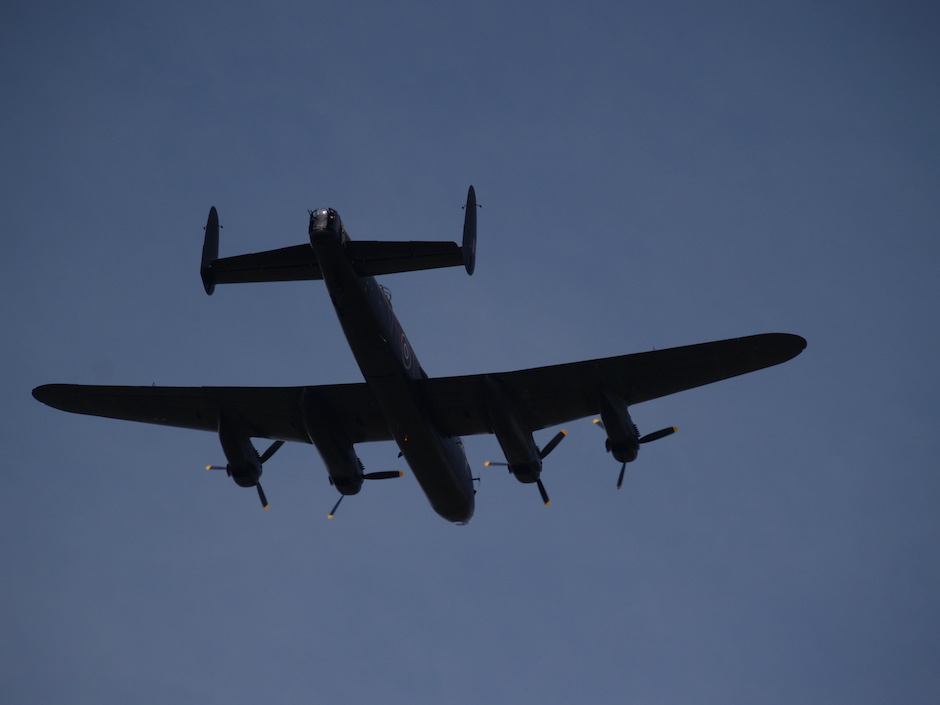
The RAF BBMF Lancaster flying over Den Ham, 4 May 2023. [Pic: Harmen Paalman]
Thanks to Melvin Chambers for help with this article, and for supplying these three further pictures.


Wg Cdr John Bell. [Pic: 617 Squadron Association.]
Guest post by Dr Robert Owen, official historian, 617 Squadron Association.
Wing Commander John Bell MBE, DFC, L d’H, the last British wartime aircrew member of No. 617 Squadron, will be 100 on Saturday 25 March 2023. As a bomb aimer, serving initially with No. 619 Sqn and then No. 617 Sqn, John is a veteran of 50 operations over enemy territory.
He was born on 25 March 1923 and left school in the summer of 1939, aged 16, just before war was declared. He then went to work for a firm of chartered accountants in the City of London. Soon, his evenings and weekends were occupied as a member of the local Home Guard platoon. Seeing the Battle of Britain being fought overhead during work visits to Kent, he determined to join the Royal Air Force as soon as he was able, and like many saw himself as a dashing young pilot.
Rather than wait to be called up, in June 1941 he presented himself as a volunteer at the recruiting office in Worcester Park. Sent to a medical board in Oxford he found his hopes of becoming a pilot dashed. At 6 ft 4 ins, he was too tall. Instead, he was offered an alternative which to him “sounded interesting” of being trained as an observer and air gunner. Accepting this, he was called up in September 1941.
After the usual spell at the Aircrew Reception Centre, Regents Park (Lord’s cricket ground) and several months in Torquay with No. 13 Initial Training Wing, he was sent to Eastbourne to learn the basics of navigation. The next stage of his training would take him farther afield.
In May 1942 he boarded a troopship bound for South Africa, to continue his navigation and bomb aiming training as an observer at No 45 Air School, Oudstshoorn, followed by a gunnery course in Airspeed Oxfords. In early 1943 he returned to the UK via New York.
Destined for Bomber Command, his next stage was with No. 14 Operational Training Unit (OTU) at Cottesmore where he was to first meet members of his future crew, captained by Bob Knights. Crewing up was a seemingly haphazard affair, sufficient trainee aircrew of the relevant trades were assembled in a hangar and told to sort themselves into crews.
John recalls: ‘I remember standing there with a Canadian navigator, probably looking a bit lost, both of us thinking, “How do we find a good pilot?” Then a rear gunner came up and said to us, “I’ve got a pilot, come with me.”’
Although flying training at the OTU was conducted using Vickers Wellingtons, by this stage Bomber Command was building up its might with the new four engined Lancaster and had introduced the “pilot, bomb aimer, navigator (PNB) scheme”. Observers now had to choose between the latter two trades. Since his bomb aiming was better than his navigation, the decision was made for him, which meant additional training, since the Mark IX on which John had trained was now being replaced by the Mark XIV sight which was not only easier to set but also allowed greater tactical freedom.
From OTU the crew transferred to No. 1660 Conversion Unit at Swinderby, in June 1943, converting initially to the twin engine Avro Manchester, before transferring to the superlative Lancaster. Here they also acquired the final member of their crew, flight engineer Ernie Twells. After a month’s conversion they were declared operational and on 30 June posted to the recently formed No. 619 Squadron, based at Woodhall Spa.
After three weeks further training, during which Bob Knights flew his initial “dicky mission” with another crew, on 24 July they were detailed to attack Hamburg. The next night saw them out again, against Essen and then on 27 July it was back to Hamburg to continue Bomber Command’s major onslaught against this German port. On this occasion the port inner engine burst into flames on the outward journey. Knights extinguished the fire, but the aircraft would not maintain height. Undeterred, they pressed on to the target, bombing from 10,000 feet, with the main force twice that height above. Two nights later they were back over Hamburg again, such was the pace of operations.
Between August 1943 and January 1944, the period of the Battle of Berlin, the crew flew to the ‘Big City’ no fewer than eight times. On 20 October, during a trip to Leipzig their two inboard engines cut owing to icing.
“We were plunging down towards the earth with a full bomb load. We had to release the bombs to release the weight on the aircraft and the flight engineer managed to get the engines working at a height of 10,000ft so we were down pretty low.”
Now, with no bomb load and the rear turret unserviceable they had no option but to turn for home.
Other targets during this period included Munich, Kassel, Hannover, and a trip to Frankfurt when they also carried Army War Correspondent Anthony Cotterell.
By January 1944, Knights had completed his tour although the others needed to fly on more trips to complete. Rather than remain with No. 619 Sqn and fly with a different captain, they decided that it was better to stay together, and opted to volunteer to join No. 617 Sqn. It would mean going straight into a second tour of 20 operations without the usual respite of a period instructing at an OTU, but it seemed the best thing to do.
After an interview with Leonard Cheshire, the crew were accepted and after a brief leave arrived at Coningsby on 29 January 1944. Within a fortnight they found themselves back at Woodhall Spa, as 617 and 619 swapped airfields to give the former more security and more dispersals.
At this time 617 were using the 12,000lb HC blast bomb (not to be confused with the later ‘Tallboy’) and were about to embark on precision attacks against factory targets in occupied France and Belgium. The attacks required extreme accuracy in order to prevent unacceptable casualties to civilians. To achieve this, 617 were equipped with the Stabilised Automatic Bomb Sight (SABS) and Leonard Cheshire and Mick Martin would pioneer a low level marking technique to provide bomb aimers like John with a small and precise aiming point. The SABS could produce remarkable results, but it required very precise flying and close-knit teamwork amongst the crew.
After a week of practice, the crew were ready for their first operation with 617, an attack on the Gnome-Rhone aero engine factory at Limoges, on 8/9 February, which was a spectacular success. At the end of the month John was commissioned.
Further factory targets followed. Inevitably there were a few failures, mainly due to weather and visibility, but the technique was proven, and Leonard Cheshire and three other selected pilots were given Mosquitoes with which to place the markers. The Squadron began to lead other No. 5 Group attacks against targets such as the Paris rail yards at La Chapelle and Juvisy, and even heavily defended German targets such as Munich.
Then suddenly, at the beginning of May 1944, the Squadron was stood down for a month to practice for a special operation to be conducted on the eve of D-Day. Operation “Taxable” involved precise flying and navigation carefully calculated tracks over the Channel between Newhaven and Cap d’Antifer, while other crew members, including John, despatched bundles of “Window” (strips of aluminium foil) at exactly timed intervals. The purpose of the operation was to create the impression on German coast-watching radar, of an invasion force of ships approaching the coast, while the real invasion force, employing counter-measures to mask its presence, approached the landing beaches of Normandy.
The operation was a success, but within two nights, the Squadron was called upon to make a precision attack against a railway tunnel at Saumur. The operation would also be the baptism of fire for the Squadron’s latest weapon, Barnes Wallis’s 12,000 lb ‘Tallboy’ deep penetration bomb. Given that the Squadron had done no bombing practice for over a month the results achieved by John and his colleagues were remarkable. One Tallboy was a direct hit on the hillside directly above the entrance, bringing down tons of earth and rock into the tunnel, others severed the rail tracks and blocked the cutting leading to the entrance. By doing so, they severely restricted the movement of reinforcements to the Normandy battlefront.
Wallis’s intention had been for his bomb to be dropped alongside structures such as the massive concrete blockhouses constructed by the Germans as part of their V-weapon campaign. Damage would be caused by the shockwaves transmitted through the earth. This was achieved to great effect by a Tallboy released by John on 17 July 1944, against the potential V-2 launch site at Wizernes in the Pas de Calais. The target was a large concrete dome on the top of a quarry face, protecting underground workings. John’s Tallboy struck the edge of the dome, causing part of the quarry to fall away, undermining the structure.
Although ‘Tallboy’ had not been developed to penetrate concrete, it was the only weapon in the RAF’s armoury capable of damaging the substantial E- and U-boat pens that were bases for naval forces which could disrupt the Allied convoys supplying the invasion forces. By August 1944 the Squadron’s attention was focused on these structures. But by this time John had completed 50 operations, (for which he would be awarded the DFC) and it was again time to consider coming off operations. Knights wanted to continue, but John was engaged to be married and felt it was time to go.
On 24 August John said farewell to the crew he had known for nearly 18 months and was posted as an instructor at No. 12 OTU, Chipping Campden. It was a different world to that of operations and heralded the start of a period of readjustment. After a spell at the Officer’s School, Hereford, John was sent to Catterick for redeployment. There his pre-war experience in accounting caught up with him and he was sent on an Accounting Officers course.
After the end of the war, in 1947 he applied for, and was granted, a short service commission and transferred to the Secretarial Branch. Posted to Fighter Command at Tangmere he was sent to Gatow, Berlin, to assist with airlift. On his return to Britain in 1951 he was sent to Shepherd’s Grove in Suffolk to reactivate a former airfield for use by the USAF. While there he learned of openings to train as a photographic interpreter and then, after completion of a PI course, he entered the world of Intelligence. For the next twenty-five years he served at Nuneham Park, in Singapore and Washington, with a period working with the USAF at Kimpo Air Base, Seoul during the Korean War when the Americans were short of specialist personnel.
Awarded the MBE in the 1970 New Year Honours List, he finally retired from the RAF in March 1977 holding the rank of Wing Commander. In March 2016 he received the Legion d’Honneur from the French Consul.
In retirement John has worked hard for charity, being a stalwart campaigner for the RAF Benevolent Fund. As a member of the Committee of the 617 Squadron Association, and latterly its President, he has played a significant role in championing the commemoration of wartime Bomber Command, raising funds for the Bomber Command Memorial in Hyde Park and working to ensure that the story of Bomber Command is passed on to future generations.
Salisbury Journal post about John Bell from 2021
You may have noticed that there has been a delay since the last post on this blog. My apologies, but I have a good reason for it. Some seven weeks ago, I had what in medicine is called a hemorrhagic stroke. I am very lucky in several respects: the stroke happened in my house in Dublin at about 9.45 pm on the evening of Thursday 12 January 2023, so my wife Jacqui was sitting with me while we watched TV together; Jacqui had the foresight to call for an ambulance immediately; my house is less than ten minutes drive away from one of Dublin’s finest hospitals, St James’s; and a skilled medical ambulance crew arrived within about 20 minutes. I remember the two crewmen asking questions and that I was able to speak to them. To be honest, I don’t remember a lot after that, except that I was taken to James’s and, after initial treatment, on to Beaumont Hospital, and then a few days later back to James’s.
I have been in hospital for almost seven weeks altogether, and have received what can only be described as top-class treatment by the Irish medical service. Last weekend, I was allowed home for three nights for the first time, and hope to be allowed home permanently before the end of this week. I will be writing more about this in due course on my personal blog, and will add a link here when it’s complete.

However, I would now like to announce here the project I had been working on since last summer, my new book, Guy Gibson and his Dambuster Crew, to be published later this year by The History Press. Because of all the new information that emerged during my research, I didn’t finish the final draft until the middle of December 2022 (some two months after the original date agreed!) and my editor Amy Rigg and I then agreed that publication would take place in September 2023. Here is the publisher’s page.
I will write more about this new book next week, so please keep an eye on this blog. (Go to the Follow Blog By Email link opposite to get an automatic notice whenever there is a new post on this blog.)

This blog’s favourite film The Dam Busters is being shown again on UK TV this evening (Channel 5 Action) so if you are checking this blog to see the names of the men who took part in the Dams Raid on 16/17 May 1943, click on here for the full list. (Or buy my book for further information!)
 Dambusters Blog