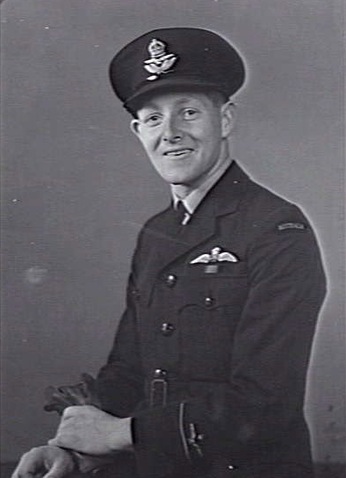
Dambuster of the Day No. 61: Edward Johnson

Hobday Knight Johnson 23Jun43

L-R: Sydney Hobday, Les Knight and Edward (‘Johnnie’) Johnson, outside Buckingham Palace in June 1943. [Pic:www.studiegroepluchtoorlog.nl] 

Flg Off E C Johnson
Bomb aimer

Lancaster serial number: ED912/G

Call sign: AJ-N

First wave. Third aircraft to attack Eder Dam. Mine dropped accurately causing final breach.

There were two bomb aimers called Johnson on the Dams Raid, something that occasionally causes confusion. A third bomb aimer was called Johnston. In the inevitable way of things in the wartime RAF, both Johnsons were also known to their friends and colleagues as ‘Johnnie’ (EC Johnson’s preferred spelling). The older of the two was Edward Cuthbert Johnson, bomb aimer in Les Knight’s crew, who was born in Lincoln on 3 May 1912, the son of Herbert and Jessie Johnson.

His father was killed on the Western Front in 1914, when the family were living in Gainsborough. He was then educated at Lincoln Grammar School. On leaving school, he worked for Woolworths and then the catering firm, Lyons.

After marrying May Beckwith in 1936, he moved to Blackpool to work in a boarding house business in Blackpool with her family. Their son, Philip, was born in 1938.

He joined the RAF in 1940, qualified as an observer/bomb aimer in early 1942, and was commissioned. After further training he was posted briefly to 106 Squadron, but then sent back to a training unit to be crewed up with Les Knight and his colleagues. They moved to 50 Squadron in September 1942, and Johnson flew on some twenty-two operations with the Knight crew.

Johnson and Hobday were the elder statesmen of the Knight crew, both nine years older than their skipper, and senior to him in rank. But they worked well as a team, each obviously seeing in the younger man the qualities of an outstanding pilot. All three were decorated for their role in the Dams Raid, Knight getting the DSO and Johnson and Hobday the DFC, and were photographed together outside Buckingham Palace on the day of the investiture.

In September, on the fateful Dortmund Ems operation, Johnson jumped from the stricken Lancaster when ordered to by Knight. He yelled: ‘Cheerio boys. Best of luck. See you in London.’ He recalled later: ‘The farewells were a little hasty but lacked nothing in sincerity for that.’ Like four of his colleagues, Johnson successfully evaded capture and reached the safety of Spain, with the help of a friendly Dutch farmer and policeman, and various members of the resistance in Holland, Belgium and France. He returned to the UK via Gibraltar. He served out the rest of the war in various ground postings, and left the RAF in 1947.

He went back to Blackpool, and joined a company selling fireplaces, where he worked until his retirement. Edward Johnson died in Blackpool on 1 October 2002.

More about Johnson online:
Obituary in the Daily Telegraph

Survived war. Died 1 October 2002.

Rank and decorations as of 16 May 1943.
Sources:
Richard Morris, Guy Gibson, Penguin 1995
John Sweetman, The Dambusters Raid, Cassell 2002
John Sweetman, David Coward and Gary Johnstone, The Dambusters, Time Warner 2003

Dambuster of the Day No. 60: Robert Kellow

AWM Kellow UK0330

[Pic: AWM]

Flt Sgt R G T Kellow
Wireless operator

Lancaster serial number: ED912/G

Call sign: AJ-N

First wave. Third aircraft to attack Eder Dam. Mine dropped accurately causing final breach.

Robert George Thomas Kellow was born in Newcastle, New South Wales, Australia on 13 December 1916, the son of George and Violet Kellow. He went to Newcastle High School, the same school as fellow Dambuster Jack Leggo, the navigator in Mick Martin’s AJ-P. He worked as a shop assistant after leaving school, but when war came he enlisted in the RAAF.
He was selected to train as a wireless operator/air gunner and was sent to Canada for training. From there, he was posted to the United Kingdom, and arrived in January 1942.
After further training he was crewed up with pilot Les Knight and then posted to 50 Squadron. He completed some 25 operations with Knight before the whole crew were offered the chance to transfer to the new secret squadron being set up at Scampton. Shortly before the transfer came about, he was recommended for a DFM and then commissioned. (The DFM wouldn’t actually be awarded until June 1943.)
There was no doubt in Kellow’s mind about the transfer, as he explained after the war: ‘The offer presented to us sounded interesting and with our faith in each member’s ability we made up our minds there and then that we would accept the offer and move over as a crew to this new squadron.’
On the flight to the dams, Kellow was watching from AJ-N’s astrodome when he had the unfortunate experience in witnessing the last moments of Bill Astell and his crew, damaged by flak near Dorsten and crashing in flames a few minutes later. He then had to wait more than an hour while the Möhne Dam was destroyed before they reached the Eder and he was told to start up the spinning mechanism for AJ-N’s mine.
Following the successful attack, Kellow was understandably preoccupied while Knight and Grayston pulled AJ-N up and over the surrounding hills, and his message confirming the drop – ‘Goner 710B’ – was sent six minutes after the message ‘Dinghy’, denoting a breach of the Eder, had been transmitted by Bob Hutchison, in Gibson’s aircraft.
Knight, Kellow and the rest of the crew were not back in action until September, in the disastrous attack on the Dortmund Ems Canal.
Five of the seven crew who baled out of Knight’s aircraft would eventually get back to England, helped by Dutch and French Resistance networks and couriers. Hobday and Sutherland had been reunited and travelled as a pair, but Kellow made the six week journey to Spain on his own a day or so ahead of them, and arrived back in England in December 1943. Like all those who had made the perilous return trip he was not allowed to fly over enemy territory again, to protect the networks he had used to evade capture, so he returned to Australia in May 1944.
He served in RAAF 37 Squadron for the remainder of the war, mainly in Australia, but including a deployment to New Guinea where he flew in a Lockheed Lodestar.

AWM OG1532 Kellow postwar

Bob Kellow, in a Lockheed Lodestar of RAAF 37 Squadron. [Pic: AWM]

In April 1946 Kellow returned to Newcastle, NSW, after being discharged from the RAAF, with a glowing report from his Commanding Officer who described him as showing ‘great possibilities for good leadership’, and  ‘one of the most liked and well known’ and  ‘invaluable’ members of the Squadron.
He returned to his job as a shop assistant in Australia, and in 1946 married Doreen Smith, a Canadian who he had met while training there in 1941. By 1952, they had two children and the whole family moved to Winnipeg, Canada, where Kellow worked for the Manitoba Power Commission.
He travelled back to the UK for a number of 617 Squadron anniversary events, and paid his respects at Les Knight’s grave in Holland.
Bob Kellow died in Winnipeg on 12 February 1988, and is buried in the city’s Brookside Cemetery.
[Thanks to Graeme Jensen for help with this article.]

More about Kellow online:
Page on Newcastle High School website

Survived war. Died 1988.

Rank and decorations as of 16 May 1943.
Sources:
Richard Morris, Guy Gibson, Penguin 1995
John Sweetman, The Dambusters Raid, Cassell 2002
Page at Memorable Manitobans website
Personnel file at National Archives of Australia

“Stand by to pull me out of the seat if I get hit!”

dam busters poster

If you live in the UK and can receive Channel 5, you may like to know that it is showing The Dam Busters again this afternoon. TV screenings of the film usually lead to a spike of new visitors to this blog, so I’d like to welcome you if you have turned up here for the first time as a result of watching it.
The purpose of this blog is to keep people up to date with Dambusters news – information about who took part in the raid, news of commemorative events (the 70th anniversary took place in May 2013) and other bits and pieces, such as the very slow progress on the remake of the original film. This is in the hands of Peter Jackson, of Hobbit fame, and will apparently be proceeding when this series of three films have been concluded. (See this series of posts for an update.)
You might like to know that we are about halfway through a series of profiles of each of the 133 aircrew who took part in the raid. (The full list can be found here and you can see photographs of each of them in this pictureboard, assembled by the BBC with help from this blog.)
If you want to subscribe to the blog, there’s a button further down the page. Or you can get a link to updates by following us on Twitter, @DambustersBlog – if that’s your thing.

Dambuster of the Day No. 59: Sydney Hobday

IWM HU91948

A group of tired looking 617 Squadron officers and pilots gather outside their mess for an official photograph, the morning after the Dams Raid. Most had been drinking for a number of hours by this stage. Sydney Hobday is in the back row, fifth from the right hand side. Edward Johnson is also in the back row, third from the right, and Les Knight is in the front row, second from the right. [pic: IWM HU91948]

Flg Off H S Hobday
Navigator

Lancaster serial number: ED912/G

Call sign: AJ-N

First wave. Third aircraft to attack Eder Dam. Mine dropped accurately causing final breach.

Harold Sydney Hobday (known as Sydney by his family and friends) was born in Croydon, Surrey, on 28 January 1912, the younger of the two sons of Howard and Alice Hobday. After leaving school, he worked in the aviation department of Lloyd’s, the insurance business. After joining the RAF in 1940, he underwent part of his training in South Africa before qualifying as a navigator in early 1942, and then being commissioned. In the summer of 1942, he crewed up during training with Les Knight and the others who would form his Dams Raid crew and they joined 50 Squadron in September 1942.

Although some eight years older than his young Australian skipper (still then a sergeant pilot) they obviously bonded well and flew on some twenty-five operations together up until March 1943, when the whole crew volunteered to be transferred to the new squadron at Scampton for the secret mission.

One of the reasons the crew worked so well together may actually have been its disparate nature. There were the two slightly older Englishmen, Hobday and bomb aimer Edward Johnson, both married men. The flight engineer Ray Grayston was also English but Bob Kellow, the wireless operator, was Australian and both the gunners, Fred Sutherland and Harry O’Brien were Canadians. All of them shared the highest regard for their young Melbourne-born pilot.

On their return to Scampton after breaching the Eder Dam, Hobday took part in the celebrations with a fair degree of gusto. He was in the group photographed outside the Officers’ Mess around breakfast time on the morning after the raid, but fell asleep sometime later and regained consciousness at 1300, slumped in an armchair. Knight, Hobday and Johnson were all decorated for their role in the Dams Raid, Knight getting the DSO and Johnson and Hobday the DFC, and were photographed together outside Buckingham Palace on the day of the investiture.

On the night of 16 September 1943, when Knight ordered the crew to bale out after the aircraft was badly damaged approaching the Dortmund Ems canal, Hobday managed to evade capture. Within a few hours he had made contact with Dutch resistance supporters. He was taken to a woodland shack near Baarn and reunited with his colleague, Fred Sutherland. The pair were then fed into the escape network, and smuggled the whole way through France to the Pyrenees, then onward through Spain to Gibraltar, and then returned to the UK. As he had evaded capture, he was not allowed to fly again over enemy territory and so he spent the rest of the war in training roles.

When he was finally demobilised, Hobday returned to Lloyd’s and eventually became head of the aviation department. He married Ethel Simpson in 1938, and after the war they had four children. The Hobdays were a musical family and his grandson is the well-known dancer and choreographer Adam Cooper.

Sydney Hobday died in Hindolveston, Norfolk, on 24 February 2000.

Survived war.

Rank and decorations as of 16 May 1943.
Sources:
Richard Morris, Guy Gibson, Penguin 1995
John Sweetman, The Dambusters Raid, Cassell 2002
John Sweetman, David Coward and Gary Johnstone, The Dambusters, Time Warner 2003

Further information about Sydney Hobday and the other 132 men who flew on the Dams Raid can be found in my book The Complete Dambusters, published by History Press in 2018.

Merry Christmas and a Happy New Year

ID-1001056

Pic: James Barker, freedigitalphotos.net

Although things are a little quiet right now, it’s been a great year for the Dambusters Blog – many thousands of new readers, and a record number of posts. The main event of course was the 70th anniversary of the Dams Raid, and the interest that this generated was almost overwhelming.
So – greetings of the season to all readers! And many thanks to all of you, especially those who have taken the trouble to add your comments or contact me by email.
I promise that things will get busier in the New Year, and that the Dambuster of the Day articles will finally reach a conclusion. The last one will be No. 133, Sgt Arthur Buck. (By one of those odd coincidences, I actually met a great nephew of Arthur Buck at Scampton on the day of the anniversary, but omitted to get his details from him. So if you are him, or know him, then please get in touch!)

Dambuster of the Day No. 58: Raymond Grayston

CREW

Les Knight and his crew photographed at Scampton in the summer of 1943. Left to right: Harold Hobday (navigator), Edward Johnson (bomb aimer), Fred Sutherland (front gunner), Les Knight (pilot), Bob Kellow (navigator),  Ray Grayston (flight engineer), Harry O’Brien (rear gunner). [Pic: IWM CH11049]

Sgt R E Grayston
Flight engineer

Lancaster serial number: ED912/G

Call sign: AJ-N

First wave. Third aircraft to attack Eder Dam. Mine dropped accurately causing final breach.

Raymond Ernest Grayston was born on 13 October 1918 in Dunsfold, Surrey, and worked as an automobile engineer before the war.
Like many young men of his generation, Grayston was fascinated by flying and volunteered for the RAF at the beginning of the war. In a TV documentary to mark the 60th anniversary of the Dams Raid he described how he loved riding a motorbike at speed, and that this was one of the things which encouraged him into the air force. Initially he served as ground crew but then, along with many others who were mechanically minded, he was selected to train as a flight engineer on the new generation of heavy bombers which needed more personnel. He was posted to 50 Squadron in October 1942, and teamed up with Les Knight, who had just formed a new crew. He flew on some 18 operations with this crew before they were posted en bloc to 617 Squadron in March 1943.
The teamwork needed between the flight engineer and pilot was never better exemplified than in AJ-N’s successful hit on the Eder Dam. The precision required to get the aircraft into position and the skill need to keep it airborne after the hit required them both to act together and have complete confidence in each other.
On their final flight together, on the night of 15/16 September 1943, eight crews were sent to attack an embanked stretch of the Dortmund-Ems canal. The leader was shot down en route and the remainder encountered fog in the target area.
While searching for the canal, Knight’s aircraft hit trees, damaging the two port engines and tail unit. The 12,000lb bomb was jettisoned, and Knight and Grayston managed to coax the aircraft to 1,400ft to allow the crew to bale out.
With two dead engines and limited control, Knight had little chance of escaping. Grayston was the last to leave the aircraft, saying a final farewell to his captain. Knight didn’t escape and only three Lancasters returned from the raid.
Grayston landed uninjured but was captured almost immediately. He was sent to Stalag Luft III, remaining there until January 1945 when the PoWs were forced to march westwards on what became known as the Long March. He reached Stalag IVA at Luckenwalde where, after three months, he was liberated and flown back to England.
After leaving the RAF he joined Hawker Siddeley and worked as a quality inspector, retiring in 1984.
Like all the other Dambuster survivors who lived into the 2000s, Ray Grayston became something of a celebrity, and was frequently asked to participate in events, documentaries and signings. And, like his colleagues, he took part in these with good grace and great dignity, despite the fact that he must have been asked time and time again about the same events.
Grayston married Sylvia Jefferies in 1976. He died in Woodhall Spa on 15 April 2010.

More about Grayston online:
Obituary in the Daily Telegraph, 2010

Survived war. Died 15 April 2010.

Rank and decorations as of 16 May 1943.
Sources:
Richard Morris, Guy Gibson, Penguin 1995
John Sweetman, The Dambusters Raid, Cassell 2002

Dambuster of the Day No. 57: Leslie Knight

AWM Knight UK0238A

Pic: Australian War Memorial

Plt Off L G Knight
Pilot

Lancaster serial number: ED912/G

Call sign: AJ-N

First wave. Third aircraft to attack Eder Dam. Mine dropped accurately causing final breach.

Leslie George Knight was born on 7 March 1921 in Camberwell, a suburb of Melbourne, Australia. He was the older of the two sons of Harold and Nellie Knight. He had planned to become an accountant, but the war intervened. He joined the RAAF in 1941, and was sent to England in the autumn of that year.

After training as a pilot, he formed a full crew while training and, with one exception, they would go on to fly with him throughout the rest of their operational life. The crew was posted to 50 Squadron in September 1942. Knight had flown on some twenty-six operations by March 1943, when the crew were offered the chance to transfer into a new squadron being formed at nearby Scampton for a secret mission. They took a joint decision to transfer together, as his wireless operator, Bob Kellow, later explained: ‘The offer presented to us sounded interesting and with our faith in each member’s ability we made up our minds there and then that we would accept the offer and move over as a crew to this new squadron.’ The crew’s faith was probably because they had together recognised that Knight was an exceptional pilot, even though he couldn’t ride a bicycle or drive a car.

On the Dams Raid, Les Knight was flying AJ-N, the ninth and final aircraft of the first wave of Operation Chastise, tasked with attacking the Möhne and Eder Dams. Five mines had been used at the Möhne before it had been breached, which left only three for the Eder, as Bill Astell had crashed en route. David Shannon and Henry Maudslay dropped their mines but did not break the dam, so Knight’s weapon presented the last chance for success.

After a dummy run, which was dangerous enough for rear gunner Harry O’Brien to record afterwards that he ‘never thought they would get over the mountain’ on the other side of the dam, Knight brought AJ-N into attack. With a bright moon on the starboard beam, the mine was released, bounced three times and hit the dam wall. Knight climbed steeply and, as the aircraft reached a safe height, saw an explosion which caused a ‘large breach in [the] wall of [the] dam almost 30ft below top of [the] dam, leaving top of [the] dam intact.’

Bob Kellow had his head up in the astrodome, looking backwards. It seemed, he said, ‘as if some huge fist had been jabbed at the wall, a large almost round black hole appeared and water gushed as from a large hose.’

The climb after the attack was hair raising. Bomb aimer Edward Johnson said later that it ‘required the full attention of the pilot and engineer to lay on emergency power from the engines and a climbing attitude not approved in any flying manuals and a period of nail biting from the rest of us not least me who was getting too close a view of the approaching terra firma from my position in the bomb-aimer’s compartment.’

But they made it, and headed for home via the Möhne Dam, where they noticed how much the water level had already dropped. The trip back was relatively trouble-free – they avoided some flak bursts near Borken, and Fred Sutherland was able to shoot up a stationary train in a small town. They were very lucky, however, not to have fallen at the final hurdle in an incident which only O’Brien noticed: ‘… at the Dutch coast the terrain rose under us, Les pulled up, over and down. On the sea side of this rise was a large cement block many feet high. This block passed under our tail not three feet lower. As the rear gunner I was the only one to see it.’

Knight received the DSO for his work on the raid, and navigator Harold Hobday and bomb aimer Edward Johnson both got DFCs. Knight however was an abstemious character and although he appears in the ‘morning after the raid’ photograph taken outside the Scampton Officers Mess he skipped the Hungaria Restaurant party after the London investiture.

The crew went back on training after the raid, but the first action they saw was the raid on the Dortmund Ems canal in September. An extra gunner was allocated to each crew, so Knight’s Dams Raid crew was augmented by Sgt L C Woollard.

It was a terrible night, with heavy fog blanketing the heavily guarded canal. Four of the eight crews who took part had already been shot down when Knight, flying at about 100ft in fog, hit some trees and badly damaged both his port engines.

This is one of the stories which Paul Brickhill tells beautifully in his 1951 book, The Dam Busters. With his tailplane and a starboard engine also damaged Knight managed to pull the Lancaster up to about 1,000ft and called his fellow Aussie Mick Martin, who had assumed command after the CO and deputy force head had both come to grief.

‘Two port engines gone. May I have permission to jettison bomb, sir?’ It was the ‘sir’ that got Martin. Quiet little Knight was following the copybook procedure, asking respectful permission to do the only thing that might get him home.
Martin said, ‘For God’s sake, Les, yes,’ and as the bomb was not fused Knight told Johnson to let it go. Relieved of the weight they started to climb very slowly…
The controls were getting worse all the time until, though he had full opposite rudder and aileron on, Knight could not stop her turning to port and it was obvious that he could never fly her home. He ordered his crew to bale out and held the plane steady while they did.

Paul Brickhill, The Dam Busters, Evans 1951, p121

The scene inside the aircraft just before the crew began baling out was further described by wireless operator Bob Kellow in his memoirs:

[W]e had crossed the Dutch/German border and were about half way to the Dutch coast. We all knew that at this height and with only one motor working properly our chances of getting back to England were slim.
Les had asked our rear gunner, ‘Obie’ O’Brien, to go to the front gun turret …
‘OK I’m in the turret, Les. What do you want me to do?’
‘Good, now reach along below my feet Obie and see if you can find a loose, broken cable,’ said Les. ‘It belongs to the starboard rudder. When you find it, pull on it for all you’re worth.’
In a few minutes Obie announced that he’d found the cable and was pulling it.
The plane began to swing slowly to the right. It was only then that I realized that we’d been steadily swinging to the left for the past few minutes. …
‘I’ll have to stop the starboard inner, Les,’ said Ray, our flight engineer.
‘Try to hold it a bit longer, Ray,’ Les replied.
Obie meanwhile warned that his arm was breaking from pulling on the cable and he’d need a break.
‘OK Obie, but pull on it again as soon as you can,’ said Les.
It was clear Les was putting on a superhuman effort to keep our crippled plane on some sort of course, but I knew we couldn’t go on much longer. The plane was down to 1,000 feet and the glide angle was steadily increasing.
‘Send out that we’re bailing [sic] out, Bob,’ Les said to me.
I unhooked my morse key and began tapping out the message.

The crew prepared themselves, and one by one they left the aircraft. Kellow moved forward to the cockpit:

I stood by him as he firmly held the wheel and tried to keep ‘Nan’ on a steady course, making it easier for each man to jump out. Like a sea captain, he wanted to be sure everyone was safely off before he abandoned ship. His parachute was clipped onto his harness and he looked searchingly at me, probably wondering why I hadn’t jumped already.
Using signs, I asked if he was OK. He nodded his answer and a wry smile puckered his mouth.
With a last smile, I gave him the thumbs-up sign, checked my parachute and took my position at the edge of the escape hatch. Then
I bent forward with my head down and tumbled out into the dark Dutch night.

Bob Kellow, Paths to Freedom, Kellow Corporation, 1992, pp21-22

Knight stayed at the controls and attempted a forced landing in a field. He nearly succeeded, but the aircraft hit a bank running across the field and exploded. All seven of the rest of the crew landed safely. Five evaded capture, while two became PoWs. There is no doubt that they all owed their lives to their young pilot, something that they never forgot.

Knight also changed course to avoid crashing into the built-up area of the village of Den Ham. An eye witness, Henk Kremer, who was an eleven year old boy in 1943, wrote the following account in 2018:

At about 3.15am my father woke me telling me that a burning aircraft was flying towards the village. When I looked outside my bedroom window, I saw on the east side of our village a low flying burning aircraft, it was flying towards the village. I remember thinking: this is not going to end well. At that moment, I saw the machine make a slight turn to the right changing his flightpath to a northerly direction. Straight away the aircraft made another course change by turning sharply to the left… I saw the fire at the front of the aircraft had become fiercer. [From the skylight with a view to the north] I saw the aircraft quickly lose height and that the propellors were ablaze. Then the aircraft crashed, and then there was only an intense fire was visible. This happened about 1200 metres from our house.

Another witness, Bertha Bakker, then a teenager, and whose family owned the land next to the crash site, takes up the story:

My father went straight to the crash site. My sister and I just followed my father… The heat was terrifying and very intense. It was terrible to see. I was maybe 100, 200m from the crash… My father was there quicker than the Germans. My father saw Knight in the cockpit and he was crouched over. He was leaning forward. He was not sure but it looked as if he was crouched over in the seat trying to cut himself out of the safety harness. My father saw him burning. It was horrible, just horrible.

The next morning, the Dutch police and the German military cordoned off the area. Knight’s body was removed from the wreckage and a local schoolmaster called Snel took a risk by taking a photograph as this was done. He later took another of the hearse taking Knight’s body to the cemetery.

The body was taken by horse-drawn hearse to the old cemetery in Den Ham by local funeral director Gerrit Meijer, who led the cortège on foot. Dozens of local people (Hammenaren) gathered in the streets and at the entrance to the cemetery to pay their respects, although the Germans prevented them from entering the cemetery. One young boy, Henk Steen, however took a chance and climbed through a hole in the hedge.

I stayed very close to the hedge. The German soldiers saw me but did not send me away. I stood maximum ten metres from where everything was taking place. I saw six soldiers march into the graveyard with a German officer and [preacher] Dominee Meuleman.
Three soldiers stood on either side of the coffin, Meuleman said some prayers and the officer spoke of course in German. I heard him clearly but did not understand much of what he said. I was told later by someone who could understand German that the officer said that he saw Les Knight as a ‘brother-in-arms and not as an enemy’. The officer then ordered the soldiers to shoot a salvo as military salute. This of course was a very honourable thing to say. For years I have thought about what the officer said and conclude: I believe that officer was a good man. There was no way that a Nazi officer would stay anything as noble as that.

Witness quotations from Melvin Chambers, Remembering Dambuster Les Knight, Den Ham, 2018.

It is very clear from all the witness statements that Les Knight deliberately steered away from the centre of the village in an effort to avoid casualties. Another young boy who visited the crash site, Lucas Kamphuis, has said that he was ‘an exceptional person to have the clearness of mind to do what he did.’

The grave was first marked with a simple wooden cross, which was replaced after the war with a Commonwealth War Graves Commission gravestone. There is a granite memorial at the crash site itself, maintained by Lucas Kamphuis and others.

Knight’s 55 page personnel file is available online at the National Archives of Australia. Here is his final ‘casualty notification’. [Thanks to Graeme Stevenson for informing me about this resource.]

Knight NAA file

More about Knight online:
Commonwealth War Grave Commission entry
Wikipedia entry
Westmorland Gazette story about wartime family friend

KIA 16.09.43

Rank and decorations as of 16 May 1943.
Sources:
Richard Morris, Guy Gibson, Penguin 1995
John Sweetman, The Dambusters Raid, Cassel 2002
Further information about Les Knight and the other 132 men who flew on the Dams Raid can be found in my book The Complete Dambusters, published by History Press in 2018.

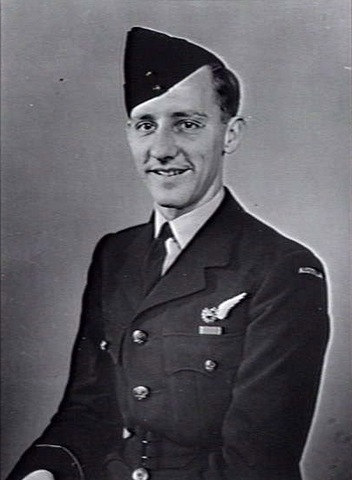
Dambuster of the Day No. 56: Richard Bolitho

SG1L7859 lores

Richard Bolitho on left, with two other air gunners, Sgt Adams (centre) and Sgt Julian Bracegirdle (right). Photograph probably taken while at Air Gunnery School, summer of 1942. [Pic: Bate family]

Sgt R Bolitho
Rear gunner

Lancaster serial number: ED864/G

Call sign: AJ-B

First wave. Crashed on outward flight.

Richard Bolitho was born on 19 January 1920 in Derry city, in Ireland*. His father William Bolitho was a commercial traveller in the seed business, originally from Cornwall. He had stayed on in Ireland after meeting and marrying a local woman, Jane Cuthbertson, the daughter of a land steward. Richard was an only child.

In 1927 the family moved to England, first to Roose in Cumberland, where Richard attended the local school. The family then bought a hotel in Kimberley, Nottinghamshire. Richard moved in with his aunt Emily, who owned a fruit and vegetable shop in the town. He was educated at the local Church Hill School and then won a scholarship to the nearby Heanor Secondary School (later Heanor Grammar School) in 1931. He joined the RAF in 1940, but wasn’t selected for aircrew training until early in 1942

After qualifying as an air gunner, he was posted to an operational training unit, where he crewed up with Max Stephenson, Floyd Wile, Don Hopkinson and Albert Garshowitz. The five were then selected for heavy bomber training and John Kinnear and Frank Garbas were added to the crew.

Their first posting to 9 Squadron was cut short when Stephenson was killed while flying with another crew, and the remaining six were sent on to 57 Squadron at Scampton, and assigned to Bill Astell. They first flew together on 13 February 1942, but some six weeks later they were all posted to the new 617 Squadron.

Bolitho spent his last leave before the Dams Raid at his home in Kimberley. He brought two of his Canadian colleagues, Floyd Wile and Albert Garshowitz, and the Scot John Kinnear along as his guests.

All would die together near Marbeck in Germany just a few days later, in the early hours of Monday 17 May 1943, and they lie together in Reichswald Forest War Cemetery, having been reinterred after the war from their original graves in Borken.

In 1946, three years after his death, his parents returned to Northern Ireland where they lived in the coastal resort of Portrush, and they lived out their days there.

Heanor memorial P0336 lores

Richard Bolitho remembered on the war memorial from Heanor Grammar School, now relocated to Marpool Church, Nottinghamshire. [Pic: Heanor & District History Local History Society.]

More about Bolitho online:
Commonwealth War Grave Commission entry
Kimberley War Memorial
Bolitho family history website
Aircrew Remembered webpage about Astell crew

KIA 17.05.43

* Bolitho’s birth predates the partition of Ireland in 1921 into Northern Ireland and the Irish Free State.

Rank and decorations as of 16 May 1943.
Sources:
Robert Owen, Steve Darlow, Sean Feast & Arthur Thorning, Dam Busters: Failed to Return, Fighting High, 2013
Richard Morris, Guy Gibson, Penguin 1995
John Sweetman, The Dambusters Raid, Cassell 2002

The information above has been taken from the books and online sources listed and other online material. Apologies for any errors or omissions. Please add any corrections or links to further information in the comments section below.

Further information about Richard Bolitho and the other 132 men who flew on the Dams Raid can be found in my book The Complete Dambusters, published by History Press in 2018.

Dambuster of the Day No. 55: Francis Garbas

p_promise1

Frank Garbas (left) and Albert Garshowitz (right) photographed at Scampton while serving in 57 Squadron. [Pic: Bomber Command Museum of Canada]

Sgt F A Garbas
Front gunner

Lancaster serial number: ED864/G

Call sign: AJ-B

First wave. Crashed on outward flight.

Francis Anthony (Frank) Garbas was born on 13 July 1922 in Hamilton, Ontario, Canada, one of the nine children of Stanley and Mary Garbas, both of whom had been born in Poland. Many of the families who had moved to Hamilton, attracted by the prospect of work in the steel mills, were also of Polish descent. He attended the town’s Cathedral High School and Technical Institute where he was good at sports, and went on to play rugby in the local Eastwood team with Albert Garshowitz. He also played in another team which became Canadian champions. After leaving school he worked for Otis Elevators, but joined the RCAF soon after the outbreak of war.

After training in Canada and qualifying as a wireless operator/air gunner he was shipped over to England in the summer of 1942, and went to the gunnery school at RAF Stormy Down, where one of his instructors was John (‘Tommy’) Thompson about whom I blogged last year.

He was then posted to a conversion unit at RAF Wigsley, and by coincidence there he met his old friend Albert Garshowitz, who was in a five man crew headed by pilot Max Stephenson. As they were training to fly on Lancasters they now needed an extra gunner. Garshowitz must have pushed successfully for Garbas to join them. He was pleased to tell his family in a letter dated 20 October 1942: ‘The [new] Gunner is from our fair city of Hamilton – I used to play football with him for Eastwood Park. He went to Wentworth Tech – He’s a swell fellow. His name is Frank Garbas.’

After completing training, the crew was posted to 9 Squadron at RAF Scampton just before Christmas. Sadly, early in the New Year, Max Stephenson flew as the flight engineer on an operation to Duisberg with another crew, and was shot down. So, without a pilot, the crew was posted to 57 Squadron, where they were allocated to Bill Astell.

In another letter home, dated 28 January 1943, Garshowitz described Astell as a ‘veteran at the trade’ and ‘an experienced and gen pilot’. He went on to describe how Garbas had only just had his first shave and ‘tore his whole side of the face – laughs galore’. It’s a sobering reminder that he would in fact die before his 21st birthday.

The new Astell crew flew on their first operation in 57 Squadron on 13 February 1943, and had completed a number more before being transferred to 617 Squadron on 25 March. Less than two months later they would die, damaged by flak and colliding with a pylon near Marbeck. They were buried in Borken.

After the war, Frank Garbas and his comrades were reinterred together in Reichswald Forest Commonwealth War Graves Cemetery.

The friendship between Frank Garbas and Albert Garshowitz is mirrored in a later generation by that of their nephews, Paul Morley and Hartley Garshowitz. Together they have done much to keep the memory of their uncles alive, and I am privileged to know them both. Many thanks to them for help with these articles about the Astell crew.

More about Garbas online:
Commonwealth War Grave Commission entry
Article by Paul Morley on Bomber Command Museum of Canada website
Article by Paul Morley on CBC Hamilton website
Aircrew Remembered web page about Astell crew

KIA 17.05.43

Rank and decorations as of 16 May 1943.
Sources:
Robert Owen, Steve Darlow, Sean Feast & Arthur Thorning, Dam Busters: Failed to Return, Fighting High, 2013
Richard Morris, Guy Gibson, Penguin 1995
John Sweetman, The Dambusters Raid, Cassell 2002

Further information about Frank Garbas and the other 132 men who flew on the Dams Raid can be found in my book The Complete Dambusters, published by History Press in 2018.

Dambuster of the Day No. 54: Donald Hopkinson

Hopkinson

[Pic: Hopkinson family]

Flg Off D Hopkinson
Bomb aimer

Lancaster serial number: ED864/G

Call sign: AJ-B

First wave. Crashed on outward flight.

Donald Hopkinson was born on 19 September 1920, in Royton, near Oldham in Lancashire, the second child of Harold and Sarah Hopkinson. His mother died of cancer when he was four months old, and his father remarried. He was educated at Chadderton Grammar School, where he excelled at cricket, and worked as a clerk before volunteering for the RAF in early 1941. After initial training in England he was selected for training as an air observer and sent to Canada. He qualified as a bomb aimer in May 1942, and was commissioned.

Hopkinson was posted to an Operational Training Unit in the summer of 1942, and crewed up with Floyd Wile, Albert Garshowitz and Richard Bolitho, with Max Stephenson as their pilot. In October 1942, all five were sent for heavy bomber training to RAF Wigsley and Frank Garbas and John Kinnear were added to the crew.

When they were ready for operational flying, the whole crew was posted to 9 Squadron. However, before they could fly together Max Stephenson was killed on a ‘second dickey’ operation.

Without a pilot, the crew was then shipped to 57 Squadron, and allocated to Bill Astell. After eight operations, Astell’s crew was moved to 57 Squadron’s C Flight, under a new Flight Commander Melvin Young. On 25 March all five crews in the flight were transferred to the new 617 Squadron being formed at the same station.

On his last home leave early in May 1943, Hopkinson mentioned to his family that he had a bad premonition about the forthcoming operation. Unfortunately he was correct and from his position in the nose of AJ-B he must have suddenly seen the HT cables and pylons in its path, realising perhaps that they could not avoid them.

Donald Hopkinson is buried with his comrades in Reichwald Forest Cemetery, having been reinterred there after the war.

More about Hopkinson online:
Commonwealth War Grave Commission entry
Aircrew Remembered web page about Astell crew

KIA 17.05.43

Rank and decorations as of 16 May 1943.
Sources:
Robert Owen, Steve Darlow, Sean Feast & Arthur Thorning, Dam Busters: Failed to Return, Fighting High, 2013
Richard Morris, Guy Gibson, Penguin 1995
John Sweetman, The Dambusters Raid, Cassell 2002

Further information about Donald Hopkinson and the other 132 men who flew on the Dams Raid can be found in my book The Complete Dambusters, published by History Press in 2018.