Dambuster of the Day No. 53: Albert Garshowitz

Garshowitz0006photo

[Pic: Garshowitz family]

Wt Off A A Garshowitz
Wireless operator

Lancaster serial number: ED864/G

Call sign: AJ-B

First wave. Crashed on outward flight.

Abram Garshowitz, known to his friends as Albert, was born in Hamilton, Ontario, Canada on 11 December 1920, the ninth of twelve children of Samuel and Sarah Garshowitz, who had emigrated from Russia in the first decade of the twentieth century.
At school, he was a keen sportsman, playing many sports but especially American football and rugby. He also played for the Eastwood team in the Hamilton Junior Rugby League, together with Frank Garbas, with whom he would ultimately serve in the Royal Canadian Air Force.

Having worked as a salesman before the war, he enlisted in the RCAF in January 1941, indicating on the enrolment form that the reason for leaving his occupation was “to fight for the country”. He qualified as a wireless operator/air gunner in April 1942, and on the day of his brother David’s Bar Mitzvah his family came to see him in Trenton, and bid him goodbye.

After arrival in England, he underwent further training on Whitley bombers, which had a crew of five, and then was posted to RAF Wigsley for conversion onto Lancasters. The crew, under pilot Max Stephenson, included his future Dams Raid crewmates Floyd Wile, Donald Hopkinson and Richard Bolitho. By coincidence also posted to Wigsley was Frank Garbas, and Albert seems to have persuaded Max Stephenson to add him to the crew, along with flight engineer John Kinnear.

The crew’s first operational posting was to 9 Squadron. After a short time, they were moved on to 57 Squadron at Scampton. However, Max Stephenson was then killed, on an operation with another crew, and they were allocated to Bill Astell, an experienced pilot embarking on a second tour of duty. Their first operation was against the French port of Lorient on 13 February 1943. They undertook a number of operations in the next few weeks.

Astell’s crew had been allocated to 57 Squadron’s C Flight, under Flight Commander Melvin “Dinghy” Young. On 25 March, news came through that the entire Flight was to be transferred to a new squadron, under the command of Guy Gibson.

Known as a gregarious and high-spirited character, Albert was responsible for chalking an inscription on the mine carried by AJ-B on the Dams Raid “Never has so much been expected of so few”, as well as another near its door saying “officer entrance only”.

However, luck wasn’t on their side that night. On the way to the Mohne Dam, near Marbeck, AJ-B encountered flak then hit a pylon and crashed in a farmer’s field, killing the crew. They were initially buried in the City Cemetery in Borken, and subsequently reinterred in 1948 in the Reichswald Forest Commonwealth War Graves Cemetery.

A prolific letter-writer, Albert wrote many letters and sent numerous pictures to family members, telling them about life in England and what was permissible under censorship rules about his duties. Albert’s nephew Hartley Garshowitz has used this correspondence to build a picture of Albert’s life, and I am grateful for his help with this article.

More about Garshowitz online:
Commonwealth War Grave Commission entry
Garshowitz family tree website
Article by Paul Morley on CBC Hamilton site
Aircrew Remembered webpage about Astell crew

KIA 17.05.43

Rank and decorations as of 16 May 1943.
Sources:
Robert Owen, Steve Darlow, Sean Feast & Arthur Thorning, Dam Busters: Failed to Return, Fighting High, 2013
Richard Morris, Guy Gibson, Penguin 1995
John Sweetman, The Dambusters Raid, Cassell 2002
Further information about Albert Garshowitz and the other 132 men who flew on the Dams Raid can be found in my book The Complete Dambusters, published by History Press in 2018.
Dambuster of the Day No. 52: Floyd Wile

Garshowitz group small

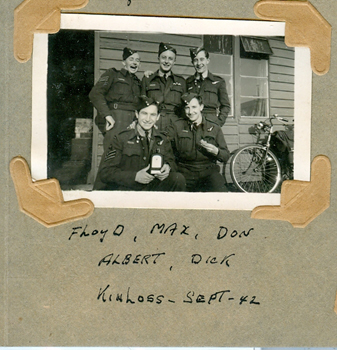
Floyd Wile and colleagues at 19 OTU, RAF Kinloss, September 1942. Four aircrew in this picture would later take part in the Dams Raid. Back row, L-R, Floyd Wile (navigator), Max Stephenson (pilot), Don Hopkinson (bomb aimer). Front row, L-R, Albert Garshowitz (wireless operator), Richard Bolitho (air gunner). From Albert Garshowitz’s photograph album. Pic: Garshowitz family. 

Plt Off F A Wile
Navigator

Lancaster serial number: ED864/G

Call sign: AJ-B

First wave. Crashed on outward flight.

Floyd Alvin Wile was born on 17 April 1919 in Scotch Village, Nova Scotia, Canada. His parents Harris and Annabell Wile had seven children, five of whom survived into adulthood. Wile went to local schools in Scotch Village and then worked in the timber trade. He enlisted in the RCAF in May 1941 and was selected for training as a navigator. He qualified as an Air Observer in February 1942. After further training he was posted to Britain, and arrived in May 1942.

He was sent to a further training unit at RAF Kinloss and crewed up with pilot Max Stephenson, wireless operator Albert Garshowitz, bomb aimer Don Hopkinson and gunner Richard Bolitho, flying Whitleys. The picture above was taken sometime in September 1942, during this period. The crew were then posted for further training on heavy bombers and Frank Garbas and John Kinnear were added to the crew.

When they were ready for operational flying, the whole crew were posted to 9 Squadron and Wile received a commission. However, before they could fly together Max Stephenson was sent to gain operational experience on a trip to Duisberg, flying as flight engineer. Unfortunately his aircraft was shot down, and he was killed.

Without a pilot, the crew was then shipped to 57 Squadron, and allocated to Bill Astell and flew their first operation to Lorient on 13 February 1943. After several more operations, they were posted together to the new 617 Squadron.

Sadly, Wile and his colleagues were all to die on 617 Squadron’s first operation, when their Lancaster was damaged by flak and collided with a pylon near Marbeck. They were buried first in Borken, and reinterred after the war in the Reichswald Forest Military Cemetery.

Thanks to Floyd Wile’s nephew, Don Lightbody, for help with this article.

More about Wile online:
Commonwealth War Grave Commission entry

KIA 17.05.43

Rank and decorations as of 16 May 1943.
Sources:
Robert Owen, Steve Darlow, Sean Feast & Arthur Thorning, Dam Busters: Failed to Return, Fighting High, 2013
Richard Morris, Guy Gibson, Penguin 1995
John Sweetman, The Dambusters Raid, Cassell 2002

Further information about Mick Martin and the other 132 men who flew on the Dams Raid can be found in my book The Complete Dambusters, published by History Press in 2018.
Sqn Ldr Tony Iveson DFC

Iveson MoD

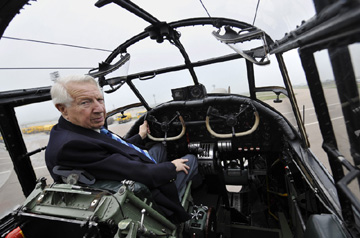
Tony Iveson in the BBMF Lancaster, 2008. [Pic: MoD]

It’s sad to hear about the death of Tony Iveson, a friend of this blog, and someone who was assiduous in campaigning for greater recognition of the role played by Bomber Command during the Second World War, particularly the campaign for a permanent memorial. Although he was at RAF Scampton for the Dambusters 70th anniversary commemorations, he was taken ill shortly afterwards.
In fact his first wartime operations were in Fighter Command during the Battle of Britain. He later retrained as a bomber pilot and joined 617 Squadron a few months after the Dams Raid. He served with the squadron for over a year and took part in three attacks on the Tirpitz, including the final one in November 1944, where the battleship was sunk after three direct hits from the Barnes Wallis-designed Tallboy bombs, dropped by crews from both 617 and 9 Squadron. In January 1945 he flew a crippled Lancaster back to Shetland from Bergen, even though four members of his crew had baled out, convinced that he would crash.
Just over five years ago, Tony Iveson flew again in the BBMF Lancaster, and took the controls for a while. (I blogged about it at the time, reproducing the fine article which appeared in the Daily Telegraph.) He also appeared on the BBC’s Desert Island Discs (another connection to the Dambusters with its signature tune by Eric Coates) and you can listen again to this here.
Obituary in the Daily Telegraph.

Dambuster of the Day No. 51: John Kinnear

Kinnear

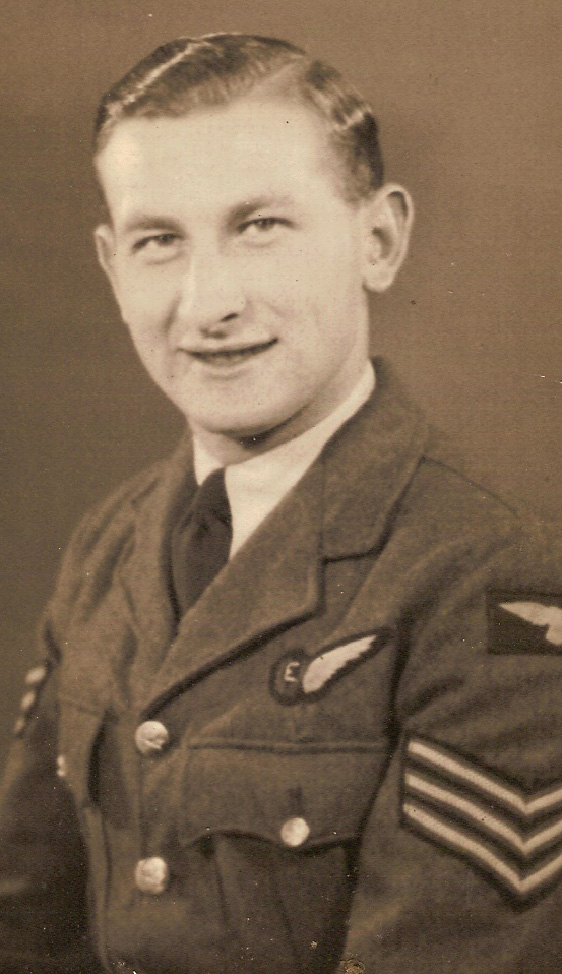
John Kinnear, probably photographed in 1942, with his Flight Engineer’s wings.
[Pic: Kinnear family]

Sgt J Kinnear
Flight engineer

Lancaster serial number: ED864/G
Call sign: AJ-B

First wave. Crashed on outward flight.

John Kinnear was typical of many of the flight engineers who took part in the Dams Raid, in that he had converted from ground crew in the the period after mid-1941, when the RAF dropped its earlier policy of putting two pilots on heavy bomber crews. He was known to his family as Jack, but in the RAF, this was inevitably changed to Jock.

He was born on 6 November 1921 in Newport, Fife, a small village on Tayside, the son of William and Helen Kinnear. His father had once been the chauffeur to the Dundee MP and publisher Sir John Leng, and the family had lived on the Leng estate. He was a mechanically-minded young man who had worked as a garage hand before joining the RAF in 1939, at the age of 16.

After more than three years’ work on ground crew, Kinnear volunteered for training as a flight engineer and was sent to No. 4 School of Technical Training at RAF St Athan. He qualified from there in the late summer of 1942. He was then posted to a conversion unit, and teamed up with Floyd Wile, Albert Garshowitz, Richard Bolitho and Don Hopkinson, who had arrived at the unit with pilot Max Stephenson. Frank Garbas was also added to the crew at this time.

When they were ready for operational flying, the whole crew was posted to 9 Squadron. However, before they could fly together Max Stephenson was sent on an operation with another crew as second pilot to gain experience. Unfortunately his aircraft was shot down, and he was killed. The full crew was then posted to 57 Squadron at Scampton.

Sadly, Stephenson was killed on an operation with another crew and the crew were then assigned to experienced pilot Bill Astell. After a number of operations in February and March, they were told that they were to be posted to a new squadron, to be formed at the same station, Scampton. This, of course, would soon be known as 617 Squadron.

Bill Astell and his crew were kept busy in the training period before the raid, but there were the occasional leave periods. On what turned out to be their last short break, Kinnear and his colleagues, Floyd Wile, Albert Garshowitz and Don Hopkinson went to stay with the family of rear gunner Richard Bolitho, at Kimberley near Nottingham.

Their luck would run out shortly after midnight on the raid, when they hit a pylon and crashed near Marbeck. The explosion was so fierce that it wasn’t until the next day that the wreckage was approached by the Germans. Along with his comrades, John Kinnear was buried first in the City Cemetery in Borken. They were all reinterred after the war, and lie together in the Reichswald Forest Commonwealth War Graves Cemetery.

More about Kinnear online:
Commonwealth War Grave Commission entry

KIA 17.05.43

Rank and decorations as of 16 May 1943.
Sources:
Robert Owen, Steve Darlow, Sean Feast & Arthur Thorning, Dam Busters: Failed to Return, Fighting High, 2013
Richard Morris, Guy Gibson, Penguin 1995
John Sweetman, The Dambusters Raid, Cassell 2002

Further information about John Kinnear and the other 132 men who flew on the Dams Raid can be found in my book The Complete Dambusters, published by History Press in 2018.

Dambuster of the Day No. 50: William Astell

Grantham Astell crop

Pic: Lincolnshire CC/Grantham Museum

Flt Lt W Astell DFC
Pilot

Lancaster serial number: ED864/G
Call sign: AJ-B

First wave. Crashed on outward flight.

In his book Enemy Coast Ahead Guy Gibson gives a couple of cursory mentions to pilot Bill Astell, describing him each time as an ‘Englishman from Derbyshire’. As their paths only crossed for a few weeks in the spring and early summer of 1943, that may be all that impacted on Gibson but in fact Astell had had one of the most eventful careers of any of the Dams Raid pilots. He had flown on a number of operations and been awarded the DFC, but all his active service had been in the Middle East and Malta.

Born in Knutsford, Cheshire on 1 April 1920, Bill Astell was brought up in Derbyshire’s Peak District. From his schooldays at Bradfield College, he had been an adventurous spirit, crossing the Atlantic by cargo boat, climbing in the Dolomites and spending three months at Leipzig University. With war imminent, he first enlisted in the navy, but then transferred to the RAFVR in July 1939. By April 1940 he had been selected for pilot training and was shipped off to Rhodesia.

After qualifying as a pilot, he had hoped to get back to the UK but found himself sent to another training unit before being posted to a Wellington squadron in Malta. There he contracted typhoid, so he didn’t actually fly on active service until September 1941, when the squadron had been posted on to Egypt.

On 1 December 1941 he was involved in a horrendous flying accident: another aircraft cut in ahead of him while he was landing, and he fractured his skull and suffered severe burns to his back. Back on operations the next summer, he was shot down over the Western Desert and crash landed behind enemy lines. He managed to evade capture and got back to his base some five days later. For this operation he was awarded the DFC.

He eventually returned to England in September 1942 and was destined to become a flying instructor, but managed to get himself trained to fly Lancasters and was then posted to 57 Squadron at RAF Scampton, arriving in January 1943. His rather unusual career meant that at this point he had no crew, but he was allocated an operationally-ready crew which had formed under pilot Max Stephenson. Stephenson had been killed shortly beforehand in a raid on Duisberg with another crew.

Their first raid was on Lorient in France on 13 February 1943 and they would fly on a number of other operations until 25 March when the news came that the whole of 57 Squadron’s C Flight was to be transferred to a new squadron for a special operation. As they were already at Scampton, this didn’t involve too much disruption, but there must have been much speculation as to what the actual target was to be.

Several weeks of intense training was to follow. Astell and his crew were tasked with the new squadron’s first flights, taking photographs of all the major lakes in England, Scotland and Wales, and they were also the first to fly the specially modified Lancaster. On 14 May, those captains who had never made a will were instructed to do so, and Astell made his. It was witnessed by Robert Barlow and Henry Maudslay. None of them would return from the raid.

On the night of the raid, Astell took off in the final trio of the first wave, led by Maudslay, with Les Knight as the third member. Everything seemed to go well until they crossed the Rhine. Astell was lagging slightly behind Maudslay and Knight, seeming to hesitate as though not sure of a turning point. Shortly afterwards, near Dorsten, they ran into unexpected light flak, from the same position that had damaged Hopgood’s aircraft about 20 minutes earlier. Looking back from the astrodome of Knight’s AJ-N, its wireless operator Bob Kellow: ‘saw two lines of tracer intersecting in a brilliant criss-cross. Through this Astell flew at 0015, and although his gunners vigorously returned fire he did not survive the ordeal. When eight miles north-west of Dorsten, Kellow watched the aircraft become swiftly engulfed in flames about two miles astern, and shortly afterwards he and Hobday reported an explosion on the ground.’ (Sweetman, Dambusters Raid, p.161.)

Astell had hit an electrical pylon near Marbeck, where a line of HT cables lay in the path of the attacking force. Gibson and Young’s trios, a few minutes ahead, had noticed them and flown over them. The Upkeep mine Astell’s aircraft was carrying exploded about ninety seconds later, shattering windows for a distance around, although a roadside shrine to St Joseph somehow survived without damage. The next day the bodies of the crew were taken to Borken and buried in the City Cemetery. After the war, they were all reinterred together in the Reichswald Forest Commonwealth War Graves Cemetery.

More about Astell online:
Commonwealth War Grave Commission entry
Aircrew Remembered page on Astell crew

KIA 17.05.43

Rank and decorations as of 16 May 1943.
Sources:
Robert Owen, Steve Darlow, Sean Feast & Arthur Thorning, Dam Busters: Failed to Return, Fighting High, 2013
Richard Morris, Guy Gibson, Penguin 1995
John Sweetman, The Dambusters Raid, Cassell 2002

Further information about Bill Astell and the other 132 men who flew on the Dams Raid can be found in my book The Complete Dambusters, published by History Press in 2018.

Dambusters at the Albert Hall

BBC screengrab

The Royal British Legion Festival of Remembrance takes place on Saturday 9 November at 9.15pm and will be broadcast live on BBC1 for UK viewers. This year it will feature a tribute to the 133 aircrew who took part in the Dams Raid, and use the pictureboard created in conjunction with this blog as part of the video sequence.
An iPlayer link will follow here on Sunday after transmission. (See here, about 5 minutes in:
http://www.bbc.co.uk/iplayer/episode/b03hwbvv/Royal_British_Legion_Festival_of_Remembrance_2013/ ).
If you know of any other Remembrance Day tributes to Dambusters, then please get in touch.

Dambuster of the Day No. 49: Norman Burrows

Burrows ©PH

Sgt N R Burrows
Rear gunner

Lancaster serial number: ED937/G
Call sign: AJ-Z

First wave. Second aircraft to attack Eder Dam. Mine overshot. Aircraft damaged, and shot down on return flight.

Norman Rupert Burrows was born on 31 August 1914 in the Toxteth area of Liverpool, the second of the three children of Norman and Jane Burrows. His father worked as a carter. He joined the RAF in June 1941, but didn’t go to Air Gunnery School until the following year. After qualifying as an air gunner, he joined 50 Squadron based at Skellingthorpe on 30 September 1942.

He flew for the first time with Henry Maudslay on 27 January 1943, on a raid to Dusseldorf, and became his regular rear gunner, taking part in a further nine operations. On one raid, to Cologne on 2 February 1943, when they bombed from 19,000 feet conditions were so cold that his guns froze. The complete crew were transferred to 617 Squadron on 27 March 1943.

Towards the end of the pre-raid training all the Dams Raid crews practised dropping dummy Upkeep mines at Reculver, off the Kent coast. Maudslay and his crew had been allocated Lancaster AJ-X (ED933) for the raid. Burrows was in its rear turret on 12 May when Maudslay came in at an altitude so low that, when the mine was dropped, the splash of water and shingle damaged the tailplane. This must have severely shaken up the gunner.

The aircraft limped back to Scampton, but the repairs couldn’t be done in time. Fortunately another specially modified Lancaster, ED937, arrived the following day, and Maudslay was allocated it for the raid. It was given the code name AJ-Z.

After being damaged at the Eder Dam, AJ-Z got as far as Emmerich near the Dutch-German border before being shot down. The body of Burrows, separated from his comrades by the length of the fuselage, was at least identifiable on its own, and he and the rest of the crew were buried in Dusseldorf North cemetery. After the war, they were all reinterred in Reichswald Forest War Cemetery.

More about Burrows online:
Commonwealth War Grave Commission entry

KIA 17.05.43

Rank and decorations as of 16 May 1943.
Sources:
Richard Morris, Guy Gibson, Penguin 1995
John Sweetman, The Dambusters Raid, Cassell 2002

Further information about Norman Burrows and the other 132 men who flew on the Dams Raid can be found in my book The Complete Dambusters, published by History Press in 2018.

Dambuster of the Day No. 48: William Tytherleigh

File_1-4

Four airmen in the garden of a pub, believed to be “The Parklands” in Lincoln, probably in June 1941. At the time, they were all serving in 50 Squadron, then flying Hampdens at RAF Swinderby. L-R: Sgt Walter “Wally” Layne, Sgt Albert “Woof” Welford, Sgt William “Johnnie” Tytherleigh (with pipe) and Sgt Stuart “Stew” Hobson. [Pic: David Layne]

Flg Off W J Tytherleigh DFC
Front gunner

Lancaster serial number: ED937/G
Call sign: AJ-Z

First wave. Second aircraft to attack Eder Dam. Mine overshot. Aircraft damaged, and shot down on return flight.

William John Tytherleigh, always known as “Johnny”, was born in Cambridge on 8 November 1921, the son of Ernest and Julia Lilley (née Bennett). His birth name was William George Lilley. His parents’ marriage broke up when he was very young, and his mother moved to London to begin a new life with Albert Tytherleigh. At some point William George Lilley became William John Tytherleigh, and the family moved to Hove in Sussex.

He joined the RAF in 1940, and qualified as an observer/air gunner the following spring. He was posted to 50 Squadron in the crew of Sgt Douglas Atkinson (who was also known by the nickname of Johnny). This crew completed a full tour in Hampdens between November 1941 and June 1942. Tytherleigh was commissioned in April 1942. At the end of their tour, he gave his pilot Atkinson an engraved gold propelling pencil, along with a handwritten message ‘To help say thank you Douglas for seeing me through – Johnny’. This was found by Atkinson’s son after the war.

After a spell in a training unit Tytherleigh rejoined 50 Squadron in the autumn of 1942. By then, they were flying Lancasters, and Tytherleigh was stationed in the mid upper turret.

On 2 February 1943, he joined up with Henry Maudslay, Robert Urquhart and Norman Burrows for the first time, on an operation to Cologne, and he flew a further eight times with this crew, until they were all transferred to 617 Squadron.

On the Dams Raid, he was occupying the front gun turret of AJ-Z, which would have meant he was very close to the explosion when its Upkeep mine went off as it hit the parapet of the Eder Dam. As their damaged aircraft stuttered homewards, it flew too close to a flak battery on the outskirts of Emmerich, and they were shot down.

When they got to the crash site, the Germans could not identify the individual remains of William Tytherleigh, Michael Fuller and Robert Urquhart, and they were buried together in a single grave. After the war, they were all reinterred in Reichswald Forest war cemetery.

Like Urquhart, Tytherleigh had been recommended for a DFC at the time of his transfer from 50 Squadron. He had completed 42 operations. However, just as happened with his colleague, the recommendation got ‘lost’ for over two years, and it was not announced until June 1945.

More about Tytherleigh online:
Commonwealth War Grave Commission entry
Titherly family name website
Articles in Brighton Argus and Daily Telegraph from 2000, about a failed attempt to auction a fake letter to the Tytherleigh family.
Tytherleigh’s first tour in Sgt Douglas Atkinson’s crew in 50 Squadron

KIA 17.05.43

Rank and decorations as of 16 May 1943.
Sources:
Richard Morris, Guy Gibson, Penguin 1995
John Sweetman, The Dambusters Raid, Cassell 2002

Further information about William Tytherleigh and the other 132 men who flew on the Dams Raid can be found in my book The Complete Dambusters, published by History Press in 2018.

Dambuster of the Day No. 47: John Fuller

P O MJD Fuller 2

Pic: Fuller family

Plt Off M J D Fuller
Bomb aimer

Lancaster serial number: ED937/G
Call sign: AJ-Z

First wave. Second aircraft to attack Eder Dam. Mine overshot. Aircraft damaged, and shot down on return flight.

Michael John David Fuller, known as John to his family, was born on 28 April 1920 in Reigate, Surrey. After leaving school, he worked for the Post Office as a telephone engineer. He joined the RAF in May 1940, but didn’t begin operational training until February 1942. He then qualified as a bomb aimer.

After a short spell in 106 Squadron he was posted to 50 Squadron, and first flew with Henry Maudslay and his new crew on 13 February 1943. He flew on a handful of other operations before the whole crew were posted over to 617 Squadron. By this time, he had been commissioned.

The bomb aimer’s job on the attack on the Eder Dam must have been ferociously difficult. The pilot had only a few seconds to level out and in that time, the bomb aimer would have had to judge exactly when to release the mine. David Shannon and Henry Maudslay made several attempts each, and it was on his third run that Fuller released AJ-Z’s mine. Some reports say that something was seen hanging down below the aircraft, perhaps caused by hitting trees on the run in. Perhaps this hampered the mechanism because the mine was dropped too late, hit the parapet and exploded almost under the aircraft.

Although the crew limped as far as Emmerich, they met their end there at the hands of a flak battery, about 50 minutes after the attack on the Eder.

When they got to the AJ-Z crash site, the Germans could not identify the individual remains of Fuller, Tytherleigh and Urquhart, and they were buried together in a collective grave in Düsseldorf North Cemetery. After the war, the whole crew was reinterred in Reichswald Forest War Cemetery.

More about Fuller online:
Commonwealth War Grave Commission entry

KIA 17.05.43

Rank and decorations as of 16 May 1943.
Sources:
Richard Morris, Guy Gibson, Penguin 1995
John Sweetman, The Dambusters Raid, Cassell 2002

Dambuster of the Day No. 46: Alden Cottam

cottam pa98-716_141

Pic: Alberta on Record

Wt Off A P Cottam
Wireless operator

Lancaster serial number: ED937/G
Call sign: AJ-Z

First wave. Second aircraft to attack Eder Dam. Mine overshot. Aircraft damaged, and shot down on return flight.

Alden Preston Cottam was born in Edmonton, the provincial capital of Alberta on 29 August 1912. His family lived in the small town of Jasper in the Canadian Rocky Mountains, some 225 miles away. The only son of the five children of Edwin and Margaret Cottam, his father worked as a hostler for the Canadian National Railway. His parents were both originally from Nova Scotia in eastern Canada.

Cottam went to the local school in Jasper and worked as a clerk and driver before the war. He joined the RCAF in February 1941 and qualified as a wireless operator/air gunner.

After arriving in England he was posted to a training unit, 1654 Conversion Unit. In October 1942, he was sent from there to 50 Squadron at RAF Swinderby. He flew on a number of operations with Sgt A.L. Kitching as pilot, and then joined Henry Maudslay’s crew for an operation to Essen on 21 January 1943. He was posted to 617 Squadron in 25 March as part of Maudslay’s crew.

Cottam is buried in Reichswald Forest War Cemetery.

[Thanks to Alan Wells for particular help with this piece, and for all the Maudslay crew.]

 More about Cottam online:
Entry at Commonwealth War Graves Commission
Listing at Alberta on Record
Listing at Canadian Virtual War memorial
Article in Canadian newspaper about visit to his grave

KIA 17.05.43

Rank and decorations as of 16 May 1943.
Sources:
Richard Morris, Guy Gibson, Penguin 1995
John Sweetman, The Dambusters Raid, Cassell 2002

Further information about Alden Cottam and the other 132 men who flew on the Dams Raid can be found in my book The Complete Dambusters, published by History Press in 2018.