Gibson: the documents are “compelling”

Well known Dambuster researcher Alex Bateman has had some thoughts about the recent Gibson furore. Here is part of his long post on the RAF Commands forum:

Many fighter pilots and bomber gunners invented and exagerrated combat claims, some intentional, some confused in the heat of battle. It is possible that the gunners exagerrated the episode, and that it didnt happen as reported. I’ll give an example.

When researching my first book, I included the story of a 617 Squadron rear gunner, who in a history of the Squadron written 20 years or so ago, had apparently downed two Me110s which were following the Lancaster, then a third before the mid upper fired upon a fourth which was later confirmed as having crashed. However, a contemporary report, compiled the day of the action noted that they were ‘…attacked by enemy fighters. Two were claimed shot down by the mid-upper gunner…’, with no mention of the rear gunner at all. You could put this down to post war bravado, or the passage of time. However, the Squadron Commander, Leonard Cheshire kept personal journals, and in that he wrote (the same day) that the rear gunner shot down two JU88s and a possible Fw190. Now, putting the post war recollection aside, we have two reports compiled within 24 hours, one by the IO and the other perhaps after a personal interview with the CO, but the results changing from the MuG getting two, to the RG getting two and possibly three, with the actual aircraft changing from Ju88s, to a pair of Ju88s and a single engined Fw190, to later on, four Me110s. A clear indication of how details are changed or badly compiled.

Gibson that night was flying a Canadian built Mosquito BXX, KB267, which was unarmed. As such, no return fire could have been seen by the Lancaster if the aircraft they fired upon was Gibson, but do remember the above. It would also explain how Gibson could have been attacked and downed, as he had no way of defending himself, and could have been mortally wounded in the first action. To me, the combat report is puzzling, as it seems the Bomb Aimer saw the ‘enemy’ aircraft in front and below. For the Mid Upper to have seen him at the same time, he would have had to be quite far ahead, because the wings would have otherwise obscured his view, but apparently the rear gunner then opened up almost at the same time. It would indicate the enemy aircraft was almost standing still to have appeared in front and then very quickly, far enough back for the rear gunner to draw a bead and open fire himself. Perhaps the aircraft in question was severly damaged, and the pilot otherwise occupied?

Paul61 makes a good point when he says that no fighter encounters were reported by our aircraft. That night, 227 Lancasters and 10 Mosquitos were flying, with 4 Lancs lost and the one Mosquito. NO enemy aircraft were lost, and as far as I am aware, no Luftwaffe pilot made a combat claim. Although the gunners of EE176 reported an attack by a JU88, was there any physical damage to the aircraft to substantiate this?

The recorded conversation where McCormack tells the story, was apparently made by his wife without his knowledge, during a reunion, recording his recollections and capturing the story at the same time. Considering my previous knowledge of Mccormack, I was doubtful. For one thing, would you go to such great lengths to name yourself as the killer, albeit accidental, of one of the RAFs greatest heroes? The Squadron ORB says nothing, the crew logs could have been added to later on. But the intelligence report for the night notes an aircraft shot down, with the incident recorded with co-ordinates which are pretty much over the centre of Steenbergen, where Gibson crashed. So we have an aircraft at relatively low level, shot down and seen to crash, but not claimed by any German crew.

It is known that Gibson was the only aircraft carrying red TIs that night, and when the aircraft crashed, it was reported as bursting on the ground in red. The excavation of the Mosquito a few years ago unearthed a burnt TI, confirming that at least one was still abaord when he went in, and seemingly being the aircraft that crashed, as witnessed ‘shot down’ by another Lancaster crew.

We can now, as then, only suppose what may or may not have happened, but if only one twin engined aircraft was lost, with details converging, its highly possible that IOs speculated as to the identity of the aircraft in question. “Was it a JU88, or do you think it might have been a Mosquito?”, they might ask, in an effort to try and establish what aircraft was downed. If any gunners admitted they saw or might actually have downed a Mosquito it would quickly help to establish that Gibson was not coming back, regardless who who did the shooting.

We can never be certain, but for me the new material is rather compelling. Not the taped interview or bragging, but the period documents recently unearthed. As for the sabotage theories and the lack of fuel, these can immediately be dismissed for a number of reasons.

Having read Alex’s explanation, I must admit that I am coming round to his view. I still can hardly believe that Gibson, with all his experience as a night fighter pilot before he went onto bombers, would put himself in such a stupid position, within range of a Lancaster’s guns. But we all make mistakes. It could be that Gibson made a fatal one that night, and paid the price.
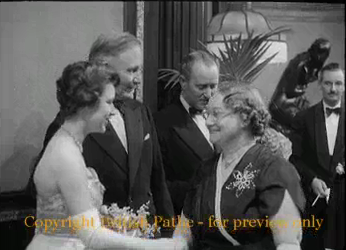
Pathe News coverage of Dam Busters premiere

The British Pathe archive site now has an eight minute film clip about the Dam Busters. The first section shows 1943  newsreel of the King and Queen’s visit to Scampton after the Dams Raid and the later investiture at Buckingham Palace. This has been around for a while and can be found on Youtube and other sites. Less well known is the second part of the film, a long sequence showing scenes from the premiere of The Dam Busters in 1955. Princess Margaret, “a radiant figure in the bright lights of Leicester Square”, is seen meeting a long queue of dignitaries amongst whom, most poignantly, are some mothers of aircrew who were killed on the Dams Raid. One of these is shown above. If anyone can identify her or any of the others, I would be glad to know.

I don’t seem to be able to embed the clip, but you can follow the link above.

It’s true, yes it is, it’s true*

When I noted, three posts ago, that a Second World War petrol bowser had recently been imported into New Zealand as a prop for the forthcoming Dambusters remake, I didn’t make the connection with the vehicle which had been sold at an auction in England earlier this year. But, as has been pointed out to me by both Graeme Stevenson and Colin Barron, they are one and the same. This bowser was at RAF Scampton in 1943, and therefore was most likely to have been used to carry fuel for the Dams Raid Lancasters. A great way to add background authenticity!

Which begs the question: how, between June and September, did it get so filthy that it required complete fumigation on its arrival in New Zealand?

* Headline courtesy J Lennon – I’ve been rereading Ian Macdonald’s magisterial Revolution in the Head

Who really killed the Dambuster?

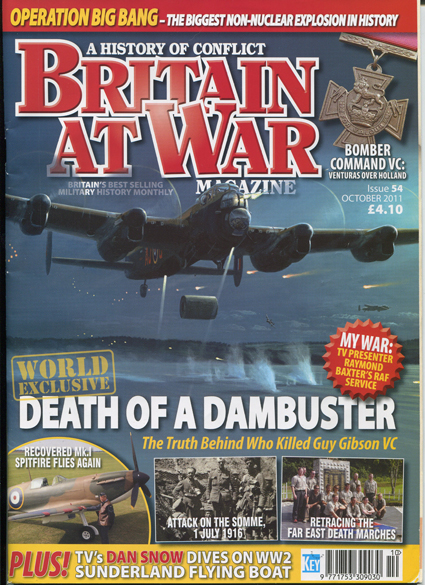
The article featured on the cover of this month’s Britain at War magazine has stirred up a certain amount of controversy.

(Coverage here in the Sun, Daily Telegraph, Daily Mail and on the BBC website.)

Provocatively entitled “Who Killed the Dambuster?” it claims to have unearthed definitive proof that on 19 September 1944 Guy Gibson’s Mosquito was shot down by “friendly fire” from a Lancaster of 61 Squadron, one of the aircraft in the strike force which he had just led on an attack on Rheydt and Mönchengladbach.
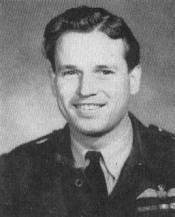
After the Dams Raid, Gibson had been removed from operational duties by senior RAF officers, worried about the propaganda consequences if he was shot down or taken prisoner. After 16 months away from the frontline, and with the invasion of Europe successfully negotiated, he managed to persuade the authorities to let him back on “Master Bomber” duties, supervising the marking of targets for other aircraft to attack. He was returning from the first of these operations, flying a unarmed Mosquito, when he crashed near Steenbergen in Holland. Both he and his navigator, Sqn Ldr James Warwick, were killed, their bodies so mangled that at first the remains found were assumed to be that of only one person.
A number of theories have been proposed as to the cause of the crash. Was the aircraft damaged by flak? Or shot down by a night fighter? Did the engines fail? Did a hung-up marker flare explode? Or was it an error, possibly caused by the pilot’s unfamiliarity with the controls of the Mosquito? In his 1995 biography, Richard Morris concluded that it was probably the latter, concluding that Gibson may not have known, or may have forgotten, about the necessity of switching fuel tanks, a duty usually undertaken by the navigator as the cock was positioned behind the pilot’s seat.
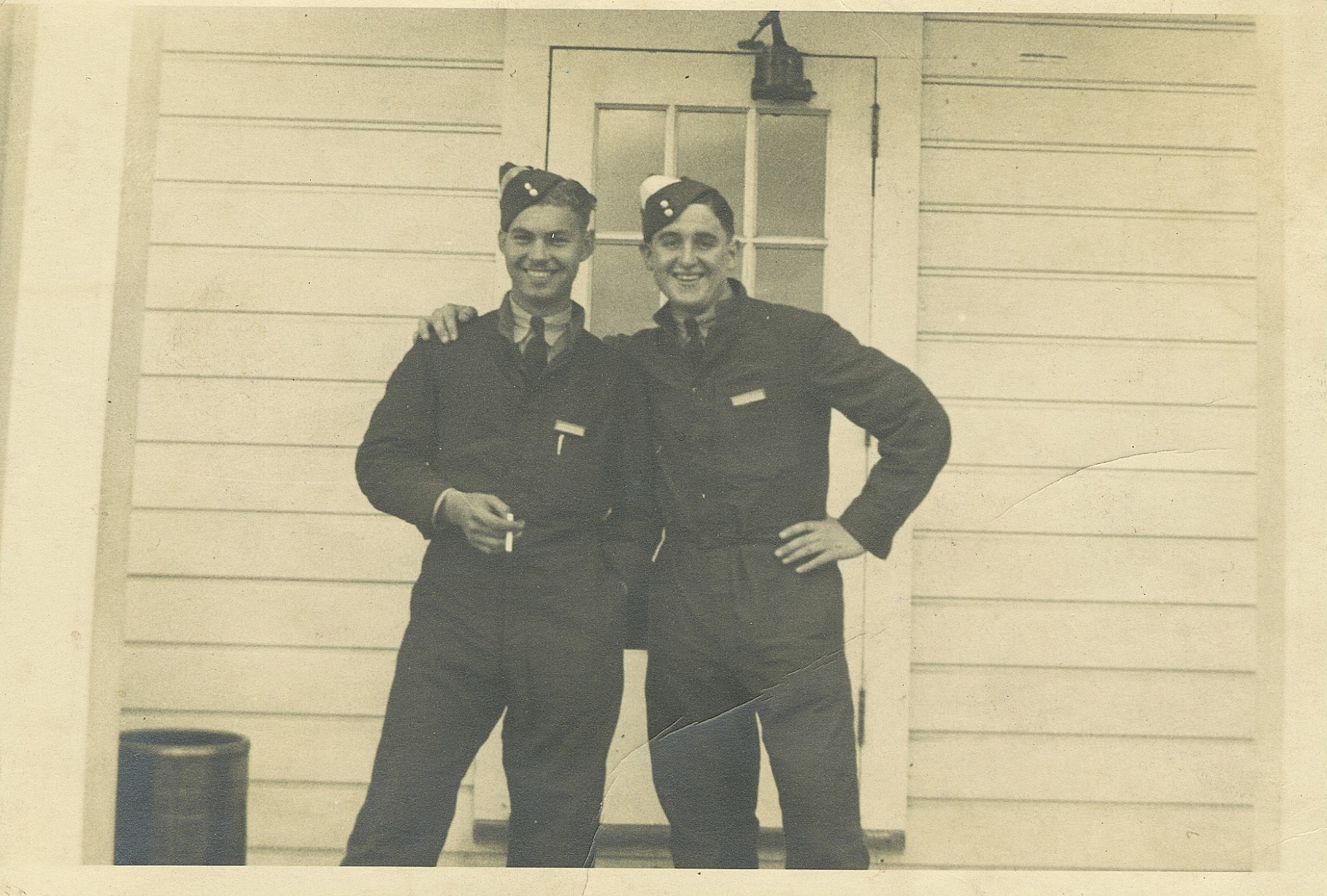
James Cutler, the author of the Britain at War article, claims that this last theory is wrong. He has come across a tape recording made in the 1980s by a 61 Squadron gunner, Bernard McCormack, who has since died. McCormack was the mid-upper gunner on Lancaster QR-V on the raid on Rheydt and his colleague, Sgt Maudersley, was in the rear turret. They had claimed that they had shot down a German JU88 at a debriefing after the raid, but the next day the intelligence officer had told them that it was in fact a Mosquito.
According to James Cutler, some of the material in the National Archives about the raid has been overlooked, but this may not be the case. Researcher Alan Wells has looked at the combat report compiled at McCormack’s and Maudersley’s debriefing, and also the one from another 61 Squadron aircraft QR-M, which opened fire on a JU88 some 20 minutes before. In a posting on the Stirling Forum, he concludes:

The combat report states that it was the A/B that saw the JU88 first, at a position given as “ahead and down”. It then moved to the “starboard down” position, where it was fired on by the M/U gunner, the R/G fired on it almost immediately after. On being fired on, the aircraft then moved to “dead astern” and attacked the Lanc, which went into a corkscrew, as it did this, the two A/G’s opened fire again, and the aircraft broke off the attack.
If this was Gibson, surely, after being fired on whilst in the starboard down position, why would he have been stupid enough to go dead astern and put himself in the firing line, instead of breaking away to safety, it does not make sense. 20 minutes earlier, another 61sqdn Lanc, was also attacked by a JU88, which started its attack from the starboard down position.

Alan Wells also points out that the gunners reported that the JU88 fired at them. Gibson’s Mosquito was not armed.

In the same forum, an actual Lancaster rear gunner veteran, Dennis Overs, suggested that if Gibson had really flown up behind a Lancaster it was tantamount to suicide:

It had been suggested that Gibson used to creep up on his crews in the stream to see if they were alert. My view at the time being that he would have been very aware that any such action on his part would have been potentially suicidal.
If the conditions on the night were quite dark, the gunner would have seen a faint outline of a twin engined a/c. creeping up on him. His reaction I believe was the correct one at that time. I certainly would have opened fire & called out corkscrew, seconds counted. The rear gunner had the advantage of his clear vision panel.
I suggest that the head on view of a Mosquito & JU 88 would have been difficult to confirm in the given time.
Even if conditions were clear, only a foolish mosquito pilot would have closed in on the rear of the a/c. in night fighter conditions.

Sgt McCormack’s tape recording, and the various documents, do make a plausible case for saying that Gibson was killed by “friendly fire,” something which is far too common in all sorts of wartime situations. However, all we can say at the moment is that the case is not yet proven.

George Baker, 1931-2011

Photo: BBC

The actor George Baker, who died on Friday, had a long and distinguished career on the stage, in TV and films, most recently as Inspector Wexford in the long running series based on Ruth Rendell’s detective stories. Dambuster aficionados will, however, recall that one of his first important film roles was that of Flt Lt David Maltby in Michael Anderson’s 1955 film.

The new Daily Telegraph film critic, Robbie Collin, has written a long and perceptive obituary for the paper, which you can read online. He cites the story I told on this blog a couple of years ago, about how George Baker wrote to me when I was researching my book about David Maltby, saying that one of the reasons he was chosen for the part was his strong resemblance to his real life character.

The real David Maltby, photographed in 1942

George Baker as David Maltby, in The Dam Busters (1955), standing at the back of the group.

In truth, the part of David Maltby in the film is quite small, and much of the time he appears his face is hidden by a flying helmet and oxygen mask. But he does get a few memorable lines, one in the ‘rag’ in the mess when the 617 squadron aircrew are teased once too often by their 57 squadron colleagues about their endless training and lack of operational flying.

This results in a giant ‘debagging’ fight with both crews trying to remove each others’ trousers. Guy Gibson, played by Richard Todd, hears the row from his office, and then has to pick his way through the scrum outside on his way to a meeting with station CO Charles Whitworth. He pauses to rescue David Maltby from the melee and receives heartfelt thanks: ‘Thank you sir. Saved my life. Never forget it.’

It was always a source of pride to my family when we were growing up that the part of our uncle in such a great film had been played by so distinguished an actor, and we used to follow George Baker’s career with proprietoral interest. He was a modest, self deprecatory man, who will be much missed.

Keep on trucking

Pic: Dominion Post

It may not look much, but the arrival of a filthy Second World War truck into a New Zealand port is the first bit of news about the Dambusters remake that we have had for months. Apparently it was covered with live spiders and other creepy crawlies, and had to be thoroughly cleansed and fumigated to comply with the country’s strict Biosecurity laws.

Quite why the Jackson outfit need a genuine truck, which will probably cost thousands to repair, rather than a life size replica is difficult to say. Perhaps it is to given a yet-to-be-disclosed leading role.

[Hat tip: Graeme Stevenson]


Dambusters remake: no news

If you’ve come to this page today after watching the C4 documentary, and then searching the web for information about the remake of the 1955 film The Dam Busters – the answer is there is no news. The film project is in the hands of Peter Jackson of Lord of the Rings fame, and is ‘in production’. Sir Peter is himself very busy on his new Hobbit film and, it would appear, has put The Dam Busters on the back burner for the moment. At various times over the last five years we have been promised that filming would start in 2009, 2010 and 2011. The best guess now is that it won’t be until 2013 at the earliest.

Dams Raid route – a modern re-creation

On right, Vivian Nicholson, while training as a navigator in Canada 1941. Pic: © Nicholson family.

One of the artifacts surviving from the Dams Raid is the navigation log of Sgt Vivian Nicholson, who was in the crew of David Maltby’s aircraft, AJ-J. It can be seen in the book, The Dambusters Raid, by John Sweetman (Cassell, 2002). A Dutch pilot called Dick Timmers, who now lives in Germany, decided to plot out the route taken by AJ-J using modern navigation software and techniques.

He has kindly agreed to make the plots available to anyone interested, and you can find them in PDF form here.

Below is an edited version of his explanation.

The nav log of Vivian Nicholson is a very meticulous piece of work done in a shaking and vibrating Lancaster in the most dangerous conditions. It took some effort and time to understand the system and its content. I ‘translated’ the log in my navigation/flight planning program from Jeppesen (a professional program used worldwide).

1. The route begins at EGXP (Scampton) via Woodhall Spa to West Raybham via a first FIX-J1 (no idea which landmark this fix represents.) further on to Southwold.

2. From Southwold via FIX-J2 (checking the drift) and FIX-J3 to FIX J-4, which is almost POSN A. POSN A is not reported in Vivian’s log and is crossed out on his route planning section on the overall sheet.

3. Also POSN B (a sandbank between the islands of Schouwen and Beveland) was not used and crossed out as well. However, this was an important waypoint/landmark at the Dutch coast. So AJ-J crossed the coast a bit off route to the north scratching Schouwen. This course deviation was not critical, because pilot, bomb aimer and flight engineer must have been able to see later on a large windmill at the coast of the peninsula of Tholen (this wind mill was according to Gibson a landmark and pinpoint). POSN C was (and still is) a railway intersection on the southern tip of Roosendaal. This position was mentioned by John Sweetman as a waypoint).

4. From Roosendaal due east to POSN D to pick up at the last third of this leg the Wilhelmina canal, which was followed until it ended in a canal (running north-south) at the village of Beek en Donk (POSN D).

5. From POSN D to Rees (POSN E). Approx. 11 miles prior arriving at Rees AJ-J pinpoints (P/P J1) at the town of Goch just behind the Dutch border. Again I have no idea what type of landmark was looked for.

6. POSN E are two sharp bends of the Rhine looking like an ‘omega’ with a small harbour on the top of the ‘omega’ at the right bank.

7. From POSN E to POSN F (landmarks are a few small lakes near Dülmen. Gibson warned for intensive flak and the coordinates were transmitted to the attacking aircraft by Group Headquarters were exactly at POSN F (according to John Sweetman).

8. From POSN F to a turning point at POSN G at Ahlen (most probably the landmark was a coal mine shaft with a slag hill, but I am not sure).

9. From POSN G to POSN H = Target X = Möhne lake.

AJ-J spent a total of 28 minutes at the Möhne Dam.

Home journey
The first part of the return flight of AJ-J is somewhat confusing, because the waypoints POSN H, especially G and T in the nav log do not sequence. However the logged Distance To Run and E.T.A. indicate clearly the route which was flown. The waypoint G on the return flight was also used for the waypoint F on the outward flight. Maybe a writing error??

1. Directly from POSN H (Möhne Lake) back to POSN G (Ahlen).

2. From POSN G to POSN G (probably writing error instead of F) to the Dülmen lakes. (Why did they not circumnavigate the Dülmen lakes avoiding the reported intensive flak? Maybe the transmitted coordinates by Group Headquarters were not correct?)

3. From the turning point Dülmen to POSN T (landmark just north-north-west of Nordhorn at the Dutch border. No idea what type of landmark. Maybe a railway/road crossing or the church steeple of Nordhorn.) Checking their course Gildehaus, a very small village, was pinpointed, but again I have no knowledge of a good visible landmark at Gildehaus).

4. From POSN T to POSN L. But POSN L (Zwarte Water) was missed by appr. 4 miles to the north. Pinpointing the town of Hardenberg (type of landmark?). Also no problem for the crew as they could pinpoint a lake (Beulaker Lake) just north of their anticipated waypoint.

5. From this lake towards POSN J in the North Sea. As indicated in Vivian’s log AJ-J became a ‘workable GEE’ just before reaching POSN J as can be seen on his first FIX he made (FIX To Base 1).

6. From POSN J to Wainfleet a further FIX To Base 2 shows that AJ-J is on track, but only if Wainfleet was their aim to make landfall. Because otherwise their heading would have brought AJ-J to Coningsby.

As Dick says, the conditions in which Vivian (who was flying on his first operation!) wrote out his log were very difficult, and these probably account for the few small writing errors.

Dick has also sent me a video diary showing part of the course from the air, when he flew along it himself. He has also recently flown over the Möhne itself and concluded that the approach from the north east is technically impossible. The aircraft must therefore have flown up from south of the dam, as first described in Arthur Thorning’s The Dambuster who cracked the Dam. If you would like to see Dick’s video, please contact me, and I will pass your details onto him.