Dambuster of the Day No. 32: Antony Stone

Stone lo res

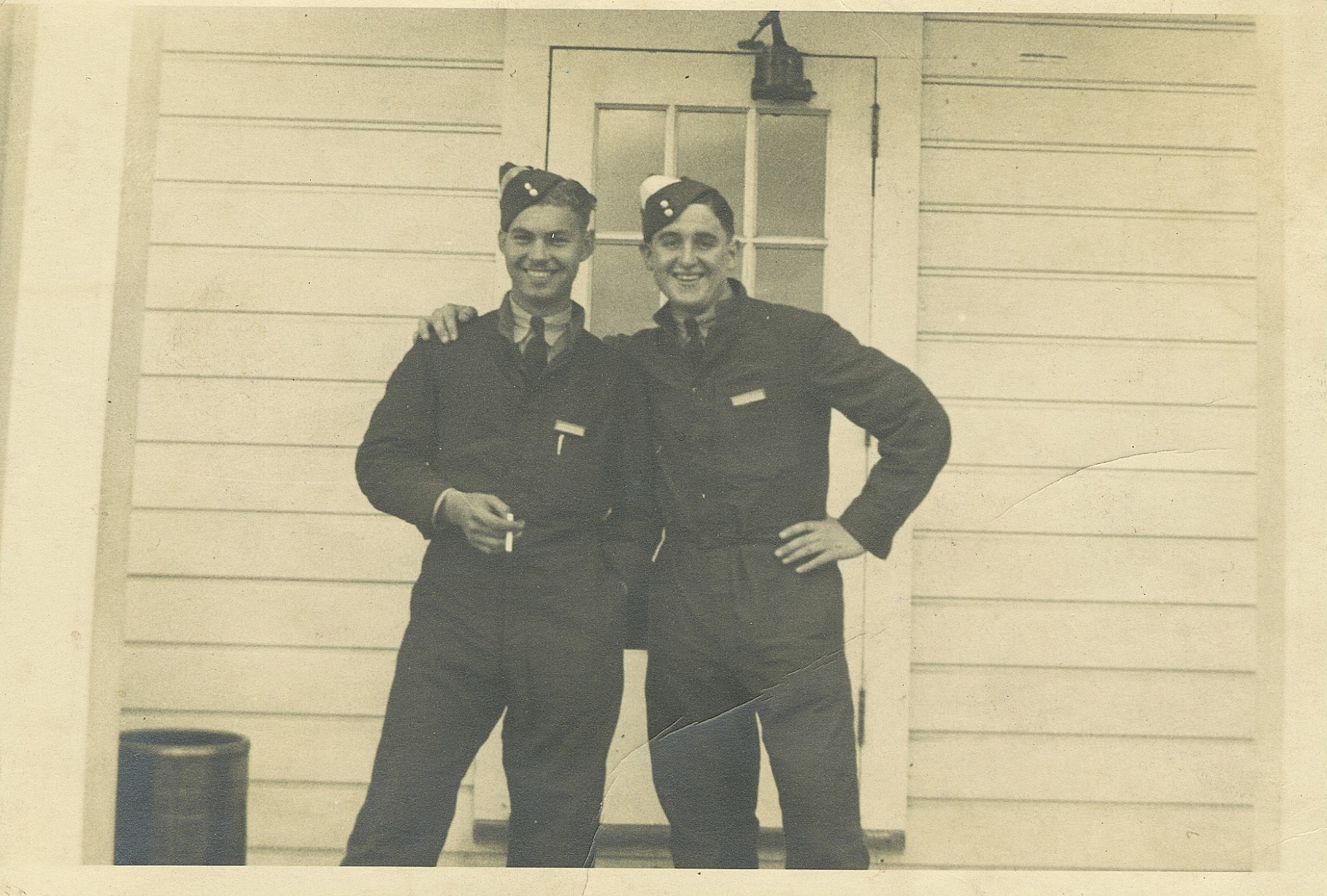
[Pic: Alan Kinge]

Sgt A J B Stone
Wireless operator

Lancaster serial number: ED906/G
Call sign: AJ-J
First wave. Fifth aircraft to attack Möhne Dam. Mine dropped accurately, causing large breach. Aircraft returned safely.

Antony Joseph Bazeley Stone was born in Winchester, Hampshire, on 5 December 1920, the younger son of a family of two boys who were the children of Joseph and Dorothy Stone. Born in Russia, from where he emigrated in the 1890s, Joseph Stone was a barber and had a shop in the centre of the city. Stone trained as a chef after leaving school, and had worked at several well known London restaurants before volunteering for the RAF in 1940.

He was selected for wireless operator training, and qualified also as an air gunner. He arrived at 10 OTU at St Eval at the same time as navigator Vivian Nicholson and bomb aimer John Fort, and it is likely that the trio teamed up there, along with gunner Austin Williams and pilot Flt Lt William Elder.

On 5 January 1943, the fledgling crew were transferred to RAF Swinderby, to join 1660 Conversion Unit, where William Hatton and Harold Simmonds were added. On 23 February 1943, the new crew were posted to 207 Squadron to begin operations but after Elder was killed on a ‘second dickey’ trip the crew was transferred to 97 Squadron at Coningsby, and allocated to David Maltby. The whole crew was posted together to 617 Squadron on 25 March 1943.

On the raid, Stone was responsible for starting up the motor which revolved the mine backwards, and checking that it had reached the correct speed of 500rpm before the aircraft started its bombing run.

Four months after the raid, on 14 September 1943, Stone took off from RAF Coningsby on 617 Squadron’s first major operation since the Dams Raid. When their aircraft suffered its final crash it sank with the bodies of all the crew except the pilot, so he has no known grave.

When the news reached his family in Winchester, his mother Dorothy was so shocked she was determined to find out more, and set off by train to Coningsby. She was shown into adjutant Harry Humphries’ office in a state of shock, asking him repeatedly: ‘Did he suffer? Did he suffer?’ She then disarmed Humphries by saying that she was glad that there were brave men like him carrying on the fight. As he noted in his autobiography, sadly, the only battles he fought were against official letters and forms.

Antony Stone left a letter for his parents, only to be opened on the event of his death. A fragment of it survives in a typescript version in the possession of the Maltby family:

I will have ended happily, so have no fears of how I ended as I have the finest crowd of fellows with me, and if Skipper goes I will be glad to go with him. He has so much more to lose and more responsibilities than I and you can rest assured and know that I’ve taken hundreds with me who lived as you do and never even gloried in the war as I did and I still experience that same thrill every time I fly.

His father kept his photograph in his shop until the day he retired, and it is still recalled by generations of boys and men who had their hair cut by him.

Antony Stone is commemorated on the Runnymede Memorial.

More about Stone online:
Commonwealth War Graves Commission
Breaking the Dams website

KIA 15 September 1943.

Rank and decorations as of 16 May 1943.
Sources: Charles Foster, Breaking the Dams, Pen and Sword 2008
Richard Morris, Guy Gibson, Penguin 1995
John Sweetman, The Dambusters Raid, Cassell 2002
Further information about Antony Stone and the other 132 men who flew on the Dams Raid can be found in my book The Complete Dambusters, published by History Press in 2018.

Dambusters 70th anniversary events (update 12 May)

Dams Raid 70th anniversary
Below is a list of most of the events planned for the 70th anniversary of the Dams Raid.
Please note that there is an event planned on Friday 17 May at the Eder Dam in Germany, and any British people staying in the area at the time are especially asked to attend this. (See below.)
It’s unlikely now that I will update this complete list again before 16 May, but you will be able to see any new individual events added to the blog by clicking on this category link Dambusters 70th anniversary .

Monday 13 May-Friday 17 May
RAF Museum London
10.00am-6.00pm daily
Exhibition

Thursday 16 May
Derwent Reservoir/Chatsworth House both in Derbyshire
1.15pm approximately
BBMF Lancaster flypast
Please note that there will be severe traffic restrictions in the area around the Derwent Dam. No tickets are being issued, parking is severely limited, and the roads will be closed if they become overly busy. See here for full details. The Lancaster flyover will be followed by modern day Tornadoes from 617 Squadron.
The aircraft, which are expected to comprise the Lancaster, a Spitfire and a Hurricane (although this is not specified), will then fly on to Chatsworth at 1.20pm where, the RAF is keen to tell you, there is plenty of parking (costing £3 per vehicle) and opportunity to take pictures.
This may well be the better option unless you are willing to spend a lot of time either hiking cross country to the dam or waiting in very long traffic queues.
The Lancaster will also overfly the nearby town of Chapel-en-le-Frith to honour pilot Bill Astell, killed on the raid. Further details. 

Thursday 16 May
RAF Museum Cosford
5.00pm
Special talk: ‘Operation Chastise – 70 years on, the successful failure’

Thursday 16 May
Barry War Museum
Barry Island, Vale of Glamorgan
7.00pm
Opening of exhibition of letters, photos and other articles that belong to the family of Sgt Gordon Yeo, front gunner in AJ-A on the Dams Raid. Further details.

Thursday 16 May
Outside broadcast from RAF Scampton
7.00-8.00pm
Live broadcast of Sunset Ceremony from RAF Scampton on BBC2.
RAF College Cranwell Band and The Queen’s Colour Squadron including the 617 Sqn Standard.
Flypast and landings by BBMF Lancaster and Spitfires, plus Tornadoes flown by today’s 617 Squadron.
Invited guests only at Scampton. Please do not ask for tickets!

Friday 17 May
Eder Dam (34549 Edertal – Hemfurth, Germany)
10.30am
Commemorative event and service
Local dignitaries and religious leaders will read messages and lay wreaths commemorating all those killed in that Dams Raid. A message from the current CO of 617 Squadron will be read. Any British people staying in the area over the period of the raid are particularly asked to attend to pay their respects. Further details from the Dambusters museum website or Facebook page.

Friday 17 May
Lincoln Cathedral
afternoon
All tickets for this event have been allocated but the BBMF Lancaster is expected to fly over the Cathedral. 

Sunday 19 May
Woodhall Spa, Lincolnshire
Morning
Service and unveiling of 617 Squadron post World War 2 memorial

Sunday 19 May
Brooklands Museum, Weybridge, Surrey
Dambusters Celebration
Bomber Command Veterans will be the special guests at Brooklands. Talks and exhibitions about Barnes Wallis. Further details.

Sunday 19 May
Derwent Reservoir (again!)
A six mile ‘Honour Walk’ around Derwent Reservoir.
12 noon.
Walk organised by Royal British Legion, starting and finishing at Fairholmes Visitor Centre. £5 per head or you can raise money with sponsorship. Further details.

Sunday 19 May
The Dambusters Project
Woodland Suite, Petwood Hotel, Woodhall Spa
7.00pm
Ticketed event. Further details.

Dambuster of the Day No. 31: Vivian Nicholson

Nicholson CNV00001

Vivian Nicholson, on right, while training in the USA in about December 1941. [Pic: Nicholson family]

Sgt V Nicholson
Navigator
Lancaster serial number: ED906/G
Call sign: AJ-J
First wave. Fifth aircraft to attack Möhne Dam. Mine dropped accurately, causing large breach. Aircraft returned safely.

Vivian Nicholson was born on 15 February 1923 in Newcastle on Tyne, the oldest of the eight sons of Arthur and Elizabeth Nicholson, who lived in Sherburn, Co Durham. He worked as an apprentice in the family joinery business but when the war started he volunteered to join the RAF.

He was sent to Canada on the British Commonwealth Air Training Plan. Canada, with its wide open spaces and safe distance from the main theatres of conflict in Europe, was ideal for aircrew training, and over 150,000 people from Britain, the Commonwealth countries and the USA, were sent there during the war. He started his training in Canada but then went on to Tuscaloosa, Alabama in the USA for part of his course. Even though the USA was not yet in the war, it was already providing training facilities for the Allies.

On arrival home, he was sent to 10 OTU at RAF St Eval, Cornwall, in September 1942. He arrived there at the same time as bomb aimer John Fort and wireless operator Antony Stone, and it is likely that the trio teamed up there, along with gunner Austin Williams and pilot Flt Lt William Elder.

On 5 January 1943, the fledgling crew were transferred to RAF Swinderby, to join 1660 Conversion Unit, where William Hatton and Harold Simmonds were added. On 23 February 1943, the new crew were posted to 207 Squadron to begin operations but unfortunately two days later Elder was killed on a ‘second dickey’ trip. A month later the pilot-less crew was transferred to 97 Squadron at Coningsby, where they were allocated to David Maltby. The whole crew was posted together to 617 Squadron on 25 March 1943.

logsheets-3 Nicholson lo res

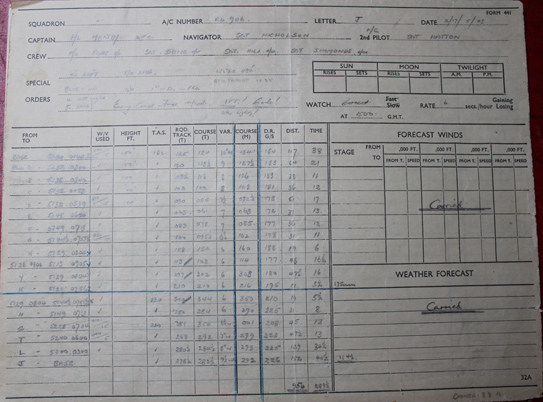
A navigator used a log sheet for each operation in order to record routes taken, changes in bearing, times of fixes etc. All these calculations were, of course, made by hand. Vivian Nicholson was on his first active operation on the Dams Raid, and we are lucky in that his log sheet has been preserved for posterity. Its accuracy has been commended by navigational experts in the years since. There was also space for the navigator to make his own notes during the raid, and he recorded comments such as ‘Bomb dropped.Wizard.’ immediately after the mine was released.

the_dambusters_at_the_a_v_roe_dinner_hungaria_restaurant_2585287

Nicholson received the DFM for his part in the raid and took an active part in the celebrations at Buckingham Palace and in the Hungaria Restaurant on 22 June 1943. He can be seen in the famous restaurant photograph, sitting behind John Fort and David Maltby, with the arm of Jack Leggo, his Navigation Leader, draped over his shoulders. We can be sure that Leggo was proud of the textbook way his young protegé had carried out his first operation.

Four months later, on 14 September 1943, Nicholson took off from RAF Coningsby on 617 Squadron’s first major operation since the Dams Raid. When their aircraft suffered its final crash it sank with the bodies of all the crew except the pilot, so he has no known grave.

After their fatal crash into the North Sea on 15 September 1943, Nicholson’s mother Elizabeth wrote to David Maltby’s father:

We knew from our son they were a proud and happy crew, and we have at least four different photos of your gallant son, his bomb aimer and our boy together with others taken while in London June 22/23rd.
It is indeed a terrible and deep wound for us when we look at them so young, happy and beautiful.
We also knew, as from what my boy told others, that, they knew the daily risks they had to run, but were prepared to face them as it was for a good cause, which surely makes us feel all the more proud of them, although our loss is at times unbearable.

Vivian Nicholson is commemorated on the Runnymede Memorial.

More about Nicholson online:
Commonwealth War Graves Commission
Breaking the Dams website

KIA 15 September 1943.

Rank and decorations as of 16 May 1943.
Sources: Charles Foster, Breaking the Dams, Pen and Sword 2008
Richard Morris, Guy Gibson, Penguin 1995
John Sweetman, The Dambusters Raid, Cassell 2002

Further information about Vivian Nicholson and the other 132 men who flew on the Dams Raid can be found in my book The Complete Dambusters, published by History Press in 2018.

Right says Fred

Sutherland screengrab

Canada’s national broadcaster CBC has put up some great new pages on its website about the Dams Raid. It features an interview with Fred Sutherland, looking fit and well in his home in Alberta, and giving his insights into the attacks on both the Möhne and Eder Dams. The news piece about Fred is here, but the more interesting stuff is here, with several more clips from the interview, some historical pieces of audio and much more well-researched information. Make sure you go through all the clips. You’ll be glad you did.

Dambuster of the Day No. 30: William Hatton

Hatton

Sgt W Hatton
Flight engineer
Lancaster serial number: ED906/G
Call sign: AJ-J
First wave. Fifth aircraft to attack Möhne Dam. Mine dropped accurately, causing large breach. Aircraft returned safely.

William Hatton was born in Wakefield, Yorkshire, on 24 March 1920, the oldest boy in a family of four children, two boys and two girls. Their parents were George and Florence Hatton. William Hatton went to Holy Trinity and Thornes House schools in Wakefield.

He joined the RAF at the outbreak of war, and worked in groundcrew. In May 1941, he went to RAF Speke in Liverpool where he serviced aircraft in the Merchant Ship Fighter Unit. This was a short lived scheme in which Hawker Hurricanes were sent to sea on special merchant ships, which were equipped with catapults for launching them. The plan was to enable the Hurricanes to be launched far out at sea to help protect the Atlantic convoys. The only drawback was that they had no way of landing, so the pilot had to bale out of the Hurricane and let the aircraft fall into the sea.

When the opportunity arose for experienced groundcrew to become flight engineers on heavy bombers, Hatton applied and was sent to the only flight engineer training facility, No.4 School of Technical Training at RAF St Athan.

After qualifying as a flight engineer in late 1942, Hatton was posted to RAF Swinderby, to join 1660 Conversion Unit on 5 January 1943. There he crewed up with Vivian Nicholson, Antony Stone, John Fort and Harold Simmonds, who had moved into the last phase of training with their pilot Flt Lt William Elder. On 23 February 1943, the new crew were posted to 207 Squadron to begin operations but unfortunately two days later Elder was killed on a ‘second dickey’ trip. A month later the pilot-less crew was transferred to 97 Squadron at Coningsby, where they were allocated to David Maltby, returning to operations after his inter-tour break. The whole crew was transferred to 617 Squadron on 25 March 1943.

After the raid, all the aircrew were sent on leave. Such was the excitement that a number of local papers covered the story, with Hatton’s arrival back in his home town given the headline ‘A Wakefield Hero’ in the Wakefield Express. The paper sent a photographer to his family house and took the photograph seen above in the street outside.

Four months later, on 14 September 1943, Hatton took off from RAF Coningsby on 617 Squadron’s first major operation since the Dams Raid. When their aircraft suffered its final crash it sank with the bodies of all the crew except the pilot, so he has no known grave. William Hatton is commemorated on the Runnymede Memorial.

More about Hatton online:
Commonwealth War Graves Commission
Entry at Breaking the Dams website

KIA 15 September 1943.

Rank and decorations as of 16 May 1943.
Sources: Charles Foster, Breaking the Dams, Pen and Sword 2008
Richard Morris, Guy Gibson, Penguin 1995
John Sweetman, The Dambusters Raid, Cassell 2002

Further information about William Hatton and the other 132 men who flew on the Dams Raid can be found in my book The Complete Dambusters, published by History Press in 2018.
Dambuster of the Day No. 29: David Maltby

IWM CH9929

David Maltby is presented to the King, Scampton, 27 May 1943. Note how his pocket bulges with smoking equipment. [Pic: IWM CH9929]

Flt Lt D J H Maltby DFC
Pilot
Lancaster serial number: ED906/G
Call sign: AJ-J
First wave. Fifth aircraft to attack Möhne Dam. Mine dropped accurately, causing large breach. Aircraft returned safely.

David John Hatfeild Maltby was born on 10 May 1920 in Baldslow near Hastings, Sussex. His parents, Ettrick and Aileen Maltby had three children: Audrey, born in June 1915; David; and Jean, my mother, born in December 1924. He went to Marlborough College, leaving in 1936. In 1938, he decided that he wanted to train as a mining engineer, and went to work at Treeton colliery in South Yorkshire, boarding with a local family in the neighbouring village of Aughton.

When the war started he tried to sign up for the RAF on 6 September 1939. At the same time so did tens of thousands of other young men. Most of them were told to go away and wait, and that they would be invited for assessment as soon as possible. Maltby was accepted for aircrew training in March 1940 and finally got his call up papers in June of that year.

He qualified as a pilot on 18 January 1941 and in June was posted to RAF Coningsby, which was then the home of two squadrons, Nos 106 and 97. He flew his first six operations in 106 Squadron’s Hampdens, but was soon transferred to the new Avro Manchester aircraft, operated by 97 Squadron. This was the two-engined precursor of the formidable Lancaster, but it was notoriously underpowered and unreliable. However by January 1942, the new Lancasters were available (97 Squadron was only the second squadron in the whole RAF to get them) and he made his first trip as first pilot with a crew of his own. He took part in a number of famous operations, including two unsuccessful attempts to destroy the German battleship Tirpitz, which was concealed in a Norwegian fjord.

He finished his first tour of operations in June 1942, and was awarded the DFC. He then spent a few months commanding a specialist Air Bomber Training Section in 1485 Target Towing and Gunnery Flight before returning to active operations with 97 Squadron, on 17 March 1943.

Maltby was given a new crew which had been posted from 207 Squadron after their pilot had been killed on a ‘second dickey’ trip on 25 February before they could begin operations. This was made up of William Hatton, flight engineer; Vivian Nicholson, navigator; Antony Stone, wireless operator; John Fort, bomb aimer; and Austin Williams and Harold Simmonds, gunners. A few days later, on 25 March, they were all transferred to a new squadron, set up under the command of Guy Gibson, to prepare for a highly secret mission. Les Munro, Joe McCarthy and their crews were also transferred out of 97 Squadron the same day.

Maltby’s crew flew on some 23 training flights over the next six weeks, with the only hiccough being in early May when front gunner Austin Williams was deemed unsuitable – the reason why is not clear – and was replaced by a new gunner, Victor Hill, hurriedly imported from 9 Squadron.

At 2147 on 16 May 1943, a group of three Lancasters, piloted by Melvin Young, David Maltby and David Shannon took off from Scampton. Maltby’s own flight is recorded in detail, thanks to the logsheet meticulously kept by his navigator, Vivian Nicholson, which notes that they arrived at the Möhne at 0026, having taken 2 hours 32 minutes.

The first three attacks were not successful. To the onlookers circling the wood beyond the lake, the fourth, Melvin Young, seemed to have delivered his mine in textbook fashion, but still the dam wall held. Gibson told Maltby to go ahead at 0048. This time, three Lancasters flew towards the target. Gibson on David’s starboard side, Martin over to port.

Antony Stone checked the spinning mine, John Fort lay flat on his stomach in the front fuselage, waiting, with Vic Hill’s feet planted in their stirrups over his head. As they came over the spit of land, Vivian Nicholson turned on the spotlights and peered out of the starboard blister at the beams, calling, ‘Down, down’ as their lights came closer and closer. Up in the cockpit, in the left-hand seat, David Maltby adjusted the height and kept the aircraft level while, next to him, Bill Hatton watched the speed and moved the throttles. As they approached the dam wall, Maltby suddenly realised that from this close he could see a small breach had occurred in the centre and that there was crumbling along the crown. Young’s mine had been successful after all! In a last second change of plan he veered slightly to port but stayed dead level as John Fort steadied himself to press the release. The mine bounced four times and struck the wall. Over the dam they flew, now turning hard left, Harold Simmonds in the rear turret firing on the gun emplacements that were still active.

It wasn’t yet obvious whether the attack had been successful so at 0050 wireless operator Antony Stone radioed ‘Goner 78A’ back to Grantham. (‘Goner’ meant a successful attack, ‘7’ an explosion in contact with the dam, ‘8’ no apparent breach, ‘A’ the target was the Möhne.) Maltby said afterwards: ‘our load sent up water and mud to a height of a 1,000 ft. The spout of water was silhouetted against the moon. It rose with tremendous speed and then gently fell back. You could see the shock wave at the base of the jet.’

‘Bomb dropped. Wizard.’ was what Vivian noted immediately in his log. The lake began to calm down again, and Shannon was called into the attack. As he readied himself, the circling crews realised, to great excitement, that the dam had been breached, and a torrent of water was pouring through.

After the Dams Raid, for which he received the DSO, Maltby became commander of A Flight and often acted as CO in Gibson’s frequent absences on official duties. He took a full and active part in the many festivities that took place, often in conjunction with the squadron’s other party animals, such as Richard Trevor-Roper. As both of them had pregnant wives at home, perhaps this gave them a special bond. Maltby’s wife Nina (née Goodson) gave birth to their son John in July 1943 at their home in Woodhall Spa. There were in fact four aircrew who flew on the raid knowing that their wives were pregnant. Trevor-Roper and David Maltby would live to see their children being born. Charles Brennan and Lewis Burpee would not.

Party hard they might, but by September the squadron was back in training for another special mission, an attack on the Dortmund Ems canal, using a special thin case bomb three times the size of a normal 4000lb ‘cookie’. Eight aircraft were assigned – Maltby would lead the second group of four, himself, Dave Shannon, Geoff Rice and Bill Divall. Less than an hour into the flight, word was received at base that the weather conditions at the target had deteriorated. The aircraft were recalled.

Then came disaster. As it turned, Maltby’s Lancaster suddenly exploded. Shannon stayed with the wreckage, sending fixes and circling above until a rescue launch arrived. It’s not clear what caused the explosion. It may have been pilot error. Something may have gone wwrong with the bomb. Or it may have been a collision with a 139 Squadron Mosquito, returning from a raid on Berlin but out of radio contact.

The only body recovered was that of David Maltby. It was brought ashore, and he was buried the following Saturday in St Andrew’s Church, Wickhambreaux, Kent – the same church in which he and Nina had been married just sixteen months before.

More about Maltby online:
Commonwealth War Graves Commission
Breaking the Dams website

KIA 15 September 1943.

Rank and decorations as of 16 May 1943.
Sources: Charles Foster, Breaking the Dams, Pen and Sword 2008
Richard Morris, Guy Gibson, Penguin 1995
John Sweetman, The Dambusters Raid, Cassell 2002

Further information about David Maltby and the other 132 men who flew on the Dams Raid can be found in my book The Complete Dambusters, published by History Press in 2018.
Dambuster of the Day No. 28: Wilfred Ibbotson

Wilfred Ibbotson. [Pic: Peter Humphries]

Sgt W Ibbotson
Rear gunner
Lancaster serial number: ED887/G
Call sign: AJ-A
First wave. Fourth aircraft to attack Möhne Dam. Mine dropped accurately, causing small breach. Aircraft shot down on return flight.

Wilfred Ibbotson was born in Netherton, near Wakefield, Yorkshire on 18 September 1913, the second son of the four children of Herbert and Anne Ibbotson. His father had been a miner, but Wilfred worked on a farm after leaving school. He married Doris Bray in 1938, and they had two daughters. When war came he was called up and served as an Army motorcycle despatch rider. In 1941 he volunteered for the RAF, and trained as a gunner.

After qualifying, he was posted to 10 Operational Training Unit at RAF Abingdon, and joined a crew piloted by Sgt Ivan Morgan. His future colleagues Charles Roberts, Lawrence Nichols and John Beesley were also in this unit at the same time, but in a different crew, that of pilot Graham Bower. In September 1942, while still training, Ibbotson flew on two operations. He was then part of a detachment sent to augment Coastal Command resources at RAF St Eval and flew on six daylight anti-submarine sweeps.

In December, he moved on to 1660 Conversion Unit at Swinderby, and it would seem that it was here that he joined Young’s future crew, at that stage still skippered by Graham Bower. After Bower’s departure on sick leave, Ibbotson flew on two operations to Berlin. The first was on 16 January 1943 with Plt Off Vincent Duxbury as the pilot, and the second the following day with Plt Off Henry Southgate. (This information comes from Ibbotson’s logbook. 1660 CU’s Operations Record Book records another man as Southgate’s rear gunner.)

The Dams Raid was thus Ibbotson’s fifth operation. His body was the last of the crew of AJ-A to be washed ashore, on 30 May. Ibbotson was buried the following day alongside his comrades in Bergen General Cemetery.

More about Ibbotson online:
Commonwealth War Graves Commission
Wakefield Express article
Sharlston war memorial

KIA 17 May 1943.

Rank and decorations as of 16 May 1943.
Sources: Arthur Thorning, The Dambuster who Cracked the Dam, Pen and Sword 2008
Richard Morris, Guy Gibson, Penguin 1995
John Sweetman, The Dambusters Raid, Cassell 2002

Thanks to Chris Bowles for help with this article.

Further information about Wilfred Ibbotson and the other 132 men who flew on the Dams Raid can be found in my book The Complete Dambusters, published by History Press in 2018.

Dambuster of the Day No. 27: Gordon Yeo

Pic: Harry Humphries collection

Sgt G A Yeo
Front gunner
Lancaster serial number: ED887/G
Call sign: AJ-A
First wave. Fourth aircraft to attack Möhne Dam. Mine dropped accurately, causing small breach. Aircraft shot down on return flight.

Born in Barry Dock, Glamorgan, on 9 July 1922, Gordon Arthur Yeo was the youngest member of Melvin Young’s crew. He was the son of Arthur and Ada Yeo and had joined the RAF in 1941, wanting to be a pilot. Having been initially posted to Elementary Flying School in Canada, he eventually qualified as a gunner.
He crewed up with David Horsfall, Charles Roberts, Lawrence Nichols and Wilfred Ibbotson at 1660 Conversion Unit at RAF Swinderby, under skipper Graham Bower. When Bower went sick, most of the crew flew on an operation to Berlin on 16 January 1943, with Plt Off Vincent Duxbury as their pilot. By the time the crew moved to 57 Squadron at Scampton in mid March, Melvin Young had taken over.
On 25 March, they were posted across the base into the fledgling 617 Squadron and the young gunner would have met a few with much more experience than him. But he would also have found several more, like him, with very few operations under their belts.
Yeo wrote several letters to his parents during his time on 617 Squadron, and they give us some insight into how hard they trained, and what they did in their spare time. Melvin drove the crew into Lincoln on a day off from training to watch a parade which was part of the city’s ‘Wings for Victory’ week. This reminded the crew of their skipper’s chequered history.‘We had a good laugh at the blokes all dressed up in flying clothes and sitting in the dinghy. [Melvin Young] had a good laugh at them because he had detailed them.’ Later, he told his parents about Young’s determined efforts to ensure they were trained hard: ‘You say you want to know the name of our skipper, well here it is, S/Ldr H M Young, he is not so bad lately, I expect that is because we are getting used to him, but he is the cause more or less of us not getting leave.’
The Lancaster’s front gun turret was not used during most war time operations, but on the Dams Raid it was manned as the modification for the special mine had necessitated the removal of the mid upper turret. So Yeo would have used it to fire directly ahead of him at the Möhne’s gun emplacements as Young kept the aircraft steady in its bombing run.
AJ-A was shot down at the last moment of danger shortly after they had passed over the Dutch coast. Gordon Yeo’s body was washed ashore on 27 May 1943, along with those of Lawrence Nichols and Vincent MacCausland. They were all buried in Bergen General Cemetery.
In the months after the raid, Gordon Yeo’s mother must have written to Henry Young, Melvin Young’s father, as his reply to her dated 13 July 1943 shows. He ends his letter with the sad words: ‘With many thanks for your kind sympathy which I feel too for all those who have suffered the same loss.’

Young letter1small

Young letter2small

Two families, united in grief. Almost 1400 more people lost their lives that night, and their families would also be suffering in the same way.


More about Yeo online:
Commonwealth War Graves Commission

KIA 17 May 1943.

Rank and decorations as of 16 May 1943.
Sources: Arthur Thorning, The Dambuster who Cracked the Dam, Pen and Sword 2008
Richard Morris, Guy Gibson, Penguin 1995
John Sweetman, The Dambusters Raid, Cassel 2002

Further information about Gordon Yeo and the other 132 men who flew on the Dams Raid can be found in my book The Complete Dambusters, published by History Press in 2018.

Telegraph story on AJ-E crash site plaque

IWM Barlow mine

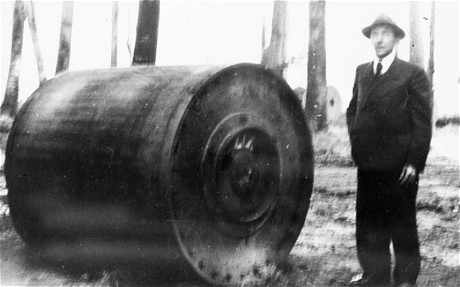
Norman Barlow’s unexploded mine, photographed by the Germans soon after the raid. [Pic: IWM]

In a nice follow up to a plea first publicised on this blog, the Sunday Telegraph has reported on the plaque installed at the spot where AJ-E crashed on the night of the Dams Raid. Local historian Volker Schürmann discovered that there was no recognition of the site, near where he lives in the small town of Haldern on the Dutch-German border.
After pinpointing the exact location where Norman Barlow’s aircraft crashed, after colliding with electricity pylons shortly before midnight on 16 May 1943, he decided to erect his own temporary plaque, and has started a campaign to install a permanent memorial.
Volker told the Telegraph:

The Dambusters are not well known in Germany. Growing up in Haldern, I did not know about his crash. I don’t think many people from this area know the story. Perhaps just a few old people who lived near the crash site – but there are now many of them left now.
It is just a small field with a lake in the background and there is nothing there to tell anyone what happened there.
I’m from two generations after the war. It was a dirty time, but why not remember these people? It is good for people to know what happened. In Germany, it is difficult to celebrate or commemorate the war, but it is a little easier for those like me from the second generation after it happened.

After all the secrecy surrounding the raid, the irony was that Barlow’s mine did not explode. It was defused by one of Germany’s top explosives experts, and the secrets of its revolving mechanism quickly uncovered.