
Congratulations to Greig Watson, pictured above right, from the BBC East Midlands newsteam, who has won a special award in the 2014 Online Media Awards for the team’s project to build a complete pictureboard of all 133 aircrew who took part in the Dams Raids. The judges praised the East Midlands website, which won the Best Regional News award, for being well organised and timely with a good range of features, and singled out the Dambusters story for special mention, recognising the historical importance of the work.
The Dambusters Blog is very proud to have been associated with this project, and once again we would like to thank all the relatives and others who provided pictures for this site, and thereby have built a permanent online Dambusters memorial. As James Lynn from BBC Online News England said: “As well as being a fantastic piece of journalism, it also feels like a fitting tribute to those who took part in the raids, and a genuine historical resource.”
“Though swirling floods are raging”
Last Saturday, I went to a reunion at my old school, St Edward’s in Oxford. It was a very pleasant occasion, helped along by the warm June weather traditional at such events. However, I was somewhat surprised during the chapel service when the chaplain announced that the tune to the next hymn might be a familiar one. The organ then sounded with a well known refrain, while I leafed hurriedly through the hymnal to the relevant page, and found this:
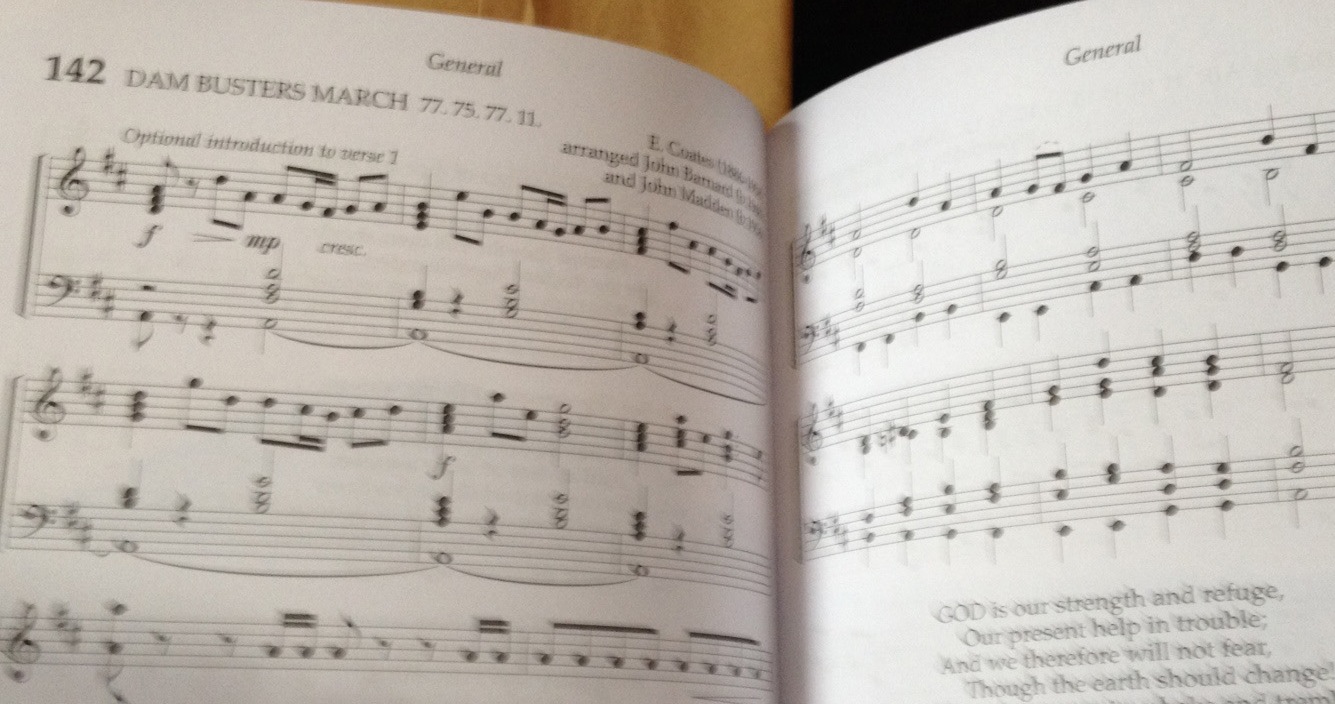
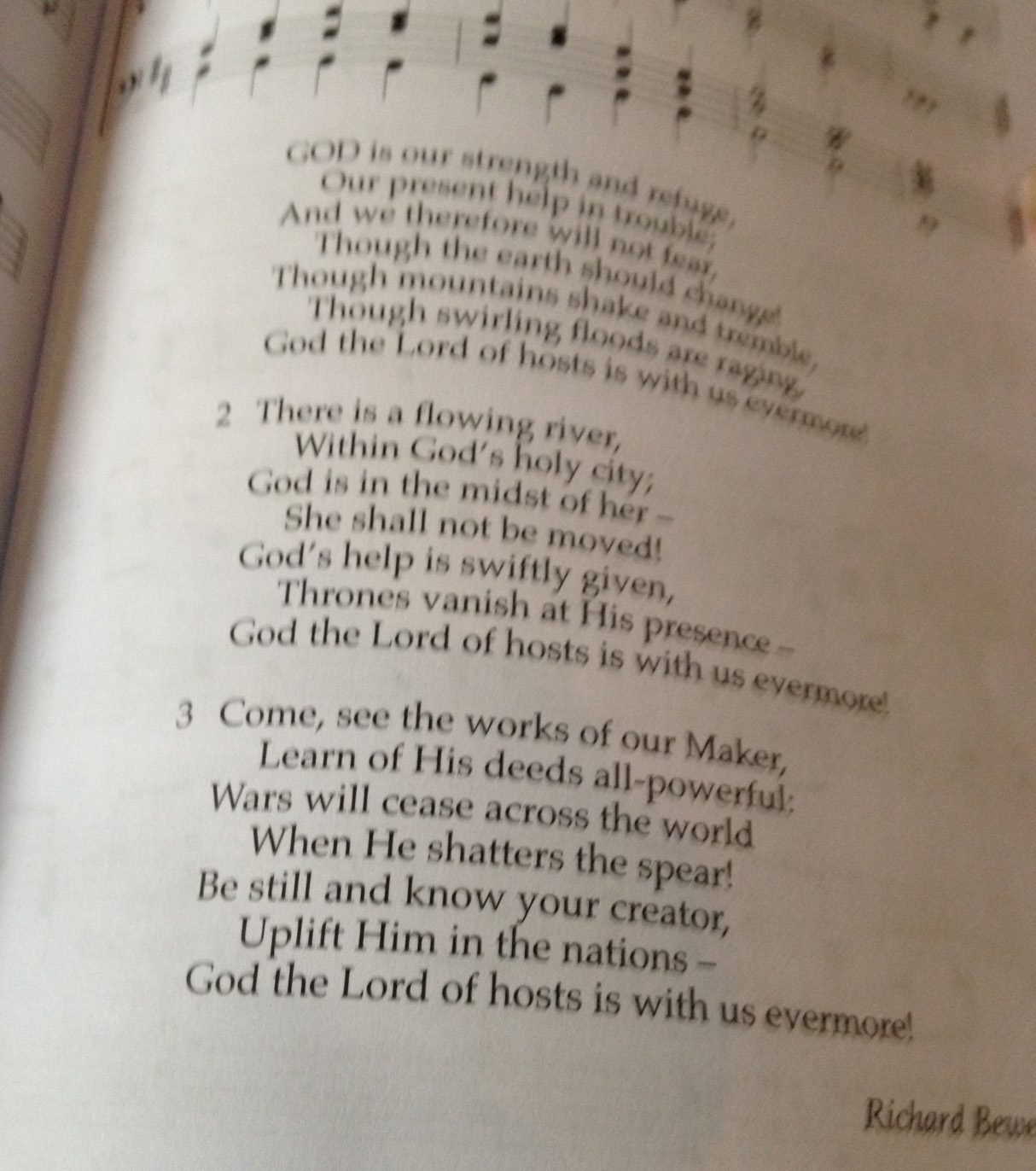
The words are new to me, perhaps, as I’m not a regular churchgoer, but they have apparently been around for some time. In fact they were written by the Rev Richard Bewes, sometime Rector of All Souls, Langham Place, and are based on Psalm 46.
I spent five years at St Edward’s in the 1960s, and spent many hours in services in this chapel, which is lined with hundreds of individual hand-painted plaques commemorating boys who died in the Great War. I whiled away endless dull sermons reading their details – a Lieutenant in the Staffordshires, a Captain in the Ox and Bucks, a Private in the 1st Canadian Battalion – without really contemplating what the stories behind these names might reveal. And I would also flick through the hymnal, noting the great names – Wesley, Vaughan Williams, Milton, Alexander – whose fine music was thundered out each week by 500 adolescent voices. “Lift up your hearts”, “Jerusalem the Golden”, “Guide me O thou great Jehovah”. Even today, as I type out the titles, the words and tunes still ring through my brain. Will “God our strength and refuge” ever be added to the list? I’m not certain it will. It is such a famous piece of orchestral music in its own right that I have to say I wonder if it really needs a vocal line. Does Beethoven’s 5th? Or the Blue Danube?
The awful toll from the First World War meant that there was no room in the nave of St Edward’s chapel for individual plaques for those who fell two decades later in its successor conflict. So it is in a side ‘Memorial Chapel’ that we find the only reference to one of the school’s most famous Second World War casualties. Their names are listed undifferentiated by service or rank, so G P Gibson appears here between R George and H T Gilbert.

After this war, the school’s particular contribution to the RAF was noted with a special memorial window, depicting a flier:
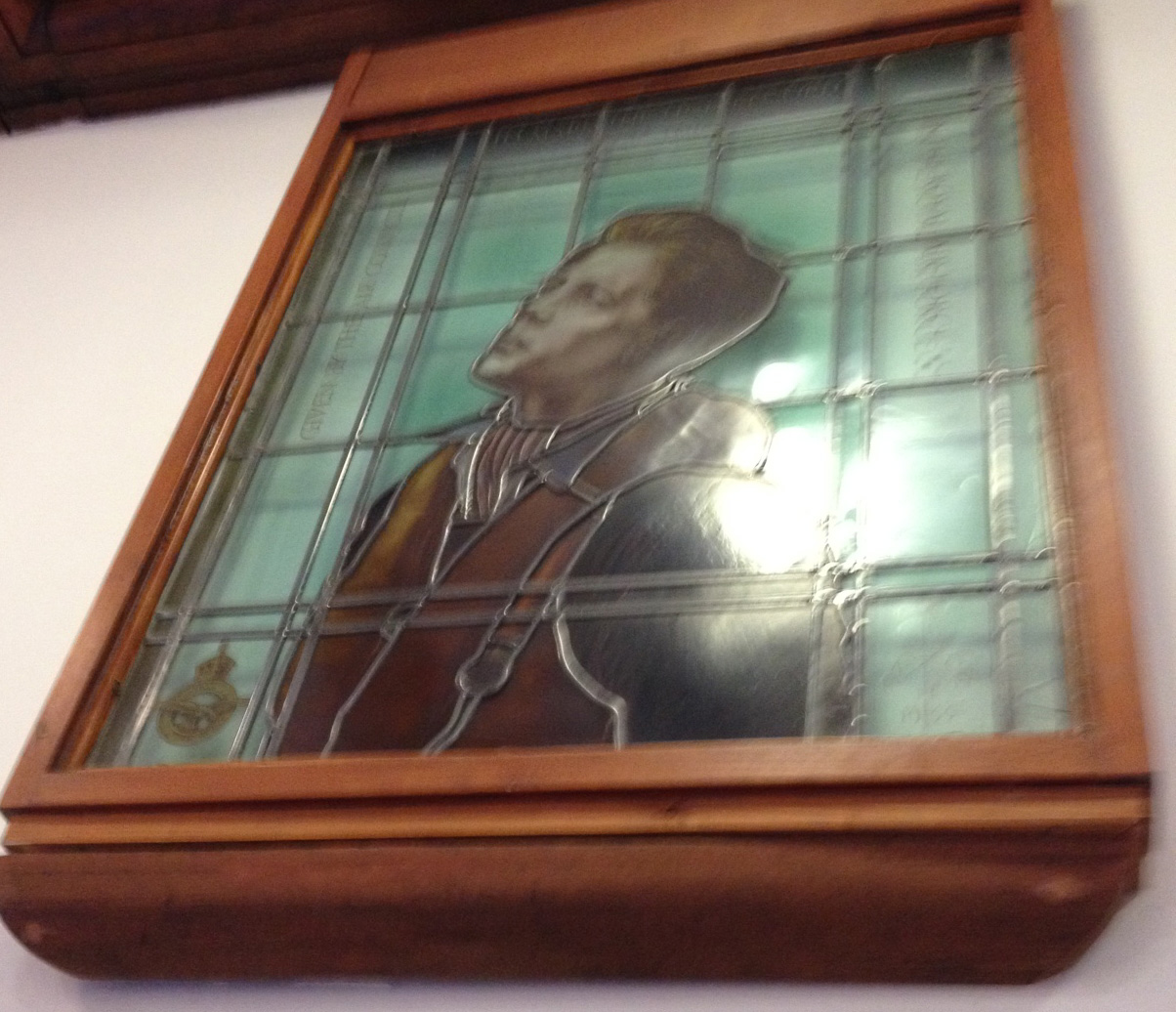
A series of portraits were later commissioned, noting also the service of several RAF war heroes such as Arthur Banks, Adrian Warburton and Douglas Bader (who of course survived the war, and in my time was frequently to be seen making his jerky way around the school as one of its Governors). I am not sure that the Gibson portrait is an exact likeness, but the subject’s maroon VC ribbon makes it recognisable as him, since he received the only one ever awarded to a St Edward’s old boy:

St Edward’s has one further connection to the Dams Raid. Between 1899 and 1901, my grandfather Ettrick Maltby was a pupil at the school. He went on to own and run a prep school outside Hastings called Hydneye House. Many Hydneye boys went on to St Edward’s to complete their education but, curiously, they did not include Ettrick’s only son, David Maltby, who went instead to Marlborough.
However, in 1943, Ettrick was delighted to read that his own Alma Mater had produced 617 Squadron’s commanding officer, and wrote to his old friend, its Warden [Headmaster] Henry Kendall.


Pic: St Edward’s School archive
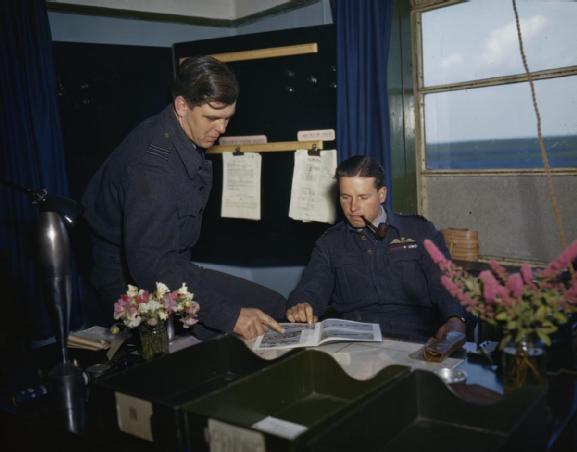
Floreat St Edward’s, indeed. It can’t have been that unusual that two young men with connections to the same institution would end up serving together in the same Second World War RAF squadron. For example, John Hopgood, another Marlborough old boy, was also a pilot on the Dams Raid and had been a close friend of Gibson’s in 106 Squadron. The fact that both Guy Gibson and David Maltby took part in the RAF’s most famous bombing operation, and are together immortalised in a famous photograph taken in July 1943 doesn’t, as I’m sure they would both have said, make them any different from the 55,000 of their colleagues from Bomber Command who paid the ultimate sacrifice. May they all rest in peace.
Tune in tonight…

…to the UK’s Channel 5 at 9pm, to watch a documentary presented by John Nichol called “What the Dambusters did next”. 77 men returned from the Dams Raid and all continued to serve in 617 Squadron or other parts of Bomber Command for the remainder of the war. Such were the dangers they faced, that a staggering 31 more would die in active service before peace arrived.
This film, directed by Matthew Wortman, looks at what the squadron did between June 1943 and May 1945 when they took on some of the war’s toughest targets, such as the Antheor and Belfield viaducts and the Tirpitz, and became the first squadron to drop the giant new bombs devised by Barnes Wallis.
Several of the squadron’s wartime veterans took part in this documentary, and there are also contributions from German combatants, and modern day historians amongst whom, I might modestly add, is myself.
It should be available online afterwards, and I will post a link later.
First to take off
Shortly before half past nine in the evening, on this day 71 years ago, Lancaster ED927, call sign AJ-E and piloted by the Australian Flt Lt Norman Barlow DFC, took off from the grass runway at RAF Scampton. It was the first of the nineteen Lancasters to set off on what would be come known as the Dams Raid.
Flying with Barlow were his crew, Leslie Whillis, Philip Burgess, Charlie Williams, Alan Gillespie, Harvey Glinz and Jack Liddell. As they were under orders to maintain radio silence, nothing more was heard from them but it emerged later that they had crashed into a electricity pylon on some farmland near Haldern, at about 2350 on 16 May 1943, killing all on board. Haldern is a community in the district of Cleves, in the lower Rhine area, not far from the Dutch border.
This site is currently not marked by any permanent memorial so if you would like to mark the anniversary of the Dams Raid, please think about making a donation to the proposed memorial stone and bronze plaque. This is being organised by Volker Schürmann, a local historian. He is looking to raise €750 (about £620) to cover the cost. We are therefore looking for 150 donations of €5. We are now more than halfway to reaching this target.
You can donate to the appeal via Paypal here: 
We should not forget that the same night 1341 people died as a result of the successful breach of the Möhne and Eder Dams, as well as another 46 aircrew.
We remember them all today.
Dambuster of the Day No. 70: Jack Liddell
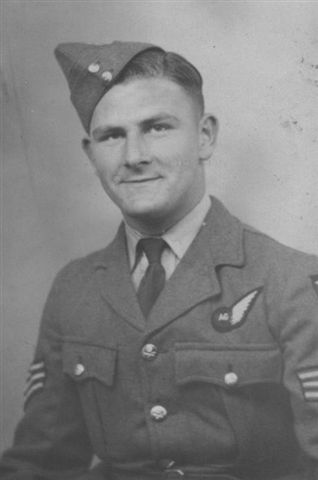
Sgt J R G Liddell
Rear gunner
Lancaster serial number: ED927/G
Call sign: AJ-E
Second wave. Crashed on outward flight.
Jack Robert George Liddell was the youngest man to take part in the Dams Raid. He was born on 22 June 1924 in Weston-super-Mare, Somerset, the son of Robert and Winifred Liddell. His father died when Jack was a young boy and his mother remarried, so he had one sister and two further half-sisters. He was educated at Weston’s Walliscote Road School, and then took up work in the butchery trade. Meanwhile his stepfather was killed at Dunkirk. One day in May 1941, his sister, Sheila Fenwick, recalls him dressing in a suit, saying he was going to Bristol for the day. When he returned, he told his family that he had volunteered for the RAF. She was not surprised as, like so many other young men of his age, he was ‘flying mad’. He must have lied about his age, since he was still only 16.
Liddell was selected for air gunner training, which he completed in May 1942. In September, he was posted to 61 Squadron as the rear gunner in a crew captained by Flt Sgt John Cockshott. This crew completed a full tour of 30 operations together, and as a gesture of thanks to their pilot, they bought him a silver tankard. They weren’t able to get it engraved, but they gave him specific instructions to do this at the end of the war and the wording that should be used.
Cockshott rose to the rank of Squadron Leader and in July 1944 he started a second tour, with 617 Squadron. He was the pilot who dropped the second ever Grand Slam, and was involved in the attacks on the Tirpitz and other big targets. He received a bar to his DFC for this second tour. He moved to the USA after the war, and died in 2010. According to his daughter, the tankard was one of his most prized possessions.
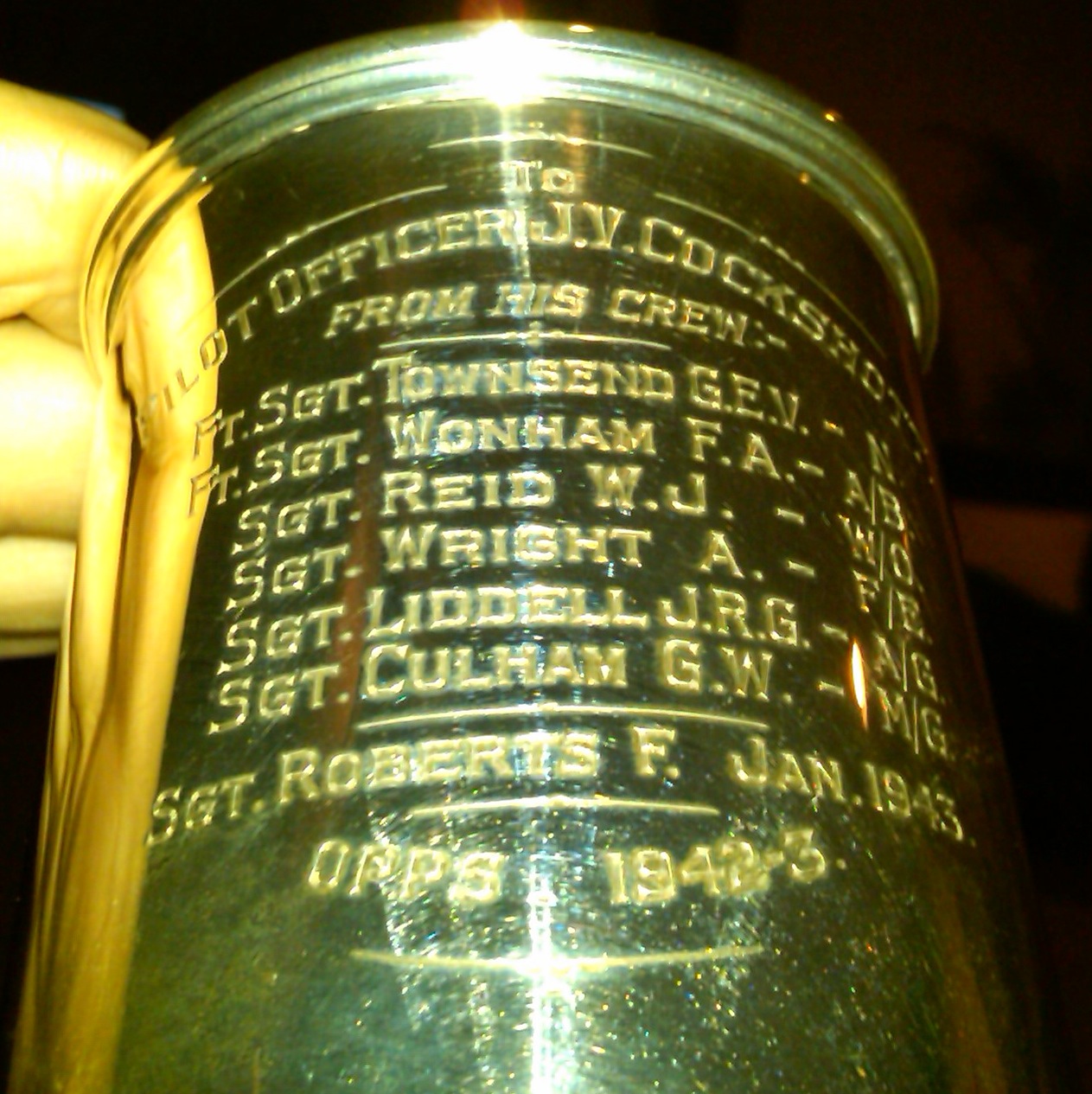
[Pic: Jackie Von Urff]
After completing his tour with Cockshott, Liddell was posted to a training flight as an instructor, but within a week he was called back to fly in the crew being put together by Norman Barlow, which would transfer to 617 Squadron. He was, of course, a much more experienced gunner than his crewmate, Harvey Glinz, but it was the officer Glinz who was chosen to be the A Flight gunnery leader.
Jack Liddell had still not reached his nineteenth birthday when he climbed into the rear turret of AJ-E in the early evening of 16 May 1943. On a night when many young aircrew died, he has the dubious distinction of being the youngest of all. Like his comrades, he was first buried by the Germans in Dusseldorf Cemetery, but now lies in the Commonwealth War Graves cemetery at Reichswald Forest.
Footnote: All the crew of AJ-E came from 61 Squadron, but only Leslie Whillis and Alan Gillespie had previously flown with Norman Barlow. The rest had mainly flown with three other 61 Squadron pilots, Ian Woodward, William Dierkes and John Cockshott. All of these would survive the war, and if their crews had stayed with them their chances of survival would have been higher. Such was the sad lottery by which so many casualties were chosen.
More about Liddell online:
Entry at Commonwealth War Graves Commission
Entry at Aircrew Remembered website
KIA 16.05.43
Rank and decorations as of 16 May 1943.
Sources:
Richard Morris, Guy Gibson, Penguin 1995
John Sweetman, The Dambusters Raid, Cassell 2002
Eric Fry, An Airman Far Away, Kangaroo Press 1993
The information above has been taken from the books and online sources listed above, and other online material. Apologies for any errors or omissions. Please add any corrections or links to further information in the comments section below.
 Further information about Jack Liddell and the other 132 men who flew on the Dams Raid can be found in my book The Complete Dambusters, published by History Press in 2018.
Buyer beware
I’ve never been happy with the idea of people digging up bits of crashed wartime aircraft, and then selling them for personal profit. How can you tell that a small piece of rusty metal came from a particular model, and that it was actually found in a specific location – a site that is actually the place where someone usually died? Even if the bodies of the men who perished were eventually recovered and buried, there is something ghoulish about trawling the ground in the hope that a personal artifact – maybe, a watch, a torch or an ID tag– will turn up.
But turn up they do, and then, inevitably, they emerge for sale on eBay or in the hands of specialist relics dealers. There’s obviously a good living to be made from this, as is proved by the emergence of large trading companies with substantial inventories and impressive websites.
One of these companies goes by the name of Historic Aviation, based in Minneapolis, in the state of Minnesota, USA. A reader of this blog, Steve Dulson, commenting on my recent article about the proposed memorial at the site where Flt Lt Norman Barlow and his crew crashed on the night of the Dams Raid, alerted me to an item for sale on this company’s website.

It is described as: ‘A rare opportunity to own a piece of World War II history! This display includes an authentic fragment from the Avro Lancaster bomber piloted by Robert Barlow of Squadron No. 617, the “Dambusters,” RAF, that was lost on May 17, 1943, during Operation Chastise, as well as a beautiful print depicting that fine machine soaring low in the night sky.’
At this point, the alarm on my Dambuster bullshit-meter began to sound. The picture quite clearly shows a Lancaster aircraft, coded AJ-E, flying over a dam but, as any Dambuster student knows, Barlow never reached the Ruhr area, colliding with a pylon shortly after crossing the Rhine. AJ-E, however, was the correct call sign for Barlow’s aircraft.
Kudos to another regular reader, Philip Knight, for pointing this out. He says that the picture shows Barlow at the Möhne Dam, but looking at it more carefully it seemed to me to be more like the Eder, which has arches in the dam wall and angled roofs on its towers.
The picture was painted by an artist called Ron Cole, so I went on a search for further information and found his website.

Well, what a surprise. The same picture, but with one important difference. The code painted on the aircraft side is AJ-N, which was borne on the Lancaster flown by Les Knight, the pilot whose weapon finally breached the Eder Dam.
It looks as though Ron Cole himself can tell his AJ-N from his AJ-E, but someone at Historic Aviation has decided that any old Lancaster picture will do as a mount for what looks like a small piece of metal plate. And it costs $24.95 more than you would pay for the print on its own on Mr Cole’s site, numbered and signed by the artist.
So what other treasures might be lurking in the Historic Aviation shop? A search through all the aviation art prints turned up another oddity. Here is a print of a picture by the British artist, Anthony Saunders, signed by the artist and Corporal Maureen Stevens, and retailing at $130.

The same image can be found on Mr Saunders’ own website, back in Blighty. So we can be fairly sure that he is responsible for this picture.
But on another page in the Historic Aviation shop, here is the same picture, but with a different title, scribed to a completely different artist, Richard Taylor, and allegedly signed by Les Munro and Johnny Johnson:

The text shown in the above screengrab seems to describe a completely different picture, which of course it is. The real “On Course for the Möhne Dam” by Richard Taylor can be found on the website of many art dealers:

So what do Messrs Cole, Saunders and Taylor make of the different ways in which their work has been misrepresented by the guys from Historic Aviation? And what does this say about the provenance of items which purport to be ‘authentic’ Dambuster relics.
I think we should be told. And, in the meantime, buyer beware.
POSTSCRIPT: Ron Cole has now contacted this blog, as can be seen in the comments below. He says that it was he himself who altered the original code on the side of the aircraft. He has also explained how it came about in an email to me:
I obtained a rather beat up panel from AJ-E about two years ago that hailed from the roof of a farm outbuilding, where it had been incorporated since the war. Since I make a business of combining such relics with my artwork, and had an earlier watercolor that portrayed a Lanc, I combined the two for a limited series of displays with the idea that one day I’d actually paint AJ-E and put together a more specific and historically accurate presentation. Then about six months ago I was commissioned to paint the cover for Guy Gibson’s ‘Enemy Coast Ahead’ on audio book, depicting AJ-N. Not long after, Historic Aviation contacted me about the possibility of carrying a ‘Dambuster’ relic display, and since I still hadn’t gotten around to painting AJ-E, I did the next best thing by altering the book cover painting. It was at least better than the old watercolor Lanc, and looked nice. So that’s the story behind the otherwise odd combination, such as it is; an imperfect compromise.
Well at least we have an explanation! And also we now know where the panel from AJ-E now resides. As Mr Cole says, it is quite well known that during the war a local farmer had used it in some building work. However, I can’t help feeling that it would be a better idea to use an accurate portrayal of AJ-E, and its brave crew who often only appear as a footnote in the Dambuster story. They were in fact the first crew to take off from Scampton on that night, and were killed some two and a half hours later.
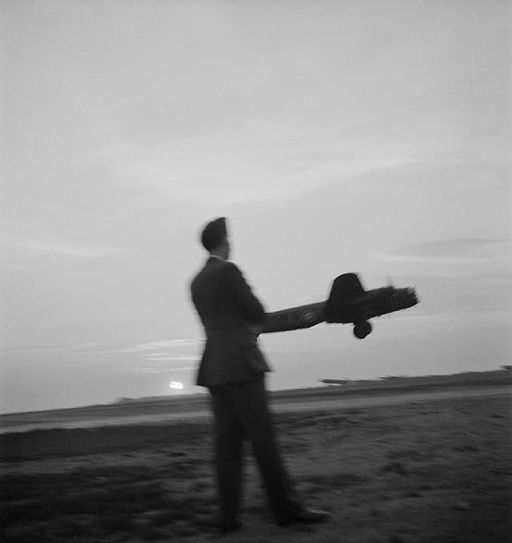
This official RAF picture, taken on the night, is the only picture of a Dams Raid Lancaster in flight and is thought to be of AJ-E taking off from Scampton. [IWM CH18006]
Dambuster of the Day No. 69: Harvey Glinz
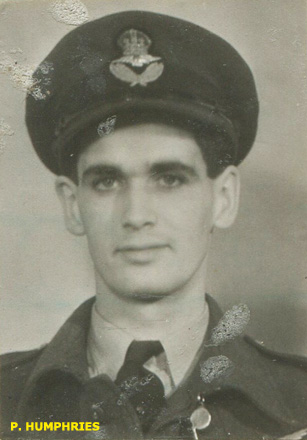
[Pic: Peter Humphries]
Flg Off H S Glinz
Front gunner
Lancaster serial number: ED927/G
Call sign: AJ-E
Second wave. Crashed on outward flight.
Harvey Sterling Glinz was born in Winnipeg, the capital city of the province of Manitoba, Canada on 2 March 1922. His father Ernest was a letter carrier, or postman. Glinz was educated at Lord Roberts and Kelvin Schools, and had worked as a clerk in the Hudson’s Bay company until the war intervened.
Having volunteered for the RCAF Glinz was interviewed on 11 September 1941, and deemed to be best fitted for work as an air gunner/wireless operator. It was noted that he was ‘A neat clean – athletic young man – sincere – and should be worthwhile addition to aircrew.’ He signed up a few weeks later and was sent off for training. Glinz excelled at his air gunnery training, passing out first in his class in February 1942. He then applied for a commission, which was granted after he had left Canada. He arrived in England at the end of March.
After various delays and yet more training, he was finally posted on operations to 61 Squadron in October 1942. His first operation was a raid on Turin on 28 November 1942, in a crew captained by Flg Off A E Foster. This would appear to have been as a replacement for Foster’s usual gunner. A week later he flew with Flt Sgt McFarlane, on an operation to Mannheim. He finally became part of the regular crew of Plt Off William Dierkes, an American who had joined the RCAF before the USA entered the war, and who would later transfer to the USAAF.
Glinz flew on eight operations with Dierkes between December and February, but then went on sick leave. The medical report shows that he had suffered from catarrh and ear infections caused by the unaccustomed British weather, and that also he was suffering from ‘mild anxiety’. This was reported to have been caused by two crashes on landings on both his second and fourth operations (although neither of these are actually recorded in the squadron’s Operations Record Book). He was also diagnosed as being in a mild ‘anxiety state’, after being observed sitting on his own in the mess and seldom conversing with people. An RAF Medical Board first recommended that Glinz should see a specialist ‘neuropsychiatrist’, but then at the end of March reported that:
‘He had been thinking things over and wishes to resume operational flying. He has an opportunity of being crewed up with an experienced pilot in whom he has every confidence. This crew is being posted to another unit to form a new squadron. He appreciates that his symptoms are nervous in origin but thinks that he can make the grade and complete his tour… The Board considers this Officer to be a fundamentally good type and should be given a further opportunity to prove himself at operational flying.’
So, off went Glinz to 617 Squadron, along with Barlow and the rest of his ex-61 Squadron crew. There are no further medical reports in Glinz’s file, although his anxiety level may have increased for a while when the crew were involved in a bird strike on a training flight on 9 April 1943, which resulted in a collision with the top of a tall tree. The flight engineer’s and bomb aimer’s canopies were smashed and two engines badly damaged. It is not recorded whether Glinz was flying in the front rather than the mid-upper turret, but it would seem unlikely. (They were flying in one of the borrowed Lancasters which the squadron were using, as the special ones modified to carry the Dams Raid mine had not yet arrived.)
Glinz was 617 Squadron’s A Flight gunnery leader, a role which would have meant he helped organise training for other gunners. He must have been awarded this role because of his rank, rather than experience, as there were other gunners in A Flight with a full completed tour under their belts.
By 16 May, training was completed and Glinz was in the front turret when AJ-E crossed the Rhine near Rees. A few minutes later they approached the line of HT electric wires outside Haldern, and collided with a pylon.
The seven bodies were buried by the Germans in Dusseldorf North cemetery, but they could only positively identify Leslie Whillis, Philip Burgess, Alan Gillespie and Charlie Williams. All were reburied after the war, as part of the work undertaken by the RAF’s Missing Research and Enquiries Service. An insight into this detailed and rather gruesome task is given by a page in Glinz’s file:
‘The only clue to the identity of these three were another rank’s shirt in Grave 42 and officer’s shirt in Grave 45 and dental charts in both Graves 42 and 45. As Fg Off Glinz was a Canadian, his dental charts were obtained from Ottawa. They definitely do not tally with the charts in either Grave 42 and 45, and this proves by elimination that Fg Off Glinz is in Grave 46. The fact that there was another rank’s shirt in Grave 42 and an officer’s shirt in Grave 45 makes it possible to allot an individual grave to the remaining two crew members, Sgt Liddell being in Grave 42 and Flt Lt Barlow in Grave 45.’
Treating the war dead with such respect is an honourable tradition in the military of many countries, and the work that this involved is perhaps not appreciated by us today. In a further sad postscript to the short lives of two of the crew of AJ-E, it emerged in October 1945 that Harvey Glinz and Philip Burgess’s service greatcoats had been inadvertently muddled up when being sent back to their families.

[Pic: National Archives of Canada]
The Glinz family were asked to inspect the coat they had received and see whether its buttons were those of the RAF or the RCAF. Having ascertained that they were in fact RAF buttons, the two coats were then exchanged. Whether Glinz and Burgess were roommates at Scampton is not known, but the fact their coats were muddled up suggests they might have been.
The two young Flying Officers are now buried together, alongside their five comrades, in Reichswald Forest War Cemetery.
Sources for this article:
Harvey Glinz RCAF personnel file, National Archives of Canada.
61 Squadron Operations Record Book.
Many thanks to Allan Wells, Susan Paxton and Ken Joyce for their help.
More about Glinz online:
Entry at Commonwealth War Graves Commission
Entry at Aircrew Remembered website
KIA 16.05.43
Rank and decorations as of 16 May 1943.
Sources:
Richard Morris, Guy Gibson, Penguin 1995
John Sweetman, The Dambusters Raid, Cassell 2002
Eric Fry, An Airman Far Away, Kangaroo Press 1993
The information above has been taken from the books and online sources listed above, and other online material. Apologies for any errors or omissions. Please add any corrections or links to further information in the comments section below.
Further information about Harvey Glinz and the other 132 men who flew on the Dams Raid can be found in my book The Complete Dambusters, published by History Press in 2018.
“Wizard!” “Tremendous!” “It’s gone!” – Dambusters comic makes a great story
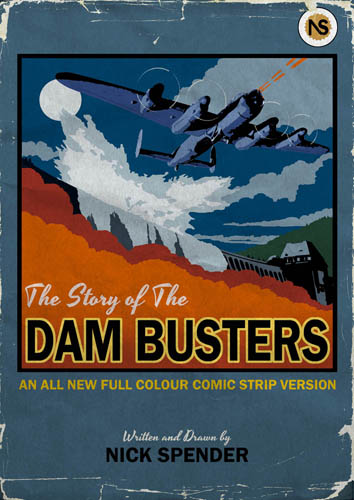
Nick Spender’s new comic book is a wonderful labour of love, and will certainly appeal to the kind of person who remembers rushing into the newsagents every week with thruppence for a copy of the Eagle.
This new ebook has been designed to look like a 1950s gravure-printed comic book – right down to the authentic library stamps – and beautifully recreates the artistic style of masters of the genre, such as Frank Hampson (who actually taught Spender in art college 30 years ago).
Although it evokes this historic style, the book is artfully constructed to transcend the period and tell the familiar story economically but accurately, with spot on details. Some of the frames resemble shots from the 1955 film, but the liberties with the truth taken in the cinematic release are not repeated here, which is something to be thankful for. For instance, there’s no nonsense about using angled spotlights to calibrate an aircraft’s altitude after a trip to a music hall. The real inventor, Benjamin Lockspeiser, gets the credit.
The comic book is sometimes underappreciated and dismissed as a method of imparting information. This view has been challenged by writers like Scott McCloud, whose book Understanding Comics should be read by anyone interested in modern communication methods. In McCloud’s words, comics offer tremendous resources to the writer and artist: ‘range and versatility with all the potential imagery of film and painting plus the intimacy of the written word’.
In the hands of a true creative comic book artist like Nick Spender a single frame can say as much as a page of a printed book. This is what makes this work such a great success, and why it is highly recommended.

It’s available as a Kindle ebook, but you really need a colour ebook reader, or an iPad, to do it justice. A printed version would be even better, and would be a terrific addition to the bookshelves of anyone with an interest in this endlessly fascinating story.
Johnny Johnson to speak in Retford

Our old friend George ‘Johnny’ Johnson is going to be busier than usual next month, because his autobiography is being published by Ebury Press, just in time for the 71st anniversary of the Dams Raid.
One of the public events to promote the book will be held near to his former home in Retford. On Friday 23 May, Johnny is giving a public talk at Retford Town Hall. He will also be answering questions from the public and signing copies.
Johnny will be joined on stage by Eric Quinney who, as a post-war pilot in 83 Squadron, flew one of the Lancasters used in the 1955 film.
The event is being organised by local bookseller Paul Trickett. Tickets for the event can be purchased and printed off here.
Appeal launched for AJ-E Dambuster memorial

The crew of AJ-E. Left to right: Norman Barlow, Leslie Whillis, Philip Burgess, Charles Williams, Alan Gillespie, Harvey Glinz, Jack Liddell.
Eight crews from 617 Squadron were lost on the night of the Dams Raid, 16/17 May 1943. Of these two, AJ-A piloted by Sqn Ldr Melvin Young and AJ-K piloted by Plt Off Vernon Byers were lost over the sea, but the other six crashed on dry land in Germany or the Netherlands.
Three of the crash sites are commemorated with a plaque or other memorial:
AJ-B: Flt Lt William Astell
AJ-M: Flt Lt John Hopgood
AJ-C: Plt Off Warner Ottley
An appeal has now been launched to add another memorial to this list. Lancaster ED927, call sign AJ-E, piloted by Flt Lt Norman Barlow DFC, crashed into a electricity pylon on some farmland near Haldern, at about 2350 on 16 May 1943, killing all on board. Haldern is a community in the district of Cleves, in the lower Rhine area.
The plan, to erect a memorial stone and bronze plaque on this site, is being organised by Volker Schürmann, a local historian, who is looking to raise €750 (about £620) to cover the cost. We are therefore looking for 150 donations of €5.
By way of thank you, donors will receive a colour souvenir postcard featuring pictures of the finished stone in place and portraits of all the AJ-E crew. It is hoped that we can arrange for a descendant of one of the crew to be present when the stone is unveiled, and, of course, all donors will also be warmly welcomed.
You can donate to the appeal via Paypal here:
If you would prefer to make a donation by cheque or bank transfer, contact me and I will give you details of how you can do this.
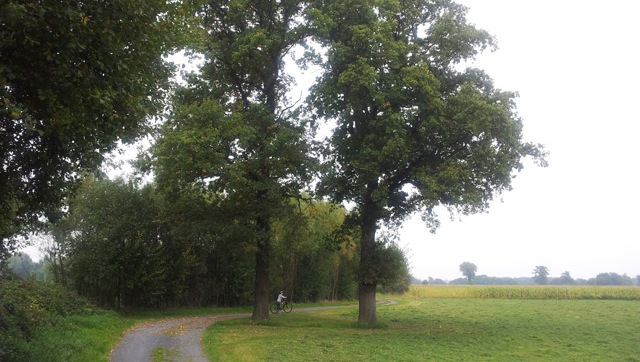
Below is a picture of the site where the memorial will be erected.
 Dambusters Blog
