In Charlie Williams country

Guest post.
Long time friend of this blog Susan Paxton has recently been to Queensland, Australia, on a trip to find out more about the life of Flg Off Charlie Williams DFC, wireless operator in the AJ-E crew which took part in the Dams Raid.
Text and all new photos by Susan Paxton.
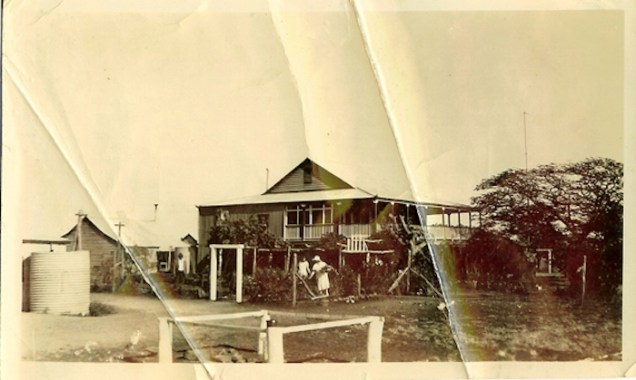
Telemon in the early 1930s. The poinciana tree to the right; in the garden Mrs Williams and daughter Sheila. Possibly H.E. Williams standing to left. Fenced rain gauge in the foreground. Photo taken by Charlie Williams. [Pic: Williams family]

On the morning of 25 March 1919, Matthew Macalister, the elderly manager of Telemon Station, located in Flinders Shire not too far, in bush terms, from Hughenden in Queensland, stepped out to walk to the shearing shed, promising to return for lunch. When he did not, someone went to check on him and found that he had never arrived. Word was sent to neighboring Marathon Station and a search effort hastily organized. All through the night the search went on, but it wasn’t until 8 am that a drover found Macalister where he’d fallen, dead of a heart attack or stroke.

Local writer “Bill Bowyang” noted in his regular column “Along the Track,” printed in the Townsville Daily Bulletin, “…the owners of Telemon will seek afar for the man to fill his place.” But in fact the owners of Telemon did not have to search far at all, for, from a nearby station they also owned, Tamworth, they tagged the manager, Horace Edward Williams, to take Macalister’s place. H.E. Williams brought with him his wife Helene, his daughter Sheila, and his two sons, Doug and Charlie.

Charles Rowland Williams, future DFC, had just turned ten when his family moved to Telemon, widely felt to be one of the finest sheep stations in Queensland, with 60,000 acres of freehold. Situated on a low hill above the Flinders River floodplain, the station homestead was beautifully located, but too small. Horace immediately set about improvements, starting by jacking the existing single-storey house up. A concrete floor was poured and a first storey built under, creating a house that was both spacious and, for the bush, elegant. Shady verandas encircled most of the first and second storeys; a spreading poinciana tree grew in the front. Stone walks were laid and gateposts marked the entrance; the usual scatter of station outbuildings spread out to one side and behind, along with a water tank on an iron stand to provide piped water. It was here that, for the next fourteen years, Charlie Williams would live and learn his trade as a station manager.

Good things do not last. In the spring of 1933 Telemon was sold, and the Williams family lost their place. The house likely sat empty for a time since Telemon was merged with adjacent Marathon. In 1948 the Stewart-Moore family bought Telemon to add to their property, Dunluce, and for several years lived there until they decided it was more practical to live at the Dunluce homestead, closer to the new Flinders Highway and the existing railroad. For a few years into the 1960s a boundary rider lived in the house; it must have been a lonely existence. Finally, the house was left to the elements.

In March 2019 my search for CharIie Williams brought me to Telemon, almost exactly 100 years since the Williams family arrived. What is left is saddening. Sometime probably in the 1980s, unheard by human ears, the house collapsed, and all of the outbuildings have followed suit. The hill is crowned with shapeless piles of broken, weathered wood, and the paddock around is littered with scattered corrugated iron sheets blown here and there by the occasional storms. Now and then a landmark can be spotted; the iron frame that supported the water tank, the flagstone walkway, one of the gateposts.

Telemon, March 2019

It is quiet there; the only sounds are the wind, the lowing of cattle, the sudden sound of disturbed locusts whirring away. Possibly if one had time to sit on the rocky ground, back against the one standing gatepost, and just listen, you might hear voices, or music. There was life here once; Charlie’s photo albums show costume parties, tennis matches, New Year’s celebrations, boating on the waterholes. The local papers record how the town folk from Hughenden would come here to play cricket against the country dwellers. Now, it is silent.
Charlie Williams, killed on 16 May 1943 in the raid on the dams, is buried a world away, in Germany. I suspect some of his heart remains here.
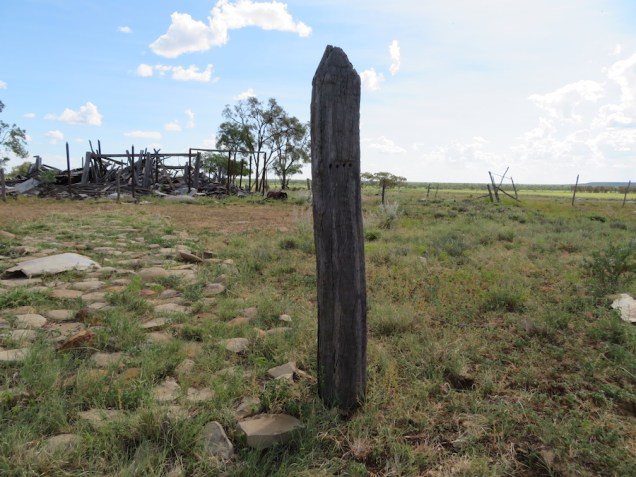
The remaining gatepost and traces of the flagstone path to the front door, with the house beyond.
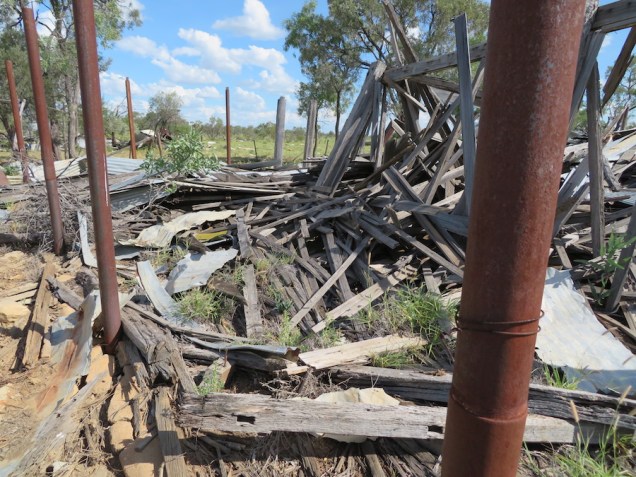
The iron posts were adapted from bore casings and once supported the upstairs veranda

One of the few identifiable features, the large post leaning to the right here stood in the living room.
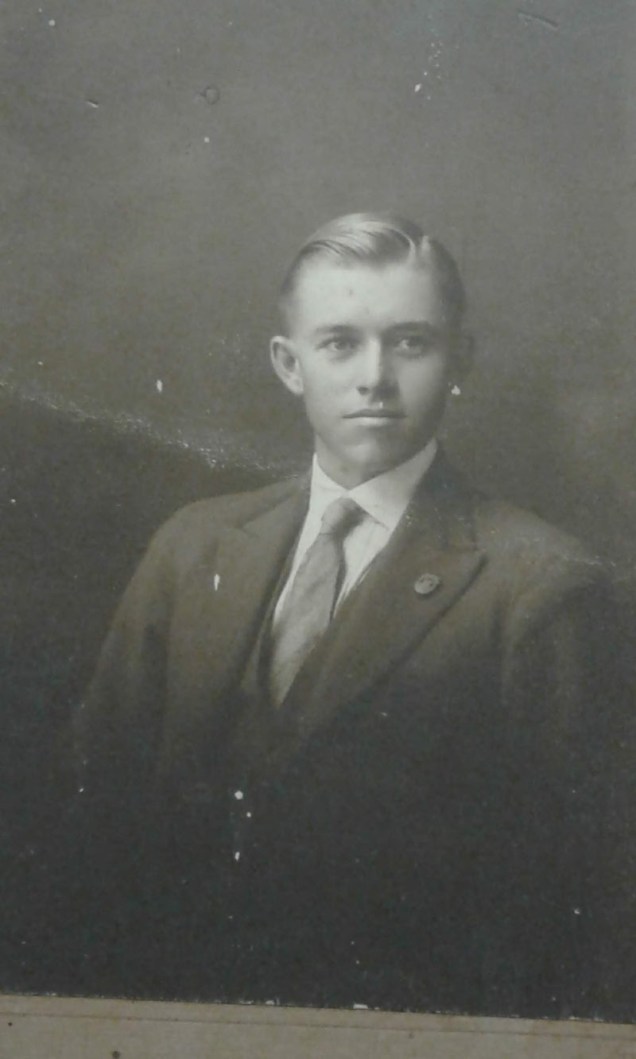
Charlie Williams, aged about 20, photographed on a trip to Townsville. [Pic: Williams family.]

My visit to Telemon was made possible by Helen Williams-Brown, who accompanied me on a whirlwind tour of what I insisted on calling “Charlie Williams country”; by Jack Stewart-Moore, whose property Dunluce subsumes the old Telemon ruin and who gave us permission; and by his manager Mark Williams, who was our gracious guide to the site.
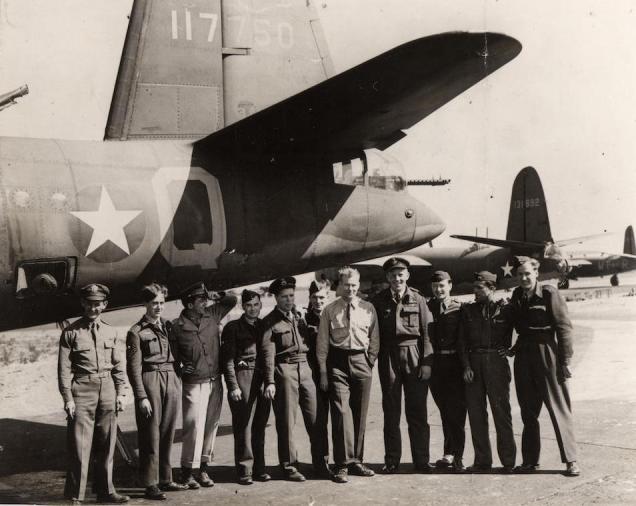
Joe McCarthy and his wartime friends

Joe McCarthy’s son, Joe McCarthy Jr, has kindly sent me some more information about the well-known picture of members of his father’s crew fraternising with the crew of an American B-26, taken at the Earls Colne airfield in Essex in 1944. I have previously reproduced a similar picture in the Dambuster of the Day article on Ron Batson.

Joe’s picture is a better shot obviously taken at the same time, as it doesn’t cover Johnny Johnson’s face. He also sent me a clipping from a newspaper given to him by Dorothy Bailey (daughter of Bill Radcliffe, the flight engineer in the McCarthy crew) which reproduces the same picture and helpfully includes a caption listing all the personnel:

Two more interesting points from Joe. The return flight from Earls Colne to Woodhall Spa was probably the last time that Johnny Johnson flew with the crew, as he left the squadron shortly after. McCarthy’s new bomb aimer was ‘Danny’ Daniels who went on to fly with ‘Willie’ Tait, including on the Tirpitz raid.

Next to McCarthy is the American pilot Major John Bull Stirling, another US citizen who joined the RCAF before the USA entered the war. In fact Stirling had been in the same RCAF training class in Ontario as McCarthy but he chose to transfer into the US Army Air Corps after Pearl Harbor. According to this entry on the American Air Museum in Britain website, he had an eventful time during the war and died in 1988.

A model masterpiece

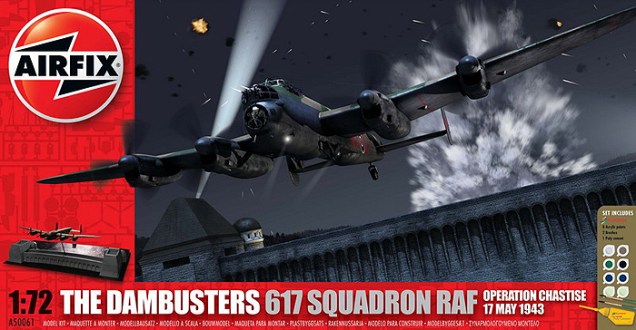
In the 1960s, like many children of my age, I was an avid builder of Airfix plastic model aircraft. I made a reasonably decent job of them, but I remember the slight disappointment that the final results never quite resembled the smart looking painting on the box.

Then, one recent Christmas some 50 years after I had last opened up an Airfix box, I was given a present of a model Lancaster.

I toyed with the idea of building the model myself, but in the end my nerve failed me and I put it away in a cupboard. There it languished for a year or two, until I had an email exchange with my old friend Dom Howard, the great nephew of Dams Raid pilot Cyril Anderson. Several years ago, we had both been active on the old Lancaster Archive Forum (still much missed by those of us of a certain age) and I knew that this had a sub-forum on model aircraft. A prominent member of this had been a model builder called Ian Collis, whose pictures of his work in progress showed that he was a real ace at this kind of detailed work.

So I decided, as a treat to myself, that I would ask Ian to build the model for me. It was to be decorated with the markings which my uncle, David Maltby, had carried on his aircraft ED906 AJ-J on the night of the Dams Raid. Ian kept me informed about how he was getting on and posted the occasional shots on his Facebook page of the work in progress. Then a few days ago he put up the final series showing the completed work. Here is a link to the page on which they are displayed.

Talk about Wow factor! In every shot one can only marvel at the level of detail of his work. Here is a shot of the cockpit, front turret and bomb aimer’s position, each with an individual figure.

And here’s the bomb aimer himself, apparently crafted from a model soldier using a pair of binoculars, using the famous wooden bombsight, made to 1:72 scale!

I’m just overwhelmed by the pictures and am much looking forward to collecting the finished model from Ian very shortly. A masterpiece indeed.

Fred Sutherland: tribute from the Johnson family

Left to right: Fred Sutherland, “Johnnie” Johnson, Ray Grayston. Pictured at East Kirkby, 2002. 

Guest post by Philip Johnson, son of Flt Lt Edward “Johnnie” Johnson DFC, bomb aimer in AJ-N on the Dams Raid. (All pictures © Philip Johnson.)

I am 81 now and my memories of my father’s crewmate Fred Sutherland and his wife Marg are based on conversations with my father and the meetings I had with Fred and Marg at the 617 Squadron major events that I was invited to over the years, starting with the premiere of The Dam Busters film in London in 1955.

My father aways called Fred by his RAF nickname “Doc”. My father would retell stories he would hear from Doc and Marg about their adventures and trips. To him, Doc was always an “outdoor in the Rockies” man. Marg would occasionally exchange ideas and information with my mother on their joint interest in fabrics and hand skills (sewing and embroidery). For years, my mother cherished a small doll given to her by Marg (I think from South America or Mexico – a fabric/weaving trip). Marg guaranteed it improved sleep. I still have it working for me.

My last meeting with them both, and the occasion when I spent most time with Doc, was at my father’s 90th Birthday party in May 2002. As a family we were fortunate to be able to enjoy his birthday in the company of Fred and Marg, and also Ray Grayston and his family. What a splendid few days we had at the Petwood Hotel and the East Kirkby Aviation Centre where we enjoyed the final pleasure of a trip down the runway in the restored Lancaster.

There will never be enough words to capture the loss the family of Doc and Marg must feel. It has to be for me to say, on behalf of all my family in UK and New Zealand, “Farewell, knowing you was a special pleasure.”

Here are some pictures to show what Fred and Marg meant to my family.

This rare picture, probably taken while they were still at 50 Squadron, shows Les Knight with his complete Dams Raid crew. Left to right: Fred Sutherland, Johnnie Johnson, Bob Kellow, Harry O’Brien, Sydney Hobday, Les Knight, Ray Grayston. The two men on the right hand side are unknown ground crew. [Amended from original post, 03/02/2019.]

Fred and Marg skiing. A note on the back in Fred’s writing says “Feb 90 at Lake O’Hara”. 

A special gift on Johnnie Johnson’s 90th birthday was a recreation of the well-known wartime picture of the Knight crew by artist Simon Smith. Johnnie, Ray Grayston and Fred Sutherland shown here with the portrait. 

Inside Lancaster “Just Jane” at East Kirkby. Fred Sutherland trying out the pilot’s seat. 

Fred and Marg Sutherland inspecting a vintage Bentley car outside the Dambusters Inn in Scampton. 

Fred Sutherland

PIC: © Sutherland family

BREAKING NEWS

I am sorry to have to report that Fred Sutherland died on Monday 21 January, at the age of 95. He was one of the only two survivors of the men who flew on the Dams Raid in May 1943. Sutherland was the front gunner in the aircraft piloted by Les Knight, which dropped the ‘bouncing bomb’ which broke the Eder Dam.

Frederick Edwin Sutherland was born in Peace River, Alberta, Canada on 26 February 1923, the only boy in a family of the three children of Dr Frederick Henry Sutherland and his wife, Clara. His father was a doctor and his mother was a nurse. From a young age, he had wanted to fly and had dreams of becoming a bush pilot, but the war put paid to that, so he joined the Royal Canadian Air Force in 1941, as soon as he turned 18. After initial training he volunteered for air gunner duties.

He arrived in England in 1942, and crewed up with pilot Les Knight and his future colleagues at a training unit before they were all posted to 50 Squadron in September of that year. He flew on 25 operations with Knight before the whole crew volunteered to transfer to the new 617 Squadron in March 1943. Sutherland was normally the mid-upper gunner but the special Lancasters used on the raid had this turret removed, so he was transferred to the front turret positioned immediately above the bomb aimer.

All the crews undertook intensive trying for about six weeks but, like most of the squadron, Sutherland had no idea what the target was to be until he walked into the briefing room hours before take off on 16 May 1943. When he saw the scale model of the Möhne Dam, the first thing he noticed were the 20-millimetre gun posts at either end of the dam. ‘I immediately thought we didn’t have a hope,’ he said recently.

In the event, Knight’s aircraft was not needed at the Möhne. After this was breached the crew moved on to the Eder, and Sutherland realised how difficult the attack was going to be:

We were all afraid of the hill. We had to drop the bomb at the right distance and the right height, and then to make it [Les] had to push the throttles right through the gate, which is not supposed to be done… I didn’t see anything when the bomb went off because I was in the nose, but I heard the rear gunner saying ‘it’s gone, it’s gone’.

After the raid, Les Knight, Sidney Hobday and Johnny Johnson were decorated. Knight was embarrassed that the whole crew had not been rewarded, Sutherland recalled. ‘He felt badly that half the crew got decorated, the other half didn’t. He said you know I’m wearing the DSO for all you guys, you all did something for it.’

The next operation the crew flew on was the fateful raid on the Dortmund Ems canal in September 1943. Knight’s crew were in the lead section of four aircraft led by the new squadron CO, George Holden, who had taken over from Guy Gibson a month previously. As they flew over the small town of Nordhorn in Holland, Holden was hit by flak, and his aircraft exploded. On board were four of Gibson’s Dams Raid crew, including fellow Canadians, Terry Taerum and George Deering. Sutherland in the front turret saw everything:

It was so close I could almost reach out and touch it. Your friends are getting killed and you are scared as hell but you can’t let it bother you because if you did, you could never do your job. All you can do is think, ‘Thank God it wasn’t us.’

Hours later, Sutherland was himself on Dutch soil, having parachuted to safety after being ordered by Knight to bale out when his aircraft, flying very low in foggy conditions, hit some trees and was badly damaged. All the seven men in his crew escaped and survived, but unfortunately Knight was killed trying while trying to crashland in a field outside the village of Den Ham. After being hidden by a friendly Dutch farmer, Sutherland was put in touch with the underground network, and then met up with his crewmate Sydney Hobday, the navigator. The pair were smuggled all the way through Belgium and France to Spain.

At one point while on a train, using forged documents provided to him by the underground, Sutherland duped a German officer who inspected his fake passport. Suspicious, the officer held the passport up to the light and scrutinized it painstakingly, trying to determine if it was forged. ‘I had to ball up my fists to keep him from seeing how much my hands were shaking,’ he recalled.

Any airman who evaded capture was not allowed to fly over occupied Europe again in case they were captured and gave up the secrets of the underground resistance, so Sutherland was sent on training duties and then in 1943 eventually sent home to Canada. He spent Christmas on a troopship and on his arrival on home soil set off for Alberta by train. Greeted in Edmonton by his parents and his girlfriend, Margaret Baker, he proposed to Margaret on the platform. A few weeks later Terry Taerum’s mother found out that he had been posted back to Canada, and asked to meet him. She wanted to know whether her son had any chance of escaping the blaze when his aircraft was hit. ‘Telling her about it was the hardest thing I ever had to do,’ he said.

After a spell as an instructor, Sutherland was demobbed from the RCAF in November 1944. He then studied forestry, and got a job with the forestry service. In 1964 he became forestry superintendent in Rocky Mountain House in his home province of Alberta, where he lived until his death. Margaret and he had three children, and they had been married for more than 73 years by the time she died in 2017.

Fred Sutherland used the famous Chemin de la Liberté route in his escape through the Pyrenees, and in 2010, he paid a return visit to the area and met the people who keep the memories of the route alive. Marge and he were both very active until late in their lives, and frequently went on hiking holidays.

Fred was a lovely man – friendly, courteous and generous with his time. He never forgot that he was lucky to have survived the war while many of his comrades did not. He will be much missed by all who knew him, especially his family, to whom we send our deepest condolences.

A message of hope

This queue of Dutch citizens of Den Ham wanting to pay their own respects to Les Knight by laying a rose at his memorial took more than 15 minutes for them all to do so. (Pic: Wim Govaerts)

On this last day of 2018 it seems appropriate that I recall here what turned out to be my most life-enhancing experience of the year. Various domestic events have prevented me recording this in detail before now, but it had such a profound effect on me that I wanted to share it with you, even though it occurred more than three months ago.

I wrote in September about how I had been to the small Dutch town of Den Ham, about 30km from the border with Germany. The occasion was to commemorate the 75th anniversary of the death of the Australian Les Knight, one of the pilots who had taken part in the Dams Raid a few months before. While flying on a foggy night on another dangerous low-level operation to attack the Dortmund-Ems canal, his aircraft struck some trees and was badly damaged. He managed to gain enough height so that his crew of seven men could bale out and then he attempted a forced landing in a field just outside Den Ham.

Eyewitnesses said that they saw him change course to avoid landing in a built-up area. Unfortunately, he hit a hidden ditch in the field, the aircraft caught fire and he died. The seven other men all landed safely. Two were captured but the other five all escaped and with the help of the local resistance, ended up crossing the Pyrenees into neutral Spain. One of his crew, Fred Sutherland, is still alive and well and living in Canada.

Not surprisingly, Knight is regarded as something of a hero in the town. He was buried the next day in the local cemetery, in a hastily arranged service which most of the local population attended, despite being ordered not to by the occupying German forces. A granite memorial stone has now been erected at the crash site itself and it was near there on Saturday 15 September that the main commemoration took place. Several hundred people attended, and listened to speeches by the mayor, local politicians, community organisers and the Australian ambassador. Little children with cute Dutch pigtails read out poems. And a brass band played a selection of hymns and the Dam Busters march. They ended with the Last Post, and this was followed by two minutes silence. One of the quietest and deepest two minutes silence I have ever attended, and terribly moving.

We then walked down the road to the memorial itself. As we left the gates of the field, we were all handed a single rose. A number of wreaths were laid at the stone and then I watched as a queue of ordinary Dutch citizens shuffled slowly forward, bearing their rose. Many were far too young to have been in the war but some were older people who had lived as children in the town when it was occupied. As each one paused for a moment at the monument and laid the flower at its base I realised the significance of what was going on.

The Australian ambassador to the Netherlands, Matthew Neuhaus, who had spoken a little earlier, summed up the event well. During the war, he said, many thousands of his compatriots had travelled halfway across the world to fight for peace and freedom. Many of these had never returned and are buried in graves across Europe, and he reminded us how important events like these were for preserving the memory of courageous individuals and for preserving the memory of the horror of war.

He went on: ‘They are also important for reminding us that it is only with co-operation, compassion and a shared dedication to a just and peaceful world, bound together by common rules and values, that we can avoid a repeat of those horrors and ensure the sacrifices of Les Knight and others were not in vain.’

The following day, the local Pastor, Rev Tijs Nieuwenhuis, spoke at a packed service in the town’s church. He recalled how his father, a devout man, had told him how during the war years he would hear Allied bombers passing overhead during the night and pray for their safe return. He was convinced that a tyrannical regime based on ‘injustice, hate, nihilism, race discrimination and mass murder’ would ultimately be destroyed. Les Knight was himself a devout Christian, the Pastor said, and he went on to give up his own life so that others might live. ‘We may be thankful that our generation has been spared the need to discover whether we could match the impossible sacrifices that [he and others] made,’ he concluded.

During the weekend, I was asked several times just why the UK was about to leave the common enterprise which had begun with the express intention to defend the peace which had arrived in 1945. Why would the British people, who had fought so valiantly for victory, not want to be part of this project, for all of its faults? A Europe which had pledged that there should be no more wars, where Dutch, German and people from many other nations could come together on an early autumn day in 2018 to commemorate a young Australian who had travelled thousands of miles from his homeland to die fighting for peace and justice, and who had thereby saved the lives of many others.

I had no answer to this. All I can hope is that, somehow, somewhere a solution will be found and the madness will cease. One of the things I have learnt from the ten years I have devoted to this blog is just how much our Dutch, German and other European friends value our contribution to the shared peace which has existed in Europe for over seventy years.

And on that note, may I wish all the readers of this blog the compliments of the season and a very happy and peaceful New Year.

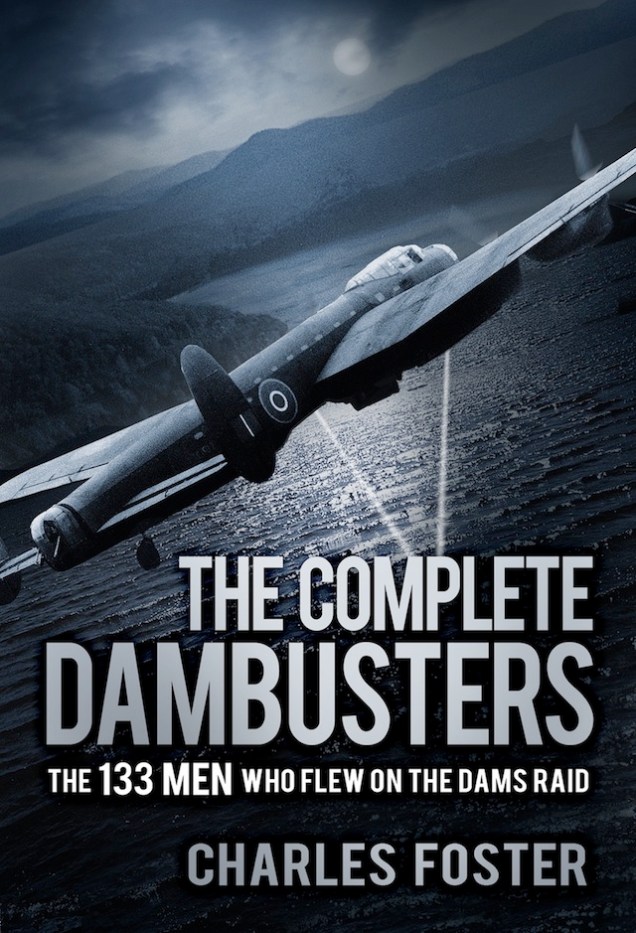
A seasonal reminder: The Complete Dambusters

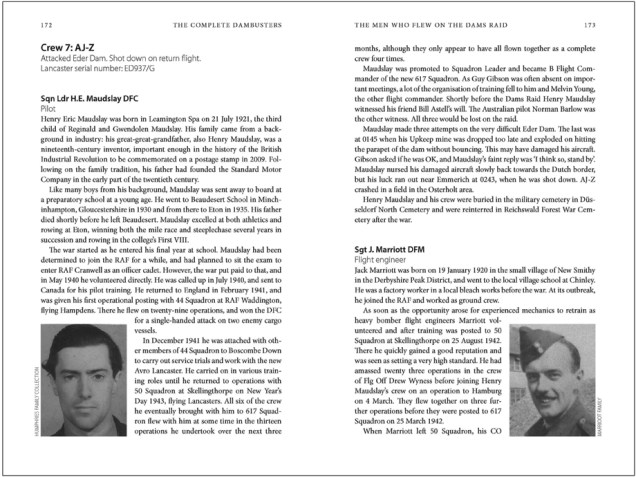
A gentle reminder that this is the perfect seasonal present for the Dambusters aficionado in your life. The only book ever published with a biography of each of the 133 men who took part in the Dams Raid, each illustrated with a photograph.

Published by the History Press in May 2018, ISBN 978 0 7509 8808, and available from your favourite bookshop or online bookseller.

If you would like a signed copy mailed to you before Christmas, please contact me before Sunday 16 December to get instructions on payment and I will send one to you.
Email me on charlesjfoster@gmail.com

Pointing the way to the Haldern memorial

The memorial to the crew of Dams Raid Lancaster AJ-E, which crashed on 16 May 1943 killing all the crew, is a few hundred yards off a quiet country road near a quiet country village in a quiet corner of Germany – and therefore a little hard to find. So the local history society, the Heimatverein Haldern, has now erected three signs to help the increasing number of tourists who are now coming to the area.

Many people have travelled to the area since the memorial was built in 2015, coming from as far as Australia, Canada and the USA and also several European countries. In August a large group of tourist came in a car cavalcade organised by the European Driving Tours group, as seen below.

Credit once again to Volker Schürmann and his colleagues in the Heimatverein Haldern. It was their initiative to build the memorial and they should be commended for all they continue to do to commemorate the seven men from other nations, the 617 Squadron crew who died in their neighbourhood and who remain buried on German soil.

Pics: Volker Schürmann

Remembrance Day tribute to Lewis Burpee at old school

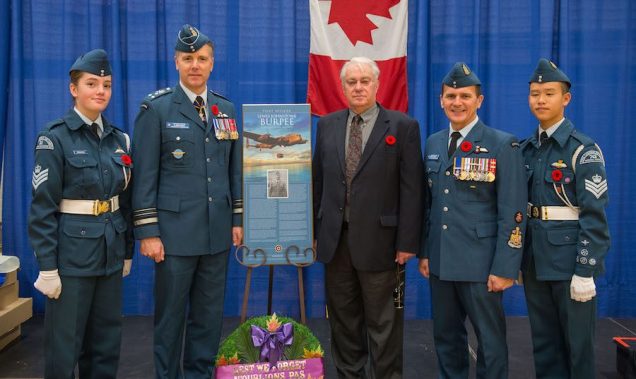
Lewis Burpee Jr lays a wreath at a Remembrance Day ceremony at his father’s old school, Lisgar Collegiate Institute in Ottawa, on 9 November. 

[Pic: Aviator Rachael Allen]

Dams Raid pilot Lewis Johnstone Burpee was born in Ottawa on 5 March 1918. He graduated from Lisgar Collegiate Institute in 1937 and went on to Queen’s University in Kingston, Ontario. He enrolled in the Royal Canadian Air Force in 1940 and after completing pilot training was posted to 106 Squadron, then under the command of Wg Cdr Guy Gibson. He completed some 30 operations in the squadron, was awarded the DFM and received a commission. In March 1943 Gibson set up the new 617 Squadron to undertake the Dams Raid and Burpee and his crew came over to RAF Scampton to join him. He was the only one of the three pilots who had served under Gibson in 106 Squadron to bring his full crew with him.

Burpee and his crew never returned from the mission on the night of 16-17 May 1943. They were shot down over Holland en route to the dams, and all crew members aboard their Lancaster bomber perished.

For several years, Robert Tang, a maths teacher at Lisgar with a strong interest in history, has been using the mathematics underpinning the innovative “bouncing bomb” that was developed by engineer Barnes Wallis to destroy the dams, saying that applying mathematics—especially trigonometry and algebra—to a real situation brings the subject to life for his students. The students even take a field trip to the nearby Canada Aviation and Space Museum, where they carry out experiments, fly a simulator and see a Lancaster bomber.

However, it wasn’t until earlier this year that Mr Tang discovered that Lewis Burpee had been a pupil at his school. He then found that Burpee’s son, also called Lewis Burpee, still lived in the city and made contact with him.

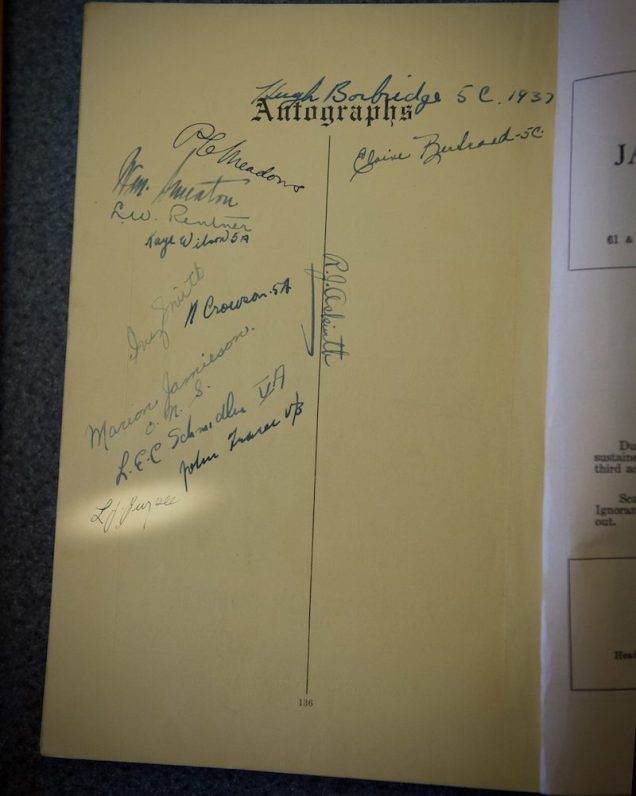
In another moment of serendipity Drew Fraser-Leach, this year’s co-president of the Lisgar Student Council, was in Mr Tang’s class last year. He knew his grandfather had been a Lisgar student at the time, so he went home and found his grandfather’s 1937 yearbook. “He flipped through it and found Plt Off Burpee’s signature,” explained Mr Tang. “That was a sign that we really had to make this our focus for the Remembrance Day ceremony.”

Lewis Burpee’s signature in a copy of Lisgar’s 1937 yearbook. [Pic: Aviator Rachael Allen]

The guests at the Lisgar Collegiate Institute also included Lieutenant-General Al Meinzinger, commander-in-chief of the Royal Canadian Air Force. “We are grateful for the sacrifices of people like Lewis Burpee, and we share the sorrow of their families and loved ones,” Lt Gen Meinzinger said in his speech during the ceremony. “I am also grateful that you, the students and staff of Lisgar Collegiate Institute, for showing our fallen—and in particular Plt Off Burpee—the same respect.”

“Plt Off Burpee, who fought and sacrificed his life for all of us, is just one example of the many brave soldiers who have fought for our peace and freedom,” said Emily He, a student and editor of Lisgar’s yearbook. “We must remember that it was their sacrifices that have led our country to where it is today, and most of all, we must remember that the freedom that all of us enjoy came at an extremely high cost.”


Second from left, Lieutenant-General Alexander Meinzinger, Commander of the Royal Canadian Air Force (RCAF) and third from left Lewis Burpee Jr, with cadets and RCAF personnel at the Remembrance Day ceremony held at Lisgar Collegiate Institute in Ottawa, Ontario on 9 November 2018. [

Pic: Aviator Rachael Allen]

“I would like to thank everyone who was involved in this today – not only Mr Tang but the whole Lisgar team,” said Mr Burpee. “I never knew my Dad; I was born after he died. For decades he was kind of a shadowy figure in my past.” This year’s series of commemorations to mark the raid’s 75th anniversary had allowed him to reconnect better, he added.

“It’s worth pointing out that for all the names on the plaques [in Lisgar’s Memorial Hall], for every airman, every soldier who didn’t come back, they are equally worthy of remembrance.”

Lieutenant-General Alexander Meinzinger, Commander of the Royal Canadian Air Force, and Mr Robert Tang. [Pic: Aviator Rachael Allen]

Jackson deal with Holland significant step forward in Dam Busters project

Peter Jackson’s recent announcement that he is pressing on with his project to remake The Dam Busters film has been widely welcomed. “It’s just a great story. It’s always been a great story,” he told the Daily Telegraph on Thursday. “But it’s an even greater story now than it was in 1955 because back then there was still so much of the story that was under The Official Secrets Act.

“They couldn’t show the bomb spinning because the fact that they applied backspin to the bomb to make it jump on the water was still a state secret. The film had a slightly romanticised view of what happened. It’s reasonably accurate but the real story is so much more interesting. It’s a story of politics, of ingenuity and peril, and it’s also a story about trying to make a weapon to destroy these dams and that cost an awful lot of money.”

However, the most solid evidence that the production will go ahead comes in the next paragraph of the Telegraph’s story with the announcement that Jackson has bought the film rights to James Holland’s 2012 book, Dam Busters: The Race to Smash the Dams 1943. Holland will also be credited as an historical adviser.

This is a big step forward. Until now Jackson has owned the rights just for the remake of the 1955 film, The Dam Busters, directed by Michael Anderson. The script for this was written by RC Sherriff, based on Paul Brickhill’s 1951 book of the same name (and also acknowledging Guy Gibson’s Enemy Coast Ahead). Brickhill’s book was revised for a second edition in 1971, and it is this version which is still in print. This is presumably the volume for which Jackson also owns the rights.

However, a lot of material has been declassified since this book was published, with the first tranche of UK government records being released in 1973, thirty years after the raid. Much more has followed, and historians have been working through these in the years that have followed. The definitive account based on these sources remains the various revised editions of John Sweetman’s book The Dambusters Raid, first published in 1982 as The Dams Raid: Epic or Myth.

James Holland’s 2012 account built on the official sources and also quarried material from various letters, a collection of recordings in the Imperial War Museum and his own interviews. This enabled him to write a much more reliable account of the raid than that of Brickhill. In turn, use of this text should allow Jackson and his scriptwriters to draft a screenplay which may be more historically accurate than Sherriff’s version, which he finished in 1952.

The difficulty will be in condensing the whole story into a single movie lasting, presumably, something under three hours. It is not really fair on the Anderson/Sherriff film to describe it as presenting a “slightly romanticised” account – it is all the more powerful for not bringing in unnecessary heroics or extraneous love stories. Whether Peter Jackson can manage to deliver something as good by today’s standards will be a big test. But a film-maker of his talents is presumably relishing the challenge.