Dambuster of the Day No. 90: William Maynard

Maynard 240913

Sgt T W Maynard
Front gunner

Lancaster serial number: ED936/G

Call sign: AJ-H

Second wave. Aircraft badly damaged and mine lost, flying low over sea on outward flight. Returned to base.

Thomas William Maynard was born in Wandsworth, London on 6 September 1923, the son of Sydney and Janet Maynard. His father was a police constable. He was known to some of his family as Bill, but to others as Tom.

He joined the RAF in December 1941, and was selected for training as a wireless operator/air gunner. He crewed up with Geoff Rice and his team at 1660 Conversion Unit in October 1942 and they joined 57 Squadron on 9 December.

Maynard kept a diary for the period between starting operations on 31 December 1942 and his arrival on 617 Squadron in early April 1943. This covers the crew’s nine operations in some detail. However, heavy rain and snow for most of the winter months meant that Scampton’s grass runways became almost unusable and some of the squadron were transferred to Swinderby. It was from there on New Year’s Eve that Rice and his crew set off on their first operation – a mine-laying trip to Gironde, off the French coast. The trip went relatively smoothly: in his diary, Maynard recorded that they laid their ‘eggs’ from a height of 500ft, and sang ‘old [sic] Lang Syne’ as the New Year came in.

On no fewer than ten occasions the operation was cancelled, often at very short notice such on this occasion in January:

Jan 29th. We were briefed for Lorient tonight. Were in the kite and ready to take off when it was scrubbed. Never felt so cheesed off in my young life as we had a decent kite and it looked like an inviting target. I would like to know who actually scrubs these trips as I reckon he is a bloody fool.

On 15 March, after the crew had finally undertaken nine operations, they learned that they were to be transferred to the squadron’s new C Flight, under the command of Sqn Ldr Melvin Young, who had joined the squadron to embark on a first tour on Lancasters after winning a DFC and Bar for two tours on Whitleys and Wellingtons. Maynard, who was still frustrated at the number of operations which had been cancelled at the last moment, wrote that this was a ‘Bad show as we were well satisfied in B Flight.’

By 25 March the flight comprised five crews, captained by Melvin Young, Bill Astell, Geoff Rice, Sgt George Lancaster and Sgt Ray Lovell. It was decided to post the whole flight over to the new squadron being formed at the same base to undertake training for a special mission. Rice and his crew had actually gone on leave the day before, and they did not find out about the transfer until they returned to base on 1 April. Rice protested at the transfer, but to no avail. Maynard recorded that they had ‘got back to find we are in a new squadron, 617, very hush-hush’. The next two entries cover what happened next:

April 2nd. Had our interview with our new CO, Wing Commander Gibson DSO & Bar, DFC & Bar, very young. He told us we (the squadron) were formed for a special mission of which even he had not the faintest idea and we have to spend the next weeks training low level by day and by night. We changed billets to the new squadron.
April 3rd. The weather is not too bad. We did a five and a half hour low level trip today and it was wizard over Wales and south west England. Lost our trailing aerial in the Bristol Channel. Ended by bombing at Wainfleet from 100ft. This is the goods when you are authorised to get down to the deck.

After writing this, Maynard must have decided to take the emphasis on security seriously, since this is the final entry in his diary.

The crew then flew on nine operations before being posted together from 57 Squadron to the new squadron being formed at the same base to undertake training for a special mission.

Like all the squadron’s mid upper gunners, Bill Maynard was switched to the front turret of the specially modified Lancasters for the Dams Raid.

Maynard flew with Rice and the rest of his crew on the handful of successful operations between the Dams Raid and December 1943, and was promoted to Flight Sergeant. However, the crew’s luck ran out on 20 December when they were shot down 14,000 feet above Merbes-Le Chateau in Belgium. Although Rice gave the order to bale out, there wasn’t time and the aircraft exploded. Rice seems to have been thrown clear by the explosion, and somehow landed in a wood but the bodies of the remaining six crew members were found in the wreckage.

Bill Maynard and his five colleagues were buried in Gosselies Communal Cemetery, near Hainaut, Belgium.

More about Maynard online:
Entry on Commonwealth War Graves Commission website
Page about Rice crew burial site, Gosselies cemetery

Maynard’s diary is held in the collection at Thorpe Camp Vistors Centre.

KIA 20.12.1943.

Rank and decorations as of 16 May 1943.
Sources:
Nigel Press, All My Life, Lancfile Publishing 2006
Richard Morris, Guy Gibson, Penguin 1995
John Sweetman, The Dambusters Raid, Cassell 2002
John Sweetman, David Coward and Gary Johnstone, The Dambusters, Time Warner 2003

The information above has been taken from the books and online sources listed above, and other online material. Apologies for any errors or omissions. Please add any corrections or links to further information in the comments section below.
Further information about Bill Maynard and the other 132 men who flew on the Dams Raid can be found in my book The Complete Dambusters, published by History Press in 2018.

‘Gibson’s cap’ and other Dambuster fakes exposed

Gibson in cap

The case below was reported on various websites just before and after Christmas. I refrained from posting about it until now because I didn’t want its important story to get confused with the recent auction of some genuine memorabilia connected with my family, which included the Dams Raid wooden bomb sight.
This story concerns a collector based in Yorkshire who goes by the name of “AndyB”. He has recently been involved in litigation with a Lincolnshire company called Military Trader UK, which is run by Mr Tony Flitter and his son Mr Nigel Flitter. The company has a website called http://www.militarytrader.co.uk and is a regular seller on Ebay.
I should add here that I have no connection with AndyB.
Over the course of the last two years, AndyB purchased a number of items from Military Trader UK which purported to be objects owned or used by various members of 617 Squadron during the war. Sadly, it turned out that although these were genuine wartime items, they had been “enhanced” in various ways, with handwriting or typed labels which supposedly added provenance.
After being threatened with litigation, Military Trader UK eventually returned AndyB’s money to him, and paid his legal and professional fees. I understand that this came to a total of about £17,000.
I believe AndyB should be commended for bringing the story to public attention. Many people would be tempted to slink quietly away, satisfied that they had got their money back, and not wanting to invite people to think how gullible he might have been.
Please be careful if you are tempted to buy something that claims a connection to 617 Squadron or the Dambusters, and get independent advice. In particular, if you notice any of the items listed below back on sale anywhere, please let me know.
The words below were written by AndyB. You can see his original post at this forum.

Due to the final agreement made between myself and Military Trader UK, not including a confidentiality clause, I am now at liberty to make other collectors aware of my experience which I feel is important in order to prevent the same thing happening to them.

Military Trader UK is run by Mr Tony Flitter and Nigel Flitter trading from Unit 10 Tattershall Park, Tattershall Way, Fairfield Industrial Estate, Louth, Lincolnshire, LN11 0YZ with their website address of militarytrder.co.uk and Ebay user name of militarytrader-uk, amongst others. In summary in April 2014 I wrote to Military Trader as it had come to my attention that items purchased from them were not what they had made them out to be. Over the previous two years I had purchased from Military Trader (UK), various Dambuster related items which were as follows:

Guy Gibson’s Cap ​​​
Jack Buckley’s Cap ​​​
Guy Gibson’s Tankard ​​​
RAF Strata Scope ​​​
RAF Scampton Microphone ​​
Brian Goodale’s Cap ​​​
Guy Gibson’s Escape Axe​​
Guy Gibson’s Mag Glass​​​
RAF 617 Bomb Counter ​​
RAF 617 Signalling Lamp ​​
RAF Scampton Phone ​​
RAF 617 Headphones ​​
Flying Boots apparently belonging to Ivan Whittaker ​
RAF Veteran Tie ​​​
Jack Buckley’s Bible ​​​
RAF Visibility Meter ​​
RAF Playing Cards ​​​
Numerous pieces of wreckage & artifacts
AM Visibility Meter ​​​
RAF Flag ​​​​
Tunic apparently belonging to Sidney Hobday ​​
Guy Gibson’s Pilot Book ​​

These items were all attributed by Military Trader to 617 Squadron and their personnel and at a cost of over £13,000

Following the last item purchased I discovered that there was immense doubt that items in question are not what they were described to be.

The Sales of Goods Act 1979 makes it an implied term of the contract that the goods be as described. Items that required expert verification or authentication to determine whether they were authentic or not were dealt with in the appropriate manner and an expert witness was found whose extensive report, had this case gone to Court, would have confirmed that these items had been misdescribed and misrepresented. In relation to these aforementioned items false verbal reassurances were given directly to me by Military Trader, they described the items as something they were not, in many cases this was supported by written evidence in the form of labels, signatures and other writing.

The signatures, writing and labels had all been studied by an independent writing expert ( calligrapher ) whom I engaged to help me confirm that the handwriting and typed labels all came from the same source. It was confirmed that all of the writing is of the same hand. The consistency of this handwriting then led to the fact that the writing and signatures which Military Trader purported to be original were from one source only, that being Military Trader. Therefore these written pieces and signatures which they claim corroborated and verified their items were false and could not be attributed to the persons or establishment as Military Trader claimed. Furthermore the professional examination of handwriting also extended to the Gibson’s Pilots book which had also been confirmed as containing writing by the same hand and therefore could not possibly have belonged to Gibson.

Consequently, with reliance on written evidence, I was able to prove beyond reasonable doubt that items sold by Military Trader to me were in fact not what they verbally reassured me they were, certainly did not match their written description and did not have authentic signatures.

I would have also had recourse under the Misrepresentation Act 1967 as Military Trader made false and fraudulent claims. I relied on these statements made by them in deciding whether or not to go ahead with my purchases; I had been persuaded to buy these items from them due to the representations which they made to me. Therefore pursuant to the Misrepresentation Act 1967 I would have had also had a potential claim due to Fraudulent Misrepresentation.

Under the Unfair Trading Regulations 2008 I would be described as a “Targeted Customer” by them. The false information which they gave me verbally and in writing was been deceptive. They had engaged in misleading action under Section 5 and through their deceptive descriptions and presentation of items I had been duped into entering into contracts to purchase the items in question from them.

In summary under the Sales of Goods Act 1979 due to the fact that the items have been “misdescribed” they were in breach of contract and I advised them that I was rejecting the items and requested that they refunded the total sum paid to them.

Prior to me writing to them in April 2014 I had already received a small sum from Military Trader for a refund for other items of forged provenance. During legal correspondence my solicitor pointed out that despite the basis of my claim being that Military Trader knowingly and deliberately faked the provenance of items and manufactured documentation to substantiate that false provenance, their solicitor’s letter was remarkably silent on this point, not even venturing a denial in without prejudice correspondence. This speaks for itself.

I would comment that it was not all of the items in the list above that I could prove had been fraudulently enhanced, it was in particular items supported by handwriting, labels and signatures. The enhancement of the higher priced items obviously in turn caused much doubt as to the authenticity of all of the other items. Tony and Nigel Flitter were aware of my passion in 617 Squadron and specifically the Dambusters and did target me as a customer.

In my opinion the amount of money that they charged me for these enhanced items was “ripping off” at its worst. It has taken me most of this year to be reimbursed for all of the items which I purchased from them, plus being reimbursed for all of my legal costs and the Professional Calligraphers report. This case did not go to court as Military Trader decided to settle and pay all of my costs in return for the items which I gladly returned. I had my evidence prepared and there was not even a murmur of any declaration from them as to the authenticity or genuineness of the items, the authenticity of which the Calligrapher’s report dismissed due to the fake handwriting and other significant issues.

It has been noticed that there have been items for sale on Ebay which are items not relating to 617 Squadron which have also been proven by the Professional Calligrapher to have the same handwriting on the items. This handwriting is done by Military Trader and is not the authentic handwriting which a genuine item would have on it.

Notwithstanding the hundreds of items, which are sold by Military Trader via their website and also via Ebay under militarytrader-uk and other associated accounts, which are genuine it is an utter shame that Tony and Nigel Flitter need to resort to enhancing items in order to purport them to be something that they are certainly not, thereby enabling them to command a much higher price for these said items.

The moral of this story is if you are in any doubt of the authenticity of an item purchased it would be advisable to consult an independent military specialist. If that item is then found to be not what it is purported to be please report it to Lincolnshire Trading Standards or Lincolnshire CID who will add it to their investigation. We have to keep items such as these out of the market place as it is harmful to genuine pieces and is just simply irritating for collectors, whether they be serious collectors, just starting out or have a slight interest.

Please be aware of these items coming back onto the market and if you come across them with the same description or anything which is similarly doubtful report it and help put a stop to fraudulent trading.

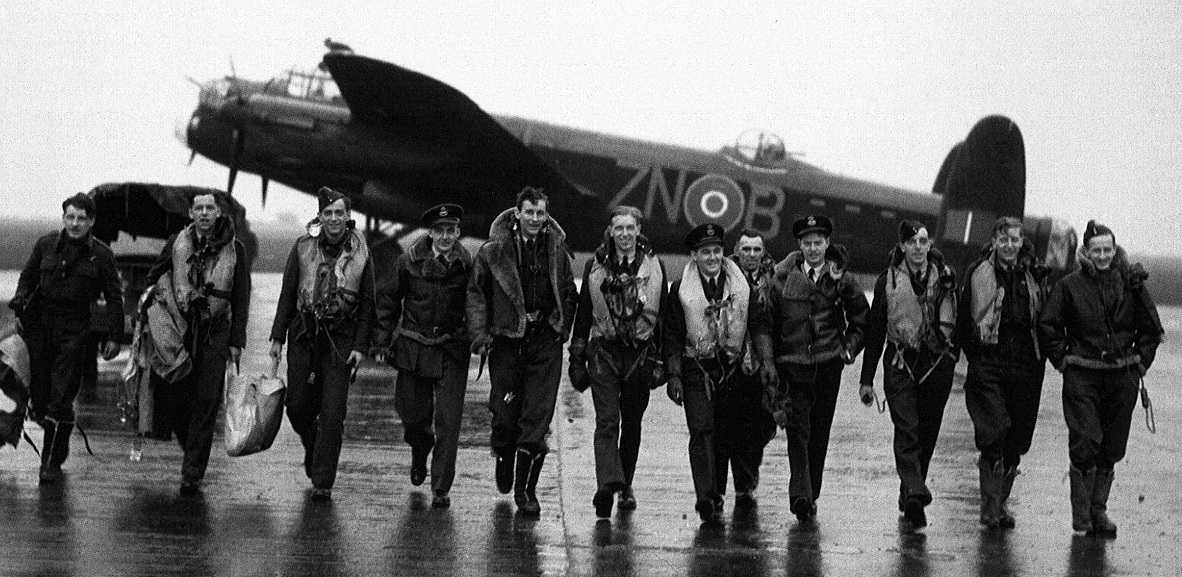
1942 picture shows Shannon and Walker in 106 Squadron

R5573 GroupPic: IWM

UPDATE 20 DECEMBER 2022: [The original text of this blog appears below, for future reference.] Thanks to Clive Smith and others, as of this date eleven of the twelve airmen in this photograph have now been identified. Numbered left to right they are:
1. Sgt Richard ‘Tash’ Goodwin, flight engineer in Plt Off Richard Wellington’s crew
2. Sgt John Humphreys, flight engineer in Flt Lt Bill Whamond’s crew
3. Wrt Off Richard ‘Mac’ McClelland RCAF, navigator in Flt Lt Bill Whamond’s crew
4. Flg Off Danny (Revie) Walker, navigator in Shannon crew
5. Sgt John Cunningham, bomb aimer in Flt Lt Bill Whamond’s crew
6. Flt Sgt Bernard Holmes, rear gunner in Shannon crew
7. Flg Off Douglas McCulloch, mid upper gunner in Shannon crew
8. Unknown
9. Flg Off David Shannon, pilot
10. Sgt Arnold Pemberton, wireless operator in Shannon crew
11. Flt Sgt Douglas Hamilton, pilot
12. Flt Sgt Dennis Woolley, navigator in Flt Sgt Douglas Hamilton’s crew

Blog reader Clive Smith has sent me this interesting picture, which he unearthed in the Imperial War Museum collection. It shows two crews from 106 Squadron, and was apparently taken at RAF Syerston on 23 October 1942, after a bombing operation to Genoa. Two men who went on to fly on the Dams Raid are easily recognisable – ninth from the left, Flg Off David Shannon and fourth from the left, his navigator, Plt Off Danny Walker.

On that day Shannon flew Lancaster W4256, code ZN-V, and the complete crew were listed as:

  • Flg Off D J Shannon – pilot
  • Sgt F A Forster – 2nd pilot
  • Plt Off D R Walker – navigator
  • Sgt W Herbert – bomb aimer
  • Sgt A P Pemberton – wireless operator
  • Flg Off D K McCullock – mid upper gunner
  • Flt Sgt B E Holmes – rear gunner

The aircraft shown in the picture is coded ZN-B. This was Lancaster R5573, and its crew on this operation was listed as:

  • Plt Off R A Wellington – pilot
  • Sgt T G Goodwin – flight engineer
  • Plt Off D W Bone – navigator
  • Flg Off V H Harley – bomb aimer
  • Sgt C R Webster – wireless operator
  • Sgt R B Hicks – mid upper gunner
  • Sgt A Naylor – rear gunner

If any reader can identify any of the other people in the picture, please leave a comment below or get in touch.

Dambuster bomb sight sells for £41,000, and is going to ‘good home’

Auction screenshot

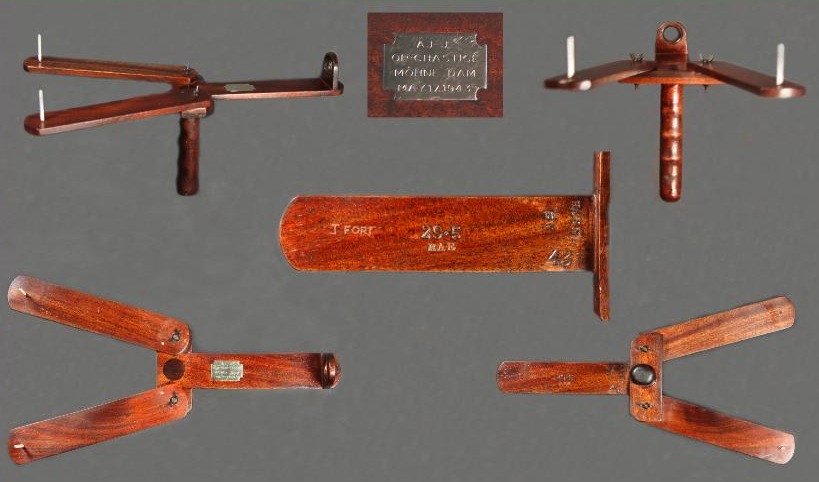
The wooden bomb sight used by Plt Off John Fort on the Dams Raid sold yesterday at auction for a staggering £33,500 hammer price (more than £41,000 with commission and taxes added). The bidding opened at £20,000 and it quickly became apparent that the only serious contenders were two people in the room who had very deep pockets.
The buyer is at present anonymous, but we have been assured by the auctioneer that the bomb sight, and the other artifacts sold to the same purchaser, have gone to a ‘good home’. We hope to bring you more details in due course.
The bomb sight and a navigator’s parallelogram and desklight were given to my grandfather, Ettrick Maltby, by his son David, the pilot of AJ-J on the Dams Raid. Following David’s death, they were placed in a display cabinet at Hydneye House School, the prep school in Hastings owned and run by the Maltby family. When the Maltbys retired they decided that they wanted them left at the school so that future generations of boys could see them.
Unfortunately the school was forced to close in the early 1970s following a Compulsory Purchase Order when the area became scheduled for redevelopment. By then Ettrick Maltby had died, and nobody from the family thought to retrieve the items from the school. So the Headmaster gave the items to an old boy of the school for his budding aerospace collection.

bomb sight

The bombsight is the only surviving example of those which were made for the Dams Raid. Not all the bomb aimers used the sight, which was devised by Wg Cdr C L Dann, supervisor of aeronautics at the Royal Aeronautics Establishment at Boscombe Down. Many used their own makeshift systems for working out the release points, with pieces of string and chinagraph marks on the perspex blister, but now it seems certain that John Fort preferred this sight.
It is not clear what all the numbers stamped on the handle refer to, although the figure 29.5 would seem to be the angle in degrees between the two arms. Although the two arms are adjustable by means of a wingnut, each arm is locked in position with a small panel pin which can be seen just to the left of the wingnut.
The metal plate was obviously added later when the sight went on display. The varnish was probably also applied at this time.

Dambuster of the Day No. 89: John Thrasher

Canadians damsraid15aThe 16 members of the RCAF who survived the Dams Raid, photographed the following day. John Thrasher is in the back row, sixth from the left. His crewmate Bruce Gowrie is in the front row crouching, fourth from the left. [Pic: Bomber Command Museum of Canada]

Wrt Off J W Thrasher
Bomb aimer

Lancaster serial number: ED936/G

Call sign: AJ-H

Second wave. Aircraft badly damaged and mine lost, flying low over sea on outward flight. Returned to base.

John William Thrasher was born on 30 July 1920 in Amherstburg, a small Canadian town in the far south west of Ontario, very close to the border with the USA. His parents, Charles and Irene Thrasher had fifteen children altogether, although two died in infancy. His father worked as a clerk in a liquor store. He was educated at St Anthony’s Primary School and St Rose’s High School, and matriculated in 1938. 
He worked as a printer’s apprentice for two years, then moved to be a laboratory worker in a soda ash plant.

He enlisted in the RCAF in May 1941, and was selected for Air Observer training, which he completed on 25 September 1941. His CO described him as: ‘Straightforward and assertive. Cautious but fairly aggressive. Quick. Cheerful. Good appearance, and personality. Very good material.’ But by December he had only passed out 20th out of 22, with an average overall mark. In further training it was noted that he was weak on navigation, but had achieved 98% in bombing.

After arriving in the UK, Thrasher was posted to 19 Operational Training Unit at RAF Kinloss in July 1942. It was there that he crewed up with Rice and two more men who would eventually form the AJ-H Dams Raid crew, navigator Richard Macfarlane and Canadian wireless operator Bruce Gowrie. They moved on to 1660 Conversion Unit at RAF Swinderby in October 1942 to complete heavy bomber training.

The crew then flew on nine operations before being posted together from 57 Squadron over to the new squadron being formed at the same base to undertake training for a special mission.

John Thrasher’s bomb aiming skills were severely tested during the Operation Chastise training period, but he acquitted himself well, coming second overall in the bombing practice sessions conducted in the first half of April 1943. 
On the raid itself, of course, he never had a chance to drop his mine, since it was torn out of AJ-H’s bomb bay over the sea.

Thrasher flew with Rice and the rest of his crew on the handful of successful operations between the Dams Raid and December 1943, and he received a commission. However, their luck ran out on 20 December when they were shot down 14,000 feet above Merbes-Le Chateau in Belgium. Although Rice gave the order to bale out, there wasn’t time and the aircraft exploded. Rice seems to have been thrown clear by the explosion, and somehow landed in a wood but the bodies of the remaining six crew members were found in the wreckage.

John Thrasher and his five colleagues were buried in Gosselies Communal Cemetery, near Hainaut, Belgium.

His brother, Plt Off Charles Thrasher, also joined the RCAF and served as a navigator in the Canadian 424 Squadron, based in Yorkshire and flying Halifaxes. He was awarded the DFC in 1944, with the citation noting his ‘fortitude, courage and devotion to duty.’ He survived the war.

More about Thrasher online:
Entry on Commonwealth War Graves Commission website
Page about Rice crew burial site, Gosselies cemetery

KIA 20.12.1943.

Rank and decorations as of 16 May 1943.
Sources:
Nigel Press, All My Life, Lancfile Publishing 2006
Richard Morris, Guy Gibson, Penguin 1995
John Sweetman, The Dambusters Raid, Cassell 2002
John Sweetman, David Coward and Gary Johnstone, The Dambusters, Time Warner 2003

The information above has been taken from the books and online sources listed above, and other online material. Apologies for any errors or omissions. Please add any corrections or links to further information in the comments section below.

Further information about John Thrasher and the other 132 men who flew on the Dams Raid can be found in my book The Complete Dambusters, published by History Press in 2018.

Dambuster of the Day No. 88: Bruce Gowrie

Gowrie RCAF 0234 lores

Pic: Canadian National Archives

Wrt Off C B Gowrie
Wireless operator

Lancaster serial number: ED936/G

Call sign: AJ-H

Second wave. Aircraft badly damaged and mine lost, flying low over sea on outward flight. Returned to base.

Chester Bruce Gowrie, always known as Bruce, was born on 14 April 1918 in the small Canadian village of Tramping Lake, which lies roughly halfway between Edmonton and Saskatoon, in the province of Saskatchewan. His parents were Malcolm and Phyllis Gowrie. He attended the local Tramping Lake School, which he left in 1936. He then worked as a post office clerk for four years, while also gaining experience of farming.


He had thought about applying to join the RCAF before the war, so when the war came it was an obvious path to take. He was accepted as a recruit in February 1941, and was selected for wireless operator training. His pre-war hobby of building radio sets made him a natural choice to be selected for wireless work.

After qualifying, Gowrie spent the Christmas of 1941 on leave and embarked for England in January 1942. He was posted to 19 Operational Training Unit at RAF Kinloss in July where he crewed up with Rice and two more from his Dams Raid crew, Richard Macfarlane and John Thrasher. They moved on to 1660 Conversion Unit at RAF Swinderby in October 1942 to complete heavy bomber training.

On 9 December 1942, the crew was posted to 57 Squadron at RAF Scampton to begin their operational career. The crew had flown on nine operations before being posted over to the new squadron being formed at the same base to undertake training for a special mission.

Gowrie flew with Rice and the rest of his crew on the handful of successful operations between the Dams Raid and December 1943, and he was promoted to a Warrant Officer First Class in December. However, their luck ran out on 20 December when they were shot down 14,000 feet above Merbes-Le Chateau in Belgium. Although Rice gave the order to bale out, there wasn’t time and the aircraft exploded. Rice seems to have been thrown clear by the explosion, and somehow landed in a wood but the bodies of the remaining six crew members were found in the wreckage.

Bruce Gowrie and his five colleagues were buried in Gosselies Communal Cemetery, near Hainaut, Belgium.

More about Gowrie online:
Entry on Commonwealth War Graves Commission website
Page about Rice crew burial site, Gosselies cemetery

KIA 20.12.1943.

Rank and decorations as of 16 May 1943.
Sources:
Nigel Press, All My Life, Lancfile Publishing 2006
Richard Morris, Guy Gibson, Penguin 1995
John Sweetman, The Dambusters Raid, Cassell 2002
John Sweetman, David Coward and Gary Johnstone, The Dambusters, Time Warner 2003

The information above has been taken from the books and online sources listed above, and other online material. Apologies for any errors or omissions. Please add any corrections or links to further information in the comments section below.

Further information about Bruce Gowrie and the other 132 men who flew on the Dams Raid can be found in my book The Complete Dambusters, published by History Press in 2018.
Dambuster of the Day No. 87: Richard Macfarlane

MacFarlane 240913

Flg Off R Macfarlane
Navigator

Lancaster serial number: ED936/G

Call sign: AJ-H

Second wave. Aircraft badly damaged and mine lost, flying low over sea on outward flight. Returned to base.

Richard Macfarlane was born in Glasgow on 12 December 1921, the older of the two sons of Daniel and Jessie Macfarlane. He attended Hyndland School and the High School of Glasgow. In 1939 he enrolled at the University of Glasgow to study law, but his studies were interrupted when he joined the RAF in 1941. He was sent to Miami in the USA to train as a navigator, and was commissioned on completing the course.

Macfarlane was posted to 19 Operational Training Unit at RAF Kinloss in July where he crewed up with Rice and two more from his Dams Raid crew, Bruce Gowrie and John Thrasher. They moved on to 1660 Conversion Unit at RAF Swinderby in October 1942 to complete heavy bomber training.

On 9 December 1942, the crew was posted to 57 Squadron at RAF Scampton to begin their operational career. The crew had flown on nine operations before being posted over to the new squadron being formed at the same base to undertake training for a special mission. As the most senior navigator in A Flight, Macfarlane became the Flight Navigation Officer.

Shortly before the raid, Macfarlane travelled home to Glasgow, on leave to see his family. In a 2013 newspaper interview, his brother recalled that they were obviously engaged in an important project:

We gathered he was going back to do something special. But he couldn’t tell us what it was.
 On the morning after the overnight raid we were listening to the wireless and heard the dramatic news. So we were pretty certain that was where Richard had been.
 They were given leave immediately and he was back at our home in Broomhill, Glasgow, sitting round the dinner-table and confirming he had been on the Dambuster raid that previous night.
The Herald, 16 May 2013

Macfarlane flew with Rice and the rest of his crew on the handful of successful operations they completed in the period July to December 1943, but they were unlucky on 20 December when they were shot down 14,000 feet above Merbes-Le Chateau in Belgium. Although Rice gave the order to bale out, there wasn’t time and the aircraft exploded. Rice seems to have been thrown clear by the explosion, and somehow landed in a wood but the bodies of the remaining six crew members were found in the wreckage.

Richard Macfarlane and his five colleagues were buried in Gosselies Communal Cemetery, near Hainaut, Belgium.

More about Macfarlane online:
Entry on Commonwealth War Graves Commission website
Page about Rice crew burial site, Gosselies cemetery
Wikipedia entry about his brother, Lord Macfarlane of Bearsden
Biography of Macfarlane at University of Glasgow website
Article in The Herald, 16 May 2013

KIA 20.12.1943.

Rank and decorations as of 16 May 1943.
Sources:
Nigel Press, All My Life, Lancfile Publishing 2006
Richard Morris, Guy Gibson, Penguin 1995
John Sweetman, The Dambusters Raid, Cassell 2002
John Sweetman, David Coward and Gary Johnstone, The Dambusters, Time Warner 2003

The information above has been taken from the books and online sources listed above, and other online material. Apologies for any errors or omissions. Please add any corrections or links to further information in the comments section below.

Further information about Richard Macfarlane and the other 132 men who flew on the Dams Raid can be found in my book The Complete Dambusters, published by History Press in 2018.

Dambuster of the Day No. 86: Edward Smith

Smith 240913

Sgt E C Smith
Flight engineer

Lancaster serial number: ED936/G

Call sign: AJ-H

Second wave. Aircraft badly damaged and mine lost, flying low over sea on outward flight. Returned to base.

Edward Clarence Smith was born in Cambridge on 26 August 1919, the middle of the three children of Clarence and Annie Smith. He joined the RAF in 1937 as ground crew, trained at the No 3 School of Technical Training at RAF Manston and served in various squadrons until 1942.

It was then that the new category of Flight Engineers was introduced, and Smith volunteered for this position. After training he crewed up with Geoff Rice and his team at 1660 Conversion Unit in October 1942. They joined 57 Squadron in December.

The crew had flown on nine operations before being posted over to the new squadron being formed at the same base to undertake training for a special mission.


On the Dams Raid, AJ-H took off from Scampton at 2131 but had to turn back after flying too low over the Waddensee and losing their mine. Smith played an important role in bringing the aircraft home safely to Scampton when hydraulic power for the undercarriage had been lost.

Smith flew with Rice and the rest of his crew on the operations they completed in the period from July to December 1943. When they were shot down over Belgium on 20 December 1943 Rice survived. Smith and the rest of the crew were killed and they were buried in Gosselies Communal Cemetery, near Hainaut, Belgium. More than 100 British and Commonwealth servicemen lie there, nearly all aircrew who died in the vicinity.

Edward Smith had married Evelyn Tyrell in Cambridge in 1942.

More about Smith online:
Entry on Commonwealth War Graves Commission website
Page about Rice crew burial site, Gosselies cemetery

KIA 20.12.1943.

Rank and decorations as of 16 May 1943.
Sources:
Nigel Press, All My Life, Lancfile Publishing 2006
Richard Morris, Guy Gibson, Penguin 1995
John Sweetman, The Dambusters Raid, Cassell 2002
John Sweetman, David Coward and Gary Johnstone, The Dambusters, Time Warner 2003

The information above has been taken from the books and online sources listed above, and other online material. Apologies for any errors or omissions. Please add any corrections or links to further information in the comments section below.

Further information about Edward Smith and the other 132 men who flew on the Dams Raid can be found in my book The Complete Dambusters, published by History Press in 2018.