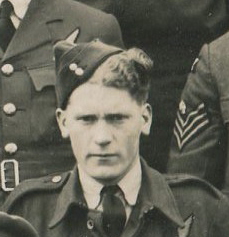
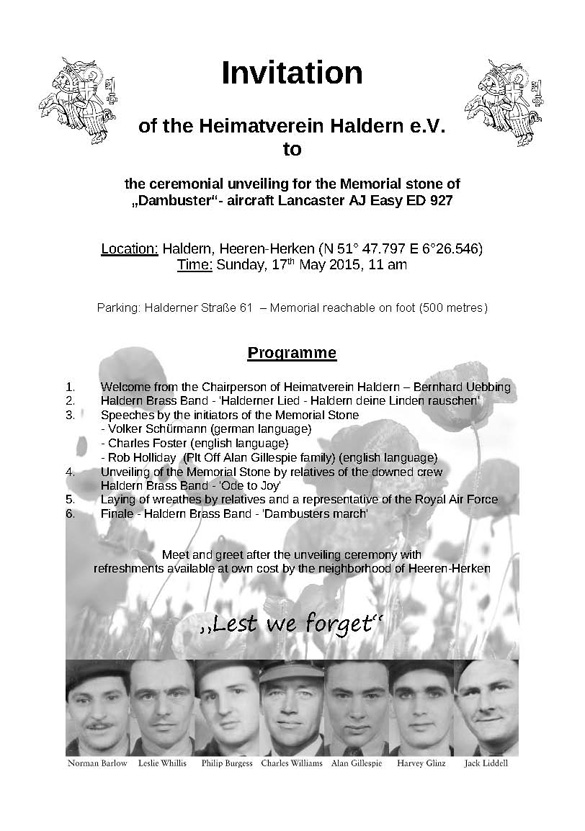
We are very pleased to announce that the details for the unveiling of the memorial to the Dams Raid crew of Lancaster AJ-E have now been finalised. Regular readers of this blog will know that a memorial stone and plaque are to be erected at the site in Germany where this aircraft crashed at 23.50 on Sunday 16 May 1943. The crew of seven, captained by Flt Lt Norman Barlow DFC, were all killed.
The unveiling will take place at 11.00am local time on Sunday 17 May 2015, the 72nd anniversary of the Dams Raid, at Heeren-Herken, near Haldern.
The memorial has been organised by local historian Volker Schürmann and the Haldern local history society, Heimatverein Haldern. The money to pay for the memorial stone and the plaque was raised by public appeal, and many readers of this blog were generous in making contributions.
The speakers will be Volker Schürmann, Charles Foster and Rob Holliday, a member of the family of Plt Off Alan Gillespie DFM, representing the families. Wreathes will be laid by the families and a representative of the RAF.
All are welcome at the event.
“Part of our country’s glory”
Pic: Ray Hepner Collection
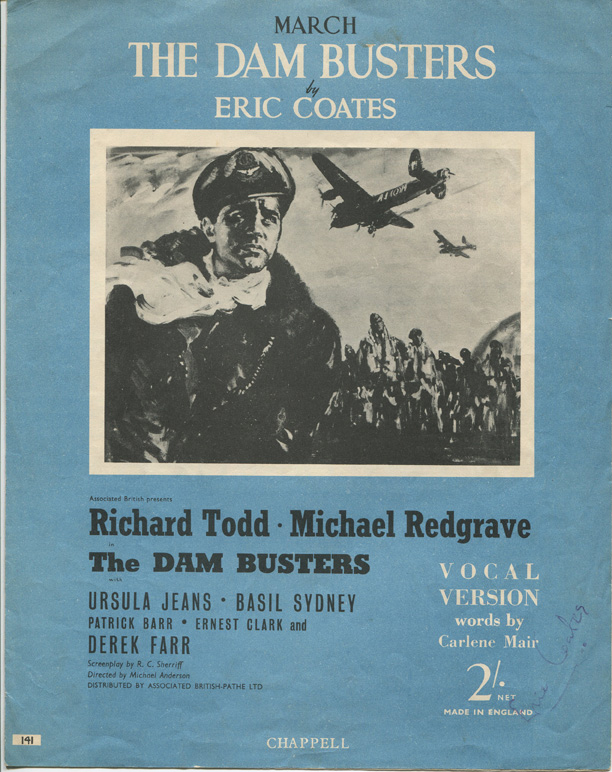
This blog has a new good friend, the collector Ray Hepner, who is very kindly allowing me to show some items from his archive over the next few weeks. The first of these is a copy of the sheet music for The Dam Busters March, autographed by its composer, Eric Coates. The item shown above is the vocal version with words by Carlene Mair.
The stirring words are not often performed, perhaps because they are not widely known. They read as follows:
Proudly, with high endeavour,
We, who are young forever,
Won the freedom of the sky;
We shall never die!
We, who have made our story
Part of our country’s glory
Know our hearts will live on
While Britons fly!
Britons fly!
We know our hearts will still live on
While Britons fly!
While Britons fly!
Words by Carlene Mair, © Chappell 1954/1956
To my mind, these are rather better words than the rather dirge-like recent hymn, about which I posted last June.
Not much seems to be known about Carlene Mair, other than that she wrote a book about the history of Chappell, the music publishers, and also the words in English for Chappell’s collections of Bavarian and Welsh folk songs. She also wrote an English translation of Charles Trenet’s La Mer, but not the words to Beyond the Sea, which uses the same tune and later became a hit for Bobby Darin. Any further information would be gratefully received.
Dambuster of the Day No. 98: David Rodger
Pic: Rodger family
Flg Off D Rodger
Rear gunner
Lancaster serial number: ED825/G
Call sign: AJ-T
Second wave. First aircraft to attack Sorpe Dam. Mine dropped successfully but failed to breach dam. Returned to base.
David Rodger was born on 23 February 1918 in Sault Ste Marie, Ontario, Canada. He went to the local technical school and then worked for the Algoma Steel company. He joined the RCAF in October 1941, and trained as an air gunner before leaving for the UK. By then he had also been commissioned. In September 1942, he joined 97 Squadron at RAF Woodhall Spa and took part in one operation on a trip to Bremen in an aircraft piloted by squadron CO Wg Cdr G D Jones. He then suffered a broken kneecap in an accident, and had a spell in hospital.
In January 1943, rear gunner Sgt Ralph Muskett was forced to stand down from Joe McCarthy’s crew after prolonged bouts of air sickness, and Dave Rodger was selected in his place. He thus became the third member of the RCAF in this crew. He went on to take part in 15 operations with McCarthy in 97 Squadron before they were all transferred to 617 Squadron in March.
Before the Dams Raid, all the rear gunners had set up the turrets of their scheduled aircraft in the way that suited them. Most chose to have the Perspex windshields removed, believing that they had better visibility without them and each would have made further adjustments to their seats and gun positions. When the McCarthy crew had suddenly to switch from the allocated AJ-Q to the spare AJ-T, none of these refinements had been made. Fortunately, Rodger was given a few minutes extra while McCarthy himself went off in hunt of the missing compass deviation cards so he was able to remove the Perspex, with the help of ground staff.
When they reached the Sorpe Dam, Rodger’s droll wit was tested to its full by the repeated attempts by McCarthy and Johnson to get into the correct position to drop the Upkeep mine. As Johnson recalled later:
Sitting in the rear turret, Dave Rodger was getting the worst of all this. He could not see what was coming, but he could feel the aircraft diving, running level and then, without warning, pulling up sharp. Because he was furthest from the aircraft’s centre of gravity, every movement was exaggerated for the rear gunner. In a tight turn, a steep dive or a harsh climb, Dave had to put up with a G-force that made his life very uncomfortable. It was hardly surprising after the sixth or seventh dummy run that we heard Dave’s voice grumbling from the tail: “Will somebody please get that bomb out of here!”…
On our tenth run in, both Joe and I were satisfied that we were right on track. I pushed the button and called “Bomb gone!” And from the rear turret was heard, “Thank Christ for that!” As we pulled away, Dave Rodger now had the ringside seat. He said “God Almighty,” as the explosion threw a fountain of water up to about 1,000 feet. “Jesus, that spray has come right into the rear turret. Not only have I been knocked about all over the place by you buggers, now you’re trying to drown me!”
George ‘Johnny’ Johnson, The Last British Dambuster, pp 171-2
Rodger continued to fly with McCarthy throughout the rest of the crew’s tour. He became 617 Squadron’s Gunnery Leader on 11 September 1943, was promoted to Flight Lieutenant and received the DFC in 1944. The citation noted “his calm resolution in the face of the heaviest opposition, which has been an inspiration to his crew”.
When he was stood down from operational flying, Rodger was offered the chance to return to Canada and work as an instructor for the rest of the war. He decided to take the opportunity, and on his return he married his Canadian girlfriend Nell Barbet. Whilst in the UK he had secretly been taking dancing lessons in order to impress her.
After the war, he returned to work at Algoma Steel in his home town of Sault Ste Marie, and stayed there until retirement. He and Nell went on to have nine children. Dave Rodger took an active part in many Dambuster reunions in Canada and travelled to the UK on several occasions. Joe McCarthy and he last met up at Rodger’s 80th birthday party in 1998, shortly before McCarthy’s death later that year.
Dave Rodger died on 1 September 2004. He was cremated locally and his ashes scattered in his own garden, and at the family cabin on Lake Superior.
Thanks to Patti Rodger Kirkpatrick and the rest of the Rodger family for help with this article.
More about Rodger online:
Daily Telegraph obituary
Survived war. Died 01.09.2004
Rank and decorations as of 16 May 1943.
Sources:
Richard Morris, Guy Gibson, Penguin 1995
John Sweetman, The Dambusters Raid, Cassell 2002
Dave Birrell, Big Joe McCarthy, Wingleader Publishing, 2012
George ‘Johnny’ Johnson, The Last British Dambuster, Ebury Press, 2014
The information above has been taken from the books and online sources listed above, and other online material. Apologies for any errors or omissions. Please add any corrections or links to further information in the comments section below.
Further information about Dave Rodger and the other 132 men who flew on the Dams Raid can be found in my book The Complete Dambusters, published by History Press in 2018.
Dambuster of the Day No. 97: Ronald Batson
This photograph, taken in August 1943, shows six members of Joe McCarthy’s Dams Raid crew fraternising with recently arrived USAAF personnel.
The printed caption on the reverse reads: “Passed By Censor No. 279211. Allied Airmen Get Together At U.S. 8th Air Force Bomber Station. Newly-arrived American airmen in the European Theatre of Operations are visited at their bomber stations by members of the R.A.F. who have had considerable experience of operational flying. In the course of friendly conversations they learn a great deal of useful knowledge. The Commander of one U.S. Bomber Station has declared that, thanks to these informal knowledge, his men are three months ahead of schedule in the field of experience. Associated Press Photo Shows:- Standing under the tail of a Martin B-26 Marauder Bomber, a group of R.A.F. and U.S.A.A.F. airmen get together at an 8th Air Force Bomber Station ‘somewhere in England’. They are (left to right): Lt. John Helton, of Clifton, Texas, Sgt. Ronald Batson, of Ferry Hill, Durham, Capt. W.M. Brier, of Anniston, Ala.; F/Sgt. Leonard Eaton, of Manchester; P/O. Don MacLean, of Toronto; Sgt. Len Johnson, of Newark; Lt. John Bull Stirling, of Annapolis; Flight Lieut. Joe McCarty, of Long Island, N.Y. (The D.S.O., D.F.C. Dambuster); Lt. Laurence McNally, of Bridgford, Conn.; Capt. Grover Wilcox, of Anahuac, Texas; and Sgt. Bill Radcliffe, New Westminster, D.C.” [All spelling and punctuation as in original.] [Pic: American Air Museum in Britain/IWM.]
Sgt R Batson
Front gunner
Lancaster serial number: ED825/G
Call sign: AJ-T
Second wave. First aircraft to attack Sorpe Dam. Mine dropped successfully but failed to breach dam. Returned to base.
Ronald Batson was born on 5 December 1920 in Ferryhill, Co Durham, the older son of Joseph and Elizabeth Batson. He was a grocer’s assistant before enlisting in the RAF in March 1941.
After qualifying as an air gunner, he was posted to 106 Squadron Conversion Flight in early September 1942. He quickly teamed up with Joe McCarthy whose logbook confirms that Batson and Bill Radcliffe first flew with him on the same day, 11 September 1942, in a Manchester on a training flight. Their first operation was on 5 October. Batson was the only one of McCarthy’s crew to fly on every single operation in 97 Squadron with his skipper. By late March 1943, they had amassed 31 trips.
On the Dams Raid, Batson was in the front turret of AJ-T. On the way back from the Sorpe, he spotted a goods train and asked McCarthy’s permission to attack it. The crew hadn’t realised, however, that this wasn’t an ordinary goods train but an armoured flak train, whose gunners responded with vigour. It was probably a shell from this which punctured a front tyre, and caused a problem a few hours later when landing at Scampton.
Batson went on to fly with McCarthy throughout the rest of his tour, and was recommended for a DFM in February 1944. The award was approved in June, with the citation reading:
BATSON, Ronald. 1045069 Flight Sergeant, No 617 Sqn.
Sorties 37. Flying Hours 264.30. Air Gunner.
“Flight Sergeant Batson has completed 37 operational sorties as Mid-upper gunner and has been operating continuously since October 1942. He has flown against many of the most heavily defended targets in Germany including Berlin, the Ruhr, Hamburg and Cologne and took part in the low-level attack on the Sorpe Dam. His enthusiasm and fighting spirit have invariably been of the highest order and he has proved his ability to face the heaviest opposition with complete calm and resolution. It is considered that the exemplary manner in which this NCO has executed his duties with the result that his captain has been able to place complete confidence in him merits the award of the Distinguished Flying Medal.”
12 February 1944
Remarks by Station Commander – “This air gunner has been engaged in operational flying for well over a year. His enthusiasm for operations has never flagged and he has set a fine example to all other air gunners. Strongly recommended.”
By the time the McCarthy crew came off operations in July 1944, Batson had reached the rank of Warrant Officer and had completed more than 60 sorties. He was posted to a training unit for the remainder of the war.
Ronald Batson had one brother, Douglas, who also volunteered for the RAF. He was killed in a freak accident on 23 August 1944, when a USAAF B24 Liberator bomber crashed into a cafe in Freckleton, Lancashire. He is buried in Duncombe Cemetery, Ferryhill, Co Durham. How ironic that one brother flew on more than 60 operations over occupied territory and survived, while the other died while eating in a Lancashire snack bar.
After the war Ronald Batson returned to Durham for a while, and worked for the Banda duplicating machine business. He later moved to Fleetwood in Lancashire. He was married twice, and moved back to Leeholme, Co Durham, with his second wife Muriel in the 1990s. He died there on 25 November 2006.
Thanks to the Batson family and Kevin Bending for help with this article.
Survived war. Died 25 November 2006.
Rank and decorations as of 16 May 1943.
Sources:
Richard Morris, Guy Gibson, Penguin 1995
John Sweetman, The Dambusters Raid, Cassell 2002
Dave Birrell, Big Joe McCarthy, Wingleader Publishing, 2012
George ‘Johnny’ Johnson, The Last British Dambuster, Ebury Press, 2014
The information above has been taken from the books and online sources listed above, and other online material. Apologies for any errors or omissions. Please add any corrections or links to further information in the comments section below.
Further information about Ron Batson and the other 132 men who flew on the Dams Raid can be found in my book The Complete Dambusters, published by History Press in 2018.
Dambuster of the Day No. 96: George Johnson
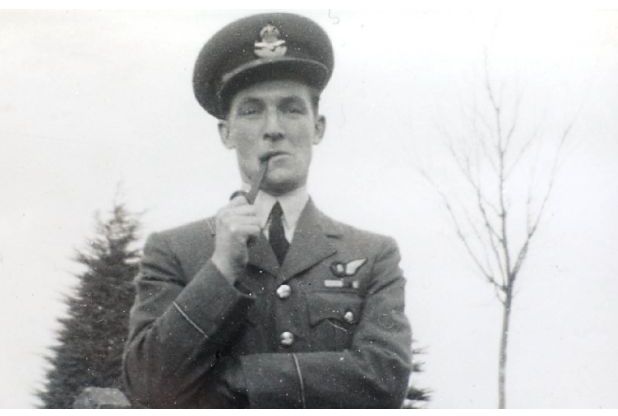
Johnny Johnson as a newly commissioned Pilot Officer, probably photographed in late 1943. [Pic: Torquay Herald Express]
Sgt G L Johnson
Bomb aimer
Lancaster serial number: ED825/G
Call sign: AJ-T
Second wave. First aircraft to attack Sorpe Dam. Mine dropped successfully but failed to breach dam. Returned to base.
George Leonard Johnson was born on 25 November 1921 in Hameringham, Lincolnshire, the sixth and last child of Charles and Ellen Johnson. He was known as Leonard to his family, but when he joined the RAF he was nicknamed “Johnny”, and this is the name by which he is mostly known now. His father was a farm foreman, living in a tied cottage and the family grew up in very poor conditions. Ellen Johnson died when Johnny was three, and his family life was very disrupted. Eventually his older sister Lena moved back home and he went to a local primary school in Winthorpe.
At the age of 11 he was sent as a boarder to the Lord Wandsworth Agricultural College in Long Sutton, Hampshire. At the time, this was a run by a charity catering for the children of agricultural families who had lost one or both parents. He did reasonably well at school and passed the School Certificate as well as playing cricket and football, and winning several athletics events. When he left school in December 1939, he started work as a park keeper in Basingstoke.
Johnson volunteered to join the RAF in June 1940, applying to become a navigator. He was, however, selected for pilot training. Eventually he joined up in November 1940, but the actual training took some time to materialise, since there was a huge bottleneck, so he was posted to various establishments. There was some compensation for all the moving around – at one posting, in Torquay, he met the woman, Gwyn Morgan, who would later become his wife.
In June 1941, Johnson was eventually sent for pilot training in Florida. More than one-third of those selected for pilot training were eventually “washed out”, which was what happened to him. As he always doubted he had the necessary skills, he was not surprised and he opted for air gunner training instead, when he arrived back in the UK in January 1942.
In July 1942, Johnson was posted to 97 Squadron at Woodhall Spa. He was designated as a spare gunner, without a regular crew, and so he flew with various skippers if one of their own gunners went sick. His first operation was on 27 August 1942, flying with the highly experienced Sqn Ldr Elmer Coton on a trip to Gdynia in Poland. However, an engine failure en route led to an early return, so the first time he saw action was the following day, on an operation to Nuremberg.
Johnson flew on a handful of operations but then the opportunity came up to train as a specialist bomb aimer, on a course at the nearby base of Fulbeck. He completed this course in late November 1942. Within a month, a vacancy for a bomb aimer came up in Joe McCarthy’s crew. At first Johnson wasn’t keen on flying with an American captain, but a conversation with McCarthy changed his mind, and he was introduced to his future crewmates. What united them, he wrote later, was the fact that they all had inbuilt confidence in McCarthy whom they regarded as the best pilot on the squadron.
Johnson’s first trip with McCarthy was an operation to attack Munich on 21 December 1942. It was packed with incident. In appalling weather, they were attacked by fighters and on the return trip lost complete power in one engine and suffered problems in another. They were forced to land at Bottesford.
Johnson went on a further 18 operations with McCarthy, which brought him to the end of a full tour with 97 Squadron. Knowing that he would then be entitled to some leave followed by six months working in a non-combat training role, he and Gwyn arranged their wedding for 3 April 1943. The ceremony was nearly called off when the whole crew were transferred to 617 Squadron for a new secret mission, and all leave was cancelled. His new CO, Guy Gibson, however relented, and gave them four days off.
In all the training for the Dams Raid Johnson practised dropping the mine as their aircraft flew straight towards the target at low level. However, on the afternoon of Sunday 17 May, when the five crews detailed to attack the Sorpe Dam received their briefing they were told that they had to fly along the dam wall and drop their mine at its centre. It would roll down the wall and explode when it reached the correct depth.
Following the delay in setting off and the switch of aircraft to AJ-T, they realised that they were the only crew which had got as far as the Sorpe Dam. McCarthy soon realised how difficult the attack was going to be, even though there were no flak batteries present to defend the dam. The approach involved flying over the small town of Langscheid, which had a prominent church steeple, and then dropping very low so that the mine could be dropped in the exact centre of the dam. It took a while to get the approach correct but eventually, on the tenth try, McCarthy managed to make a near perfect run, getting down to about 30 feet. Johnson released the weapon, and shouted “Bomb gone”.
Although AJ-T had failed to breach the dam, McCarthy, Johnson and navigator Don MacLean were all decorated for their part in the raid. Johnson received the DFM and travelled up to Buckingham Palace for the investiture. As a non-drinker, he didn’t participate in the festivities that followed.
Johnson was commissioned in November 1943 and went on to fly with McCarthy on all his subsequent 18 operations with 617 Squadron up until April 1944. At that point, knowing that Gwyn Johnson was shortly to have their first child, McCarthy insisted that he stand down. Reluctantly, Johnson agreed and was sent back to Scampton as a bombing instructor and served out the rest of the war in various training jobs. After the war, he was told that if he qualified as a navigator, he would get a permanent commission. He accepted this offer, and stayed in the RAF until 1962, retiring with the rank of Squadron Leader.
Johnson then retrained again, this time as a teacher. He worked first of all in primary schools and then later in adult education, including a period teaching psychiatric patients at Rampton Hospital.
When Johnny retired, he and Gwyn moved to Torquay, where Gwyn had been brought up. They became active in local Conservative Party politics, and Johnny was elected as a councillor, and became chair of the constituency party.
Gwyn Johnson died in August 2005 and for a while Johnny withdrew from public life. But then he started accepting invitations from the media for interviews and documentary appearances, and now he is one of the most familiar of the dwindling number of Bomber Command veterans, and has played a full role in the recent anniversaries of the Dams Raid.
As “the last British Dambuster”, Johnny now occupies an important place in what sometimes seems an insatiable public interest in the events of 16/17 May 1943. But, as his son Morgan points out in the last chapter of Johnny’s autobiography, “he is the first to recognise that all this attention is not purely about him personally, but is directed at what he represents. The Dambusters became a wartime legend that captured the public imagination and, as the last British survivor of that night, he represents all of them and what they achieved. There are many, many other stories of individual and collective achievements during World War II. Stories of extraordinary courage, of battles won in impossible situations, of acts of heroism against overwhelming odds. But the Dambusters remain high on the list of public affection. And that is what he will be remembered for, by the public at large.”
George “Johnny” Johnson, The Last British Dambuster, Ebury Press, 2014, p.298.
More about Johnson online:
Media biography compiled by UK Ministry of Defence
Survived war.
Died 7 December 2022, Bristol.
Rank and decorations as of 16 May 1943.
Sources:
Richard Morris, Guy Gibson, Penguin 1995
John Sweetman, The Dambusters Raid, Cassell 2002
Dave Birrell, Big Joe McCarthy, Wingleader Publishing, 2012
George “Johnny” Johnson, The Last British Dambuster, Ebury Press, 2014
The information above has been taken from the books and online sources listed above, and other online material. Apologies for any errors or omissions. Please add any corrections or links to further information in the comments section below.
Further information about Johnny Johnson and the other 132 men who flew on the Dams Raid can be found in my book The Complete Dambusters, published by History Press in 2018.
Dambuster of the Day No. 95: Leonard Eaton
Flt Sgt L Eaton
Wireless operator
Lancaster serial number: ED825/G
Call sign: AJ-T
Second wave. First aircraft to attack Sorpe Dam. Mine dropped successfully but failed to breach dam. Returned to base.
Leonard Eaton, aged 37, was the oldest man to take part in the Dams Raid. He was born in Manchester on 16 March 1906, one of the seven children of Thomas and Edith Eaton. He followed his father’s trade as a bookbinder after leaving school. He enlisted in the RAF in 1940. He was eventually sent for training as a wireless operator/air gunner and was posted to a conversion unit in the late summer of 1942. There he became one of the first people to crew up with Joe McCarthy, flying for the first time with McCarthy, Bill Radcliffe and Ron Batson on 13 September 1942.
The crew joined 97 Squadron, and Eaton flew on 17 operations during their tour, missing two periods of about a month, presumably through illness. The crew then transferred to 617 Squadron.
When they eventually took off on the Dams Raid, Eaton had a problem with the radio equipment in the spare aircraft AJ-T, and lost communication with Group HQ. Aware that this should mean that he abort the trip, McCarthy told him he didn’t hear what he said, and ploughed on. Eaton must have got the set working again, as later on they were able to communicate their progress, and he was able to hear the code word for the breach of the Möhne Dam being transmitted as AJ-T lined up to attack the Sorpe.
Following the raid he completed a further 34 trips with McCarthy, until the whole crew were taken off operations in July 1944. He was promoted to Warrant Officer in June 1944, and awarded the DFM.
In August 1944, he was posted to a training unit and commissioned. He left the RAF in 1945 and took up employment as an agent for a clothing firm. He carried on this work until his retirement.
Len Eaton died in Manchester on 22 March 1974 and was cremated at Manchester Crematorium.
Thanks to Roy Eaton for his help with this article.
Survived war. Died 22 March 1974.
Rank and decorations as of 16 May 1943.
Sources:
Richard Morris, Guy Gibson, Penguin 1995
John Sweetman, The Dambusters Raid, Cassell 2002
Dave Birrell, Big Joe McCarthy, Wingleader Publishing, 2012
George ‘Johnny’ Johnson, The Last British Dambuster, Ebury Press, 2014
The information above has been taken from the books and online sources listed above, and other online material. Apologies for any errors or omissions. Please add any corrections or links to further information in the comments section below.
Further information about Len Eaton and the other 132 men who flew on the Dams Raid can be found in my book The Complete Dambusters, published by History Press in 2018.
Dambuster of the Day No. 94: Donald MacLean
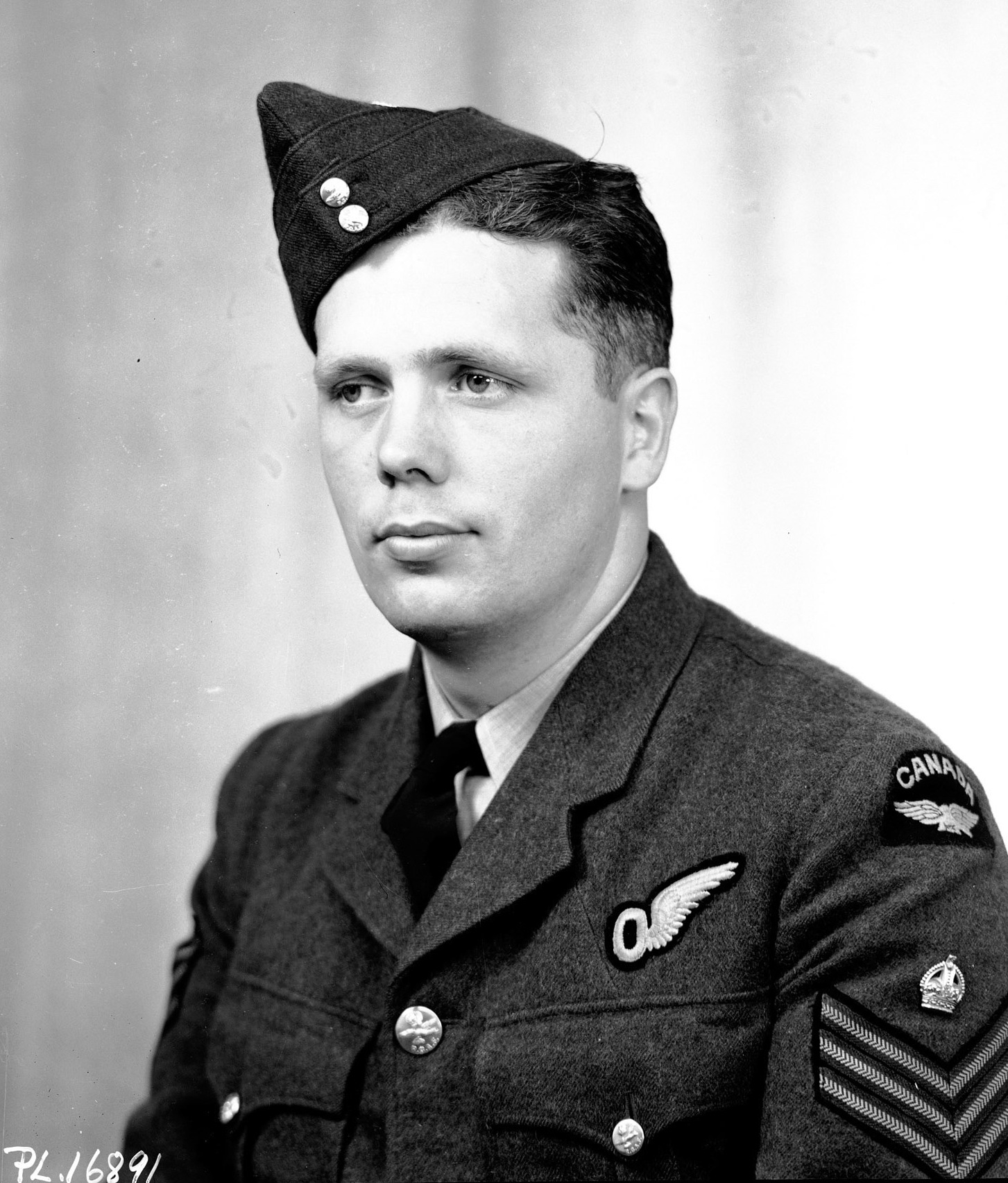
Don MacLean in an official photograph, probably taken soon after the Dams Raid, as he is still wearing his Flight Sergeant’s stripes and crown. [Pic: RCAF]
Flt Sgt D A MacLean
Navigator
Lancaster serial number: ED825/G
Call sign: AJ-T
Second wave. First aircraft to attack Sorpe Dam. Mine dropped successfully but failed to breach dam. Returned to base.
Donald Arthur MacLean was born in Toronto, Canada, on 2 April 1916, one of the four children of James and Edith MacLean. His father worked as a foreman at Goodyear Tires in the city. He went to Bloor Collegiate school and the University of Toronto, and then qualified as a teacher. He was a good ice hockey player, and this helped him get teaching positions in the small towns of Head Lake and Powassan in Ontario.
MacLean volunteered for the RCAF shortly after the war started. After qualifying as a navigator, he set out for England. After further training and a short spell in 44 Squadron, he arrived at 97 Squadron at the end of 1942. His first operation was with Flt Lt K G Tew, when they took part in “gardening” on 31 December 1942. MacLean then flew on a further 17 operations over the next three months, all except one with Tew as his pilot. He then transferred to Joe McCarthy’s crew. He may have seen this as a temporary move, since McCarthy and the others were all at the end of their first tour, but when the chance came for a move to a new squadron he went along with it. The easy rapport between McCarthy and his crew would surely have swayed his decision, along with the fact that it already held two other Canadians. Whatever the reason, with MacLean’s arrival, McCarthy’s crew was complete and wouldn’t change again for another 13 months.
MacLean’s navigation log for the Dams Raid provides an account of AJ-T’s journey, along with some fascinating details. At 0020, before the aircraft reached the target, MacLean wrote: “W.Op fixing TR9 under my table”. He recorded the time of arrival at Target Z as 0030 and at 0046 wrote “Bombs Gone”. If there were nine or ten runs in all, as Johnny Johnson recalls, then this would mean that they took not much more than 90 seconds each time to get back to the starting point.

MacLean’s log doesn’t seem to record the fact that AJ-T went off course on the way home, ending up over the heavily defended town of Hamm. Fortunately McCarthy managed to find a way through and the aircraft returned unscathed. The error might have been due to the earlier change in compass deviation cards.
MacLean and Johnson were both awarded DFMs for their work on the Dams Raid. It emerged a few days later that MacLean had in fact been commissioned shortly before the raid, but didn’t receive notification until afterwards. This meant that logically, he should have received the officers’ medal, the DFC, instead. Adjutant Harry Humphries offered to try and get the draft award changed, but MacLean declined, saying: “Hell, no!”
MacLean carried on flying with Joe McCarthy throughout the rest of their tour, ending with 57 operations under his belt. He married his wife Josie, who had worked as a wireless operator at Scampton, in Lincoln Cathedral in 1944. She went out to Canada and lived with her parents-in-law until MacLean himself was able to return there later that year.
Don MacLean stayed in the RCAF after the war, and eventually retired in 1967 as a Wing Commander. He was stationed in many locations across Canada and the USA but also had a four year stint from 1957 to 1961 on the Canadian Joint Staff in London. The family, which by then included four children, lived in Croydon at that time.
After leaving the RCAF, he worked as Director of the Ontario Health Insurance Program (OHIP) in Toronto. He finally retired in 1981 and died in Toronto on 16 July 1992.
Survived war. Died 16 July 1992.
Rank and decorations as of 16 May 1943.
Sources:
Richard Morris, Guy Gibson, Penguin 1995
John Sweetman, The Dambusters Raid, Cassell 2002
Dave Birrell, Big Joe McCarthy, Wingleader Publishing, 2012
George ‘Johnny’ Johnson, The Last British Dambuster, Ebury Press, 2014
The information above has been taken from the books and online sources listed above, and other online material. Apologies for any errors or omissions. Please add any corrections or links to further information in the comments section below.
Further information about Don MacLean and the other 132 men who flew on the Dams Raid can be found in my book The Complete Dambusters, published by History Press in 2018.
Dambuster of the Day No. 93: William Radcliffe
Six members of the McCarthy crew, photographed in July 1943. L–R: George “Johnny” Johnson, Don MacLean, Ron Batson, Joe McCarthy, Bill Radcliffe, Len Eaton. [IWM TR1128]
Sgt W G Radcliffe
Flight Engineer
Lancaster serial number: ED825/G
Call sign: AJ-T
Second wave. First aircraft to attack Sorpe Dam. Mine dropped successfully but failed to breach dam. Returned to base.
William Gordon Radcliffe was born in New Westminster, British Columbia, Canada on 24 September 1919, and was educated at New Westminster Central School and I J Fopp Technical High School.
In March 1939, suspecting that war was on its way, Radcliffe travelled to England with his friend Howard Godfrey, and volunteered to join the RAF as a ground crew mechanic. Over the next three years he developed the skills which Joe McCarthy would come to rely on later in the war.
In 1942 the RAF decided to dispense with the second pilot and institute the new position of flight engineer in its heavy bomber squadrons. Many ground crew saw this as their chance to fly, and amongst these was the young Canadian. Radcliffe was sent to the No 4 School of Technical Training at St Athans in Wales, and qualified as a flight engineer in July 1942. He was posted to 97 Squadron and flew on his first operation on 10 September 1942. A few days later, he had teamed up with Joe McCarthy and together with Ron Batson and Len Eaton became the nucleus of a crew which would stay together for almost two years.
Radcliffe was also the owner of the crew’s mascot, a small stuffed Panda Bear which he would tuck into his boot on every flight. Its features were also copied onto the nose art on several of the crew’s regular aircraft.
Their first operation as a crew was on 5 October on a trip to Aachen. Most crews were given what was thought to be a relatively easy assignment on their first operation. The McCarthy crew’s first outing most certainly was not. In a letter home, Radcliffe wrote:
You usually get a nice easy trip for the first time and we were told this one was going to be fairly easy. But it didn’t turn out that way. … [W]hen we got up to 10,000 feet we ran into an electrical storm. It sure was pretty at first seeing sparks and flashes all over the windscreen and flashes all over the wings and fuselage and the tips of the props were glowing. But then it started to ice up and then the trouble started.
We climbed right up to 15 or 16 thousand and we were still in it. We’d pass through a cloud with a negative charge and then hit one with a positive and the result was a big blinding flash that scared the daylight out of me. We weren’t much troubled by Jerry and we made the target O.K. and just managed to bomb through a gap in the clouds but couldn’t see the results.
Coming back it got worse and we ran into a lot more ice. We must have dropped over 14,000 feet in less than nothing and the rapid change in temperature or the ice cracked the perspex windows on each side of the cabin and blew a two foot hole out of each side. Believe me then I was scared. I thought for sure we had been hit, my log and the navigator’s log, pencil and instruments etc just vanished outside. As soon as I realised what happened, I looked out and saw that we were skimming the tree tops of France. You could see the roads and houses plainly and we passed over a large town that didn’t seem to be blacked out at all.
We got everything under control again and made some height to cross the coast. When we got back to the aerodrome we couldn’t get any answer from our radio and after half an hour of circling we had to land by signals. When we got down we found the aerial inside the kite instead of outside. It must have broken off in the storm and come through the window. Believe me I was relieved to find some of the other crews were scared as much as we were. Mac is a wizard at handling the machine. If it hadn’t of [sic] been for him … I think if I had to go through these storms on every trip I’d be grey before I’m 24.
[Dave Birrell, Big Joe McCarthy, p.55]
Fortunately not every operation was as eventful as this, and Radcliffe went on to complete his full tour with McCarthy by March 1943. The whole crew was then transferred to the new 617 Squadron for “just one more trip”.
After all the training came the raid itself. Because of the late change of aircraft, the McCarthy crew were more than half an hour late leaving the ground. Radcliffe’s skills as a flight engineer were put to the test as they pulled out all the stops to make up time, something McCarthy would later acknowledge, and they were only nine minutes late reaching the Sorpe Dam. On their return journey, Radcliffe’s experience told again:
We decided that we’d map-read through the Zieder Zee and go home the way we came in. We scooted up the Zieder Zee. My engineer had flown with me on many, many trips. He and I always used to argue about speed and he’d say “No we’ve got to save gas, we’ve got to save gas.” He’d never give me my speed. But this night, coming out I was saying “Cut those motors back, you’re going to burn them out.” He had them set right up to the max and we were really tooting along. He had it all set like that until we got out into the middle of the North Sea.
[Dave Birrell, Big Joe McCarthy, p.123]
Radcliffe went on to fly with McCarthy throughout the rest of their second tour. He was commissioned in November 1943, and awarded the DFC in June 1944. After coming off operations, he served in training units for the remainder of the war, returning to Canada in February 1945.
After the war he became a Customs and Excise Officer, and was also attached to the recruiting branch of the RCAF Reserve. Bill Radcliffe died on 5 July 1952 when his car failed to go round a bend in the road and went into the Fraser River, where he drowned. It was thought he had had a blackout. He was cremated and his ashes were scattered by his colleagues in the RCAF Reserve over his favourite mountain, Burnaby Mountain in Canada (also known as Eagle Mountain).
He had married Joyce Palfreyman, an English WAAF, and they had three children. Following his death, Joyce returned to the UK with the children to be nearer her own family.
Footnote: It is interesting to note that there were two Canadian-born flight engineers on the Dams Raid. Both joined the RAF as ground staff before the war, and became flight engineers when the positions became available in 1942. The other was Sgt Charles Brennan in John Hopgood’s crew who was born in Calgary, Alberta in 1916. His family emigrated back to the UK in 1928.
Thanks to Dorothy Bailey for help with this article.
Survived war. Died 5 July 1952.
Rank and decorations as of 16 May 1943.
Sources:
Richard Morris, Guy Gibson, Penguin 1995
John Sweetman, The Dambusters Raid, Cassell 2002
Dave Birrell, Big Joe McCarthy, Wingleader Publishing, 2012
George ‘Johnny’ Johnson, The Last British Dambuster, Ebury Press, 2014
The information above has been taken from the books and online sources listed above, and other online material. Apologies for any errors or omissions. Please add any corrections or links to further information in the comments section below.
Further information about Bill Radcliffe and the other 132 men who flew on the Dams Raid can be found in my book The Complete Dambusters, published by History Press in 2018.
Dambuster of the Day No. 92: Joseph McCarthy
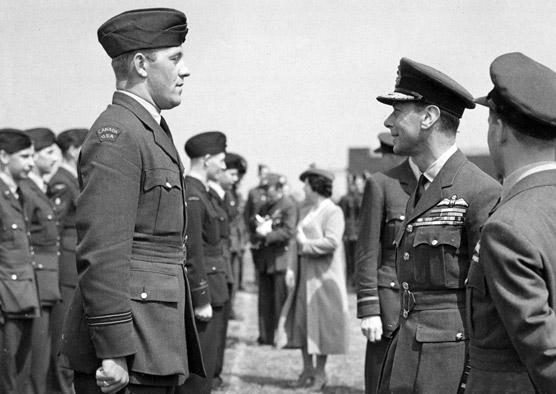
Joe McCarthy talks to the King, Scampton, 27 May 1943. Note McCarthy’s dual “Canada USA” shoulder flash. [Pic: IWM CH9925]
Flt Lt J C McCarthy DFC
Pilot
Lancaster serial number: ED825/G
Call sign: AJ-T
Second wave. First aircraft to attack Sorpe Dam. Mine dropped successfully but failed to breach dam. Returned to base.
Joseph Charles McCarthy was born on 31 August 1919 in St James on Long Island, New York, USA, the older of the two sons of Cornelius and Eve McCarthy. His father worked as a clerk. Shortly after Joe was born, the family moved to the Bronx in New York City, where Cornelius worked as a book-keeper in a shipyard. Later he became a firefighter.
Joe’s mother died when he was eleven and his grandmother took over the running of the household. Although they lived in the Bronx, they had a summer home on Long Island and it was there he became a champion swimmer and baseball player, and worked as a life guard at various beaches including Coney Island. In his late teens, he and his friend Don Curtin became interested in flying and took lessons at Roosevelt Field on Long Island, then the busiest airfield in the USA.
When the war started, Joe made several attempts to join the US Air Corps but was rebuffed because he didn’t have a college degree. By May 1941, he was getting frustrated and so he and Don decided to take an overnight bus up to Ottawa in Canada. Having located the RCAF recruiting office, they were first told to come back in six weeks.
‘Don and I responded that we didn’t have the money to return again so if the airforce wanted us they had better decide that day.’ With that the officer in charge looked the two young, strong, healthy Americans over, realised that they were ideal prospects, and said ‘Okay.’ Enlistment papers were filled out, medical examinations were passed, and Joe and Don were enlisted in the Royal Canadian Air Force Special Reserve.’
Dave Birrell, Big Joe McCarthy, Wingleader 2013, p19.
The pair became two of the almost 9,000 American citizens who eventually joined the Royal Canadian Air Force. By the end of 1941, they were both qualified pilots and, with new wings stitched proudly on their uniforms, were on board a ship bound for Liverpool.
More training was to follow in a variety of different establishments. By 31 July 1942, both Curtin and McCarthy were at 14 Operational Training Unit, training on Hampdens, when they were both called on to participate in one of the large raids which followed the series of Thousand Bomber Raids. 630 aircraft were mobilised from many different squadrons and OTUs for a raid on Dusseldorf. McCarthy’s operational debut passed off without incident, but Curtin had a more eventful trip, evading two separate fighter attacks and then hit by anti-aircraft fire. He landed in a field in Devon and dragged his wounded crew from the aircraft. For this action, he received an immediate DFC, a very rare occurrence of such an award being made for a first operation.
In September 1942, both were posted to 97 Squadron’s conversion flight for their training on Lancasters. Flight engineer Bill Radcliffe, a Canadian, wireless operator Len Eaton and air gunner Ron Batson, both British, all joined the squadron at about the same time and became regular members of Joe McCarthy’s crew. These four would stay together for the next 21 months, coming off operations at the same time in July 1944.
The conversion course finished, and McCarthy and his crew were initially posted to 106 Squadron at Coningsby, along with Don Curtin and his crew. At the last minute, McCarthy was sent instead to 97 Squadron at Woodhall Spa, as one of the replacements for a series of heavy losses it had undergone. The other three members of McCarthy’s crew at this time were navigator Flt Sgt W Brayford, bomb aimer Sgt Alan Westwell and rear gunner Sgt Ralph Muskett.
McCarthy made the usual “Second Dickey” trip on an operation to Krefeld on 2 October 1942, flying as co-pilot with Flg Off C D Keir. Three days later, the crew undertook their first full operation together, in an attack by 257 aircraft on the town of Aachen. Weather conditions were very poor, and McCarthy and his crew suffered severe problems with icing which left the cockpit side windows with large holes.
McCarthy went on to complete several more operations by early December. At that point, there was a change in his crew. The navigator, Sgt Brayford, left and Sgt Westwell, the bomb aimer who was also a trained navigator, moved into his job. The replacement bomb aimer was Sgt George “Johnny” Johnson, who had been on the squadron for a few months but had no regular crew. He had flown on a number of operations as a gunner. His first trip with McCarthy was on a raid on Munich on 22 December 1942.
In January, the crew flew on an operation to Duisburg using Lancaster ED340 for the first time. They would use this aircraft for most of the rest of their tour, and named it “Uncle Chuck Chuck” after a small toy panda which Bill Radcliffe always carried. They had the name and a picture of the panda painted on its nose, and would have similar pictures painted on most of the aircraft they used regularly during the rest of the war.
Later in January, rear gunner Sgt Muskett left the crew, after suffering bad reactions during corkscrews and other necessary evasive actions. His replacement was Flg Off Dave Rodger, another Canadian. On 25 February, McCarthy set off on his 24th operation, an attack by 337 aircraft on Nuremberg. Also on this raid was Don Curtin, in a detachment from 106 Squadron, but unfortunately he was shot down near Furth. When word reached 97 Squadron, someone in authority decided not to tell McCarthy until he had completed his tour. Less than three weeks later, on 12 March, navigator Sgt Westwell finished his tour after a trip to Essen and was replaced by the crew’s third Canadian, Flt Sgt Don MacLean.
By 22 March 1943 McCarthy had completed a tour of 33 operations. He was promoted to Flight Lieutenant, and recommended for a DFC. By then, he had also been told about Don Curtin. The pair had discussed their future, possibly thinking of joining the USAAF. But without his friend, McCarthy was considering his position. Then he had a phone call from Guy Gibson to ask him personally to join the new squadron he was setting up for a special secret operation. Gibson had known McCarthy from his time at 97 Squadron conversion flight the previous September and had also been Don Curtin’s CO in 106 Squadron. McCarthy recounted later:
He asked me if I’d like to join a special squadron for one mission. He also asked if I could bring my own crew along… He couldn’t tell me what we were going to do, where we were going to go, or anything… He said “If you can’t bring the whole crew take as many as you can. We’ll probably find some for you, but we would prefer your own.”
I explained it to my crew and I got a lot of flak back, quick, “Why? What are we going to do?” Same thing I asked and I just had to tell them I didn’t know but it was going to be just one trip. I don’t know whether I, at that moment, had any decision from them that they would accompany me. But in two days, I arrived at the Officers Mess and I was looking around and I found all my crew there with a brief but proud little grin, and they were all ready and waiting to go again. So I had the original crew all the way through.
The next thing we knew we were at Scampton. Gibby didn’t fool around.
Dave Birrell, Big Joe McCarthy, 2013, p87
When the crew arrived at Scampton, they hit a problem. Orders had been issued that since training for the special operation was to begin straightaway, all leave was cancelled. McCarthy and his crew had been due to go on a week’s leave, and bomb aimer Johnny Johnson had arranged to get married during this time, on Saturday 3 April. When he told McCarthy he reacted quickly, gathering the entire crew together and marching them into Gibson’s office. Johnson recalled:
Joe laid it on the line.
“The thing is, sir,” he said, very forcibly, “we’ve all just finished our tour and we are all entitled to a week’s leave. My bomb aimer is due to be married on the third of April and let me tell you he is going to get married on the third of April!”
There was a short pause while the others, no doubt, wished they were anywhere else except standing in the office of Wg Cdr Guy Gibson DSO, DFC and Bar, who had a fearsome reputation as a strict disciplinarian and had been known by the crews of 106 Squadron as “The Arch-Bastard”.
He looked us up and down and said, “Very well. You can have four days. Dismissed.”
Thank you Joe!I left for Torquay immediately, before our new CO could change his mind.
George “Johnny” Johnson, The Last British Dambuster, Ebury Press 2013, p133
In fact, Gibson was probably relieved. He would have known at this stage that he didn’t yet have enough aircraft for his new squadron to train on, so a crew going on leave for four days was hardly going to upset the schedule too much. On their return, the training began in earnest. It involved low flying for days at a time, something they all found exhilarating. At one point McCarthy was flying at about 100 feet above the ground when another Lancaster flew below him. He was livid, as he wasn’t prepared for this and could only think of what might have happened. Everyone he asked denied responsibility, although later Les Munro confessed it was him. (Johnson, p146)
Five days before the raid, Gibson wrote up a provisional order of battle on an early draft of the operational order. Nine aircraft were listed in the First Wave, scheduled to attack the Möhne and Eder Dams, and they included both Joe McCarthy and Les Munro. Then, during the long meeting which took place the day before the operation, the pair were moved to the Second Wave, attacking the Sorpe Dam. This was not a reflection of the bombing abilities of either crew but rather a late acknowledgement that the Sorpe should be seen as a higher priority.
With hindsight, the lack of a detailed strategy for attacking the Sorpe can be seen as a major failure by Barnes Wallis and the operation’s planners. Tests had shown that the ‘bouncing bomb’ had a good chance of working when delivered at right angles to a concrete walled dam, like the Möhne and Eder. But no one had been able to think of an effective way of delivering the same exploding depth charge against an embankment type dam with its sloping wall, built of earth and concrete.
So it was that, on the day of the raid, the five crews of the Second Wave were suddenly told that the type of attack they had been training for would not be used. Instead, they were to fly along the dam wall at low height and release the mine in such a way that it would roll down the wall and explode when it reached the correct depth. Joe McCarthy was given the responsibility of leading the Second Wave, controlling it using the newly installed VHF radios. The five aircraft would not fly in formation but would take off at one minute intervals, starting at 2127, and ahead of the Second Wave. Because they were to take a longer route, this would mean that they would cross the Dutch coast at the same time as the First Wave, but further north.
The crew headed out to their designated aircraft, ED923 code name AJ-Q, which they had nicknamed “Queenie Chuck Chuck”. Unfortunately, while the engines were being run up one on the starboard side developed a coolant leak and it was obvious that it could not be used. Determined not to miss the action, McCarthy ordered his crew out and set off for the spare Lancaster AJ-T, which had only arrived on the base six hours previously. A series of mishaps then occurred. As they threw all the essential equipment out of the windows, McCarthy’s parachute caught on a hook and blossomed all over him on the ground. They reached AJ-T, only to find it didn’t have its important compass deviation card on board. McCarthy charged off himself in a truck to the flight office to get the card. His approach resembled a “runaway tank”, recalled adjutant Harry Humphries later. A search for the card followed, while Humphries did his best to calm the big American down. It was found quite quickly and McCarthy headed back to AJ-T, where Dave Rodger had spent several minutes getting ground crew to remove the Perspex sliding panel in his rear turret.
AJ-T eventually took to the air some 33 minutes later than their scheduled departure time, after the nine aircraft in the First Wave had departed. Bill Radcliffe’s engineering skills were tested as AJ-T flew as fast as possible to make up time, and they had made up 16 minutes by the time they reached the Dutch coast.
The Second Wave was already in severe trouble, a fact unknown to their designated leader flying behind them. Byers had been shot down and Munro and Rice had been forced to abandon the operation. Barlow had got through, but would crash in flames less than an hour later. McCarthy ploughed on, although by the time he was in ememy territory, he had lost radio contact with base, the GEE navigation system had failed and a light had come on in the nose compartment, which made them a much easier target for the night fighters they could see above them. The light problem was easily fixed with a blow from Radcliffe’s crash axe, and later Len Eaton managed to reestablish radio contact.
When they reached the Sorpe, they realised that none of the other crews had made it. Surveying the scene, McCarthy realised how difficult the attack was going to be, even though there were no flak batteries present to defend the dam. The approach involved flying over the small town of Langscheid, which had a prominent church steeple, and then dropping very low so that the mine could be dropped in the exact centre of the dam. After several attempts, McCarthy realised that he could use the steeple as a marker and eventually, on the tenth approach, he managed to make a near perfect run, getting down to about 30 feet. Johnson released the weapon, and shouted “Bomb gone”. “Thank God” came the reply from Dave Rodger in the rear turret, pretty fed up with the continuous buffeting he was getting from the steep climb necessary at the end of the run.
McCarthy set course for home, but went via the Möhne, having heard over the radio that it had been breached. They saw a clear breach in the wall and noted that the level was already well down. On the return flight they went badly off course and flew over the heavily defended town of Hamm, a place they had been warned to avoid. Realising that the compass was not reading accurately they managed to navigate by sight across the reast of enemy territory, narrowly avoiding being shot down on several occasions. As they came in to land at Scampton, they realised that one of the undercarriage tyres had been shot through, but McCarthy still landed safely.
McCarthy and some of his crew participated in the party which followed their debrief, although it was tinged with sadness as it became clear how many crews had been lost. One of the highlights of the weeks that followed was the royal visit on 27 May, with McCarthy photographed as he talked to the Queen, towering over her and with his “Canada USA” shoulder flash clearly visible. He met her again at Buckingham Palace on 21 June when he received his DSO. He is supposed to “have turned pink and stammered out answers” as she questioned him about his home life in New York. (Brickhill, The Dam Busters, p.111)
McCarthy stayed on in 617 Squadron without a break for another 13 months after the investiture, flying on 34 more operations altogether. His Dams Raid crew stayed with him all this time, with the exception of Johnny Johnson, who left in April 1944 shortly before his first child was born. McCarthy insisted he move on, knowing that he had done a full second tour, and telling him his duties were to his burgeoning family.
After the war, McCarthy went back to Canada and in 1946 married Alice, the American girlfriend he had met while training in 1941. They went on to have two children. In order to stay in the RCAF he took Canadian nationality, but when he finally retired from the service in 1968, he moved back to the USA. He lived in Virginia and worked in real estate.
Over his career he flew nearly seventy different types of aircraft. McCarthy died in Virginia Beach, VA, on 6 September 1998.
Joe McCarthy died on 6 September 1998.
More about McCarthy online:
Wikipedia entry
Obituary in The Independent
Obituary in the New York Times
Survived war. Died 06.09.1998
Rank and decorations as of 16 May 1943.
Sources:
Richard Morris, Guy Gibson, Penguin 1995
John Sweetman, The Dambusters Raid, Cassell 2002
Dave Birrell, Big Joe McCarthy, Wingleader Publishing, 2012
George ‘Johnny’ Johnson, The Last British Dambuster, Ebury Press, 2014
The information above has been taken from the books and online sources listed above, and other online material. Apologies for any errors or omissions. Please add any corrections or links to further information in the comments section below.
Further information about Joe McCarthy and the other 132 men who flew on the Dams Raid can be found in my book The Complete Dambusters, published by History Press in 2018.
Dambuster of the Day No. 91: Stephen Burns
Sgt S Burns
Rear gunner
Lancaster serial number: ED936/G
Call sign: AJ-H
Second wave. Aircraft badly damaged and mine lost, flying low over sea on outward flight. Returned to base.
Stephen Burns was born in Dudley, Worcestershire on 27 December 1920, the oldest of the four children of John and Sarah (Sally) Burns. John Burns was a labourer in a steel works. He had served in the Gordon Highlanders during the First World War, and they moved back to his home town of Manchester for a while during Stephen’s childhood. As a reservist, his father was called up at the outset of the Second World War, and served in the Royal Engineers.
Stephen Burns was working in an armaments factory in Dudley when the war started. Although he was in a reserved occupation and therefore not eligible for call up, he volunteered for the RAF in 1941, and after a period working as ground crew trained as an air gunner.
After qualifying, he was posted to 57 Squadron in November 1942. He flew in both the mid-upper and rear gunner’s turrets on a number of operations with at least four different pilots between December 1942 and 7 February 1943, when he was first allocated to Geoff Rice’s crew, when they flew on a trip to Lorient. On this operation he replaced Charles Challenger, who had previously filled this position. Challenger returned to the Rice crew on a couple more occasions but in early March Burns became its regular rear gunner. He was transferred along with the rest of the Rice crew to 617 Squadron at the end of March.
On the Dams Raid, Burns suffered the ignominy of being soaked by a combination of sea water and Elsan contents when AJ-H flew too low and hit the sea, and its Upkeep mine was torn away. The damage was caused by the tail wheel being forced up into the fuselage. Geoff Rice later recalled his understandable reaction, shouting over the intercom: ‘Christ, it’s wet back here!’ Worse nearly followed since, as the aircraft climbed, all the water flooded into the rear turret, threatening to drown its occupant. Burns had to smash the Perspex window so that it could drain out.
Burns flew with Rice and the rest of his crew on the handful of successful operations they undertook between the Dams Raid and December 1943, and was promoted to Flight Sergeant. However, the crew’s luck ran out on 20 December when they were shot down 14,000 feet above Merbes-Le Chateau in Belgium. Although Rice gave the order to bale out, there wasn’t time and the aircraft exploded. Rice seems to have been thrown clear by the explosion, and somehow landed in a wood but the bodies of the remaining six crew members were found in the wreckage, and they were buried in Gosselies Communal Cemetery, near Hainaut, Belgium.
A few weeks earlier, Burns had been best man at the wedding of Sgt Bill Haworth, Les Munro’s gunner. Haworth flew on the same operation on 20 December and apparently witnessed the shooting down of Rice’s aircraft. He visited the family afterwards and told them what he had seen. After the war, Burns’s brother John visited the grave, and was given a pair of gloves belonging to Stephen Burns, which had apparently been retrieved from the wreckage by local villagers. They had taken articles from all the bodies so that if relatives came visiting they could be given some small memento of their loved one.
[Thanks to the St John’s Church Preservation Group for their help with this article.]
More about Burns online:
Entry on Commonwealth War Graves Commission website
Page about Rice crew burial site, Gosselies cemetery
KIA 20.12.1943.
Rank and decorations as of 16 May 1943.
Sources:
Nigel Press, All My Life, Lancfile Publishing 2006
Richard Morris, Guy Gibson, Penguin 1995
John Sweetman, The Dambusters Raid, Cassell 2002
John Sweetman, David Coward and Gary Johnstone, The Dambusters, Time Warner 2003
Chris Smith, Tales from a Churchyard, Volume 1, St John’s, Church Hill, Dudley.
The information above has been taken from the books and online sources listed above, and other online material. Apologies for any errors or omissions. Please add any corrections or links to further information in the comments section below.
Further information about Stephen Burns and the other 132 men who flew on the Dams Raid can be found in my book The Complete Dambusters, published by History Press in 2018.