First hand account of 617 Squadron’s attack on the Lützow

The flag of the German navy flying on the Lützow before it was attacked and sunk by 617 Squadron in April 1945. [Pic: Rudolf Ritscher/Horsley family]

Flt Lt Robert Horsley joined 617 Squadron towards the end of the war as a pilot, but he already had an earlier tour of operations under his belt in Bomber Command as a wireless operator/air gunner before retraining. He took part in a number of famous operations in late 1944 and early 1945, and went on to have an interesting and colourful post-war career. His family have kindly sent me a number of pieces of interesting material, including those shown below relating to the attack on the German battle cruiser Lützow, which took place on 16 April 1945.

Robert Horsley was born on 4 May 1921 at Poppleton near York, the youngest of the four sons of Edgar and Irene Horsley. One of his brothers, Hugh, joined the RAF and was killed when his bomber crashed shortly after take-off on its way to a sortie over Germany. The other two were in the army.

Horsley trained as a wireless operator/air gunner before joining 50 Squadron, which was then equipped with twin-engine Hampdens, at Skellingthorpe in August 1941. He flew on a number of operations before moving on to the Manchester. One of his 50 Squadron colleagues and a good friend was fellow air gunner Johnnie Tytherleigh, who later went on to fly on the Dams Raid with pilot Henry Maudslay. He flew on the first Thousand Bomber raid in May 1942, an attack on Cologne. The Manchester aircraft was in poor condition, and had to fly below its designated bombing height. Exposed to German flak, the plane took several hits.

The pilot, Flg Off Leslie Manser, decided to try to make it back to England or, at worst, reach the Channel. However the damage was so bad that eventually, at just 800 ft, he calmly ordered his crew to jump. They all baled out, but for Manser it was too late and he died when the aircraft crashed near Bree in Belgium. He was posthumously awarded the VC, and Horsley was awarded the DFC.

Horsley eventually made it back to Britain, aided by the Belgian ‘Comet’ escape line who passed Allied aircrew from one contact to another until eventually they crossed the Pyrenees into Spain. When he returned he put in for pilot training and was sent to Canada to qualify. He then worked as an instructor since he was not allowed to carry on flying over occupied Europe as he had once evaded capture there.

After the liberation of France and Belgium in late 1944, the policy was changed and Horsley was allowed to return to operational flying. He joined 617 Squadron as a pilot on 25 November 1944, with the crew seen below. Together they flew on about 12 operations by the end of the war. These included the raids on various U-boat pens, the docks at Bremen and the attack on the battle-cruiser Lützow on 16 April 1945. Reconnaissance aircraft had located this ship in the Kaiserfahrt, the canal near Swinemunde and the Baltic Sea.
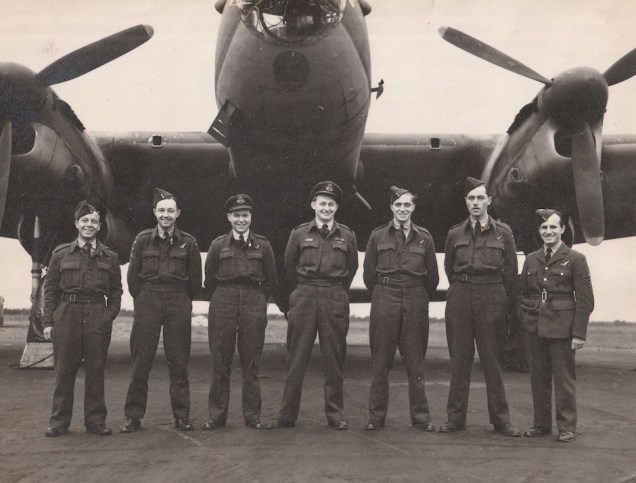
Flt Lt Robert Horsley and his crew. Left to right: Sgt Harry Farino, mid-upper gunner; Sgt Peter Durose, wireless operator; Flg Off Johnnie Barleycorn, navigator; Horsley; Flt Sgt Paddy Armstrong, flight engineer; Sgt Derek Wilson, bomb aimer; Sgt Louis Neale (Belgium), rear gunner. [Pic Horsley family]

Ten years later Horsley, still a serving RAF officer, was contacted by a German ex-sailor, Rudolf Ritscher, who had been part of the Lützow’s crew. Ritscher sent Horsley some photographs, published here for the first time, and in return Horsley sent him an account of the attack, an extract from which follows.
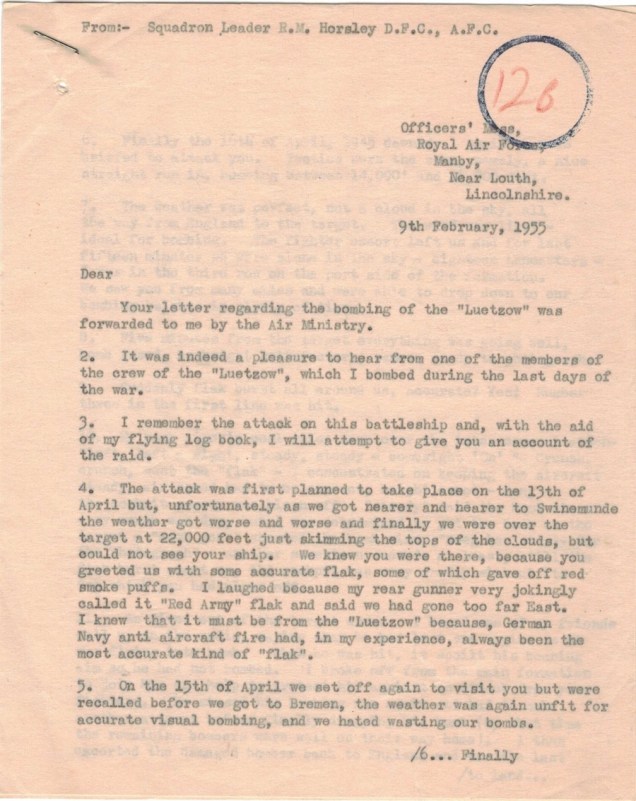
Letter written in 1955 from Horsley to Rudolf Ritscher. [Pic: Horsley family]

In the letter, Horsley explained how operations on the two previous days had to be aborted because of poor weather, but then on 16 April, the attack began. Of the eighteen 617 Squadron aircraft fourteen, including Horsley, were carrying the 12,000lb Tallboy bombs.

Tactics were the same, namely, a nice straight run in, bombing between 14,000 and 16,000 feet. 
The weather was perfect, not a cloud in the sky, all the way from England to the target. The wind was light – ideal for bombing. The fighter escort left us and for last fifteen minutes we were alone in the sky – eighteen Lancasters – I was in the third row on the port side of the formation. We saw you from many miles and were able to drop down to our bombing heights in plenty of time. 
Five minutes from the target everything was going well, bomb fused, bombsight satisfactory, camera fready to photograph.
Suddenly flak burst all around us, accurate? Yes! Number three in the first line was hit.
My bomb aimer’s cool voice came over the inter-communication – “left, left – right, steady, steady – bombsight ‘on’ ”– Crunch, crunch went the flak – I concentrated on keeping the aircraft steady, air speed had to be correct, height exact – Bang – the cockpit canopy was blown off – “steady” said the bomb aimer – my mouth was dry, but I was determined to get the bomb on the target – “Bomb gone” shouted the bomb aimer “Keep her steady for the photograph” – another seventeen seconds at least, still the flak burst about us, the cockpit was very drafty without its top which you had blown off.
We dived out of the target area. I heard one of my friends call up on the radio, saying that he had lost one engine as he was flying into bomb. When he was hit it spoilt his bombing aim so he had not bombed. I broke off from the main formation to join him and help protect him against an attack from your fighters. He missed his bombing run again and had to make another attempt before finally dropping his bomb (by that time the remaining bombers were well on their way home). I then escorted the damaged bomber back to England and was the last to land. 
[Punctuation and spelling as in original.]

The Lützow had been sunk, although because the water was so shallow it wasn’t immediately obvious. Its guns remained above the water level, however, so for a number of days they continued to be used as a stationary battery against advancing Soviet forces.
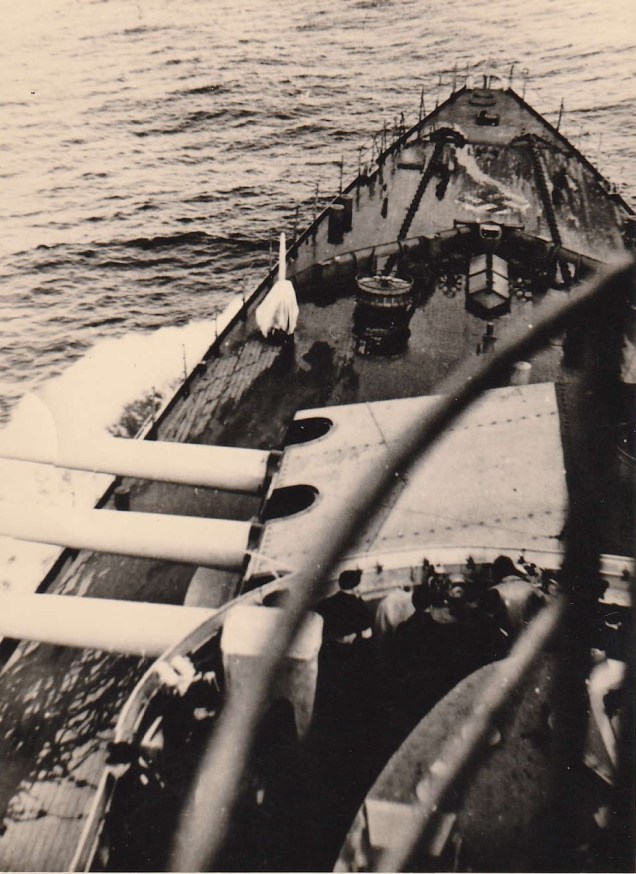
General view of the deck and one of the large gun batteries. [Pic: Rudolf Ritscher/Horsley family]
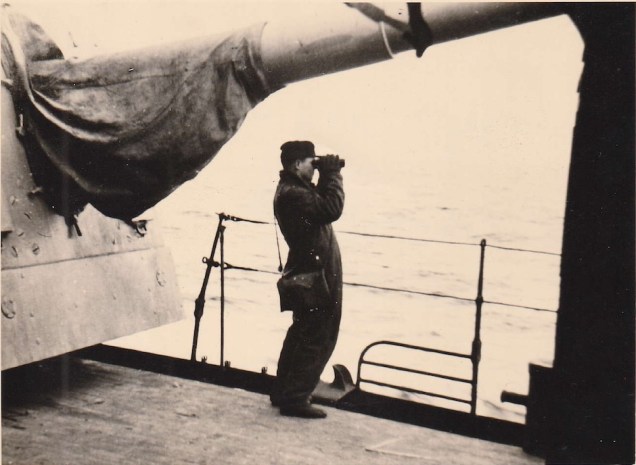
Lookout. [Pic: Rudolf Ritscher/Horsley family]

Flak gun battery. [Pic: Rudolf Ritscher/Horsley family]

After this successful attack Horsley and his crew flew on two more operations before the end of the war. The first, on 19 April, was a massive show of strength when 900 aircraft bombed the town and naval base at Heligoland. The final act was 617 Squadron’s last operation of the war, the attack on Hitler’s ‘Eagles Nest’ at Berchtesgaden on 25 April in which 359 Lancasters took part.

After the war, Horsley was granted a permanent commission in the RAF. He converted to jet aircraft, commanded a jet training squadron and did stints at the staff college and Air Ministry. Finally he was seconded to the Foreign Office, served as Air Attaché in both Iraq and Saudi Arabia and then worked on what are euphemistically called ‘special duties’ while stationed in Beirut. He eventually retired in 1972 and moved to Australia. He died on 19 January 2016.

Daily Telegraph obituary
The Times obituary (behind paywall)

[Pic: Geoff Armstrong]

By coincidence Geoff Armstrong, the son of Horsley’s flight engineer, Wrt Off Edward (Paddy) Armstrong, has recently posted this image of his father’s logbook on the Bomber Command Crews and Aircraft Facebook page. It covers the crew’s operations over the same period, in April 1945.

The attack on the Lützow was the last operation of the war in which 617 Squadron suffered casualties, the loss of Sqn Ldr John Powell and his crew. You can read more about them in this post from January 2012.

Thanks to Nigel Horsley for help with this article.

Flak battery which shot down AJ-A on Dams Raid confirmed

Pic: Christian Koenig

EXCLUSIVE to Dambusters Blog

The family of the German naval officer who commanded the anti-aircraft battery which shot down Melvin Young’s AJ-A on the night of the Dams Raid have recently been in touch, and have sent me the ‘Punktliste’ form you can see above. A Punktliste (‘points list’) was kept for each battery crew, and leading to decorations if they achieved a score of eight points.

The battery was a Kriegsmarine (German navy) artillery unit, commanded by a Batteriechef. A number of batteries formed a so called Abteilung. Each Abteilung had range finders and fire direction instruments, and an officer in charge for fire control. During May 1943 this officer was Herbert Alfred Koenig, who had joined the Ersatz Ausbildungs-Kompanie (auxiliary training) in Harlem, Netherlands in November 1941. In January 1942, he was posted to Ugruko Ijmuiden, and served with both Marine Flak Abteilung 808 and Marine Flak Abteilung 816 as both a machine gunner and eventually fire control officer.

The sheet above shows Koenig’s verified ‘kills’ (Abschuss) and ‘damaged’ (Beteiligung) while serving with 3. Batterie of Marine Flak Abteilung 816 in May 1943.

The ‘Abschuss’ on 17 May refers to the shooting down of AJ-A. Koenig was credited with two points, which suggests that his battery was the only one to have fired on it. On the night of 16/17 May 1943 he was the control officer, directing the gunners, in his battery located at Ijmuiden. According to his family, he said afterwards that it was him who instructed the battery to fire when a single, low-flying bomber was spotted over the coastline heading seawards. Having crossed the coast, the aircraft increased its height slightly, and became an easier target to hit. It was in fact the first round of fire which brought it down, and if it had stayed low then it would have been a much more difficult target.

Koenig went on to serve as a naval artillery officer in two different sea-born flotillas, and spent a period after the war as a PoW clearing mines.

The two incidents on 3 May listing attacks on aircraft leading to damage are believed to refer to two Lockheed Venturas from 487 (New Zealand) Squadron. This was the result of firing during the RAF’s Operation Ramrod 16 when ten out of the eleven of the Squadron’s aircraft were shot down, and Sqn Ldr Leonard Trent received the VC.

Herbert Koenig is shown along with his wife and children in the picture below, taken in July 1944.

Pic: Christian Koenig

Thanks to Christian Koenig for the information and permission to use photographs.

A giant leap for a Dambuster grandson

Here’s a question for your next pub quiz: What is the link between that excellent film Billy Elliott (shown again on BBC TV last night) and the Dams Raid? The clue is in the picture above.

It shows a screenshot from the very end of the film, as the now-adult Billy makes a dramatic entrance in a performance of Swan Lake in London. The dancer who played the adult Billy in this scene is Adam Cooper, who had played the role of the lead Swan in the acclaimed Matthew Bourne production of Tchaikovsky’s famous work.

The connection with the Dams Raid is that Adam Cooper is the grandson of Flg Off Sydney Hobday DFC, the navigator in Les Knight’s aircraft AJ-N on Operation Chastise. A few months later, Hobday evaded capture and got back to England after baling out of another Lancaster on 617 Squadron’s ill-fated attack on the Dortmund Ems canal. You can read more about him in his Dambuster of the Day profile here.

Wallis Dams Raid plan shown on Antiques Roadshow

Air Marshal Sir Arthur Harris wrote the above comment on a memorandum sent to him on 14 February 1943. The memo summarised the research in Barnes Wallis’s paper ‘Air Attack on Dams’ sent to Air Ministry chiefs a few days earlier. [National Archives AIR 14/595.]

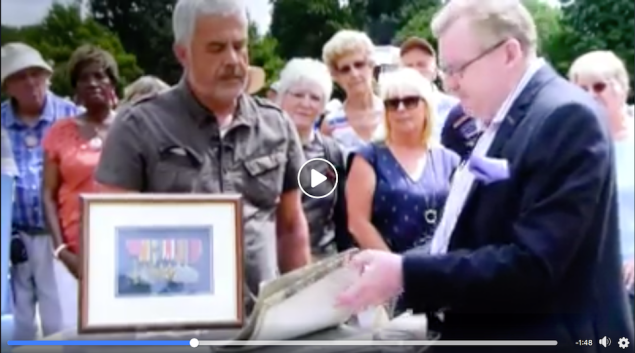
In an edition of the BBC TV Antique Roadshow programme, broadcast on 19 May 2019, the grandson of a wartime army officer, Maj H F Boddington OBE brought a collection of his grandfather’s wartime memorabilia for valuation. The programme’s expert, Mark Smith, focussed on one particular file for mention during the recording. It had been given to Maj Boddington in early 1943 by Barnes Wallis, and included a copy of Wallis’s paper ‘Air Attack on Dams’.

Several copies of this paper still exist in official files, including those available to the public in the National Archives. It has 19 pages of text, including a number of tables and footnotes, and a further eight pages of illustrations, which appear to be the ones which excited Mark Smith.

A meeting with Boddington is recorded in Wallis’s diary. Boddington had been brought in to oversee security arrangements for the forthcoming RAF trials of the Upkeep ‘bouncing bomb’ and it is likely that the paper was passed over to him then.

The paper is interesting because it was written and produced by Wallis at a crucial stage in the planning for the Dams Raid. A summary of it was discussed at an important meeting at the Air Ministry on 13 February 1943, chaired by Air Vice Marshal Ralph Sorley, the Assistant Chief of the Air Staff (Technical Requirements). This was the meeting when it was decided to bring Bomber Command into the picture, since its personnel would be required to drop the weapon from specially adapted Lancasters, and Gp Capt Charles Elworthy, a New Zealand-born officer who would go on after the war to become Chief of the Defence Staff, was deputed to brief the command’s staff.

His first contact must have been with the Bomber Command Senior Air Staff Officer, Air Vice Marshal Robert Saundby, who then wrote a lengthy memo for his boss, the AOC of Bomber Command, Air Marshal Arthur Harris. This outlined the research and testing that had gone on so far and considered the possibility of a weapon being developed for the special purpose of destroying dams, in particular the Möhne. A specially modified Lancaster would be needed and the attack would be need to be made when the dam was full or nearly full. One squadron would have to be nominated, depriving Bomber Command of its strength for ‘two or three weeks’ for training. The tactics are not difficult, Saundby concluded, somewhat optimistically. He appended a copy of Wallis’s ‘Air Attack on Dams’ paper and sent it over to Harris.

Harris was not at all convinced. He handwrote a scathing note on Saundby’s memo:
‘This is tripe of the wildest description. … there is not the smallest chance of it working. To begin with the bomb would have to be perfectly balanced around it’s [sic] axis otherwise vibration at 500RPM would wreck the aircraft or tear the bomb loose. I don’t believe a word of it’s [sic] supposed ballistics on the surface. … At all costs stop them putting aside Lancs & reducing our bombing effort on this wild goose chase. … The war will be over before it works – & it never will.’

Wallis was not defeated by this setback, perhaps knowing that Harris himself would not have the final say on the matter. Some nine days later, he was able to show Harris the films of the test drops, but the AOC was still not impressed and sent an impassioned letter to the Chief of the Air Staff, Air Chief Marshal Charles Portal. ‘All sorts of enthusiasts and panacea-mongers are now careering round MAP [the Ministry of Aircraft Production] suggesting the taking of about 30 Lancasters off the line to rig them up for this weapon, when the weapon itself exists so far only within the imaginations of those who conceived it,’ he wrote.

Portal tried to smoothe Harris’s ruffled feathers. He accepted that the weapon might come to nothing, but it was worth conducting a trial in a Lancaster to see if it could work. Portal assured Harris: ‘I will not allow more than three of your precious Lancasters to be diverted for this purpose until the full scale experiments have shown that the bomb will do what is claimed for it.’ [Harris papers, H82, RAF Museum.]

Harris reluctantly accepted Portal’s decision, and by the end of the month the operation was given the final go ahead. Further trials were now lined up, some of which Maj Boddington may well have witnessed. One must hope that his archive – which apparently contains much other interesting material unrelated to the Dams Raid – finds a safe home if it ever leaves the care of the family.

Here is the relevant clip from the programme in a rather poor quality video grab, courtesy of Richard Taylor’s Facebook page. The full programme is available for another 21 days for UK viewers here on the BBC iPlayer.

Thanks to Dr Robert Owen.
Source: John Sweetman, The Dambusters Raid, Cassell 2012, pp49-59.

Emotional unveiling in Germany of AJ-Z memorial

Pic: MoD

Guest post by Mark Welch and Marcel Hahn

The memorial for Squadron Leader Henry Maudslay DFC and his crew of Dambuster Lancaster ED937 AJ-Z was unveiled in Emmerich am Rhein, Germany, on Friday 17 May, 76 years from the day that the aircraft was brought down by ground fire on its return from attacking the Eder Dam.

AJ-Z was the second Lancaster to attack the Eder but for some reason the Upkeep “bouncing bomb” was released too late and hit the top of the dam, detonating under the aircraft. Although undoubtedly damaged by this, Maudslay and the crew limped towards home but flew off course near the Dutch border flying over an oil installation on the banks of the Rhine, which was defended by anti-aircraft guns.

There were no survivors and all seven crew are now buried in the Reichswald Commonwealth War Graves cemetery.

L-R: Organiser Marcel Hahn, Johannes Doerwald, Mark Welch, Wg Cdr Paul Withers, Burgomeister Peter Hinze. Pic: Wim Govaerts.

The event was organised by local researcher Marcel Hahn from Germany and Mark Welch from England. They met at another memorial event a few years ago and decided to work together to ensure that the last remaining Dambuster crew had a memorial placed at the spot their aircraft came down.

Marcel said: “This was one of the most important days of our lives. I was so happy that so many people joined us. It was very emotional for us to have some members of the crew’s families here today. It is a sign of peace, cooperation and reconciliation.”

Maudslay’s niece, Victoria Trevelyan, embraced Johannes Doerwald telling him: “I don’t want you to feel guilty. I would have done exactly the same for my country if I was in the same situation.” Pics: Melvin Chambers

This sentiment was powerfully demonstrated when Victoria Trevelyan, the niece of the pilot, embraced Johannes Doerwald, who served in the gun crew which felled the aircraft, telling him “I don’t want you to feel guilty. I would have done exactly the same for my country if I was in the same situation.”

Johannes Doerwald was a 16 year old gun-layer on the night of 17 May 1943 and was credited with bringing down the aircraft. In his thought-provoking speech, Johannes said: “I still remember well the moonlit night of 16-17 May 1943, when the catastrophe at the dams happened. A four-engined bomber flew past us at low altitude towards the Möhnesee. I cannot forget the sight of this colossus. When the gunner released ‘fire’ I was so excited that I had forgotten to put the safety lever around. The machine flew so low that it collided 20 km from here with a high voltage line. Then on the return flight came Lancaster ED937. I still recall today how it was hit by the tracer ammunition. That night, 53 young people, who still had their lives ahead of them, died. Such a cruel war must not be repeated.”

Mr Peter Hinze, the Burgomeister of Emmerich, welcomed the guests in English before a speech by RAF representative Wg Cdr Paul Withers from the NATO Combined Air Operations Centre in Uedem. Addressing the audience in German and English Wg Cdr Withers said:

“Henry Maudslay and his crew gave their lives attempting a difficult and dangerous mission in the hope that it would contribute to bringing to an end one of the darkest periods in European history. Since the end of the war, Europe has enjoyed relative peace and stability.”

He added: “It has done so because post-war reconciliation led to strong bonds of friendship between former enemies, aided by a strong NATO alliance. That this memorial stone has been created is evidence of the strength of those bonds of friendship and it is a fantastic tribute to the crew of AJ-Z.”

Mark and Marcel then paid tribute to each of the individual crew members before a minute’s silence was observed and the memorial stone was unveiled.

Many local people came to the event. There were also representatives from six NATO nations, including Polish Brigadier General Slawomir Zakowski, who is the Deputy Commander of the Combined Air Operations Centre. Also attending were other family relatives of the aircrew, including 86-year old Norma Bagshaw, the niece of flight engineer Sergeant John Marriott DFM and Susan Maudslay-Maguire, Angela Gardiner, Victoria Trevelyan and Nigel Maudslay, the nieces and nephew of Squadron Leader Maudslay DFC.

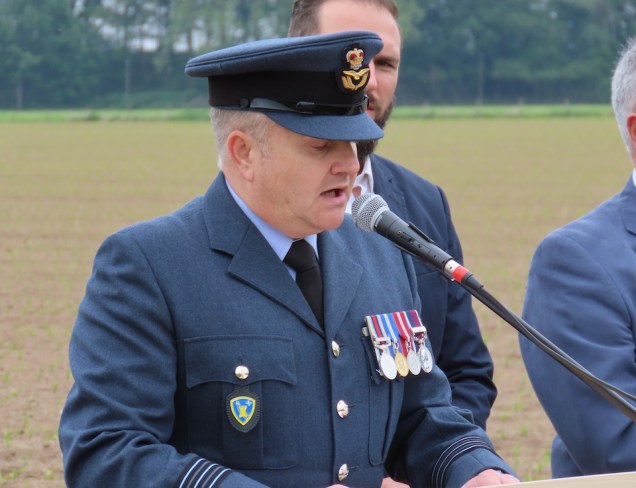
Wg Cdr Paul Withers, speaking on behalf of the RAF. Pic: Wim Govaerts

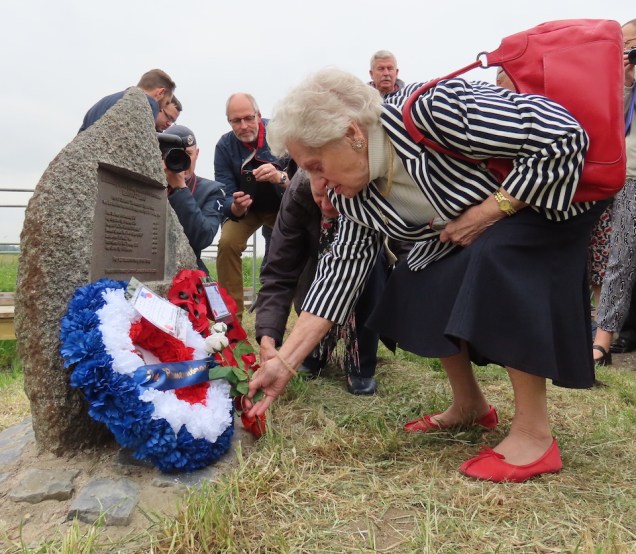
Norma Bagshaw, niece of Sgt Jack Marriott, laying a wreath. Pic: Wim Govaerts

Mark Welch reads a tribute to each of the crew of AJ-Z while Marcel Hahn displays a picture. Pic: Danielle Roubroeks

Marcel and Mark present Johannes with the painting Approaching the Eder by Mark Postlethwaite. Pic: Katarzyna Sidorowicz

Flg Off Robert Urquhart’s logbook displayed for the camera. The logbook is now owned by Simon Muggleton. Pic: Wim Govaerts


The crew of AJ-Z remembered on a banner. Pic: Danielle Roubroeks

Rare Gibson picture from RAF Syerston

Pic: Valerie Davies Arends

To mark tomorrow’s 76th anniversary of the Dams Raid, here is a rarely seen photograph of Guy Gibson, taken while he was Commanding Officer of 106 Squadron at RAF Syerston. It is undated, but must have been taken before 8 December 1942 as the central figure is Gp Capt Augustus Walker, CO of RAF Syerston, who lost his right arm that day on his own airfield, trying to rake burning incendiaries from an aircraft which had somehow ignited. The man on the right is Wg Cdr Richard Coad, the CO of 61 Squadron, which was also based at Syerston.

Gibson was one of those who accompanied Walker to hospital after his accident, and it was while Walker was being treated that Gibson first met Cpl Margaret North, a WAAF nurse, with whom he later had an intense but platonic liaison.

[Thanks to Valerie Davies Arends for the use of this picture.]


Mary Stopes-Roe

Pic: Barnes Wallis Foundation

I am sorry to have to announce the death of Mary Stopes-Roe, who died peacefully at her home in Birmingham on Friday 10 May.

Mary Eyre Wallis was born in York in 1927, the second of the four children of Barnes and Molly Wallis. When her father’s job at Vickers took him to Brooklands in Surrey, the family moved to nearby Effingham. Mary went away to boarding school at Godolphin School in Salisbury, and was a pupil there in the run up to the Dams Raid in 1943. Earlier she and her siblings had helped her father in his famous home experiments with marbles, a catapult and a tin bath as he tried to work out how to ‘bounce’ a bomb across water. When she heard the news about the raid itself from her headmistress she worked out what had been going on and sent a telegram to her ‘wonderful Daddy’.

After the war, Mary got a degree in history from the University of London. She then married the academic Harry Stopes-Roe, who had started his career as a physicist, but went on to take a PhD at Cambridge in philosophy. They had four children of their own, the last born in 1958 shortly before they moved to Birmingham, when he took up a post at the city’s university. Once all of her four children were at grammar school, Mary took a second degree in Psychology. ‘I thought the subject would be rather interesting, and I didn’t want to dust the house for the rest of my life,’ she said in a recent interview. She also gained a PhD and became a Research Fellow in the University of Birmingham School of Psychology where she remained until she retired in the 1990s. During her academic career she did extensive research, particularly on parent and family-child interactions, and was widely published.

After retirement she took on organising her father’s archives as well as other work on her family history. She edited the extensive pre-marital correspondence between Barnes and Molly Wallis in the early 1920s which had taken the form of a correspondence course in mathematics, but in fact was composed of dozens of charming love letters. This was published as Mathematics with Love in 2004. The archives are now housed in various institutions, and Mary herself became the President and a Trustee of the Barnes Wallis Foundation, formed to advance education in aviation design and honour her father’s name.

Mary was also very active in 617 Squadron Association affairs, and made many media appearances in the last few years talking about her father’s involvement in Operation Chastise. She will be sadly missed at future events.

Mary and Harry Stopes-Roe were married for 66 years until he died, almost five years to the day before her, on 11 May 2014. Mary leaves four children, ten grandchildren and five great-grandchildren, and also her sister, Elisabeth.

Sources: Barnes Wallis Foundation
Moseley B13 magazine

In Charlie Williams Country, part II

Bannockburn today. The central part of the house directly ahead is original. The section to the left is partly filled-in and partly more recent construction. This includes the kitchen, which likely was originally separate from the house.

Guest post: more from Susan Paxton’s recent trip to Queensland, Australia, in the footsteps of Flg Off Charlie Williams. Here she visits the home where the Williams family lived from 1933.  Text and all new photos by Susan Paxton.

When Horace Edward Williams lost his place as manager of Telemon Station, he had to act quickly. At 69 years of age, likely he had been looking forward to a pleasant retirement once his sons Doug or Charlie took his place, but any promises his former employer had made were now moot. Horace made Townsville, on the coast, his temporary base of operations, and set to work looking for a new opportunity. One day, he spotted this advertisement in a local paper:

AUCTION SALE
Under Instruction from THE UNION TRUSTEE COMPANY OF AUSTRALIA LIMITED, Executors and Trustees in the Estate of William Charles Reed deceased; Solicitors to the Estate, Messrs. Marsland & Marsland, MESSRS. DALGETY &. COMPANY LIMITED, HUGHENDEN, in conjunction with the QUEENSLAND PRIMARY PRODUCERS’ CO- OPERATIVE ASSOCIATION LIMITED, TOWNSVILLE, will offer by PUBLIC AUCTION AT CENTRAL HOTEL LOUNGE, HUGHENDEN, on SATURDAY 21st OCTOBER, 1933, at 11 a.m.
“BANNOCKBURN”
SITUATED – Approximately 80 miles south-easterly from Prairie Railway

A long description of the property followed making it sound paradisiacal. Horace knew better. When he’d first arrived in Queensland as a 16-year-old immigrant he’d worked for his uncle James Tolson at a property adjacent to Bannockburn, Uanda. He was well aware that the area was arid and, unlike Telemon, extremely isolated. The nearest towns were Prairie and Torrens Creek – both specks on the railroad that ran inland from Townsville through Charters Towers and on west – to the north, and Muttaburra and Aramac to the south, only slightly larger and even farther away. Horace also knew that, run very carefully and with the minimum of paid help, Bannockburn could be made to turn a tidy profit. While too arid for lambing, wethers (castrated male sheep) would put on high quality wool eating the available forage. Organizing a syndicate with two friends who were in the shipping industry in Townsville, Horace assembled enough capital to buy the place.

For Charlie and Doug, any hopes that they had had of becoming station managers pretty much ended at Bannockburn. They became station hands, nothing more; the work of the place fell entirely onto them, with only one hired hand. Perhaps what it meant to Charlie in particular comes from his photo albums. His photos of Telemon are full of fun, of visits to and from neighbors, trips to Townsville and Sydney, parties, picnics, often with amusing captions. There are only four or five snaps from Bannockburn, all of them views of the house, with no captions at all other than “Bannockburn.”

The Williams family put a great deal of effort and money into Bannockburn and indeed almost immediately had the place earning its way and providing enough income to make further improvements. Horace had the small and bare homestead enlarged, added stands to the shearing shed, had new bores drilled, bought more sheep. But with the coming of war, at least one of his sons was more than eager to get away from the place and its unrelenting drudgery and tedious isolation. So it was in late January 1941 that Charlie Williams walked down the steps, into a car, and was off to the railroad station at Torrens Creek. He would never return.

Telemon today is a ruin; Bannockburn is a working station owned and run by Bill and Amy Dart, with their children Cameron, Malcolm, and Ruby. In the Williams’ day it was a sheep station; the Darts run cattle, sturdy Droughtmaster breeds.

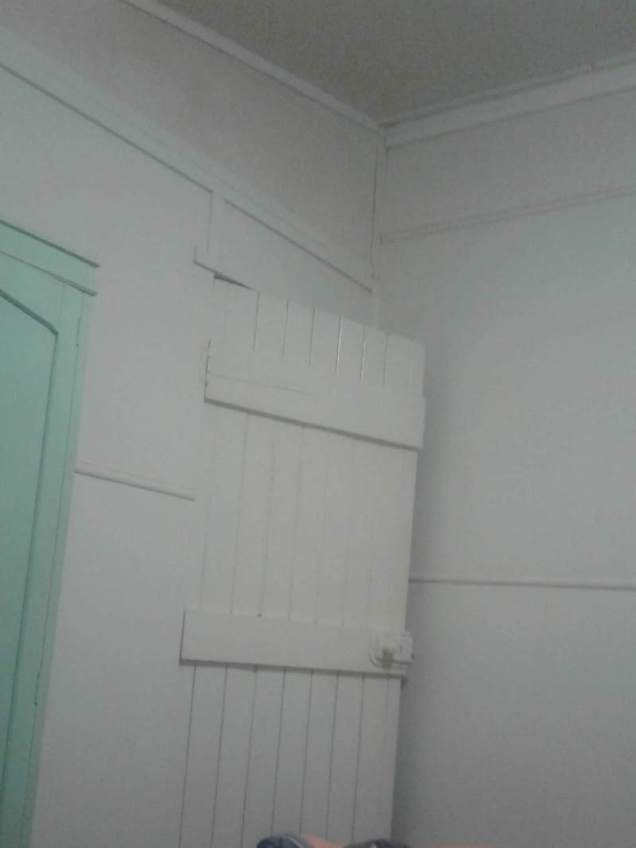
While the interior of Bannockburn has changed a good deal, this is almost certainly original and gives an impression of the rather spare house the Williams family moved into.

The shearing shed at Bannockburn. The reason for the height of the building above ground is two-fold; it made it easier to load bales of wool directly into the bed of a truck, and if rain started during shearing the sheep would be driven under the building and penned in to stay dry, since wet sheep cannot be sheared.

The interior of the shearing shed, which Bill Dart uses today to store hay. The prefabricated iron construction is notable.

This single-cylinder diesel motor was used to turn the drive belts for the shears and other equipment. Although taken down, most of the pulleys and other equipment are still stacked around the shed.

The shearer’s quarters, now used for storage. The chimney marks the kitchen.

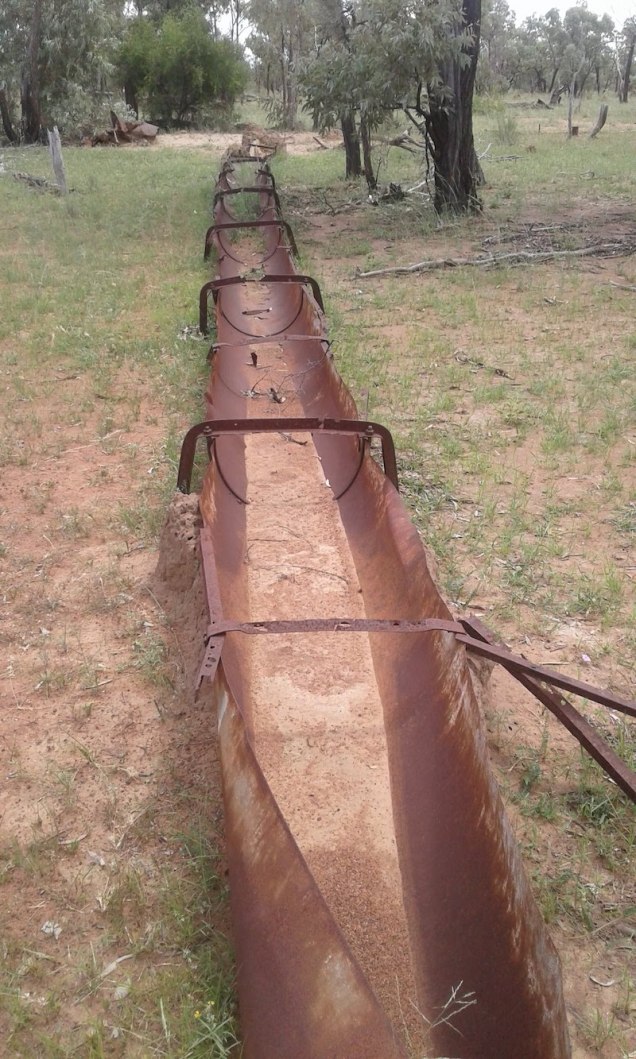
This old water trough dates from the Williams’ time. The remains of the tank it was once attached to are visible behind it. The bare patch gives an indication of the size of the tank; Bill Dart told me it takes decades for plants to regrow in this area when the roots have been killed.

The last sheep at Bannockburn! The Darts found this now-elderly resident on the road when it was a baby and they saved and raised it.

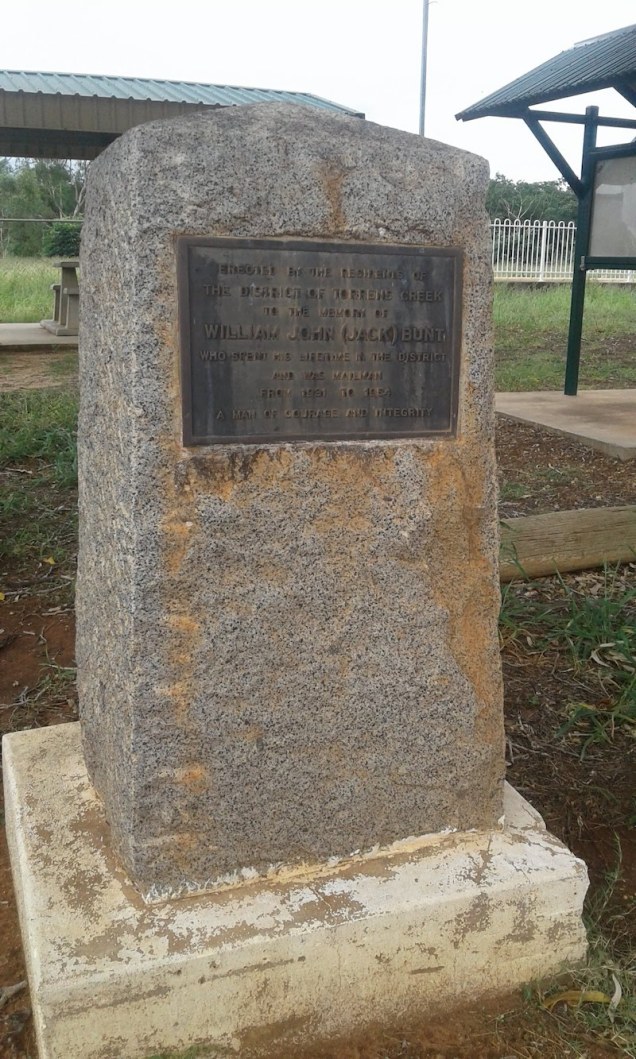
This monument in Torrens Creek remembers Jack Bunt, “A man of courage and integrity,” the local mailman whose long, lonely route took him every Monday to Bannockburn, where he delivered the letters Charlie Williams was writing home. The fence beyond marks the site of the railroad station from which Charlie left to report to the RAAF.

Once again, my visit was made possible by Helen Williams-Brown, who was my patient companion in my pilgrimage. Bill and Amy Dart and their children Malcolm and Ruby (oldest son Cameron was away at school) were our unfailingly pleasant and very interesting hosts for our overnight stay at Bannockburn.

AJ-Z memorial to be unveiled in May

The crew of AJ-Z, killed returning from the attack on the Eder Dam, 17 May 1943. L-R: Henry Maudslay, Jack Marriott, Robert Urquhart, Alden Cottam, John Fuller, William Tytherleigh, Norman Burrows. [Collage of pics: © Dambusters Blog]

The memorial to the Dams Raid crew skippered by Henry Maudslay will be unveiled on 17 May 2019, near where they were shot down in the early morning of 17 May 1943, seventy-six years ago. The event has been organised by local researcher Marcel Hahn.

On the Dams Raid, Henry Maudslay and his crew in Lancaster AJ-Z, had been spectators at the Möhne Dam when it was breached. The three Lancasters still with bombs on board were directed to go to the Eder dam. The attacking force quickly realised that the dam presented a much more difficult target. The lake is smaller and set in a deep valley, meaning that there is a much shorter approach which starts with a very tricky steep dive from over the Waldeck Castle. This is followed by a sharp turn to port. Given the geography, the Germans had obviously discounted the idea of an aerial attack, since there were no gun batteries in the vicinity.

David Shannon in AJ-L was the first to try an attack, and made three or four passes without releasing his mine. It was very difficult to get down to the right height after the dive, and then turn. Then Gibson told Maudslay to try, and he found it just as hard, so Shannon had another go. Two more dummy runs followed until, at last, he got the angle and speed right and dropped his mine. It bounced twice, hit the dam wall and exploded sending up a huge waterspout. At the later debriefing his effort is reported as ‘no result was seen’ but Shannon in fact felt that he had made a small breach.

Maudslay had another attempt but then something went wrong. His mine was released too late, hit the parapet and exploded. Although his aircraft was beyond the dam by the time this occurred, it may have been damaged, since his later progress home was slower than would be expected. Some reports say that something was seen hanging down below the aircraft, perhaps caused by hitting trees on the run in.

Gibson saw that AJ-Z had fired a red Very light signal after passing over the dam wall and called Maudslay on the radio: ‘Henry – Henry. Z-Zebra – Z-Zebra. Are you OK?’ Nothing was heard, so he repeated the call. This time Maudslay’s voice could be heard, although the signal was faint: ‘I think so. Stand by …’ This signal – confirmed by members of Shannon’s and Knight’s crews – was the last voice contact anyone made with AJ-Z.

In fact they would stay airborne for a further fifty minutes. At 0157, some twenty minutes after they had dropped their mine, wireless operator Alden Cottam sent a ‘Goner 28B’ message back to base, which indicates that they were making progress. At about 0230, they had reached the Rhine. The turning point on the return route was supposed to be at the town of Rees, but Maudslay headed 20 miles north of this towards Emmerich, which was defended by several Heimat light flak anti-aircraft batteries, largely manned by non-military personnel. Some of the outbound force had in fact passed over the town a few hours earlier so the batteries were on alert for the opportunity to fire on any returning crews. When AJ-Z was heard approaching Emmerich it came within range of the batteries on the south and east edges. They fired on the aircraft, and although it turned to the right to try and avoid the flak, either an engine or a fuel tank was hit, as there was a burst of flame. The aircraft lost height and crashed in a field at 0236 close to the hamlet of Osterholt, between the German town of Klein Netterden and the Dutch town of ’s Heerenberg. The following morning, German officials recovered seven bodies from the wreckage. Two were identified as Alden Cottam and Jack Marriott, but the rest were recorded as unidentified. All seven were buried in the Northern Military Cemetery at Düsseldorf, and were reburied after the war in the Commonwealth War Cemetery in Reichswald Forest.

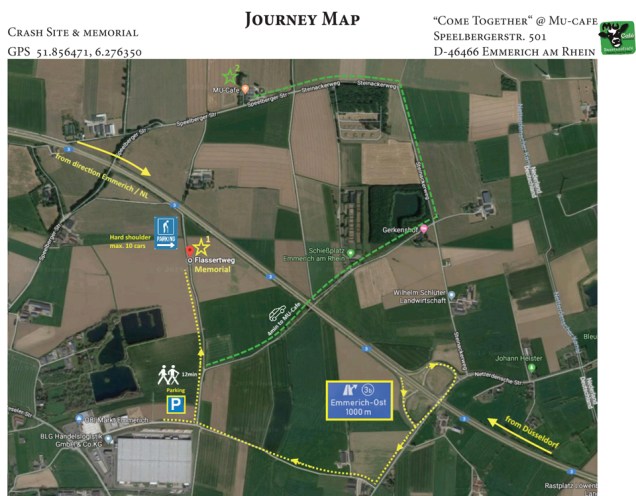
Members of the Maudslay and Marriott families are expected to attend the unveiling of the memorial, which will take place at 1430 on Friday 17 May. Other families and distinguished guests will be confirmed nearer the time. Members of the public are welcome to attend. The location is shown in the map below. Refreshments will be served afterwards in the MU-Cafe, also shown on the map.

Marcel Hahn can be reached by email here and also on the event’s Facebook page.