The Herne Bay Cultural Trail got off to a rocky start last autumn with controversy about a poorly-worded plaque describing the Dams Raid as ‘infamous’. The plaque had been placed on a new statue of Barnes Wallis, erected overlooking the Reculver area, where trials of the ‘Upkeep’ weapon were carried out in May 1943. The wording has now been amended, and the rest of the Cultural Trail is nearly complete. One of the items will be a large mural depicting the trials. This can’t yet be seen on the Trail’s own website, but the work in progress is shown on that of the artist, Penny Bearman.
I mentioned this BBC Radio Kent programme back in May last year, but it seems a good place to link to it again. It’s a first hand account of the Reculver trials, as witnessed by two boys who sneaked up onto the sand dunes.
Author: dambusters
Dambusters remake: Fry says 2010, we say 2011
UPDATE, 16 August 2014. We were even wronger! Best guess is now 2016 or 2017.
UPDATE, 24 September 2011. We were wrong! Best guess is now 2013 or 2014.
UPDATE, 16 December 2009: Jackson confirms shooting to start in 2010
While he was recently down under in New Zealand, filming a nature programme for the BBC, Stephen Fry gave an interview to the entertainment section of the Wellington newspaper, the Dominion Post. Most of this was about his travelogue, Stephen Fry in America, which was coming up on air down there, but at the end he spoke briefly about his work on the remake of The Dam Busters.
The article is not available on the interwebnet, but I managed to track it down via a library subscription, so I bring it to you here.
Interviewer: Is it true that you have rewritten The Dam Busters?
SF: Yes, well, I won’t say rewritten. The great New Zealand director, Peter Jackson, asked me if I would be interested in writing a screenplay on The Dam Busters. This was fascinating because – I yield to none my admiration to him as a film-maker; he’s astounding – I had no idea he’d be interested in this story.
It turns out, actually, that it was David Frost who had bought the rights to the Paul Brickhill book The Dam Busters and was desperate to find someone to direct it, and he was told by a friend that Peter Jackson had a huge poster of the original film on his wall in his office and David thought, ‘I’ll call him up’, and the deal was struck. Then Peter got in touch with me. Now the original film is a magnificent film – it genuinely is a masterpiece.
Interviewer: And when will we see your version?
SF: 2010.
Dominion Post, Wellington, NZ, 17 February 2009.
The great man says ‘2010’, but I still think he is being optimistic. IMDB Pro has a few people listed as working on pre-production visuals, but no one else, which would indicate that shooting is still some way away.
Plink, plink, plink, plink, plinka, plink, plink, plink…
I met the late Sir Bill Cotton of the BBC once, many years ago – he was a lovely, funny man, much loved by all. This was evidenced by the huge turnout at his memorial service earlier this week, where there apparently was much mirth amongst the tributes. The report in The Times that some of the music was provided by the Ukulele Orchestra of Great Britain playing, amongst other ditties, a version of the Dambusters March arranged by Bill Cotton’s namesake and father, set me off on a search on Youtube. Unfortunately this performance doesn’t seem yet to have been videoed (although I did find both Shaft and Teenage Kicks) so I ended up at the orchestra’s own website, where I was able to purchase the Eric Coates tune for a meagre one pound. A bargain! Altogether now – plink, plink…
UPDATE: Here’s a sample, about 20 seconds long, of the Dambusters March.
The glamour of the Dambusters
What is the connection between the Dambusters and the 1960 Michael Powell cult film, Peeping Tom (being shown in the UK on ITV in the early hours of Friday 27 February)? The answer is Pamela Green, the celebrated 1950s glamour model and actress, who made her ‘straight’ acting debut in this film. While Ms Green was still a student, her first nude photographs were taken by Dams Raid survivor Sgt Douglas Webb DFM, the front gunner in Bill Townsend’s aircraft, AJ-O. After the war, Webb had returned to a job in Fleet Street as a photographer and then branched out into film stills and ‘glamour’ work. He is probably the only Dams Raid participant with an entry on IMDb. In the 1950s and 60s Ms Green made a career out of glamour work, culminating in the naturist picture Naked as Nature Intended. When Peeping Tom emerged, in those still-censorious times, the moderately explicit shots of her which were included got local watch committees in a fuss. Doug Webb and Pamela Green married in 1967, and later retired to the Isle of Wight. Sadly he died in 1996, but Ms Green is still flourishing, and can be seen from time to time on nostalgia TV shows.
Lancaster in flight caught on Google Eearth
This picture, taken a couple of years back, of the Battle of Britain Memorial Flight Lancaster over Huntingdon caused a flurry of interest on the Google Earth discussion lists at the time, but I never saw it mentioned elsewhere. The Google Earth database has been updated, so the pic is no longer available online, but we can thank the likes of The Register for preserving it.
Bouncey bouncey
This is one way to amuse the crowd next time you go to a hen party. I’m intrigued to know whether us chaps could also do this trick, but have no intention of trying it myself. I wonder if you have to pay Eric Coates any royalties if you perform this in public?
Advance Australia fair!
Happy Aussie day to Our Friends Down Under. To mark the day, here are three more pictures from the Australian War Memorial Collection that have rarely, if ever, been seen in print: Jack Leggo leading a VE Parade, Mick Martin’s Dams raid aircraft P-Popsie, and Bob Kellow in uniform.
David Shannon’s trousers…
… are in the Australian War Memorial collection in Canberra, as are his jacket, cap and medals. You can also read an entry about Shannon in the online exhibition, Fifty Australians:
a cross-section of Australians – sometimes a leader, a hero, or even a rogue – who saw war and its effects. Some of these men and women gave their lives, others became renowned for their wartime courage or example, while others, affected for better or worse, emerged to face the peace where they would make their own particular mark. Each has a fascinating story.
Some of these people, such as the cricketer Keith Miller, may be familiar to non-Aussies. Many more are not, but their stories add to our wider knowledge of just how deeply the scars of war are etched on us all.
The Dam Busters: Patrick McGoohan’s first words on screen
Patrick McGoohan may have reached international stardom as Danger Man and The Prisoner, but his first speaking role on the screen was in 1955, in The Dam Busters. He played the guard on the briefing room door, who turns Gibson’s dog away. Here is the clip on YouTube:
Les Knight’s crash site and memorial
Teunis Schuurman, a Dutch writer and designer, has a huge website, much of which is devoted to pictures of wartime memorials and crash sites. On this page (which is very large — scroll about three quarters of the way down) I found pictures of a plaque commemorating Les Knight, at Den Ham in the Netherlands. (Images courtesy Dick Breedijk.)
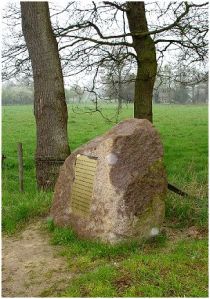
 The inscription is in Dutch. Translated into English it reads:
Early in the morning of 16 Sep 1943 a Lancaster of the RAF crashed in this meadow. The Australian Pilot of the 4-engine bomber – Fl/Lt Leslie Gorden Knight, DSO – was killed after he ordered his seven crewmen to bail out first.
He was buried the same day at the “Old Cemetery” in Den Ham. The others landed safely nearby. The two left engines were out, but he pulled up to avoid the disaster of a crash on the village of Den Ham. That night the plane was on a raid targetting a dyke of the Dortmund-Ems canal near Ladbergen. Les Knight and his crew belonged to 617 Squadron and in May 1943 were also one of the “Dambusters”, the famous attack on the Ruhr dams in Germany.
This raid took place in very bad weather conditions. The 617 Squadron detachment were using a new thin case 12,000lb bomb, dropped from a very low height. However they failed to damage the canal, and five aircraft were lost. Four complete crews and Les Knight, pilot of the fifth plane, were killed. All the remaining seven of Knight’s crew, including Fred Sutherland, still alive and well in Canada, baled out while Knight struggled to keep his damaged aircraft aloft. They owe their lives to him, as do people in the village of Den Ham which he managed to avoid when crashing.
 Dambusters Blog
.jpg)