This blog’s official football team is of course The Mighty Imps, whose fans have now taken the sensible decision to keep The Dam Busters March as their theme tune, played when the teams run out onto the pitch.
Lincoln City has also given a first managerial position to none other than one half of the famous SAS partnership, feared and respected in Blackburn Rovers long-ago reign as Premiership champions. And, what do you know, the team won its first match under his leadership. Mid-table mediocrity beckons?
One fan reckoned that the Imps could benefit from being more like the chaps from 617 Squadron, telling the Echo:
Lincoln City Football team could learn from the Dambuster’s experience of how the aircrew came together and did what they were instructed to do.
W/C Guy Gibson was their key man and leader.
Why cannot the manager of Lincoln City’s football club show what football is all about as with what Guy Gibson did with 617 Squadron?
The football team needs to bond together, know their positions, play football for what they are paid for, and start scoring goals which is their mission.
Lincoln City Football team could learn from the Dambuster’s experience of how the aircrew came together and did what they were instructed to do.
W/C Guy Gibson was their key man and leader.
Why cannot the manager of Lincoln City’s football club show what football is all about as with what Guy Gibson did with 617 Squadron?
The football team needs to bond together, know their positions, play football for what they are paid for, and start scoring goals which is their m
Great account and brilliant photos by Damien Burke of a trip to all three dams involved in Operation Chastise, as well as the Rheinberg and Reichwald War Cemeteries.
These war cemeteries are an incredible sight, with long rows of identical headstones, each one beautifully carved with a name, a rank and a number – a testament to the individual buried below. As Damien says they really bring home the real sacrifices which are often forgotten when the huge numbers of people killed are mentioned.
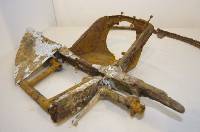
I might be wrong, but I think this is the only original part of a Dambuster Lancaster on public display anywhere in the world. Eleven Lancasters got back from the original Operation Chastise but those that survived the rest of the war were all scrapped in the late 1940s. This bit of rusty twisted metal is the gunner’s mount and hatch from the rear of Lancaster ED825, which was flown by Joe McCarthy on the Dams Raid. Almost seven months later it was being piloted by Flt Lt George Weeden on an operation to send ammunition and supplies to the French resistance when it was shot down near Doulens in France.
The story of its excavation, by a team which included Dams Raid expert Alex Bateman, was told in the Channel Five documentary, misleadingly titled The Last of the Dambusters, shown on British screens last year. Sqn Ldr George (Johnny) Johnson, bomb-aimer in McCarthy’s crew, accompanied the team on their journey.
The hatch will join the other Dambuster exhibits – many of them from the collection of 617 Squadron adjutant Harry Humphries – on display at the Grantham Museum. Well worth a visit!
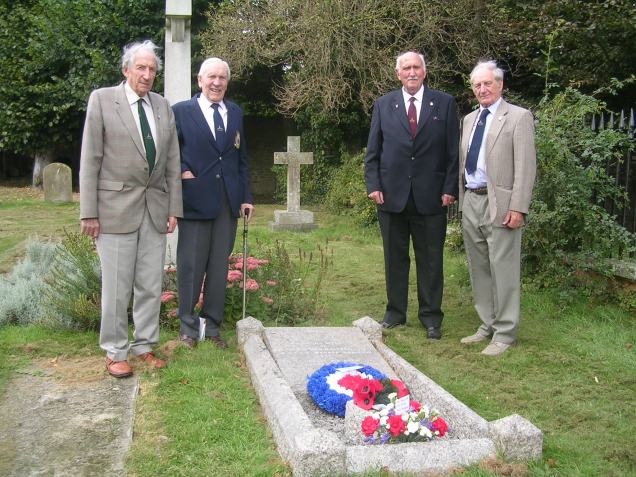
The annual tribute to Sqn Ldr David Maltby DSO DFC and his crew took place at David Maltby’s graveside in St Andrew’s Church, Wickhambreaux, Kent, on Monday 14 September. The largest turnout for several years brought together the East Kent branch of the Aircrew Association, who organise the event, the Maltby family, members of the public and, for the first time, the Littlebourne branch of the British Legion.
Anyone in London during the next month will have a rare opportunity to see some of Guy Gibson’s personal effects – his log, a hat and some letters. They are on show in the (you might think unlikely) venue of the Lords Cricket Museum in St John’s Wood.
You wonder why this particular museum has been chosen but, as a MoD official press release explains:
Few are aware that Lord’s Cricket Ground was once a constituent part of the wartime RAF. After the Battle of Britain the Nation turned its attention to taking the war to Germany, but it was realised that existing RAF selection establishments were unable to cope with the sudden demand for thousands more aircrew.
It was decided to create an [AircrewReceiving Centre] at Lords in London because of its central position in the rail transport network.
Civilian volunteers for air crew training were recruited and given a basic medical and attested at centres near their home. Later they would receive a letter telling them to report to Lord’s. On arrival, they were assembled into flights, each under the command of a Corporal, kitted out and accommodated in a number of requisitioned blocks of flats nearby. Collectively, the assets were known as RAF Regents Park. The ARC opened on 14 June 1941 with the first intake of cadets on 30 June 1941.
The recruits would be marched to the canteen of the nearby London Zoo for their meals. During a two to three week period, they received basic instruction on service life; underwent a rigorous medical and a series of tests designed to weed out unsuitable candidates and identify the most suitable aircrew role for those remaining. From Lord’s they were posted to appropriate Initial Training Wings around the country to continue further training in their selected roles.
With the decreasing need for aircrew in the latter stages of WW2, ARC Lords was closed on the 31st Aug 1944. During the period from 1941 more than 115,000 civilians and 44,000 in-service volunteers for air crew passed through its doors. Many thousands of these young men were later to lose their lives on operations.
Was it a coincidence that the Battle of Britain Memorial Flight Lancaster overflew Lords last Sunday in a salute? The simple answer is, I don’t know, but I will do my best to find out!
(Hat tip David Layne at Lancaster Archive Forum.)
Anyone in London during the next month will have a rare opportunity to see some of Guy Gibson’s personal effects – his log, a hat and some letters. They are on show in the (you might think unlikely) venue of the Lords Cricket Museum in St John’s Wood.
You may wonder why this particular museum has been chosen but an official MoD press release explains:
Few are aware that Lord’s Cricket Ground was once a constituent part of the wartime RAF. After the Battle of Britain the Nation turned its attention to taking the war to Germany, but it was realised that existing RAF selection establishments were unable to cope with the sudden demand for thousands more aircrew.
It was decided to create an [AircrewReceiving Centre] at Lords in London because of its central position in the rail transport network.
Civilian volunteers for air crew training were recruited and given a basic medical and attested at centres near their home. Later they would receive a letter telling them to report to Lord’s. On arrival, they were assembled into flights, each under the command of a Corporal, kitted out and accommodated in a number of requisitioned blocks of flats nearby. Collectively, the assets were known as RAF Regents Park. The ARC opened on 14 June 1941 with the first intake of cadets on 30 June 1941.
The recruits would be marched to the canteen of the nearby London Zoo for their meals. During a two to three week period, they received basic instruction on service life; underwent a rigorous medical and a series of tests designed to weed out unsuitable candidates and identify the most suitable aircrew role for those remaining. From Lord’s they were posted to appropriate Initial Training Wings around the country to continue further training in their selected roles.
With the decreasing need for aircrew in the latter stages of WW2, ARC Lords was closed on the 31st Aug 1944. During the period from 1941 more than 115,000 civilians and 44,000 in-service volunteers for air crew passed through its doors. Many thousands of these young men were later to lose their lives on operations.
Some of the aircrew who flew on the Dams Raid must therefore have spent their first days in the RAF at this ARC, eating meals at London Zoo.
Was it a coincidence that the Battle of Britain Memorial Flight Lancaster overflew Lords last Sunday in a salute? The simple answer is, I don’t know, but I will do my best to find out!
(Hat tip David Layne at Lancaster Archive Forum.)
All members of the public are welcome to join members of the East Kent RAF Aircrew Association and the Maltby family at David Maltby’s grave in St Andrew’s Church, Wickhambreaux, Kent, at 11.30am on Monday 14 September 2009.
This annual event, commemorating the lives of all of David’s crew, takes place on the anniversary of their last operational flight. Weather permitting, local flyers led by David Maltby’s nephew George Foster will be conducting a flypast and poppy drop.
All members of the public are welcome to join members of the East Kent RAF Aircrew Association and the Maltby family at David Maltby’s grave in St Andrew’s Church, Wickhambreaux, Kent, at 11.30am on Monday 14 September 2009.
This annual event, commemorating the lives of all of David’s crew, takes place on the anniversary of their last flight. Weather permitting, local flyers led by David Maltby’s nephew George Foster, will be conducting a flypast and poppy drop.
The crew who flew on that last flight, in Lancaster JA981, was the same as that which had flown on the Dams Raid, almost exactly four months previously:
Sqn Ldr David Maltby DSO DFC (pilot) Baldslow, Sussex Flt Sgt Vivian Nicholson DFM (navigator) Sherburn, Co Durham Plt Off John Fort DFC (bomb aimer) Colne, Lancashire Flt Sgt Antony Stone (wireless operator) Winchester, Hampshire Sgt William Hatton (flight engineer) Wakefield, Yorkshire Flt Sgt Victor Hill (front gunner) Berkeley, Gloucestershire Sgt Harold Simmonds (rear gunner) Burgess Hill, Sussex
Warrant Officer John Welch (mid upper gunner) Chesham, Buckinghamshire, seconded from 218 Squadron, flew as an extra gunner.
(Picture shows the Aircrew Association’s 2007 tribute.)
I can only find this one picture of yesterday’s flypast over Lord’s cricket ground during an England-Australia one day international. by the BBMF Lancaster.
I wonder whether its arrival was the cause of yet another England batting collapse: England captain Andrew Strauss was dismissed 3 balls after the flyover briefly stopped play, and England went on to lose by 39 runs. Here is the ball-by-ball summary on Cricinfo which lays the blame pretty squarely on the flypast. (Translation of cricketing terms is available on request!)
17.1
Hauritz to Strauss, 1 run, cut hard out to point
A Lancaster Bomber is due to fly over Lord’s soon. What a sight that will be
17.2
Hauritz to Shah, FOUR, top shot. Down the pitch, and Shah clouts him over extra cover for four
More importantly, the Lancaster bomber is now flying over Lord’s. Wonderful sight and the crowd stand to applaud! Ah, great moment and a great noise, too, spluttering away with its four propellers and it banks to the right, over the pavilion. Super stuff
17.3
Hauritz to Shah, no run, down the pitch but is rapped on the pads
And there goes the Lancaster again. Graeme Swann’s giving it a standing ovation all by himself
17.4
Hauritz to Shah, 1 wide, down the leg side. Paine whips off the bails and says “ohh-ayyye” which is tongues for “how was that, dear fine fellow umpire?”
17.4
Hauritz to Shah, 1 run, clipped to leg
17.5
Hauritz to Strauss, OUT, got him! Australia have three as Strauss tried to turn it to leg, but was squared up – it gripped on the surface – and spooned it back to the bowler
AJ Strauss c & b Hauritz 47 (78m 53b 6×4 0x6) SR: 88.67
I think Strauss was Lancastered
17.6
Hauritz to Collingwood, no run, flicked to leg
End of over 18 (7 runs) England 85/3
I can only find this one picture of yesterday’s flypast by the BBMF Lancaster over Lord’s cricket ground during an England-Australia one day international.
I wonder whether its arrival was the cause of yet another England batting collapse: England captain Andrew Strauss was dismissed three balls after the flyover briefly stopped play, and England went on to lose by 39 runs. Here is the ball-by-ball summary on Cricinfo – which lays the blame pretty squarely on the flypast. (Translation of cricketing terms is available on request!)
17.1 Hauritz to Strauss, 1 run, cut hard out to point
A Lancaster Bomber is due to fly over Lord’s soon. What a sight that will be
17.2 Hauritz to Shah, FOUR, top shot. Down the pitch, and Shah clouts him over extra cover for four
More importantly, the Lancaster bomber is now flying over Lord’s. Wonderful sight and the crowd stand to applaud! Ah, great moment and a great noise, too, spluttering away with its four propellers and it banks to the right, over the pavilion. Super stuff
17.3 Hauritz to Shah, no run, down the pitch but is rapped on the pads
And there goes the Lancaster again. Graeme Swann’s giving it a standing ovation all by himself
17.4 Hauritz to Shah, 1 wide, down the leg side. Paine whips off the bails and says “ohh-ayyye” which is tongues for “how was that, dear fine fellow umpire?”
17.4 Hauritz to Shah, 1 run, clipped to leg
17.5 Hauritz to Strauss, OUT, got him! Australia have three as Strauss tried to turn it to leg, but was squared up – it gripped on the surface – and spooned it back to the bowler
AJ Strauss c & b Hauritz 47 (78m 53b 6×4 0x6) SR: 88.67
I think Strauss was Lancastered
17.6 Hauritz to Collingwood, no run, flicked to leg
End of over 18 (7 runs) England 85/3
Calm down, film fans – this report refers to the news that the other Peter Jackson has lost his job with the Imps, also known as the mighty Lincoln City FC. After a poor start to the season – two wins out of seven games – he has been one of League Two’s earliest casualties. It doesn’t seem to have been much of a surprise to the long-suffering supporters, if contributions to the BBC chat pages are to be believed. Armchair supporters, particularly those who know the county’s connections with certain heavy bomber squadrons, will not be surprised at the club’s current state. It’s because the management have threatened to drop the playing of a certain tune when a goal is scored.
Guy Gibson’s relationship with the crew who flew with him on the Dams Raid is one of the interesting sub-plots of the whole Dambusters story. In contrast to the scene in the 1955 film where his old crew discuss his posting to a new squadron on his own and then unanimously decide to go with him, only one, wireless operator Robert Hutchison, had actually flown with Gibson in 106 Squadron. Hutchison is thought to have recommended navigator Harlo Taerum, who in turn recommended bomb aimer Fred (Spam) Spafford. Both of these had been in 50 Squadron, as had rear gunner Richard Trevor-Roper. These four were all officers, which meant that Gibson would see something of them socially at Scampton, but the final pair, front gunner George Deering and flight engineer John Pulford were both NCOs.
This may be why Gibson had a rather low opinion of both. In his biography of Gibson, Richard Morris writes how in the first draft of Enemy Coast Ahead he described Deering as:
‘pretty dumb’ (tactfully changed to ‘pretty green’ in the published version) ‘and not too good at his guns and it was a bit of a risk taking him’. This was rubbish, as Deering had flown thirty-five operations.
Morris goes on to cite Gibson’s opinion of Pulford, who he described as a ‘sincere and plodding’ Londoner:
Gibson had a low opinion of Pulford, thinking him dull and incapable of independent thought. This may say more about Gibson than Pulford, for Gibson never listened to him long enough to notice that he came from Yorkshire rather than London. In the cockpit of Gibson’s Lancaster there was a distinct air of master and servant. In the fuselage as a whole his crew represented Britain’s class structure in microcosm and the pattern of the Empire beyond. (Richard Morris, Guy Gibson, Penguin, 1995, p.152.)
Whatever their relationship, the crew were not together for very long, flying just the one operation as a complete crew, the Dams Raid itself. Hutchison, Taerum, Spafford and Deering transferred to George Holden’s crew when he took over command of 617 Squadron, and died with him on the Dortmund Ems Raid on 16 September 1943.
None of the other three survived the war. Trevor-Roper and Gibson died later in 1944, both on operations with other squadrons, but Pulford was still in 617 Squadron when he flew on the operation to bomb the Antheor viaduct in southern France in February 1944. His pilot, Bill Suggitt, landed the aircraft successfully at Ford in Sussex, which they had used as a staging post, but in the short hop home from Ford to Woodhall Spa, they crashed into a hill on the Sussex Downs, near the village of Upwaltham.
For some years local people have been collecting for a proper memorial to Suggitt’s crew, and it was unveiled on 22 August:
Today, 65 years on, the crew of DV382 KC J-Jug will be honoured in a tiny parish church just below the crash site at Upwaltham, West Sussex, after the hamlet of 25 inhabitants raised £10,500 for a memorial.
Relatives of the British, Canadian and Australian victims will attend, along with air attaches from all three nations and 617 Squadron’s current commanding officer.
The white Italian stone ‘Four Nations Memorial’ also remembers seven Americans whose Dakota aircraft crashed across the valley a year later in February 1945.
A Lancaster from the Battle of Britain Memorial Flight will complete three circuits overhead at the ceremony, which will also be attended by relatives of the farm workers who were honoured by King George VI for braving flames and exploding ammunition to try to rescue the Lancaster crew.
Today, 65 years on, the crew of DV382 KC J-Jug will be honoured in a tiny parish church just below the crash site at Upwaltham, West Sussex, after the hamlet of 25 inhabitants raised £10,500 for a memorial.
Relatives of the British, Canadian and Australian victims will attend, along with air attaches from all three nations and 617 Squadron’s current commanding officer.
The white Italian stone ‘Four Nations Memorial’ also remembers seven Americans whose Dakota aircraft crashed across the valley a year later in February 1945.
A Lancaster from the Battle of Britain Memorial Flight will complete three circuits overhead at the ceremony, which will also be attended by relatives of the farm workers who were honoured by King George VI for braving flames and exploding ammunition to try to rescue the Lancaster crew.
There is a nice tribute page to the crew on the Roll of Honour website. John Pulford’s body was recovered and he was buried in Hull.
 Pic: Grantham Journal
 (Picture shows the Aircrew Association’s 2007 tribute.)
 Dambusters Blog