Les Knight’s mother at his grave – new picture

A Dutch correspondent, Hans Dekker, who lives in Den Ham, has kindly sent me some exciting rare photographs concerning Flt Lt Les Knight, the pilot of AJ-N on the Dams Raid, who was killed in a later operation on 16 September 1943.
I have told the story of his final flight before, notably in a 2010 obituary of Ray Grayston, his flight engineer, but it bears repeating.
Four months after the Dams Raid eight crews from 617 Squadron were sent out with another new weapon, a 12,000lb ‘thin case’ bomb, to attack the Dortmund Ems canal. It was a terrible night, and heavy fog blanketed the target. Four crews had been shot down when Knight, flying at about 100ft in fog hit some trees, and badly damaged both his port engines.
His tailplane and starboard engine were also damaged, and Knight was left with no option but to jettison his bomb and get his crew to bale out. He held the aircraft steady while they left and when the last man, Grayston, had gone he must have tried to bale out himself. However as soon as he took pressure off the control stick and rudder the aircraft flicked on its back and plunged to the ground. Knight did not get to the hatch in time.
All seven of the rest of the crew (they were carrying three gunners) landed safely. Five evaded capture, while two became PoWs. There is no doubt that they all owed their lives to their young pilot, something that they never forgot.
Knight’s crash occurred just outside the village of Den Ham, and he is buried in the village’s general cemetery.
The grave was first marked with a simple wooden cross, which was replaced after the war with a Commonwealth War Graves Commission gravestone.

His mother, Mrs Nellie Knight, visited the grave in about 1954.

Some other members of the Knight family may be in this picture. I would welcome any further information.

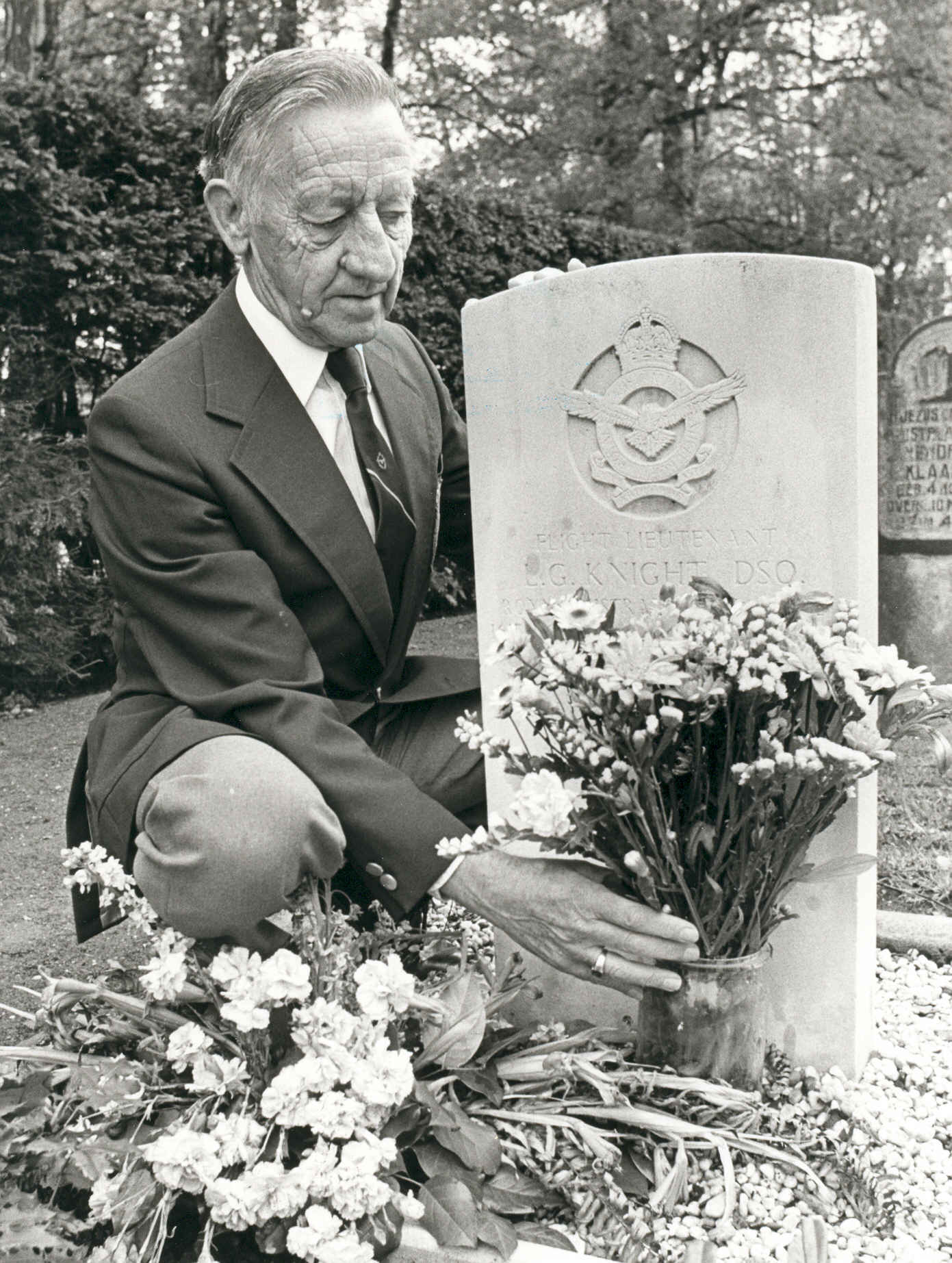
Other members of his crew have visited Les’s grave on a number of occasions. Here is Bob Kellow, the wireless operator, probably taken in the 1980s.
Finally, here is the full crew, pictured at Scampton in July 1943, as one of the series of publicity photographs taken by official RAF photographers of members of 617 Squadron.

IWM CH11049

Left to right: Harold Hobday (navigator), Edward Johnson (bomb aimer), Fred Sutherland (front gunner), Les Knight (pilot), Bob Kellow (wireless operator),  Ray Grayston (flight engineer), Harry O’Brien (rear gunner).

Blink and you’ll miss it

My good friend Dom Howard kindly recorded Stephen Fry’s very brief reference to the Dambusters remake on The One Show on BBC1 last night.

Receiving an award for “Most Consistent Attempt to Remake a Film” the great man revealed that he will be flying out to New Zealand “next Monday” for talks with Peter Jackson on “restarting” the remake. Rest assured, gentle readers, that they will be taking nothing away from the original, “one of the greatest British films ever made… Peter is still passionate about it, and so am I”.

(And, if this is your first time reading this blog, please don’t waste your time writing in about the dog’s name. It won’t be published. See this post for the reason why.)

The wrong Dambusters

Patrick Bishop is a great author, and his books Bomber Boys and Fighter Boys are invaluable sources of reference for anyone wanting to find out more about life in the wartime RAF. But someone has taken their eyes off the ball in creating the artwork for the jacket of his latest work, Target Tirpitz.

In the breathless prose loved by publishers’ blurb writers (confession: my first ever job!) HarperCollins tell us:

The Tirpitz, Hitler’s greatest weapon, was reputed to be unsinkable and the battleship inflamed an Allied obsession: to destroy her at any cost.
More than thirty daring operations were launched against the 52,000 ton monster. Royal Navy midget submarines carried out an attack of extraordinary skill and courage against her when she lay deep in a Norwegian fjord in an operation that won VCs for two participants.
No permanent damage was done and the Fleet Air Arm was forced to launch full scale attacks through the summer of 1944 to try and finish her off. But still the Tirpitz remained a significant threat to Allied operations.
It was not until November 1944 that a brilliant operation by RAF Lancaster Bombers, under the command of one of Britain’s greatest but least-known war heroes finally killed off Hitler’s last battleship.

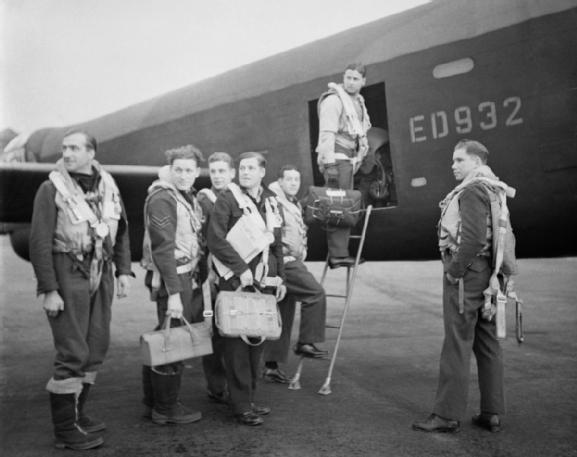
The writer is referring to the raid carried out by 617 and 9 Squadrons, who dropped Barnes Wallis-designed Tallboy bombs which blew the final massive holes in the Tirpitz’s hull. The 617 Squadron contingent was under the command of Group Capt Willie Tait, and a picture of him and a crew which was not his own, taken after the raid, appears in a recent Sunday Telegraph review. However, these are not the five airmen who appear on the cover. Instead, the designer has chosen to use figures from one of the most famous pictures of the war, the photograph taken of Guy Gibson and his crew as they set off on the Dams Raid, 18 months before the Tirpitz was sunk.

(Imperial War Museum, CH18005)

From the left, the figures are Richard Trevor-Roper (rear gunner), John Pulford (flight engineer), George Deering (front gunner), ‘Spam’ Spafford (bomb aimer) and Bob Hutchison (wireless operator). Guy Gibson, on the ladder, and ‘Terry’ Taerum, the navigator, have been cropped out of Harper Collins colour-tinted version.

All five men were of course Dambusters, so they fall into the category mentioned in the book’s subtitle, ‘X-craft, agents and Dambusters’. But it’s a disservice to the real men who were on the raid, and a bit of an insult to the five portrayed on the cover, who couldn’t have been there for one simple reason – they were all dead.

UPDATE: Alex Bateman has kindly pointed out another bit of artistic licence on this cover. The Lancaster shown in the background is in fact Guy Gibson’s usual aircraft from 106 Squadron, known colloquially as ‘Admiral Prune’.

617 Squadron’s last wartime casualties

The last wartime loss from 617 Squadron happened on 16 April 1945, when 18 Lancasters set off to attack the German cruiser Lutzow in the Kiel Canal. This was the third mission against the ship. The previous two, in the preceding days had been unsuccessful, due to poor weather conditions. Most of the aircraft attacked the ship and successfully bombed the target. (See this post from December 2009, with an account by the son of Flg Off Joe Merchant).

Even though the war was obviously nearing its end, there was strong German flak near the target. Lancaster NG228 was hit, and crashed in Karsibor woods near Swinemunde (Swinoujscie). There were no survivors.

The aircraft was piloted by Sqn Ldr John Powell, an experienced pilot, who had completed 16 operations on his second tour after joining 617 Squadron on 5 December 1944. Some of his regular crew were not available, so some spare men were added. The crew comprised:
Pilot: Sqn Ldr John Leonard Powell DFC, age 29 from Glamorgan. Joined 617 Sqn 5.12.44. Completed 16 ops of 2nd tour.
Flight engineer: Flt Sgt Henry William Felton DFM, from Teddington. Joined 617 Sqn 19.10.44; Completed 18 ops with sqn.
Navigator: Flt Lt Michael Terence Clarke DFC, age 22 from Farnham. Joined 617 Sqn 3.4.45 (2nd time). 1st op on this tour.
Bomb aimer: Flg Off Alfred Lawrence Heath, from Folkestone. Joined 617 Sqn 8.12.44. Believed to have flown on 8 ops with sqn.
Wireless operator: Plt Off Kenneth Arthur John Hewitt, from Hemel Hempstead. Joined 617 Sqn 28.1.45. Completed 7 ops with sqn.
Mid-upper gunner: Flt Sgt William Knight, from Croydon. Joined 617 Sqn 10.3.45. Completed a tour with 227 Sqn, on 1st op with 617 Sqn.
Rear gunner: Flg Off James Watson, from Peebleshire. Joined 617 Sqn 19.10.44. Completed 20 ops with sqn.

Sandra Foster (no relation of mine) is William Knight’s niece and has been researching his career over a number of years. She recently posted a number of pictures in a thread on the Lancaster Archive forum, and has kindly allowed me to reproduce them here.

Sandra told me in an email:

Will did not come from a privileged background, like many of his generation, he left school at 14. At 16 he tried his luck in Canada but could not find the opportunities and eventually got home by trying to cross into America and got deported. Apparently he was in a very sorry state when he arrived back, just the clothes he stood up in. When the war started he tried several time to join the RAF and was turned down. By this time he worked in engineering and was classed as in a reserved occupation. Eventually he succeeded. When he was lost, his wife, my Aunt Phyl, was first told he was MIA, then that he was safe and was on his way home. On the day he was expected home, she got the telegram saying it was a mistake and he had been killed.

Will had completed his missions and did not expect to fly again, he even returned his lucky rabbit’s foot to Phyl. My mum told me that on the day he was due home, the house was decked with flags and ‘Welcome Home’ banners… From what I remember from my mum, he knew he was to be made up to Pilot Officer but hadn’t told his wife as he intended surprising her when next home.

In this picture of his crew in 227 Squadron, Will is seated on the left, in the front row.

The crew was initially buried in Swinemunde, then still in Germany. It came under Polish control after the war and is now called Świnoujście. In 1949, the bodies were all disinterred and reburied in an official war cemetery in Poznan.

The local people marked the crash site with a tail fin and in the 1990s the aircraft was excavated with the assistance of the Polish Air Force who erected a more formal memorial.

Sandra and her family visited the crash site/memorial a few years ago, and also Will’s grave at Poznan. Here is her picture of the memorial in Świnoujście:

Bouncing bomb reaches US screens

If you haven’t yet caught up with the Windfall Films documentary Building the Bouncing Bomb, screened last May in the UK and later in Canada, you now have a chance to see it, if you live in the USA. It’s being screened on PBS’s Nova documentary channel on Wednesday 11 January at 9pm (not sure which time zone that applies to). The title has been changed to Bombing Hitler’s Dams.

The background to the documentary was extensively covered in this blog at the time it was shot, in October 2010, and when it was released in the UK, in May 2011. Go back to the posts from those two months if you want further information.

My favourite picture from that time is the shot of Dambuster Grant MacDonald (rear gunner in Ken Brown’s AJ-F) visiting the site of the shoot. Here it is again!

The Dam Busters – Heffer’s view

If you watched The Dam Busters earlier today on ITV4, and are now paying your first visit to this blog, welcome.

You may be searching for more information about the remake of the film, which is in the hands of Peter Jackson, in which case I can tell you quite categorically, there is no news. There are rumours aplenty, but all we can currently say is that it seems unlikely that he will make much progress on the project until he has got his Hobbit blockbuster out of the way – and that will last well into next year.

But in the meantime we can report that in the more rarefied atmosphere of the BBC Radio 3 studios, there will be a radio talk this week on the original film by the well known pundit, Simon Heffer. This is one of a series he is doing on British war films of the 1950s. You can catch it on Wednesday 11 January at 10.45pm.

Bill Townsend obituary

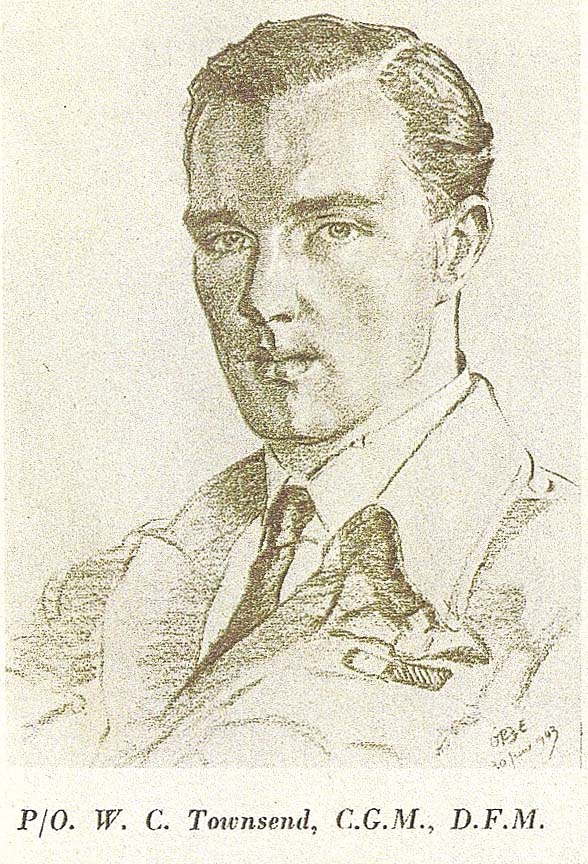
Wartime portrait by Cuthbert Orde, published in The Tatler, September 1943

The last pilot to land his aircraft safely on the night of the Dams Raid was Bill Townsend, pilot of AJ-O. He had been detailed as one of the five mobile reserves, taking off from Scampton at 0014 on Sunday 17 May. He was sent to one of the raid’s secondary targets, the Ennepe Dam, which he and his crew attacked — after three attempts — at 0337. Although it bounced twice, the mine exploded short of the dam which remained intact. They hung around for a while waiting to see if others would arrive, but then set off for home. They passed over the Möhne, saw for themselves the extent of the devastation already wreaked and then set off as fast as they could.

With dawn breaking, AJ-O had a very hairy journey back to base. As they approached Texel on the Dutch coast the Germans depressed a heavy flak gun on them and deliberately bounced shells off the water, a tactic which navigator Lance Howard later described as ‘not cricket’. (You imagine that he was being ironic, given the weapon that they had bounced off the Ennepe lake a few hours previously!) They finally landed, with only three engines working, at 0615 and were met on the hardstanding by a group of Bomber Command’s most senior officers, including AOC ‘Bomber’ Harris, whom Townsend failed to recognise and pushed past. It was however, as his crew later recalled, a piece of ‘superb flying’ which had brought them home.

After the war, Townsend had a quiet life. At one point he and his wife owned a pub, but he later worked as a civil servant, including a spell in the Department of Employment in Bromsgrove. Although he died as recently as 1991, there doesn’t seem to have been any obituary published in the national press. However one from a local (unnamed) Bromsgrove newspaper has now been unearthed by members of the WW2Talk Forum. Poster ‘Spidge’ started a thread three or four years ago trying to identify all the final resting places of the 129 Dambusters who are no longer with us, and one of his colleagues, Geoff, put up this snap:

Like so many of his generation, Bill Townsend was a modest man who rarely spoke of his part in the RAF’s most famous ever bombing operation. He surely deserves to be more widely celebrated.

BFI shows off Dam Buster stills

The British Film Institute has revamped its stills website, so that it now displays many more items from its collection. The first thing I searched for was, of course, The Dam Busters, where there are 24 items including most of the well known film stills and posters.

What is still missing, however, are those extra unused stills from cinematographer Erwin Hillier’s personal collection which turned up a couple of years ago, on which I reported at the time.