Dambuster of the Day No. 18: Leonard Chambers

National Collection

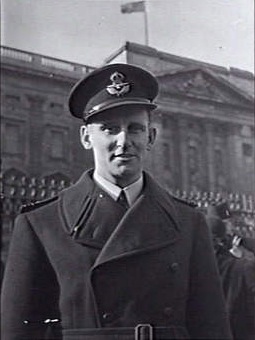
The five members of the crew of AJ-P  who were awarded honours for the Dams Raid pose outside Buckingham Palace. L-R: Len Chambers, Bob Hay, Mick Martin, Tom Simpson and Jack Leggo. [Pic: Australian War Memorial]

Flg Off L Chambers
Wireless operator
Lancaster serial number: ED909/G
Call sign: AJ-P
First wave. Third aircraft to attack Möhne Dam. Mine veered left after dropping and exploded at side of dam.

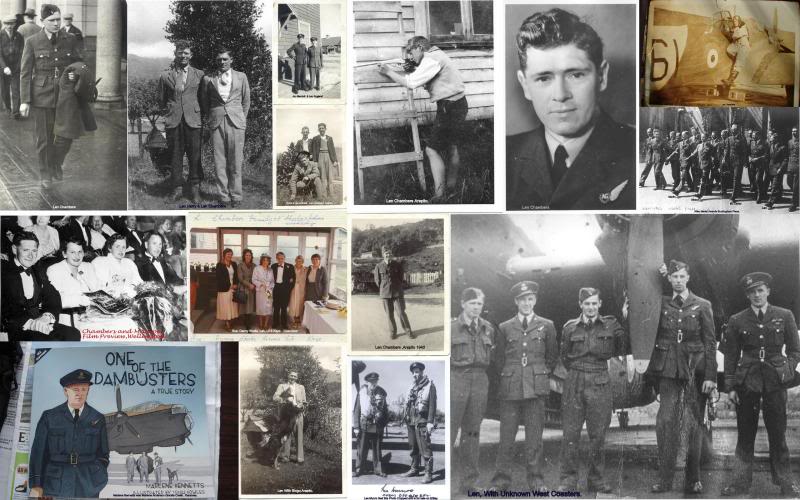
Len Chambers was born in Karamea, New Zealand on 18 February 1919. He joined the RNZAF in September 1940. After qualifying as a wireless operator/air gunner, he arrived in England where he was posted to a training unit and then 460 Squadron, an RAAF squadron. He flew on twenty operations there, before being transferred to 75 (NZ) Squadron, where he flew a further thirty-seven operations and became the Squadron Signals Leader.
When Mick Martin joined 617 Squadron he brought most of his old 50 Squadron crew with him, but was short of a wireless operator, so Chambers was brought in. He was awarded a DFC for his part in the raid.
After the raid, he flew on six further sorties before leaving 617 Squadron at the same time as Jack Leggo, in order to qualify as a pilot. However, he did not, apparently, ever fly on any operations in this role.
He returned to New Zealand in November 1944, and left the RNZAF in 1945. After the war, he worked as a carpenter and builder. He died in his native Karamea on 1 March 1985.

[Hat tips: Dave Homewood and Kevin Smith]

TwoNZers Chambers

Biography of Len Chambers from the programme for the New Zealand premiere of The Dam Busters, 1955. [Pic: Chambers family]

Chambers album WW11Dambusters

Collage of photos from a family album. [Pic: Chambers family]

Dams Film Preview

At the New Zealand premiere of The Dam Busters, 1955. L-R: Len Chambers, Lil Chambers, Betty Munro, Les Munro. [Pic: Chambers family]

Survived war. Died 1985.
Rank and decorations as of 16 May 1943.
Sources: Richard Morris, Guy Gibson, Penguin 1995
John Sweetman, The Dambusters Raid, Cassell 2002
Chris Ward, Andy Lee, Andreas Wachtel, Dambusters: Definitive History, Red Kite 2003

The information above has been taken from the books and online sources listed and other online material. Apologies for any errors or omissions. Please add any corrections or links to further information in the comments section below.
Further information about Len Chambers and the other 132 men who flew on the Dams Raid can be found in my book The Complete Dambusters, published by History Press in 2018.

Dambuster of the Day No. 17: Jack Leggo

Leggo 17Feb43 AWM UK0026

Pic: Australian War Memorial

Flt Lt J F Leggo DFC
Navigator
Lancaster serial number: ED909/G
Call sign: AJ-P
First wave. Third aircraft to attack Möhne Dam. Mine veered left after dropping and exploded at side of dam.

Jack Frederick Leggo was born in Sydney on 21 April 1916, the son of Frederick Henry Leggo and Leah Druce. He was brought up in Newcastle, New South Wales and went to Newcastle High School. He then worked as a bank clerk before joining the RAAF shortly after the outbreak of war.

Like many other Australians, he did part of his training in Canada. After qualifying as a navigator he arrived in England and was posted to 455 (Australia) Squadron, where he crewed up with Mick Martin in the autumn of 1941. Toby Foxlee and Tom Simpson joined Martin and Leggo in the crew over the next few months, and the fact that all four stayed together for almost two years illustrates the bond between them. In April 1942, 455 Squadron moved to Coastal Command but the four Australians transferred together to 50 Squadron, a heavy bomber squadron, and retrained on Manchesters and Lancasters. They completed a tour there, and then went off separately to various training units. Leggo received a DFC for his work on the completed tour.

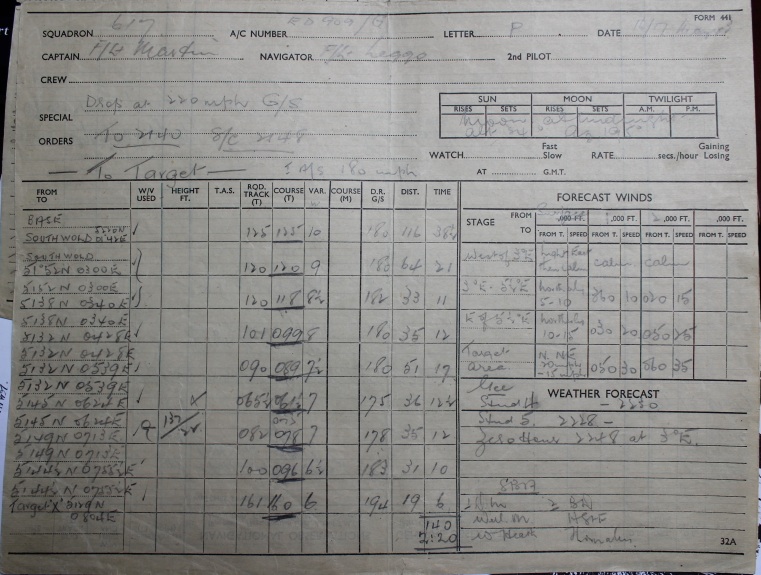
When Martin was asked to join the new 617 Squadron, he brought his old team together as the core of the crew of AJ-P. Leggo was made the Squadron Navigation Officer, responsible for all the other navigators. His confidence on the operation can be seen in the steady hand with which he completed the navigation logs, a page of which can be seen below.
logsheets2-1 Leggo crop

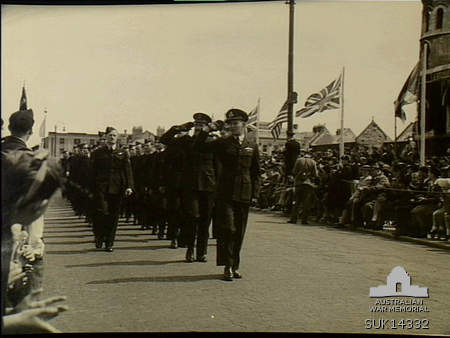
After the raid, for which he received a Bar to his DFC, he carried on flying with Martin for a while, but then he put in for retraining as a pilot. Martin supported him in this, praising him for his exemplary character, loyalty, conscientiousness, and devotion to duty. ‘No higher standard could be asked for,’ he added. Leggo qualified as a pilot and moved to 10 Squadron in Coastal Command, where he flew Sunderland flying boats for the rest of the war. Based in Plymouth, the double DFC is pictured below taking the salute as he leads a victory parade on VE Day.

National Collection

Pic: Australian War Memorial

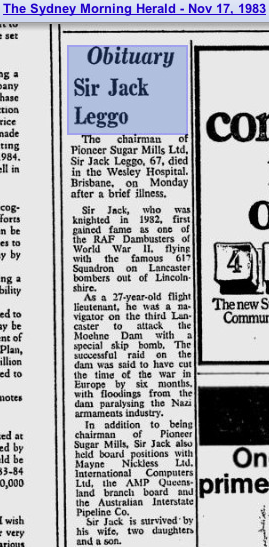
He returned to Australia after the war and went into the sugar industry in Queensland. He married Mary Best in 1947 and they had three children. After a successful business career he was knighted by the Queen in 1982. He died in Brisbane on 14 November 1983.

Extra research: Graeme Jensen

Leggo obit

More about Leggo online:
Entry at ww2awards.com

Survived war. Died 1983.

Rank and decorations as of 16 May 1943.
Sources: Richard Morris, Guy Gibson, Penguin 1995
John Sweetman, The Dambusters Raid, Cassell 2002
Chris Ward, Andy Lee, Andreas Wachtel, Dambusters: Definitive History, Red Kite 2003

The information above has been taken from the books and online sources listed and other online material. Apologies for any errors or omissions. Please add any corrections or links to further information in the comments section below.

Further information about Jack Leggo and the other 132 men who flew on the Dams Raid can be found in my book The Complete Dambusters, published by History Press in 2018.
It’s all for you, on Radio 2

Dams + Radio 2

News just in. On Friday 17 May, BBC Radio 2 is to spend an entire day devoted to the Dambusters 70th anniversary. Highlights will include:

Chris Evans broadcasting from the home of the Dambusters – RAF Scampton – and to fly in a Lancaster Bomber
• Interviews with Dambusters veterans Les Munro and George (Johnnie) Johnson, and Barnes Wallis’ daughter, Mary Stopes-Roe
• The largest live music event for the anniversary – Friday Night Is Music Night presents The Dambusters 70 Years On from Biggin Hill Airport
• The Central Band of the RAF to perform a new composition, plus the Military Wives Choir and the BBC Concert Orchestra.

Plenty more details here. We will add further information as and when it comes in. We will also check how much of this will be streamed live outside the UK.

Dambuster of the Day No. 16: Ivan Whittaker

Avro boardroom photo lores

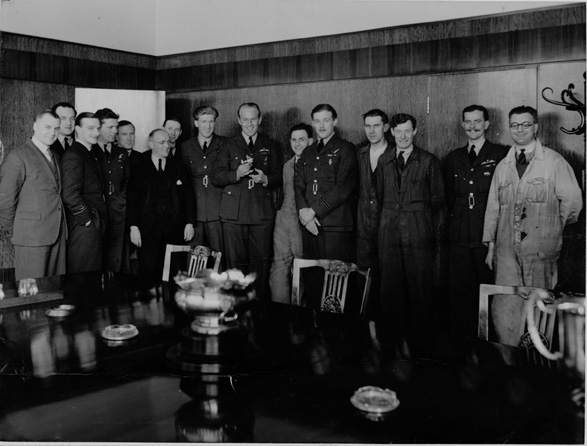
Ivan Whittaker is fifth from the right in this picture taken in the Avro Boardroom near Manchester sometime in late 1943 or early 1944. The 617 Squadron party are all members of Joe McCarthy and Mick Martin’s crews. [Pic: Ken Hickson/Peter Cunliffe]

Plt Off I Whittaker
Flight engineer
Lancaster serial number: ED909/G
Call sign: AJ-P
First wave. Third aircraft to attack Möhne Dam. Mine veered left after dropping and exploded at side of dam.

Ivan Whittaker was born in Newcastle on Tyne on 9 September 1921, the younger of the two sons of William and Jane Whittaker. His father was a seagoing marine engineer. Whittaker attended Wallsend Grammar School and then, in 1938, he joined the RAF as an apprentice at the No 1 School of Technical Training at RAF Halton. He spent the first three years of the war as ground crew. In 1942, he retrained as a flight engineer and was soon posted to 50 Squadron. There he met Mick Martin and flew with him on a number of operations. When he was called into 617 Squadron, Martin gathered together most of his old crew with the newly commissioned Whittaker sitting beside him in the flight engineer’s seat.

After the raid, he was promoted again and won his first DFC in September 1943, overdue recognition for a tour completed a year previously. The Martin crew carried on flying throughout the autumn and winter and on 12 February 1944 set off on an operation to attack the Antheor viaduct in Southern France. This was a disaster. Martin’s aircraft was hit by a shell which killed bomb aimer Bob Hay, wounded Whittaker and damaged the aircraft severely. Martin’s supreme skill as a pilot and Whittaker’s careful handling of the engines meant that they were able to make a dangerous landing at a tiny airport in Sardinia.

For his part in this, Whittaker received a Bar to his DFC, and is thought to be the only flight engineer with the double award. Part of the citation read:

‘Whilst over the target the aircraft was repeatedly hit and sustained much damage. Flight Lieutenant Whittaker was wounded in both legs but, in spite of this he coolly made a detailed examination of the aircraft and gave his Captain a full report of the damage sustained. He displayed great fortitude and devotion to duty and his efforts were of much assistance to his Captain who flew the damaged bomber to an airfield where a safe landing was effected.’

In March 1944, after forty-four operations, he was finally transferred into a training unit, where he served to the end of the war. He stayed on in the RAF after the war, eventually transferring to the Technical Branch and rising to the rank of Group Captain, finally retiring in 1974.

Whittaker was married with three sons. The family lived in Wendover, near the Halton base where he had first joined the RAF before the war, and he died in its hospital on 22 August 1979.

More about Whittaker online:
Listing at ww2awards.com

Survived war. Died 1979.
Rank and decorations as of 16 May 1943.
Sources: Richard Morris, Guy Gibson, Penguin 1995
John Sweetman, The Dambusters Raid, Cassell 2002
Chris Ward, Andy Lee, Andreas Wachtel, Dambusters: Definitive History, Red Kite 2003

The information above has been taken from the books and online sources listed and other online material. Apologies for any errors or omissions. Please add any corrections or links to further information in the comments section below.

Further information about Ivan Whittaker and the other 132 men who flew on the Dams Raid can be found in my book The Complete Dambusters, published by History Press in 2018.

Dambuster of the Day No. 15: Harold Martin

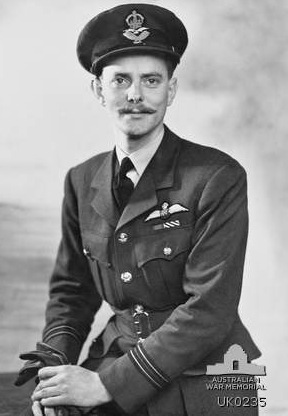
Martin AWM UK0235

Pic: Australian War Memorial

Flt Lt H B Martin DFC
Pilot
Lancaster serial number: ED909/G
Call sign: AJ-P
First wave. Third aircraft to attack Möhne Dam. Mine veered left after dropping and exploded at side of dam.

Harold Brownlow Martin was universally known throughout his long RAF career by his nickname ‘Mick’. He was born in the Sydney suburb of Edgecliff, Australia on 27 February 1918, the son of Dr Joseph Martin and his wife Colina. He went to Randwick High School, Sydney Grammar School and Lyndfield College. Before the war, Martin seemed destined for the medical profession like his father. In 1939 he had accepted a place at a medical school in Edinburgh, but shortly after he arrived in Britain his intentions were overtaken by the outbreak of war. He first joined the Australian army, but then in 1940, he transferred to the RAF, and began pilot training. He qualified as a pilot in June 1941, and his first operational posting came in October, when he was sent to 455 (Australia) Squadron, an RAAF outfit flying Hampdens. Two of his regular crew came to include fellow Australians Jack Leggo as navigator and Toby Foxlee as wireless operator/gunner.

On 18 February 1942, another Australian gunner, Tom Simpson, arrived on the squadron and was immediately assimilated into the crew. They flew on a trip to Cologne that night, thereby becoming the first all-Australian crew to fly on operations over Germany. When Simpson reported for duty to the gunnery section the following day, the officer in charge said that he would get him crewed up. Simpson replied:

‘I am crewed up. I flew last night.’ He looked at me in quite blank amazement and said ‘Well, who did you fly with? I wasn’t told anything about it.’
I said: ‘I flew with a Pilot Officer who told me his name was Martin … a Sergeant Foxlee told me that I was in his crew.’ The Flight Lieutenant then said ‘Well, there’s not much hope for you if that’s the case because Martin is as mad as a grasshopper; he likes flying his own style.’(Tom Simpson, Lower than Low, Libra Books, 1995, p40.

The crew went on a further dozen operations together until, in April 1942, 455 Squadron were transferred to Coastal Command. Martin, Leggo, Foxlee and Simpson then moved to 50 Squadron in order to continue their tour in Bomber Command. 50 Squadron was flying Manchesters at the time, but was in the process of moving over to the more powerful Lancasters. Three more Australians (Plt Off Burton, Sgt Paton and Sgt Smith) joined the Martin crew on their first 50 Squadron sortie, the Thousand Bomber raid which attacked Cologne on 30 May 1942. They thereby became the first ever all-Australian crew to fly a Manchester operationally.

By October 1942, Martin had completed his tour, with thirty-six operations, and was awarded the DFC. He had acquired a reputation both as a low flying specialist but also as someone who prepared meticulously for an operation, personally polishing the Perspex on his cockpit canopy, since a smear could easily obscure an approaching fighter. He demanded the same high standards from those who flew with him. According to Max Hastings, he and his crew ‘achieved an almost telepathic mutual understanding and instinct for danger.’ (Bomber Command, 1979, p165.)

It must have been at the investiture ceremony for this DFC that Martin first met Guy Gibson. It is recorded that it was there that they had a conversation about low flying methods. A few months later, Martin was just coming to the end of a spell as an instructor in 1654 Conversion Unit at Wigsley. Gibson recalled the earlier conversation and was quick to recruit him for the new project.

Martin set about bringing back together a crew mainly based on old 50 Squadron comrades, with a New Zealander from 75 Squadron, Len Chambers, as wireless operator. He also seems to have been instrumental in bringing in other men to the new squadron, often other comrades from 50 Squadron.

On the Dams Raid, Martin lined up to attack the Möhne Dam just minutes after disaster had overtaken Hopgood. Gibson joined his attack, flying slightly ahead on his starboard side. This tactic seemed to distract the dam’s gunners and Martin was able to drop his mine correctly. However, something must have gone wrong as the mine veered off to the left and exploded some 20 yards short. Later, as both Young and Maltby attacked, Martin joined Gibson in diversionary tactics, putting himself at further risk. Luckily, although one of his fuel tanks was damaged it had already been emptied, and he was able to fly back to Scampton when the Möhne was breached.

After the Dams Raid, Martin was a key figure in many of the celebrations and at the investiture in London, where he received the DSO. The Australian press and broadcasters were very keen to have pictures of their boys shown back at home, and with his distinctive moustache Martin was often recognised.

In September 1943, Martin was acting CO of 617 Squadron in the unhappy circumstances following the catastrophic attack on the Dortmund Ems canal when six pilots and most of their crews were lost in two days. Strangely, this was the only period during the war when he took command of a squadron.

Later, when Leonard Cheshire arrived, Martin participated in attacks on targets in France, Italy and Germany. In February 1944, during an abortive attack on the Antheor Viaduct in the French Riviera, Martin’s Lancaster was hit by ground fire, killing the bomb aimer Bob Hay, and causing Martin to force land his crippled aircraft in Sardinia. This was Martin’s forty-ninth (and last) heavy bomber operation. However he flew another thirty-four operations in Mosquitos in 515 Squadron.

Martin stayed on in the RAF after the war, and had a distinguished career. He broke the speed record for flying from England to Cape Town in a Mosquito, and then went on to a succession of staff jobs including being an ADC to the Queen, C-in-C RAF Germany and the Air Member for Personnel. He was knighted and rose to the rank of Air Marshal before retiring in 1974. Martin was described by Ralph Cochrane as being the greatest pilot the RAF produced during the war. (Paul Brickhill, The Dam Busters, Evans 1951, p163.) There would be few who would dispute this view.

Martin married his wife Wendy Lawrence in 1944, and they had two daughters. He died in London on 3 November 1988 after complications following a road accident. He is buried in Gunnersbury Cemetery in London.

More about Martin online:
Entry on Wikipedia
Entry in the Australian Dictionary of Biography

Survived war. Died 3 November 1988.
Rank and decorations as of 16 May 1943.
Sources: Richard Morris, Guy Gibson, Penguin 1995
John Sweetman, The Dambusters Raid, Cassell 2002
Chris Ward, Andy Lee, Andreas Wachtel, Dambusters: Definitive History, Red Kite 2003

The information above has been taken from the books and online sources listed and other online material. Apologies for any errors or omissions. Please add any corrections or links to further information in the comments section below.

Further information about Mick Martin and the other 132 men who flew on the Dams Raid can be found in my book The Complete Dambusters, published by History Press in 2018.
Dambuster of the Day No. 14: Anthony Burcher

Tony Burcher

Plt Off A F Burcher DFM
Rear gunner
Lancaster serial number: ED925/G
Call sign: AJ-M
First wave. Second aircraft to attack Möhne Dam. Aircraft hit by flak. Mine dropped late and bounced over dam. Aircraft crashed on far side of dam

Anthony Fisher Burcher was born in Vaucluse in Sydney, Australia on 15 March 1922, the fifth of the twelve children of Harvey and Estelle Burcher. He worked as a wool sorter before volunteering for the RAAF. He arrived in England in September 1941 and after further training was posted to 106 Squadron, whose CO was Guy Gibson. His first operation was the Thousand Bomber raid on 1 June 1942 when he attacked Essen in the crew of Wrt Off Peter Merrals. He went on to join Sgt James Cassels’s crew where he completed a full tour in November.

He received the DFM for his tour of operations, with the citation particularly noting his part in a skirmish on a trip to Saarbrucken when five enemy fighters were attacked and driven off.

Burcher was a complicated character and although he was at one point put onto a ‘dry’ stint by Gibson for scrapping in the mess, the CO obviously respected his gunnery skills as he was then transferred to the Gunnery Leaders Course at Sutton Bridge in Lincolnshire, with a commission.

After completing the Gunnery Leaders Course, Burcher was sent to 1654 Conversion Unit at Wigsley as an instructor. One of the pilots there was Mick Martin and according to Burcher’s account when Gibson telephoned Martin to ask him to join the new squadron he was told to bring Burcher along as well. As he knew Hopgood from 106 Squadron, he was placed in his crew.

On the Dams Raid itself, Burcher, in the rear turret, could only hear what was going on in the front of the aircraft via the intercom. It would seem that when AJ-M was hit by flak some twenty minutes before the dam was reached, Burcher received superficial wounds to the leg and stomach.

When Hopgood gave the order to bale out after the aircraft was hit again on the final attack, the wounded John Minchin managed to drag himself towards the rear escape hatch, with one leg almost severed. Burcher prioritised his colleague by pushing Minchin out of the hatch first, pulling his parachute ripcord as he did so, and then followed him. Sadly, Minchin did not survive the drop, but Burcher did and he and John Fraser, who had escaped from the front of the aircraft, were captured separately and taken prisoner. Burcher had broken his back in the fall and was then beaten up by the Germans for not cooperating with their interrogation.

On release from PoW camp in 1945, Burcher married Joan Barnes, a WAAF who had also served in 106 Squadron. They moved to Australia where Burcher continued service with the RAAF, and they had two daughters. At some point in the late 1940s his conduct became unsatisfactory and he suffered a number of health problems. His superiors speculated that some of this behaviour might have been caused by the effects of his wartime experiences. He was transferred to RAAF Overseas Headquarters in London in 1950, and was eventually discharged there in 1952, at the rank of Flight Lieutenant. He was repatriated to Australia at his own expense later that year.

Some time afterwards he returned to the UK and worked in various businesses. Sadly he fell in with some dubious characters and in 1961 he was successfully prosecuted for being involved in a criminal fraud case. He then returned to Australia. In later life he gave a number of interviews to researchers and the media, and his actions on the night of the dams raid were widely commended. He died in Hobart, Tasmania, on 9 August 1995.

More about Burcher online:
Burcher’s account of AJ-M’s final flight (scroll down)

Survived war. Died 9 August 1995.
Rank and decorations as of 16 May 1943.
Sources: Richard Morris, Guy Gibson, Penguin 1995
John Sweetman, The Dambusters Raid, Cassell 2002

The information above has been taken from the books and online sources listed and other online material. Apologies for any errors or omissions. Please add any corrections or links to further information in the comments section below.

Further information about Tony Burcher and the other 132 men who flew on the Dams Raid can be found in my book The Complete Dambusters, published by History Press in 2018.
Dambuster of the Day No. 13: George Gregory

Gregory photo

Plt Off G H F G Gregory DFM
Front gunner
Lancaster serial number: ED925/G
Call sign: AJ-M
First wave. Second aircraft to attack Möhne Dam. Aircraft hit by flak. Mine dropped late and bounced over dam. Aircraft crashed on far side of dam.

George Henry Ford Goodwin Gregory was born in Govan, Glasgow on 24 June 1917, one of the seven children of Edwin and Agnes Gregory. He worked as a printer before joining the RAF at the outset of the war. He had completed a full tour of operations as a gunner in 44 Squadron by the autumn of 1942, and received the DFM. He then moved on to a training unit and was commissioned. He went back onto operations in March 1943, and was posted to 617 Squadron where he joined John Hopgood’s crew.

Gregory was married, but his wife Margaret had remained in Scotland. In the run up to the Dams Raid he was living at RAF Scampton, and sharing quarters with squadron adjutant Harry Humphries.In his memoirs, Humphries recalled the night before the raid:

Old Greg was a tough proposition, tall, handsome and like most Scots, very independent. If he liked you, all well and good, If he disliked you, well at least you knew… [His] wife had been in Lincoln a few days previously and I really think he needed her in his strung up state. He did not know what he wanted to do. First he wanted to go out in his car and find a drink, then he wanted to play snooker, and then he would talk about bed… I said ‘Come on old lad, let’s go for a walk around the mess. It’s getting damned hot in here.’ … Just as we were leaving the anteroom John Hopgood, Gregory’s pilot, spotted us and aimed an almost playful kick at his rear gunner’s backside, which I am sure would have crippled him if it had landed. When I eventually separated them, with Greg, needless to say, on top by sheer brute force, Hopgood or ‘Hoppy’ as we knew him, dragged himself painfully to his feet. ‘Just as I said,’ he complained loudly, ‘air gunners are all bloody brawn and no brains.’

They then walked back to their quarters, and had a cup of tea with their batman in his kitchen.

Greg was the first to move. ‘I think I will go to bed,’ he said, ‘may be working tomorrow.’ With that he had gone and little did I know that for Greg it was probably his last cup of tea in that kitchen. In fact it was his last night on earth. (Harry Humphries, Living with Heroes, 2003, pp. 1-3)

From Tony Burcher’s account, we now know that it is likely that Gregory was severely wounded some twenty minutes before Hopgood’s aircraft reached the Möhne Dam, as he wasn’t answering his intercom. In the same flak attack Hopgood, Minchin and Brennan himself were also wounded. However they pressed on, the mine was dropped, and moments afterwards Hopgood told the crew to bale out. According to John Fraser’s post-war debriefing after his release from PoW camp, it would seem that Gregory attempted to get back to the rest area to retrieve his parachute but never escaped.

Hopgood, Brennan, Earnshaw, Minchin and Gregory are buried together in Rheinberg War Cemetery, Germany.

More about Gregory online:
Commonwealth War Graves Commission listing

KIA 17 May 1943
Rank and decorations as of 16 May 1943.
Sources: Richard Morris, Guy Gibson, Penguin 1995
John Sweetman, The Dambusters Raid, Cassell 2002
The information above has been taken from the books and online sources listed and other online material. Apologies for any errors or omissions. Please add any corrections or links to further information in the comments section below.

Further information about George Gregory and the other 132 men who flew on the Dams Raid can be found in my book The Complete Dambusters, published by History Press in 2018.
Dambuster of the Day No. 12: John Fraser

p_fraser1

Pic: Bomber Command Museum of Canada

Flt Sgt J W Fraser
Bomb aimer
Lancaster serial number: ED925/G
Call sign: AJ-M
First wave. Second aircraft to attack Möhne Dam. Aircraft hit by flak. Mine dropped late and bounced over dam. Aircraft crashed on far side of dam.

John William Fraser was born in Nanaimo, British Columbia, Canada on 22 September 1922 and joined the RCAF soon after the war started. After qualifying as a bomb aimer he arrived in England in April 1942, and shortly after was posted to 50 Squadron. There he flew a full tour of thirty operations, mostly with Canadian pilot Norman Schofield, whose crew also included two more people who would become Dambusters: another Canadian, the navigator Ken Earnshaw, and gunner Brian Jagger.

By mid April 1943, Fraser and Earnshaw were both scheduled to go to a training unit for the normal inter-tour rest period. However a call came from the new 617 Squadron being set up at Scampton. Pilot John Hopgood needed an experienced navigator and bomb aimer. His first navigator had fallen ill and his bomb aimer had not come up to scratch. Earnshaw and Fraser were recommended, and arrived at Scampton at the end of April, some time after training for the Dams Raid had begun. However, as Fraser had already arranged his wedding for 29 April, he was given special permission to have a day off.

On the Dams Raid itself, Hopgood’s aircraft AJ-M was hit by flak well before they reached the Möhne Dam. One engine was damaged, Hopgood himself was wounded, as was George Gregory in the front turret.

Fraser released the mine and it bounced over the dam, blowing up the power station on the other side. But his Lancaster was doomed.

After the war he wrote: ‘We flew on and the pilot gave the order to abandon the aircraft within about 25 seconds after we passed over the dam. I knelt facing forward over the escape hatch and I saw that the trees looked awful close. I thought there was only one thing to do and that was to pull the rip cord and let the pilot chute go out first and then let it pull the chute out and me after it, and that’s what I did.’

He landed almost a mile away from where the aircraft crashed, but was soon captured by the Germans. After interrogation, where he was forced to give some details of the mission, he was sent to a PoW camp.
Released at the end of the war, he saw his wife Doris again in May 1945 for the first time since the day after their wedding. They made their home in Canada. Fraser never forgot the sacrifice made by John Hopgood which saved the lives of two of his crew. The names of all of his children were chosen as a tribute to Hopgood and 617 Squadron. His first son has the given names John Hopgood; his daughter was called Shere, after Hopgood’s home village; and his second son was called Guy, after the squadron CO.

Fraser worked in the forestry service, and fulfilled his lifetime ambition to qualify as a pilot. Unfortunately, he was killed in a flying accident, at Saltery Bay in British Columbia on 2 June 1962.

More about Fraser online:
Articles at Bomber Command Museum of Canada 1 2

Survived war. Died 2 June 1962.
Rank and decorations as of 16 May 1943.

Sources: Richard Morris, Guy Gibson, Penguin 1995
John Sweetman, The Dambusters Raid, Cassell 2002
The information above has been taken from the books and online sources listed and other online material. Apologies for any errors or omissions. Please add any corrections or links to further information in the comments section below.

Further information about John Fraser and the other 132 men who flew on the Dams Raid can be found in my book The Complete Dambusters, published by History Press in 2018.
Dambuster of the Day No. 11: John Minchin

MINCHIN (Custom)

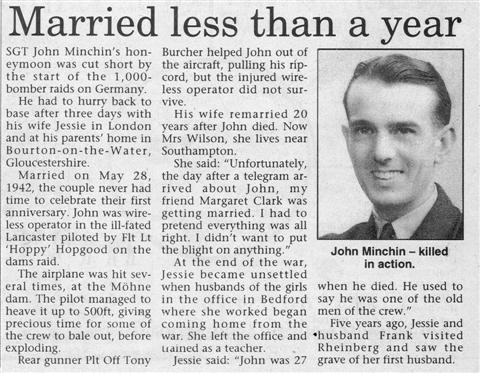
Press cutting about John Minchin from unnamed newspaper. [49 Sqn Association]

Sgt J W Minchin
Wireless operator
Lancaster serial number: ED925/G
Call sign: AJ-M
First wave. Second aircraft to attack Möhne Dam. Aircraft hit by flak. Mine dropped late and bounced over dam. Aircraft crashed on far side of dam.

John William Minchin was born on 29 November 1915 in the picturesque Gloucestershire village of Bourton-on-the-Water (‘The Venice of the Cotswolds’). He was the third of the six sons of Bertram and Eliza Minchin. His father was a baker. He joined the RAF soon after the onset of war, and after training as a wireless operator/air gunner was posted to 49 Squadron at Scampton in October 1941.

He married Jessie Irving in London on 28 May 1942 but only got three days honeymoon before being recalled to his base to take part in the first Thousand Bomber raid.

In August 1942, he completed a full tour in both Hampdens and Manchesters, and was posted to a training unit. From there he went straight to join John Hopgood’s crew in the new 617 Squadron. What happened to Minchin on the Dams Raid is told in an online extract from John Ward’s book Beware A Dog at War on the 49 Squadron Association website:

Minchin was badly wounded in the leg when M-Mother was hit by flak en-route to the Möhne Dam. Sgt Minchin sat for almost an hour at his radio set nursing this terrible injury before the target was reached.
M-Mother, the second aircraft to attack, was severely hit by ack-ack on the run-in and set on fire. The bomb was released but hit the parapet wall and exploded. F/Lt Hopgood struggled valiantly to keep his blazing aircraft airborne in order for the crew to bale out.
Tony Burcher evacuated his rear turret and made for the crew door. There he was confronted by the pained face of John Minchin, who had dragged himself the length of the fuselage, his leg almost severed.
All Burcher could do to help his comrade was to clip on Minchin’s parachute and push him out into the darkness, pulling his D-ring in the process. The Lancaster crashed 3 miles to the north-west of the dam and exploded in flames.

The aircraft crashed in a field near Ostönnen. Hopgood, Brennan, Earnshaw and Gregory’s bodies were found in the wreckage. Minchin’s body was found about 2km from the crash site.

Tragically, just six weeks after the Dams Raid on 27 June 1943, the family lost another son, Ronald Buckland Minchin, aged 23, who served with 295 Squadron. Both are commemorated on the Bourton-on-the-Water War Memorial.

The Minchins were one of the three families who lost a son who took part in the Dams Raid and another son serving elsewhere in Bomber Command during the war.

Hopgood, Brennan, Earnshaw, Minchin and Gregory are buried together in Rheinberg War Cemetery, Germany.

More about Minchin online:
49 Squadron Association article
Bourton-on-the-Water memorial
Commonwealth War Graves Commission listing

KIA 17 May 1943
Rank and decorations as of 16 May 1943.

Sources:
Richard Morris, Guy Gibson, Penguin 1995
John Sweetman, The Dambusters Raid, Cassell 2002
Research by Andy Bailey
The information above has been taken from the books and online sources listed and other online material. Apologies for any errors or omissions. Please add any corrections or links to further information in the comments section below.

Further information about John Minchin and the other 132 men who flew on the Dams Raid can be found in my book The Complete Dambusters, published by History Press in 2018.

Dambuster of the Day No. 10: Kenneth Earnshaw

50 sqn Schofield crew

Ken Earnshaw, back row, third from left, in his 50 Squadron crew.
Back, L-R: W Mooney, J W Fraser, K Earnshaw, N L Schofield, B Jagger.
Front, L-R: J O Christie, R A Baker.

Flg Off K Earnshaw
Navigator
Lancaster serial number: ED925/G
Call sign: AJ-M

First wave. Second aircraft to attack Möhne Dam. Aircraft hit by flak. Mine dropped late and bounced over dam. Aircraft crashed on far side of dam.

Kenneth Earnshaw was born in Bridlington, Yorkshire, on 23 June 1918, the son of Joseph and Janet Earnshaw. His family emigrated to Canada a year later and took up farming in rural Alberta. He was educated at Camrose High School. He qualified as a teacher at Alberta Normal School in Edmonton, and then taught at Whitebush School in Bashaw, Alberta, before leaving to enlist in the RCAF. He married Mary Heather in November 1941, and they lived in Bashaw.

After training in Canada, at the end of which he was commissioned, he travelled over to England, and was posted to 50 Squadron in November 1942. He was part of a Lancaster crew which flew with pilot Norman Schofield; the crew’s bomb aimer, fellow Canadian John Fraser, became a close friend. Together they flew on 30 operations in under six months. Gunner Brian Jagger, who would fly on the Dams Raid with David Shannon in AJ-L, was also in this crew.

By mid April 1943, they were scheduled to go to a training unit for the normal inter-tour rest period. However both Earnshaw and Fraser were recommended when a call came from the new 617 Squadron being set up at Scampton. Pilot John Hopgood needed two new crew members. His first navigator had fallen ill and his bomb aimer had not come up to scratch. Earnshaw and Fraser were recommended and arrived at Scampton at the end of April, some time after training for the Dams Raid had begun.

As navigator, Ken Earnshaw sat immediately behind John Hopgood and Charles Brennan in the cockpit. He must have seen the trouble Hopgood was in, hit by flak before they even reached the Möhne Dam. He had little chance of reaching the escape hatch when Hopgood ordered the crew to bale out, and he died when AJ-M crashed in a field near Ostönnen, 6km from the dam. Hopgood, Brennan, Earnshaw and Gregory’s bodies were found in the wreckage.

Kenneth Earnshaw is buried in Rheinberg War Cemetery.

More about Earnshaw online:
Canadian Virtual War Memorial entry
Bomber Command Museum of Canada article
Commonwealth War Graves Commission listing

KIA 17 May 1943
Rank and decorations as of 16 May 1943.

Sources:
Richard Morris, Guy Gibson, Penguin 1995
John Sweetman, The Dambusters Raid, Cassell 2002

The information above has been taken from the books and online sources listed and other online material. Apologies for any errors or omissions. Please add any corrections or links to further information in the comments section below.

Further information about Ken Earnshaw and the other 132 men who flew on the Dams Raid can be found in my book The Complete Dambusters, published by History Press in 2018.