Fake “Gibson” telegram withdrawn from auction

721

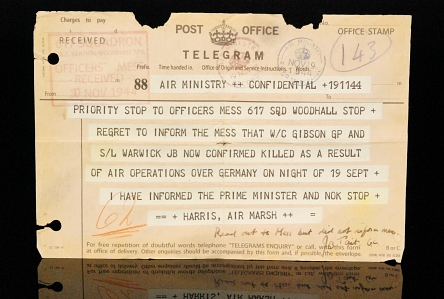
A telegram confirming the 1944 death of Guy Gibson, described as being from Sir Arthur Harris, has now been withdrawn from auction after doubts about its authenticity. It was due to be sold by Fieldings Auctioneers in Stourbridge on Saturday 16 May, with an estimated price of £600.
The sale was trumpeted in articles in the Daily Express, the Daily Mirror and other newspapers, with typical over-excitement. None of these publications thought to contact any historian or serious collector who might be able to throw some light on the telegram. “Dambusters hero’s death kept secret for MONTHS to protect morale during WW2,” said the Express. The Mirror also went along with the morale idea, saying: “RAF hushed up death of Dambusters hero Guy Gibson to preserve morale, wartime telegram reveals”.
The telegram, we were told in both papers, had been found by a dealer inside a book during a house clearance sale, apparently being used as a bookmark.
Having seen the newspapers, I contacted the auctioneers. I pointed out some of the reasons I had to doubt the telegram’s authenticity, and they decided to seek the opinion of professional curators. I am glad to say that they agreed with me, and the item was then removed from the sale.

I am now quite convinced that the telegram is a fake. I have commented in this blog before how Fleet Street editorial standards have slipped over the years. In this case, the newspapers seem to have stoked up the hype and not questioned the item’s provenance. Anyone with any knowledge of the RAF’s wartime communication systems would surely have smelt a rat. And there are several other features, visible even in the small photograph on the auctioneers’ website, which were very suspicious indeed.

Use of a telegram
In November 1944, Sir Arthur Harris held the rank of Air Chief Marshal and the job title of Commander-in-Chief Bomber Command. The job was normally abbreviated to AOC-in-C HQBC in official communications. Messages, instructions and orders between him and other sections of the RAF were normally communicated via official message forms or by telex. On both of these, his official job title or its recognised abbreviation would be used. The use of a normal Post Office telegram for any important service purpose seems most unlikely, as would the signature being abbreviated to “Harris Air Marsh”. And finally, if by any chance a normal telegram form was used, the sender’s address would be shown as “HQ Bomber Command”, not “Air Ministry”.

Overall look
Many examples of wartime telegrams survive, and some general observations can be made when they are compared with the “Gibson” telegram. Here is a genuine wartime telegram, found on the 206 Squadron website:
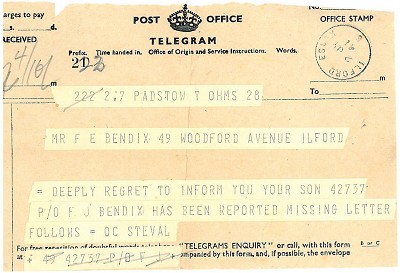
Bendix - MIA TelegramLet us start with the form itself. Even though it is possible to get genuine blank wartime forms, the “Gibson” telegram would appear to be composed on a fake form. There are several different designs of wartime Post Office telegram forms, but they all have one thing in common – the font used is Gill Sans, as seen above. The form had been redesigned in Gill Sans by the famous typographer Stanley Morison in 1935. The “Gibson” telegram uses a different font, another sans serif, but not Gill Sans.
Furthermore, in “real” telegrams, the message itself was cut from the output of a telegraph machine and then pasted onto the form. The message would have been printed with a fabric ribbon, which led to a rather grey colour. The individual words themselves are usually spaced well apart, the gap between each word being almost two characters wide. And the individual characters which make up each word are themselves spaced quite widely.
In the “Gibson” telegram, the lettering looks as though it was produced by modern computerised typesetting. The letters and the words are more closely spaced than their wartime equivalent.

Wrong ranks
Harris had been promoted from Air Marshal to (Temporary) Air Chief Marshal [(T) ACM] on 16 August 1944. He would have signed any communication after this date as either (T) ACM or ACM.
Below the official print is a handwritten note: “Read out to the Mess but did not inform men. J B Tait GC”. However, in November 1944, the Officer Commanding 617 Squadron, J B (“Willie”) Tait was still a Wing Commander. He was not promoted to Group Captain until after he left 617 Squadron at the end of 1944. Any note written by him at this time would therefore would have been signed as “J B Tait WC”.

Address and rubber stamps
It seems most unlikely that a telegram would be sent to the Officers Mess of any squadron. In any case, in November 1944 the arrangements for officers stationed at Woodhall Spa was quite complicated and there was no single Officers Mess as such. 617 Squadron’s officers were billeted at the Petwood Hotel in the town of Woodhall Spa, as were some other officers serving on the station, such as some intelligence officers and the station commander, Gp Capt “Monty” Philpott. The actual RAF station was a few miles away in Tattersall Thorpe, and other officers on the station, such as those in 627 Squadron, were housed there in a series of temporary concrete or brick huts.
The correct mode of address for a communication to the squadron would be to its officer commanding. Any rubber stamp used would say “617 Squadron/RAF Station Woodhall Spa/Received/date”, without mention of the Officers Mess.

Unlikely wording
The wording of the text does not sound as though it was composed by a wartime writer, used to writing succinct messages where excess words and pronouns are removed. A genuine text would be more likely to read “Prime Minister and NOK informed”, not “I have informed the Prime Minister and NOK”.

Caveat Emptor
The estimated price of £600 for this item was very conservative, given the huge sums reached recently for genuine Dambuster memorabilia. According to the auctioneers there had already been “substantial interest” in it. My guess is that it would have reached at least £5000, and possibly nearer £10,000.
The amount of profit available means that there may well be other attempts to deceive the market with further fake material. One collector recently went public after a bad experience with a well-known unscrupulous trader. My advice to anyone who sees anything offered for sale is to get good advice from a reputable independent source.

Thanks to the various researchers who have helped with this article.
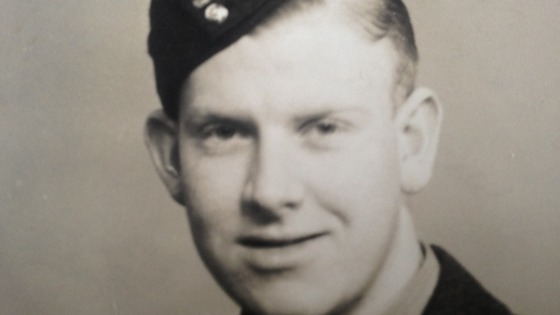
Dambuster of the Day No. 105: Frederick Tees

Fred_Tees_1943

Sgt F Tees
Rear gunner

Lancaster serial number: ED910/G

Call sign: AJ-C

Third wave. Crashed on outward flight.

Frederick Tees was born in Chichester, Sussex on 16 June 1922, one of the five children of Henry and Elizabeth Tees. His father was a barber and had a shop in the town. Tees went to the Central CofE School and the Lancastrian School in Chichester.

He joined the RAF in 1941 and was finally selected for air gunner training in 1942. His final training was at 1660 Conversion Unit, where he joined up with Bill Ottley and the crew who would eventually fly on the Dams Raid. They were posted together to 207 Squadron in November 1942, and took part on their first raid on 23 November. Tees and flight engineer Ron Marsden were the only two who flew on all 17 operations which Ottley undertook in 207 Squadron between then and April 1943. Ottley, Tees and the rest of the crew were transferred to 617 Squadron shortly after their last operation in 207 Squadron, on 4 April 1943. They undertook their first training flight in the new squadron on 8 April 1943.

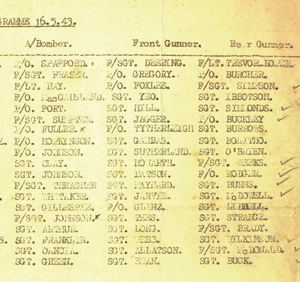
Although they normally flew in the rear and mid-upper turret respectively, Fred Tees and Harry Strange had occasionally swapped positions while serving in 207 Squadron. As the specially adapted Dams Raid Lancasters had no mid-upper turret, it is possible that both tried out the front turret of AJ-C during training. This may explain why some of the documents for the operation, including the Night Flying Programme typed up on the morning of Sunday 16 May, listed Tees in the front turret and Strange in the rear.

Grantham 0003 fly order cropped
Detail from the Night Flying Programme shows Fred Tees listed as flying as AJ-C’s front gunner.

When the aircraft took off from Scampton at 0009 on Monday 17 May, however, Tees was definitely in the rear turret, a decision which would save his life. Flying so low that at one point he saw a church steeple above him, Tees fired at some searchlights and gun emplacements as they crossed Holland and Germany.

As they neared Hamm, a “tremendous commotion” occurred and he realised that AJ-C had been hit on the port side. His turret was immobilised and flames began to streak past it. He heard Ottley say “I’m sorry boys, we’ve had it”, and he recalled thinking “there’s no future at baling out at nought feet with three engines on fire”. Some minutes later, he regained consciousness on the ground. His turret had somehow been blown clear of the wreckage, perhaps as a result of a second explosion as the Upkeep mine blew up. He was badly burned and was quickly captured by the Germans. He spent the rest of the war as a prisoner of war.

The fact that Tees had survived did not become known for some months, and so his family were told that he was missing in action. Almost a year after the Dams Raid, on Thursday 11 May 1944, his mother, Mrs Elizabeth Tees, was killed in an accident when a USAAF B24 Liberator crashed on the laundry in Chichester where she was working. It had been damaged by flak on a bombing operation over France. After the pilot set a course for it to crash into the English Channel, the crew baled out. Unfortunately, the aircraft veered off this course and crashed on land, killing three civilians. Some sources say that Mrs Tees defied instructions and ran back into the burning building to collect her handbag. Tees apparently only found out about his mother’s death on release from his PoW camp in 1945.

Tees became a hairdresser after the war, the same trade as his father, with a business in Letchworth, Hertfordshire. He took part in a number of 617 Squadron reunions before his death by suicide on 15 March 1982. He was cremated in Luton, but his last wish was for his ashes to be scattered on the graves of his fallen comrades in Reichswald Forest War Cemetery.

Thanks to Mick Tees for help with this article.

More about Tees online:
ITV News reports about Tees family visits to the graves of the Ottley crew
Chichester Local History booklet on the Liberator crash on Chichester, May 1944
Entry in Wikipedia

Survived war. Died 1982.

Rank and decorations as of 16 May 1943.
Sources:
Richard Morris, Guy Gibson, Penguin 1995
John Sweetman, The Dambusters Raid, Cassell 2002

The information above has been taken from the books and online sources listed above, and other online material. Apologies for any errors or omissions. Please add any corrections or links to further information in the comments section below.

Further information about Fred Tees and the other 132 men who flew on the Dams Raid can be found in my book The Complete Dambusters, published by History Press in 2018.

Dambuster of the Day No. 104: Harry Strange

strange_harry_

Pic: Dorothy Bill

Sgt H J Strange
Front gunner

Lancaster serial number: ED910/G

Call sign: AJ-C

Third wave. Crashed on outward flight.

Harry John Strange was born in Birkenhead on 25 April 1923, the oldest of the six children of Harry and Margaret Strange. After his parents’ marriage broke up, he moved to London with his mother who had remarried to a man called Robert Lynn. Lynn adopted Strange as his son. He joined the RAF in 1941, soon after his 18th birthday, and was sent for air gunner training in 1942.

He arrived at 1660 Conversion Unit in late 1942, and would seem to have met most of his future crewmates there. Although he joined 207 Squadron from 1660 CU on the same day, 11 November 1942, as most of the rest of the Ottley crew, he flew his first two operations with Sgt G. Langdon as pilot. His first operation with Ottley as his skipper was on 21 December on a trip to Munich. This was the day when the crew who would eventually fly on the Dams Raid with Bill Ottley all flew together operationally for the first time.

Strange flew another operation with Langdon in January 1943, but on 2 February he made a permanent move to Ottley’s crew. He went on to fly on another twelve trips with Ottley, the last being their final operation in 207 Squadron, an attack on Kiel on 4 April 1943. He seems to have flown on most of the trips as the mid-upper gunner, but occasionally he swapped with Fred Tees, and flew in the rear turret. On the Dams Raid, Strange flew as AJ-C’s front gunner, thereby sealing his fate.

Along with five others in his crew, he died when the aircraft was shot down near Hamm on 17 May 1943. Harry Strange and his comrades were originally buried in by the Germans in Hamm, but were reinterred after the war in Reichswald Forest War Cemetery.

More about Strange online:
Entry at Commonwealth War Graves Commission

KIA 17.05.43

Rank and decorations as of 16 May 1943.
Sources:
Richard Morris, Guy Gibson, Penguin 1995
John Sweetman, The Dambusters Raid, Cassell 2002

The information above has been taken from the books and online sources listed above, and other online material. Apologies for any errors or omissions. Please add any corrections or links to further information in the comments section below.

Further information about Harry Strange and the other 132 men who flew on the Dams Raid can be found in my book The Complete Dambusters, published by History Press in 2018.

Dambuster of the Day No. 103: Thomas Johnston

johnston_102

Flt Sgt T B Johnston
Bomb aimer

Lancaster serial number: ED910/G

Call sign: AJ-C

Third wave. Crashed on outward flight.

Thomas Barr Johnston was born on 19 July 1921 in Bellshill, Lanarkshire, the youngest of the three children of Peter and Elizabeth Johnston. His father was a music teacher at Bellshill Academy, and the young Tommy went to school there. After leaving school he went to work in the laboratory of the local steelworks.

Like many young men of his generation, Johnston wanted to fly, and he volunteered for the RAF when the war broke out. He was sent to Canada to train, returning in 1942. He was posted to 207 Squadron in July 1942, and flew on his first operation on 21 July as bomb aimer with Flt Sgt V. Duxbury, on a trip to Duisburg. He took part in three more operations with different pilots in September, and was then posted to a Conversion Unit.

It would seem that he then met up with Bill Ottley and his crew and flew on about fourteen more operations in 207 Squadron. (The 207 Squadron Operations Record Book frequently gives him the initials K R, in an obvious confusion with Sgt K R Johnson, a flight engineer, who was present in the squadron at the same time. The confusion seems to end when K R Johnson was killed on operations on 25 February 1943. He is buried in Durnbach War Cemetery.)

By the middle of March 1943 Johnston was established as Ottley’s regular bomb aimer and is unlikely to have hesitated when offered a posting to the new 617 Squadron.

There was recipe for further confusion in the new squadron, when it emerged that there were already two bomb aimers with the surname Johnson. Sadly, this soon ceased to be a problem for the young Scot as the crew did not complete their first operation, the Dams Raid.

Tommy Johnston and his comrades were originally buried in by the Germans in Hamm, but were reinterred after the war in Reichswald Forest War Cemetery.

Thanks to Bill Gracie for help with this article.

More about Johnston online:
Entry at Commonwealth War Graves Commission

KIA 17.05.43

Rank and decorations as of 16 May 1943.
Sources:
Richard Morris, Guy Gibson, Penguin 1995
John Sweetman, The Dambusters Raid, Cassell 2002

The information above has been taken from the books and online sources listed above, and other online material. Apologies for any errors or omissions. Please add any corrections or links to further information in the comments section below.

Further information about Tommy Johnston and the other 132 men who flew on the Dams Raid can be found in my book The Complete Dambusters, published by History Press in 2018.

Dambuster of the Day No. 102: Jack Guterman

Grantham Guterman cropPic: Lincolnshire Library Services

Sgt J Guterman DFM
Wireless operator

Lancaster serial number: ED910/G

Call sign: AJ-C

Third wave. Crashed on outward flight.

Jack Guterman was born in Ramsgate, Kent, on 1 August 1920, the older of the two children of Jack and Jane Guterman. His family then moved to Guildford. His father, an accountant, served on the Western Front in the First World War, and came from a Jewish family who had fled Poland in the 1890s, while his mother was of Irish descent. Guterman went to Sandfield Primary School and on to Guildford Royal Grammar School in 1931. He left school in 1937 and studied at art school in Andover, where his tutor was the artist Dick Hosking. He then went to work in his father’s accountancy practice.

When the war came, he volunteered for the RAF and was selected for training as an air observer. He went on to qualify as a wireless operator/air gunner, and finished his training in the autumn of 1941.

Guterman had great potential as an artist, and hung his own oil paintings and drawings on the walls of the various rooms he lived in during his RAF career. He took his paints and drawing materials from base to base and carried on producing quality work. He also loved literature and music, and collected records and books. He wrote regularly to his family, sending them a remarkable series of letters with details of concerts he had heard on the radio, accounts of how his artistic work was progressing, witty pen portraits of his RAF colleagues and vivid descriptions of the countryside over which he had flown.

He was posted to 207 Squadron in February 1942, and started operational flying in June 1942. Along with navigator Plt Off Jack Barrett he joined the crew of Flt Sgt Anthony Walters, and they flew on some nineteen operations together before going first to a conversion unit and then back to 207 Squadron to a new crew skippered by Bill Ottley.

He became good friends with Ottley, and they shared a room together in their quarters at RAF Bottesford. They spent much of their spare time talking about the arts and listening to music. Guterman’s last operation in 207 Squadron was on 8 March 1943, on a trip to Nuremburg. With this he finished his tour and could have opted to go to a training unit for at least six months. He was also recommended for a DFM, of which part of the citation read:

In both capacities [as air gunner and wireless operator], he has consistently shown the greatest enthusiasm, determination and efficiency. In the capacity of air gunner, Sergeant Guterman displays a fine fighting spirit, welcoming every opportunity to use his guns against the enemy. On one occasions when returning from Kassel, he successfully attacked light gun and searchlight positions from a low level. His courage, reliability and perseverance have made this airman a most valuable member of aircrew.

Unfortunately the award did not come through before the Dams Raid, and the medal was sent to his family after the war.

Although he could have gone on an instructional role in an OTU, Guterman wasn’t enthusiastic at the prospect: ‘Ugh! Ugh!’, he wrote to his sister on 18 February, and followed this up on 4 March with the news that he was to be posted to a ‘wretched training station in the Lincoln vicinity’. He managed somehow to postpone this transfer, so he was still at Langar when Ottley and his crew were nominated for a transfer to 617 Squadron. As they did not have a regular wireless operator, Guterman must have volunteered to join up with his old comrades, and was posted along with them.

Naturally, he took his painting and drawing materials. He told his family that he had been allocated a room in one of Scampton’s ‘married quarters’ which he shared with a ‘Scots lad’. In a later letter, he referred to him as ‘Johnnie’, so this was probably his crewmate Thomas Johnston. One day, when workmen arrived to paint the outside of the quarters they noticed through the window the display on the walls and enquired what they were. Johnston told them that they were ‘works of art’: ‘fleeting fancies materialised in a fleeting form’, a description which left the workmen somewhat baffled.

During the training in the run up to the Dams Raid Guterman somehow found quite a lot of time in which he could paint. He began work on a painting which he called ‘Gethsemane’. In a letter to his sister which is dated ‘early May’ he told her how excited he was by the work he had done so far on the project:

My ‘Gethsemane’ is progressing and flavours of Fra Angelico, the Italian Primitive especially in the ‘flora’ parts. I get so thrilled about it that I cannot get it out of my mind and rush back to do odd things to it throughout the day. I believe it will turn out to be my chef-d’oevre.[sic]

The finished painting was among the large collection of works which were sent back to the family. He didn’t however mention it in his last letter home, sent to his sister and dated 16 May. Instead he described a trip to Lincoln the day before, in which he had bought three records and studied some art books in the reference library. All in all, he concluded, he was discovering ‘some most quaint corners which each help to raise my opinion of the town’. The letter concluded: ‘I’m boring myself so I don’t know about you! Fond Love Zak.’

As AJ-C’s wireless operator, Guterman received the message from Group HQ to attack the Lister Dam at 0231 on the morning of 17 May 1943. A second message, sent a minute later, ordering them to go to the Sorpe instead was never acknowledged. By then the aircraft had been hit by flak, and was about to crash in flames.

Jack Guterman and his comrades were originally buried by the Germans in Hamm, but were reinterred after the war in Reichswald Forest War Cemetery.

Thanks to Kevin Bending and the Guterman family for help with this article.

More about Guterman online:
Entry at Commonwealth War Graves Commission

KIA 17.05.43

Rank and decorations as of 16 May 1943.
Sources:
Richard Morris, Guy Gibson, Penguin 1995
John Sweetman, The Dambusters Raid, Cassell 2002

The information above has been taken from the books and online sources listed above, and other online material. Apologies for any errors or omissions. Please add any corrections or links to further information in the comments section below.

Further information about Jack Guterman and the other 132 men who flew on the Dams Raid can be found in my book The Complete Dambusters, published by History Press in 2018.

Dambuster of the Day No. 101: Jack Barrett

Barrett PH

Pic: Peter Humphries

Flg Off J K Barrett DFC
Navigator

Lancaster serial number: ED910/G

Call sign: AJ-C

Third wave. Crashed on outward flight.

Jack Kenneth Barrett was born in Hackney, London, on 9 September 1920, the only child of David and Ethel Barrett. He joined the RAF in 1940, and was sent to South Africa for training as a navigator. On qualification, he was awarded a commission. On arriving back in the UK, he was sent for further training and then posted to 207 Squadron in February 1942, at the same time as wireless operator Jack Guterman, with whom he shared an interest in the arts and cinema. In June 1942 they both joined the crew of pilot Flt Sgt Anthony Walters, which flew on its first ‘gardening’ operation to the Deodars area on 3 June 1942. The pair flew on some nineteen operations together until September, when Walters was transferred out. Barrett and Guterman were then posted to a conversion unit.

In November, they returned to 207 Squadron, now in a new crew skippered by Bill Ottley. Flight engineer Ron Marsden, bomb aimer Tommy Johnston and gunners Fred Tees and Harry Strange were also all posted to 207 Squadron at about the same time. This was the same crew who would fly on the Dams Raid six months later. The crew went on to fly on some twenty more operations between December 1942 and March 1943, although Barrett was absent for about a month, perhaps through illness. By the end of March 1943, he had reached the end of his tour and could have opted for a training position for a period. He was also recommended for a DFC, the citation for which read:

Flying Officer Barrett has invariably displayed a high standard of navigation during operational flights. His good work has contributed to the success of the operations in which he has participated. On one occasion, when returning from a raid on Saarbrucken, one engine failed when leaving the target area and a second failed when over the French coast. Although the situation appeared desperate for a time, Flying Officer Barrett continued to give cool and effective navigational directions which greatly assisted the captain in landing the bomber safely. Throughout his operational career, this officer has displayed exceptional skill, courage and devotion to duty.

Unfortunately the award did not come through before Jack Barrett set off on the Dams Raid shortly after midnight on the morning of 17 May 1943. Within three hours he was dead, shot down near Hamm.

Jack Barrett and his comrades were originally buried by the Germans in Hamm, but were reinterred after the war in Reichswald Forest War Cemetery.

More about Barrett online:
Entry at Commonwealth War Graves Commission

KIA 17.05.43

Rank and decorations as of 16 May 1943.
Sources:
Richard Morris, Guy Gibson, Penguin 1995
John Sweetman, The Dambusters Raid, Cassell 2002

The information above has been taken from the books and online sources listed above, and other online material. Apologies for any errors or omissions. Please add any corrections or links to further information in the comments section below.

Further information about Jack Barrett and the other 132 men who flew on the Dams Raid can be found in my book The Complete Dambusters, published by History Press in 2018.

Dambuster of the Day No. 100: Ronald Marsden

Marsden PH

Pic: Peter Humphries

Sgt R Marsden
Flight engineer

Lancaster serial number: ED910/G

Call sign: AJ-C

Third wave. Crashed on outward flight.

Ronald Marsden was born on 8 May 1920 in Scarborough, North Yorkshire, one of the five children of William and Emily Marsden. The family lived in Stockton, where he went to school. He joined the RAF in 1935 as a young apprentice at the No 1 School of Technical Training in Halton.

He then served in ground crew in a number of establishments. When the new trade of flight engineers was established, Marsden was quick to apply and was sent to the No 4 School of Technical Training in St Athan.

He qualified as a flight engineer in September 1942, and was posted to a conversion unit to join a crew. It would seem that he met up with Bill Ottley and his colleagues there. Marsden went on to fly with Ottley on all the 20 operations he completed in 207 Squadron, so he is unlikely to have hesitated when offered a posting to the new 617 Squadron. His crewmate Jack Guterman, who was always interested in his colleagues’ intellectual life, described Marsden as being ‘philosophical’ and owning a book on anthropology.

Unfortunately, the crew did not complete their first operation in 617 Squadron, and six of them died when they were shot down near Hamm on 17 May 1943. Ronald Marsden and his comrades were originally buried in by the Germans in Hamm, but were reinterred after the war in Reichswald Forest War Cemetery.

More about Marsden online:
Entry at Commonwealth War Graves Commission

KIA 17.05.43

Rank and decorations as of 16 May 1943.
Sources:
Richard Morris, Guy Gibson, Penguin 1995
John Sweetman, The Dambusters Raid, Cassell 2002

The information above has been taken from the books and online sources listed above, and other online material. Apologies for any errors or omissions. Please add any corrections or links to further information in the comments section below.

Further information about Ronald Marsden and the other 132 men who flew on the Dams Raid can be found in my book The Complete Dambusters, published by History Press in 2018.
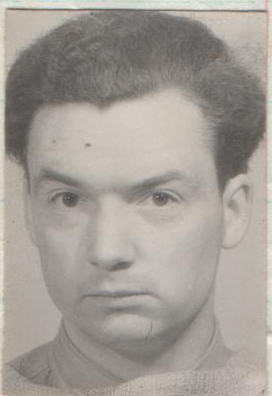
Dambuster of the Day No. 99: Warner Ottley

Grantham Ottley lores

Pic: Lincolnshire Library Services

Plt Off W Ottley DFC
Pilot

Lancaster serial number: ED910/G

Call sign: AJ-C

Third wave. Crashed on outward flight.

Warner Ottley was born in Battersea, London on 4 March 1922, the oldest of the three sons of Warner Herbert Taylor Ottley and his wife Hilda, née Edwards. Although given his father’s first name, he was always known by the nickname of Bill. His father was a civil servant, working in the War Office, and had been awarded the French Legion d’honneur for his work with that country during the First World War.

Ottley was educated at Hurstpierpoint College, and was still at school when the war broke out. He joined the RAF in 1941, and was selected for pilot training. He went to Canada for training, qualified as a pilot in August 1941 and returned to the UK three months later.

After further training he was sent to his first operational squadron, 50 Squadron, in June 1942, but then immediately reposted to 83 Squadron, then based at Scampton. Between 29 July and 6 August 1942 he flew on four ‘second dickey’ operations with Flt Sgt L.T. Jackson as pilot.

Ottley was then transferred to 207 Squadron and flew on several more operations before being transferred to the squadron’s conversion flight. There he was teamed up with the bulk of the men who would make up his Dams Raid crew: Ronald Marsden, flight engineer; Thomas Johnston, bomb aimer; Jack Guterman, wireless operator; Fred Tees, air gunner; and Jack Barrett, navigator. The crew transferred back to the main squadron and undertook their first operation together on a ‘gardening’ trip to Biarritz on 23 November 1942.

Ottley made close friendships with most of his crew, particularly Guterman and Barrett, with whom he shared an interest in music and art. Guterman provides a vivid description of his skipper in a letter written in late 1942:

I now occupy the bed next to Ottley (the fellow in between left today and we are glad as he was deadly dull) so now I am entertained all night by his long and endless store of anecdotes (some of which are remarkably funny but could hardly be accepted with any degree of morality in the drawing room) so it is impossible to relapse into status melancholis.
I have just read the former paragraph out to Ottley himself whose sole remark was ‘Oh Christ’ – but he’s really quite respectable. We were listening to the news just now and his remark on an announcement concerning the calling up of women (of a certain age) was: ‘Oh Yes! My mother gets great sport out of this calling up business. It’s the only way of finding out her best friends real ages: “You know Bill, Mrs X once told me she was 35 but she registered today so she must really be 41!”’ That’s the sort of thing I have to put up with.

Jack Guterman, letter to Babs Guterman, dated “Friday”, probably October 1942, courtesy Guterman family

Ottley went on to fly on twenty further operations with this crew between December 1942 and April 1943, although there were the occasional minor changes in personnel. Guterman reached the end of his tour on 8 March 1943 and so the last three operations for the crew each had a different person as wireless operator. The crew’s final operation in 207 Squadron was on 4 April 1943, with a trip to bomb Kiel.

Ottley and his crew were then transferred to 617 Squadron, one of the last crews to arrive. Ottley had been commissioned and then recommended for a DFC by this point, although the decoration wouldn’t be confirmed until after the Dams Raid and was backdated to 16 May 1943.

The Ottley crew undertook their first training flight in the new squadron on 8 April 1943. About five weeks later, they were designated to be the first crew in Operation Chastise’s Wave Three, the mobile reserve. Their duty was to be in the air over Germany after the earlier two waves had done their work, and then be diverted by 5 Group headquarters to attack whatever target it deemed necessary.

Ottley led off the wave, and AJ-C was airborne at 0009 on Monday 17 May. It crossed the Dutch coast at about 0130 and proceeded on the same route taken earlier by the First Wave towards Ahlen. At 0231, Group sent the code word “Gilbert” to AJ-C, and the signal was acknowledged. This meant proceed to the Lister Dam. A minute later a change of plan occurred, and the code word “Dinghy” was sent, instructing AJ-C: “Eder destroyed, attack Sorpe”.

The second signal was not acknowledged, indicating that AJ-C had met its fate at about 0231. Ken Brown, flying AJ-F a few minutes behind, reported seeing him hit the ground at 0235. He recalled later: “Ottley, on my right, was hit and pulled up, his tanks exploded then his bomb – the whole valley was lit up in a bright orange.” Bill Townsend and Lance Howard in AJ-O also saw AJ-C’s final demise.

Sitting in AJ-C’s rear turret, Fred Tees later recalled the sequence of events:
… Tees heard the wireless operator say over the intercom “Möhne gone,” and almost immediately Ottley began “We go to…,” when “a hell of a commotion” occurred to interrupt him. The aircraft was suddenly bathed in searchlight and a tremendous barrage of flak struck it, mainky from the port side. … Distinctly he heard Ottley say, “I’m sorry boys we’ve had it,” and thereafter Tees’ memory of events became blank.
John Sweetman, The Dambusters Raid, p.189

AJ-C hit the ground at Heessen, five miles north-east of Hamm, which suggests that it was probably hit by flak west of Hamm itself. Tees’ turret was blown clear of the rest of the aircraft and he regained consciousness on the ground, very badly burnt, and spent the remainder of the war as a prisoner.

Bill Ottley and the rest of the crew died instantly. They were originally buried in by the Germans in Hamm, but were reinterred after the war in Reichswald Forest War Cemetery.

As further proof of Ottley’s interest in arts and culture, in March 1945 the Hurst Johnian school magazine reported that his record collection had been donated to the school’s Gramophone Society. Bill’s father, Warner Ottley, worked in the War Office throughout the Second World War, and received the award of a CB in the New Year’s Honours List in 1945. He died in 1980.

Thanks to Alan Wells and the Guterman family for help with this article.

More about Ottley online:
Entry at Commonwealth War Graves Commission
Details of Warner H T Ottley’s awards

KIA 17.05.43

Rank and decorations as of 16 May 1943.
Sources:
Richard Morris, Guy Gibson, Penguin 1995
John Sweetman, The Dambusters Raid, Cassell 2002

The information above has been taken from the books and online sources listed above, and other online material. Apologies for any errors or omissions. Please add any corrections or links to further information in the comments section below.

Further information about Warner Ottley and the other 132 men who flew on the Dams Raid can be found in my book The Complete Dambusters, published by History Press in 2018.

Best for both sides as Les Munro accepts medals offer

Les_Munro_at_Bomber_Command_Memorial_(med)_big

The generous offer by Les Munro to sell his medals and memorabilia to raise funds for the Bomber Command Memorial in London has now been matched by another from the British peer and collector Lord Ashcroft, which means that the collection will stay in New Zealand.
Lord Ashcroft has offered to pay £75,000 for the collection and the Museum of Transport and Technology in Auckland is donating a further NZ$20,000. The collection will be displayed in the Museum.
This seems to be the best result possible. The medals and memorabilia (which include a signed menu from the post raid dinner at the Hungaria Restaurant) will now stay in New Zealand as a permanent reminder of the proud role played by the country’s aircrew in Bomber Command. And the fund to maintain the memorial gets a substantial financial boost.
Les Munro (and his family) should be congratulated for their generosity in making the collection available for posterity. Incidentally, the listing for the sale contains a very long article about Les, which can be downloaded as a PDF and is well worth reading.
Lord Ashcroft is well known for his philanthropy and his interest in military history. He is a trustee of the Imperial War Museum in London, which houses his collection of Victoria and George Crosses.