Dambuster of the Day No. 111: William Long

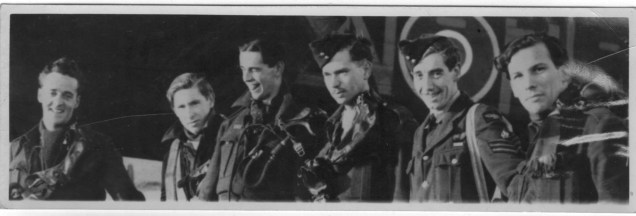
Burpee crew composite loresThis reverse of this picture of the Burpee crew taken on 18 January 1943 shows that William Long was known by the nickname “Ginger” by his colleagues. It also shows a list written by Burpee of the composition of his “recent crew” – the one which would fly with him on the Dams Raid. The list reads:
Pilot – Lew [Lewis Burpee]
Rear A/G – Gordie [Gordon Brady]
Mid Upper – Ginger [William Long]
W/Op – Sam [Leonard Weller]
Bomb/A – Jimmy [James Arthur]
Engineer – Johnny [Guy Pegler]
Nav – Tommy [Thomas Jaye]
Pic: Burpee family

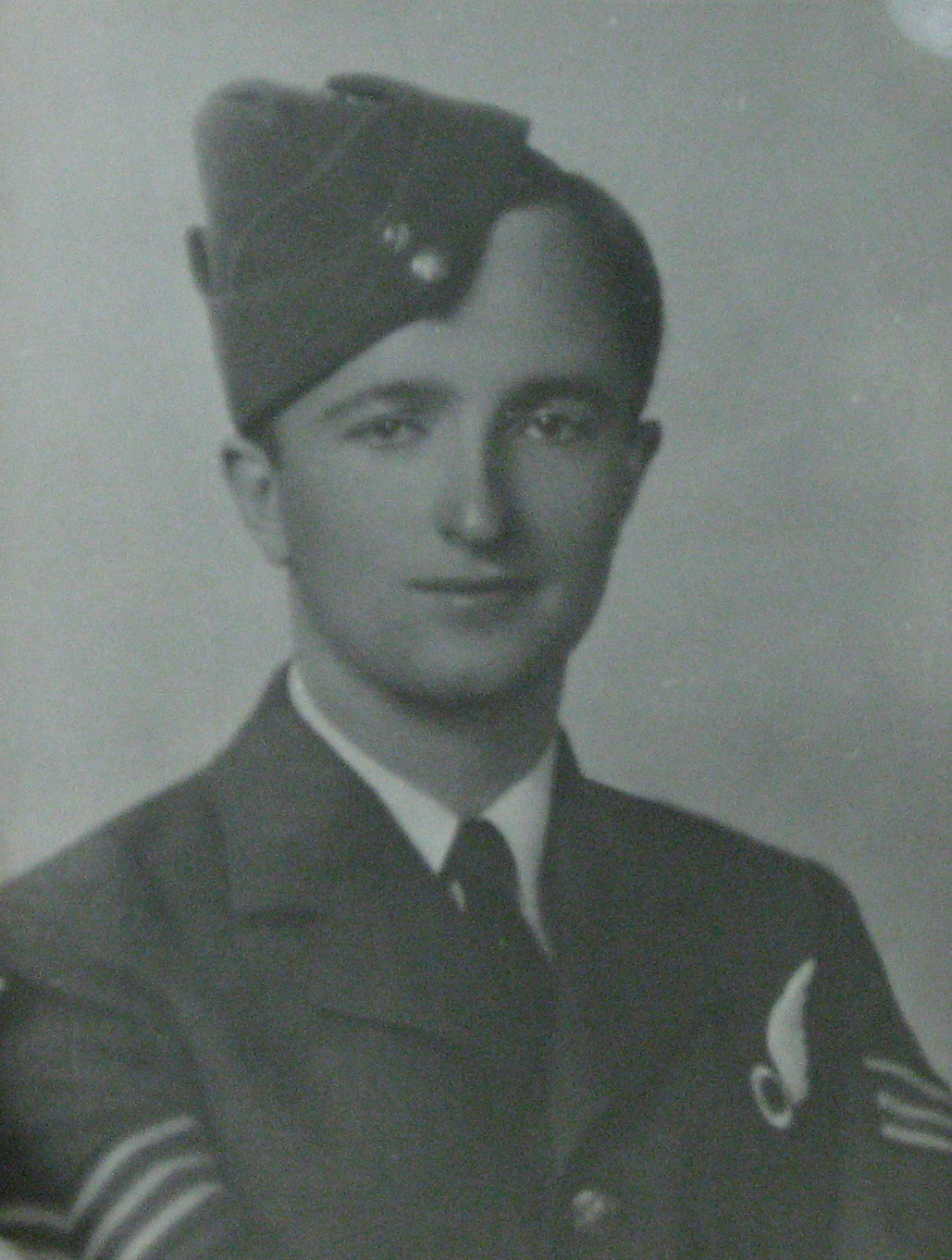
Sgt W C A Long
Front gunner

Lancaster serial number: ED865/G

Call sign: AJ-S

Third wave. Crashed on outward flight.

William Charles Arthur Long was born on 11 September 1923 in Eastleigh, Hampshire, the older of the two sons of William and Ethel Long. His father was a baker. The family would later move to Bournemouth.

Long applied to join the RAF around the time of his 18th birthday, but like many young men of his time had to wait several months before eventually being accepted. He was selected for air gunnery training, and qualified in August 1942. He was posted to 106 Squadron in September 1942. He flew on two operations: on 17 October with Sgt Lace on the Le Creusot raid and 8 December, with Flg Off Healey to Turin, before joining Lewis Burpee on 20 December. His first trip with Burpee and his crew was a trip to Duisburg.

He thus became the fourth member to join what would eventually become the Dams Raid crew of AJ-S, and would fly on all the 21 further operations flown by Burpee in 106 Squadron, as well as a single trip to Berlin on 16 January with Flt Lt Wellington.

Long moved over to 617 Squadron on 29 March, along with all of his colleagues. Like all the Dams Raid mid-upper gunners he had to get used to flying in the unfamiliar position of the front turret, and he was in this position when AJ-S left the ground at 0011 on the morning of Monday 17 May 1943. It was shot down less than two hours later, and everybody on board was killed instantly. The Germans could not individually identify the bodies of Guy Pegler, Bill Long, Tom Jaye and James Arthur, so they were buried in a communal grave in Zuylen Cemetery, Prinsenhage, next to the individual graves of Lewis Burpee, Gordon Brady and Leonard Weller. After the war the bodies of all seven were exhumed and reburied in Bergen-op-Zoom War Cemetery.

More about Long online:
Entry at Commonwealth War Graves Commission
Aircrew Remembered page about Burpee crew

KIA 17.05.43

Rank and decorations as of 16 May 1943.
Sources:
Richard Morris, Guy Gibson, Penguin 1995
John Sweetman, The Dambusters Raid, Cassell 2002

The information above has been taken from the books and online sources listed above, and other online material. Apologies for any errors or omissions. Please add any corrections or links to further information in the comments section below.
Further information about William Long and the other 132 men who flew on the Dams Raid can be found in my book The Complete Dambusters, published by History Press in 2018.

Dambuster of the Day No. 110: James Arthur

617 arthurPic: Bomber Command Museum of Canada

Wrt Off J L Arthur
Bomb aimer

Lancaster serial number: ED865/G

Call sign: AJ-S

Third wave. Crashed on outward flight.

James Lamb Arthur was born in Toronto, Canada, on 3 July 1917, the second of the four children of Rev Alfred and Dora Arthur. His father was an Anglican clergyman with a parish in the city.

Arthur was educated at Dennis Avenue School and York Memorial College, where he did well in maths. When he left school he went to work in the Bank of Toronto. He had a great interest in flying, and his youngest sister can still recall the excitement of seeing him, his brother and their father flying overhead in a small aircraft, and using a bedsheet to wave to them. He also had a great love of classical music and took his younger sisters to concerts.
He enlisted in the RCAF in 1941. After first being selected for pilot training he was then remustered as an observer, and qualified in May 1942. After arriving in the UK he then went on to qualify as a bomb aimer on heavy bombers.

Arthur was posted to 106 Squadron to begin operations in February 1943, but it wasn’t until 12 March that he flew on his first operation. Lew Burpee’s bomb aimer George Goodings had come to the end of his tour, so the chance of joining an experienced crew with two other Canadians probably looked like a good choice. Their trip took them to Essen, which they bombed successfully from 19,000ft. They reported very heavy flak and “scores of searchlights”.

Arthur’s first operation turned out to be the last that Burpee and his crew would fly in 106 Squadron, and it was therefore the only time that the complete Dams Raid crew would fly together before the raid itself. Fewer than three weeks later they were at RAF Scampton, training for the secret mission which would prove fatal for them.

In training, the focus quickly fell on the inexperienced bomb aimer, who may well have been the only one to fly on the Dams Raid with just one operation under his belt. Nevertheless the AJ-S crew came through the training successfully and took their place in the mobile reserve for the operation.

Sadly, AJ-S was shot down some two hours after take-off, and everybody on board was killed instantly. The Germans could not individually identify the bodies of Guy Pegler, Bill Long, Tom Jaye and James Arthur, so they were buried in a communal grave in Zuylen Cemetery, Prinsenhage, next to the individual graves of Lewis Burpee, Gordon Brady and Leonard Weller. After the war the bodies of all seven were exhumed and reburied in Bergen-op-Zoom War Cemetery.

Thanks to Frances Houlston and Clive Smith for help with his article.

More about Arthur online:
Entry at Commonwealth War Graves Commission
Aircrew Remembered page about Burpee crew

KIA 17.05.43

Rank and decorations as of 16 May 1943.
Sources:
Richard Morris, Guy Gibson, Penguin 1995
John Sweetman, The Dambusters Raid, Cassell 2002

The information above has been taken from the books and online sources listed above, and other online material. Apologies for any errors or omissions. Please add any corrections or links to further information in the comments section below.

Further information about James Arthur and the other 132 men who flew on the Dams Raid can be found in my book The Complete Dambusters, published by History Press in 2018.

Dambuster of the Day No. 109: Leonard Weller

Weller+Burpee

Leonard Weller, left, photographed with Lewis Burpee, probably in February/March 1943. [Pic: Burpee family]

Plt Off L G Weller
Wireless operator

Lancaster serial number: ED865/G

Call sign: AJ-S

Third wave. Crashed on outward flight.

Leonard George Weller was born on 1 September 1915 in Edmonton, north London, the son of Arthur and Marian Weller. He worked as a toolmaker before the war, and was married with an infant daughter by the time he joined the RAF in 1940.

After training as a wireless operator/air gunner, he was eventually posted to 106 Squadron in early 1943. At 0040 in the early morning of 14 February his predecessor as wireless operator in Lewis Burpee’s crew, Flt Sgt Eddie Leavesley DFM, completed his second tour of operations, after a six hour trip to Lorient. Then, at 1830 the same day, the crew set off again on a ten hour operation over the Alps to Milan, with a new wireless operator on board, Len Weller. (Eddie Leavesley would survive the war, and earned a rare bar to his DFM for his second tour.)

This was the middle of a very busy period for Lew Burpee, his crew and 106 Squadron in general. A further ten operations would follow in the next four weeks, and Weller flew on them all. By the time the crew were transferred to 617 Squadron, he had been commissioned, so he now outranked his skipper.

More training followed, and early in the morning of Monday 17 May, Weller was in the crew of AJ-S as it set off on the Dams Raid. AJ-S was shot down at 0200, so the messages which Weller should have received at 0232 and 0233 went unanswered.

The body of Len Weller was one of the three which were positively identified by the Germans before it was buried in Zuylen Cemetery, Prinsenhage. Lewis Burpee and Gordon Brady were buried alongside, while the other four shared a communal grave. After the war the bodies of all seven were exhumed and reburied in Bergen-op-Zoom War Cemetery.

More about Weller online:
Entry at Commonwealth War Graves Commission
Aircrew Remembered page about Burpee crew
Report on Biggleswade Today website

KIA 17.05.43

Rank and decorations as of 16 May 1943.
Sources:
Richard Morris, Guy Gibson, Penguin 1995
John Sweetman, The Dambusters Raid, Cassell 2002

The information above has been taken from the books and online sources listed above, and other online material. Apologies for any errors or omissions. Please add any corrections or links to further information in the comments section below.

Further information about Len Weller and the other 132 men who flew on the Dams Raid can be found in my book The Complete Dambusters, published by History Press in 2018.

Dambuster of the Day No. 108: Thomas Jaye

JayePic: Jaye family

Sgt T Jaye
Navigator

Lancaster serial number: ED865/G

Call sign: AJ-S

Third wave. Crashed on outward flight.

Thomas Jaye was one of the two sons of James and Helena Jaye of Crook, Co.Durham. His father worked as a miner at Roddymoor Collery. He was born on 3 October 1922 and went to Wolsingham Grammar School. After leaving school he worked as an electrical engineer.

He joined the RAF in 1941 and was sent for training as a navigator to the flying school run by Pan-American in Miami, Florida.

His final stint of training, after arriving back in the UK, was at 1654 Conversion Unit at RAF Wigsley in November and December 1942, where one of the instructors was Henry Maudslay. He was posted to 106 Squadron on 28 December 1942.

In his six operations in the first three weeks of January 1943, Lewis Burpee had flown with five different navigators. On the afternoon of 21 January Jaye flew with him for the first time on a Night Flying Test and they went on their first operation together that evening, a trip to Essen. Jaye was immediately established as Burpee’s regular navigator and they went on a further 16 operations before being transferred out on 29 March.

The Burpee crew were about to leave 106 Squadron when Jaye bumped into an old friend from his home village. Sgt Fred Smooker was about to begin a tour of operations as a bomb aimer in 106 Squadron, and had just arrived at Syerston:

Having settled in our barracks we all decided to go to the Sergeants’ mess for a meal and on our way we noticed numerous black, brooding, Lancasters standing silently at their dispersals, at different parts of the airfield. When we reached the Sergeants’ mess, coming down the steps from the main entrance, was a navigator, a young man of about twenty one.  I didn’t recognise him until he said to me:
“Hello, Fred, have you just arrived?”
I looked again. “Why,” I said, “Tom Jaye. We’re just going to have a meal.”
“Well, that’s a pity,” he said, “I’m just leaving,” and with that I hurried on to catch up with my crew. Tom Jaye was on his way to Scampton to join 617 Squadron.
Meeting Tom caused me to reminisce about Roddymoor, the village where we both came from, not far from Crook. His father Jimmy Jaye and my father Billy Smooker were coal miners at Roddymoor Colliery, where I would have been had I not volunteered for RAF aircrew. Tom Jaye had gone to grammar school and joined the RAF before me. I remember his mother telling me that he was based in Nottinghamshire while I was on leave, during training.
Clive Smith, Lancaster Bale Out, Tucann 2013, p62

Jaye’s first flight in 617 Squadron was on 31 March, with Burpee as pilot and he went on to complete another 21 training flights in April. In early May, the crew were given some leave and he spent some of it staying with his cousin Derek and family in Durham before continuing to see his mother at Crook. A few days later, in the early hours of Monday 17 May 1943, he was dead when AJ-S was shot down some two hours after take-off. The Germans could not individually identify the bodies of Guy Pegler, Bill Long, Tom Jaye and James Arthur, so they were buried in a communal grave in Zuylen Cemetery, Prinsenhage, next to the individual graves of Lewis Burpee, Gordon Brady and Leonard Weller. After the war the bodies of all seven were exhumed and reburied in Bergen-op-Zoom War Cemetery.

Like many of his colleagues, Tom Jaye had developed the habit of filling in his logbook at the end of each month, because his May 1943 flights are in someone else’s handwriting. They finish with the entry for 16 May: “Operations – Eder Dam – Missing”. The page is signed off by Mick Martin “O/C B Flight” and David Maltby “For W/C O/C 617 Sqn”.

Thanks to Clive Smith for help with this article.

More about Jaye online:
Entry at Commonwealth War Graves Commission
Aircrew Remembered page about Burpee crew
Memorial at Wolsingham Grammar School

KIA 17.05.43

Rank and decorations as of 16 May 1943.
Sources:
Sgt T Jaye logbook in RAF Museum
Richard Morris, Guy Gibson, Penguin 1995
John Sweetman, The Dambusters Raid, Cassell 2002

The information above has been taken from the books and online sources listed above, and other online material. Apologies for any errors or omissions. Please add any corrections or links to further information in the comments section below.

Further information about Tom Jaye and the other 132 men who flew on the Dams Raid can be found in my book The Complete Dambusters, published by History Press in 2018.

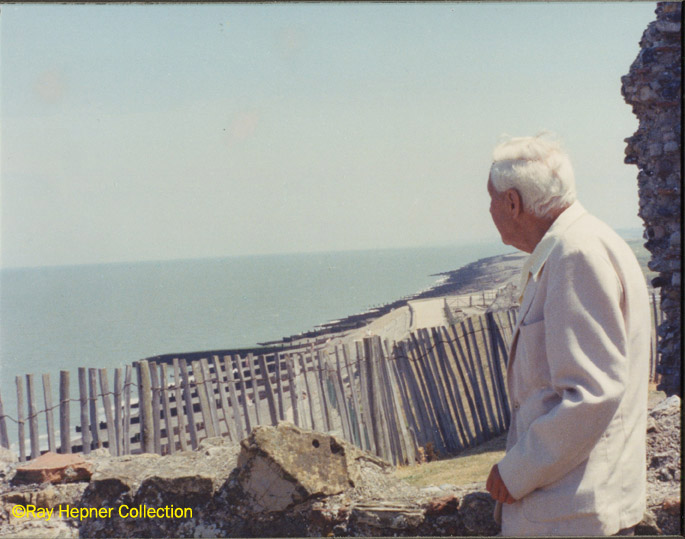
Barnes Wallis at Reculver, 33 years on

RH10 Wallis Reculver 07.07.76 loresPic: © Ray Hepner Collection

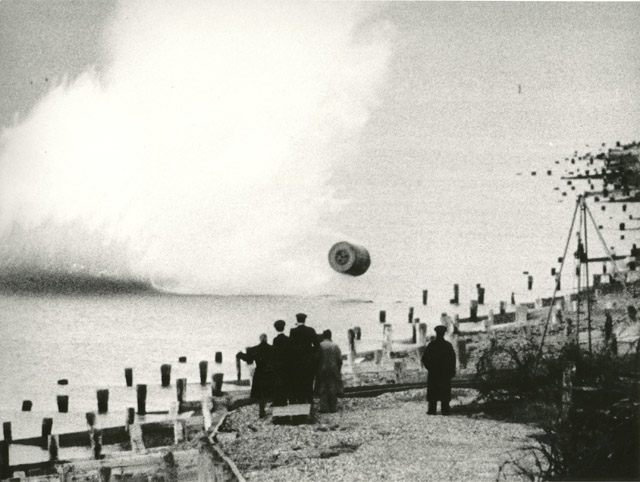
Barnes Wallis had never been back to Reculver in Kent, the place where the final test drops of his “bouncing bomb” took place in May 1943, until he was taken there by Ray Hepner in 1976. Above, in this previously unpublished photograph taken by Ray and kindly given to me by him, he surveys the scene. Below is a still from the film sequcnce shot of the tests, now in the Imperial War Museum. Wallis is the bareheaded figure on the far left of the group. In the film, he is seen to be waving his arms as if to urge the bomb onwards.

Update: Mark Welch kindly pointed out the error in the title of my original post, “Barnes Wallis at Reculver, 43 years on”. My maths was badly wrong!

Wallis Reculver IWMPic: IWM FLM2343

Dambuster of the Day No. 107: Guy Pegler

Burpee 106sqn

Guy (“Johnny”) Pegler pictured on the far right, standing next to Gordon Brady. Their skipper, Lew Burpee is on the far left. Picture taken in 106 Squadron, probably late 1942. [Pic: Burpee family]

Sgt G Pegler
Flight engineer

Lancaster serial number: ED865/G

Call sign: AJ-S

Third wave. Crashed on outward flight.

Guy Pegler was born on 27 September 1921 in Ringwood, Hampshire, the older of the two sons of Claud and Charlotte Pegler. The family would later move to Letchworth in Hertfordshire, where he went to Letchworth Grammar School. Pegler was known by the nickname “Johnny” during his time in the RAF, which he joined in 1938 as an apprentice at No 1 Training School, RAF Halton.

He served in ground crew in the early part of the war, mainly servicing aircraft in Fighter Command, before taking the opportunity in 1942 to train as a flight engineer in Bomber Command.

After qualifying, he was posted to 106 Squadron’s Conversion Flight where he joined up with Lewis Burpee and gunner Gordon Brady for the final stages of Lancaster training. The trio were posted to 106 Squadron in October 1942.

On 24 October 1942, the day Burpee flew on his final operation as second pilot (with David Shannon), Pegler had the dubious privilege of making his operational debut, accompanying the Squadron CO, Wg Cdr Guy Gibson on a trip to Milan. At that stage in his career, Gibson had a different flight engineer or second pilot on nearly every one of his operations. Whether they volunteered or instead were chosen by him is not recorded. Pegler survived the experience, and was able to rejoin Burpee and his crew for their first trip together as a crew, on a “Gardening” operation to the Silverthorn area on 16 November 1942.

Thereafter, Pegler flew with Burpee on all his 25 operations in 106 Squadron and went with him to 617 Squadron. On the Dams Raid, he would have been in his usual seat, alongside his skipper, as they flew too close to the heavily defended Gilze-Rijen airfield and crashed in a ball of flame.

The Germans could not individually identify the bodies of Guy Pegler, Bill Long, Tom Jaye and James Arthur, so they were buried in a communal grave in Zuylen Cemetery, Prinsenhage. After the war the bodies of all seven of the crew of AJ-S were exhumed and reburied in Bergen-op-Zoom War Cemetery.

More about Pegler online:
Entry at Commonwealth War Graves Commission
Aircrew Remembered page about Burpee crew

KIA 17.05.43

Rank and decorations as of 16 May 1943.
Sources:
Richard Morris, Guy Gibson, Penguin 1995
John Sweetman, The Dambusters Raid, Cassell 2002

The information above has been taken from the books and online sources listed above, and other online material. Apologies for any errors or omissions. Please add any corrections or links to further information in the comments section below.

Further information about Guy Pegler and the other 132 men who flew on the Dams Raid can be found in my book The Complete Dambusters, published by History Press in 2018.

Dambuster of the Day No. 106: Lewis Burpee

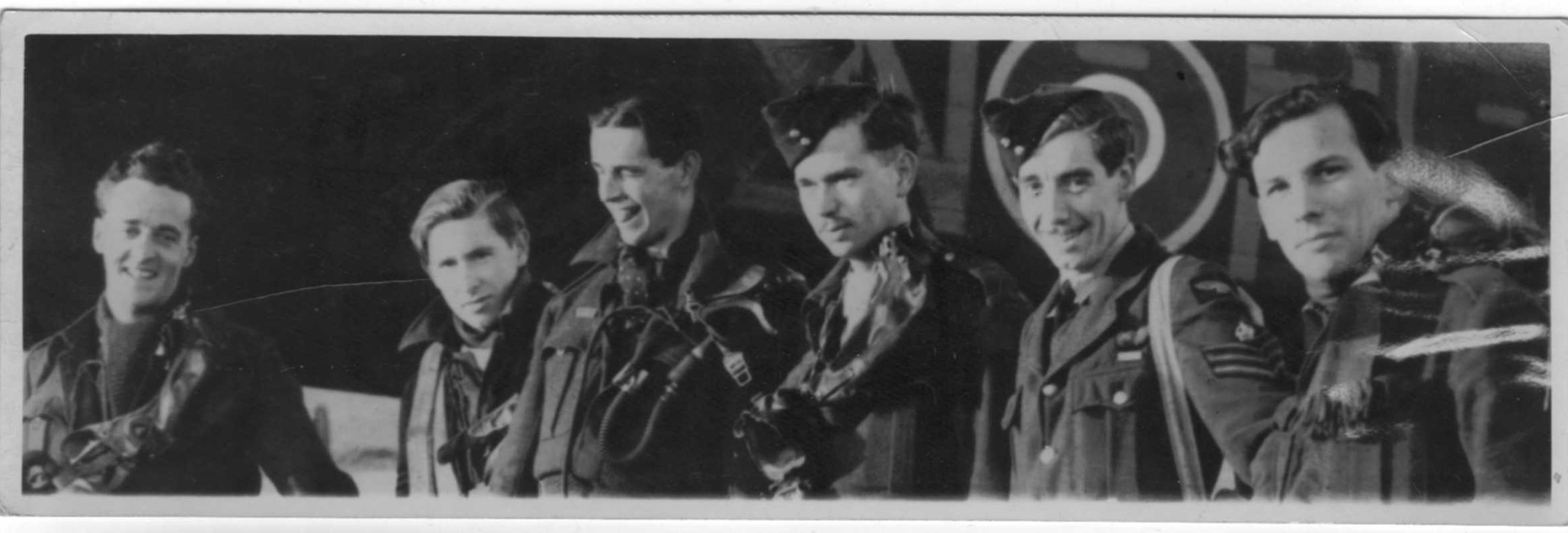
Burpee sqd106 smalPhoto of Lewis Burpee and his crew in 106 Squadron, taken on 18 January 1943, after a trip to Berlin. Left to right: Gordon Brady (Rear Gunner), Bill Long (Mid Upper Gunner), Guy Pegler (Flight Engineer), Lewis Burpee (Pilot), Edward Leavesley (Wireless Operator), George Goodings (Bomb Aimer). (Pic: Burpee family)

Plt Off L J Burpee DFM
Pilot

Lancaster serial number: ED865/G

Call sign: AJ-S

Third wave. Crashed on outward flight.

Lewis Johnstone Burpee was born on 5 March 1918 in Ottawa, one of the three children of Lewis Arthur and Lilian Agnes Burpee. His father was the manager of Charles Ogilvy, a large department store in the city. He went to Elgin Street Public School and Lisgar Collegiate School in Ottawa, and then on to Queen’s University in Kingston, Ontario, where he got a degree in English, History and Politics. He was also a member of the college’s Officer Training Corps. When war came, he joined the RCAF, enlisting in December 1940.

Burpee qualified as a pilot in September 1941 and embarked for the UK shortly afterwards. It took about a year for him to start operations, since after training on Wellingtons, he was then sent for heavy bomber training. While training he crewed up first with fellow Canadian, air gunner Gordon Brady, and then with flight engineer, Guy Pegler. The three were finally posted to 106 Squadron in October 1942. Air gunner William Long joined his crew in December 1942. These four would fly together throughout their time in 106 Squadron and then transfer to 617 Squadron. The CO of 106 Squadron at this time was of course Guy Gibson.

After three trips as a “second dickey” Burpee undertook his first trip as a captain on 7 November 1942 on a mission to bomb Genoa. This was abandoned, but his first successful operation was later that month. He went on to complete some 25 further operations and was recommended for the DFM. The citation stated:

He has consistently displayed the greatest determination in the execution of whatever tasks were allotted him. Berlin, Nuremburg, Stuttgart, Genoa and Turin are some of the many objectives he has attacked with satisfactory results and in recent weeks he has taken part in the highly successful raids on Lorient (aiming point photograph), St Nazaire and both of the Essen attacks. He also flew on the daylight attack against Milan in October 1942. Flight Sergeant Burpee has shown coolness and courage throughout his operational tour and has performed his duties conscientiously and efficiently.

Gibson obviously knew Burpee as a pilot from his old squadron and rated his abilities positively. He was happy to have him in 617 Squadron as one of the three pilots from his previous assignment. Burpee was in fact the only one of the three who transferred directly – by the end of March 1943, both David Shannon and John Hopgood had already been posted out to other duties. However much Gibson rated Burpee as a pilot, a few weeks previously he had thought that he wasn’t yet ready for a commission, writing on his application: “This Canadian is an excellent type of N.C.O. but should be given more experience of service life before being given a commission.” But Gibson was then overruled by his station commander, Gp Capt E L Bussell, who wrote that Burpee was “Possessed of the attributes of an officer… Strongly recommended for commissioning.” (National Archives of Canada). The commission duly came through shortly after he joined 617 Squadron, and was backdated to the beginning of March.

Burpee had other things besides flying on his mind, since he had got married in September 1942 and his wife was now expecting their first child. In Enemy Coast Ahead, Gibson wrote that he had spoken to Burpee on his arrival in 617 Squadron: “He had just married a young English girl and was busy trying to find her a house not too far away. He was telling me that he had found it a very difficult job.” (p.241).

After six weeks training, Burpee and his crew were assigned a place in Operation Chastise’s final wave of five crews, the mobile reserve. They were due to be assigned a target when the outcome of the first two rounds of attacks was known. Before they left the ground, however, Burpee went over to his fellow Canadian, Ken Brown, piloting AJ-F and due to take off a minute after him. “Goodbye, Ken,” was all he said, Brown later recalled. (Account at Bomber Command Museum of Canada website.)

AJ-S left the ground at 0011 on the morning of Monday 17 May, and never made it as far as the German border. While still over Holland, and approaching the gap between the heavily defended airfields at Gilze-Rijen and Eindhoven, AJ-S strayed off course. It climbed slightly, probably in an effort to determine its exact position, but was then caught in searchlights and hit by flak. It crashed on the edge of Gilze Rijen airfield, six miles south west of Tilburg. Its mine exploded on impact, demolishing a large number of buildings and doing damage estimated at 1.5 million guilders. 
The demise of the Burpee crew was seen by Stefan Oancia, bomb aimer in AJ-F, and Douglas Webb, a minute or so further back in AJ-O’s front turret. Its last minutes were also seen by a German witness, a Luftwaffe airman based at Gilze Rijen called Herbert Scholl, interviewed by Helmuth Euler. He was of the opinion that AJ-F was in fact not hit by flak at all, but was dazzled by a searchlight beam hitting it horizontally. The pilot tried to fly even lower, and then hit some trees.

The next morning, Scholl went to the crash site and saw that it was a total wreck. Only the rear turret and tail unit were intact, and he saw rear gunner Gordon Brady’s body, which didn’t appear to have any sign of injury. He noticed that Brady was scantily dressed, wearing thin uniform trousers and lace up shoes with holes in the soles. (Helmuth Euler, The Dams Raid through the Lens, After the Battle, 2001, p.106.)

After the crash, only the bodies of Burpee, Brady and Weller were positively identified. The other four were buried in a communal grave. They were first interred by the Germans at Zuylen Cemetery, Prinsenhage, but after the war all seven bodies were exhumed and reburied in Bergen-op-Zoom War Cemetery.

Lewis Burpee was one of the four aircrew who flew on the raid knowing that their wives were pregnant. Richard Trevor-Roper and David Maltby would live to see their children being born. Burpee and Charles Brennan would not. After her husband died, Mrs Lillian Burpee travelled across the Atlantic in order to meet her in-laws for the first time, and have her baby in Canada. Their son, also called Lewis Johnstone Burpee, was born on Christmas Eve 1943.

More about Burpee online:
Entry at Commonwealth War Graves Commission
Aircrew Remembered page about Burpee crew
Entry at Canadian Virtual War Memorial (includes picture gallery)

KIA 17.05.43

Rank and decorations as of 16 May 1943.
Sources:
Richard Morris, Guy Gibson, Penguin 1995
John Sweetman, The Dambusters Raid, Cassell 2002

The information above has been taken from the books and online sources listed above, and other online material. Apologies for any errors or omissions. Please add any corrections or links to further information in the comments section below.

Further information about Lewis Burpee and the other 132 men who flew on the Dams Raid can be found in my book The Complete Dambusters, published by History Press in 2018.

Dambuster Memorial unveiled as many pay tribute

IMG_6611Pic: Wim Govaerts

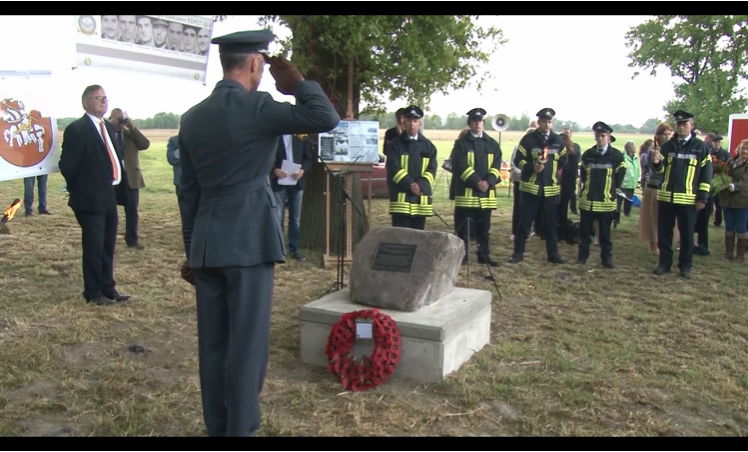
Several hundred people gathered on Sunday 17 May 2015 on the edge of a small wood in Haldern, north western Germany, to pay tribute to the crew of Dams Raid Lancaster AJ-E, piloted by Flt Lt Norman Barlow DFC. This was the spot where the aircraft crashed shortly before midnight on the night of 16 May 1943, en route to attack the Sorpe Dam.
Some of Norman Barlow’s letters home to his mother in Australia were read out during the ceremony. In one, written on 3 May 1943, he told her about the new aircraft he had been assigned for the Dams Raid. “I have just got a brand new machine. “E” for Edward or Elsie or Elliott. I hope I am as lucky as I was with “G” for George”.
And then, just 12 days later and the night before died, he sent love to everyone back at home, including his daughter, then four years old: “I must close now and have a bath and get a little shut eye whilst I can.  So keep your chin up Mother dear it can’t last forever. Your loving son Norman xxxx.”
Sadly, E-Edward would not turn out to be not a lucky machine for Norman and his crew, and they were all killed instantly in the crash. For seventy years, the site was not marked in any way, but then in 2013 local historian Volker Schürmann began a campaign to have a permanent memorial established. He organised a public appeal which succeded in raising the funds, after many generous donations from supporters from around the world. There were further donations of materials from the local community, and the farmer on whose land the aircraft crashed was kind enough to make a space available.
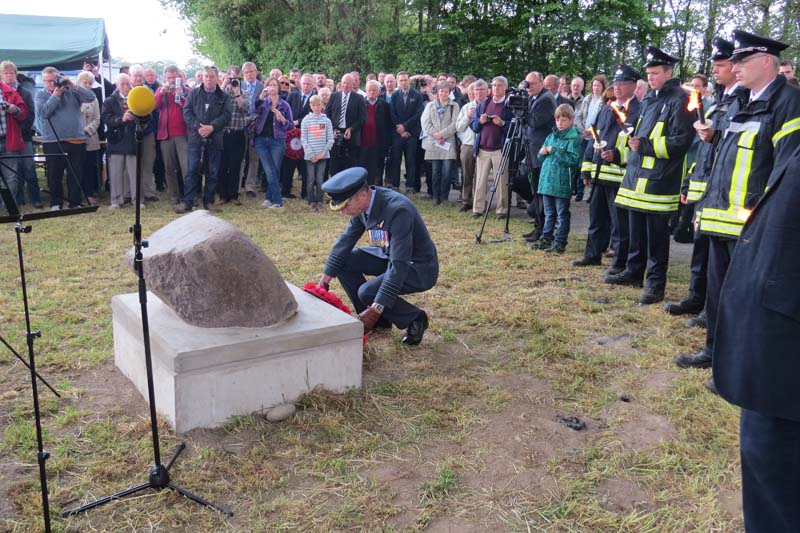
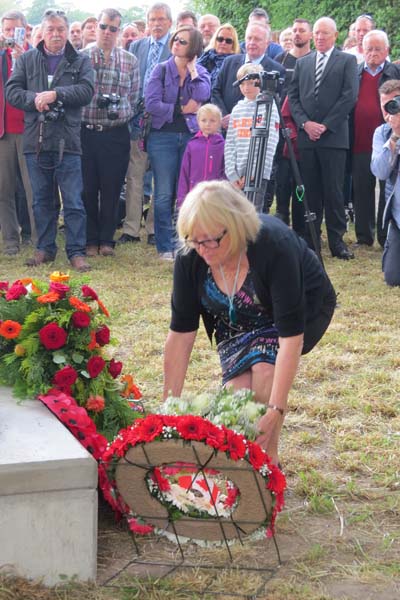
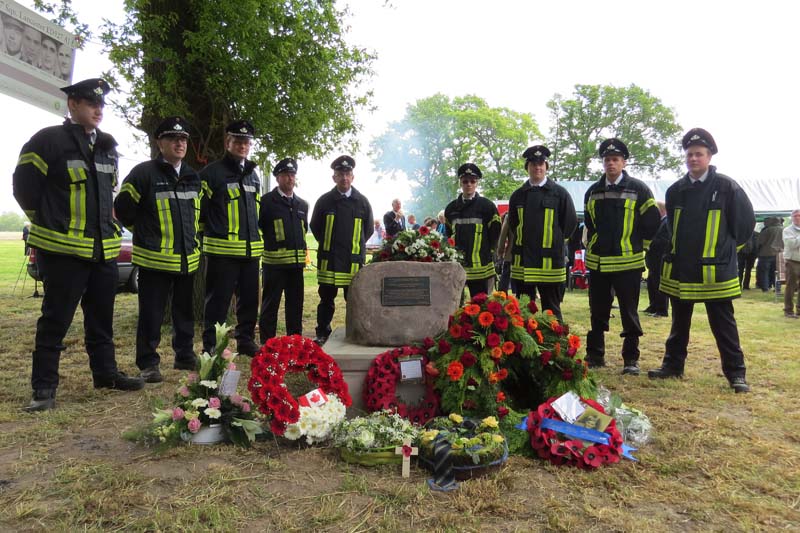
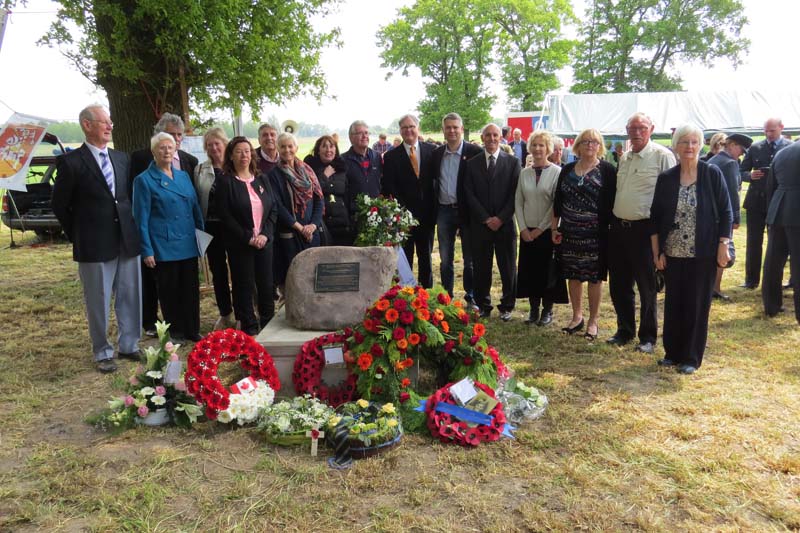
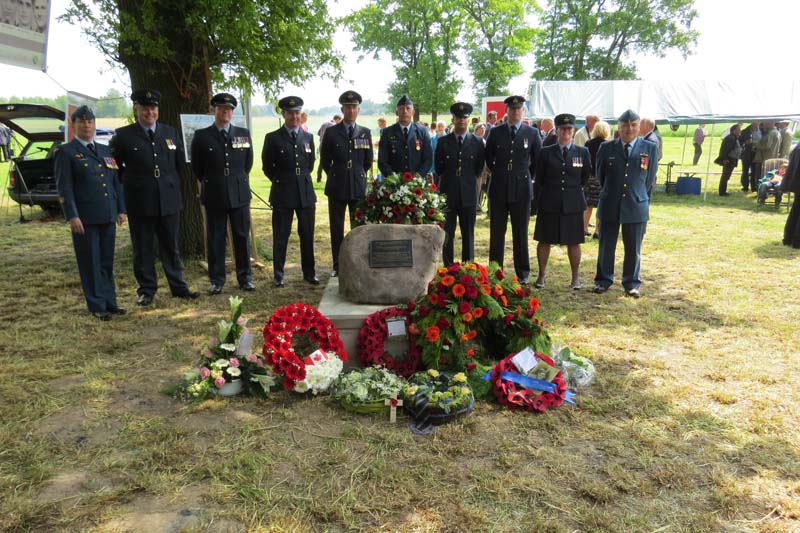
Relatives and representatives of five of the crew travelled to Germany, and unveiled the memorial. Wreathes were also laid by the Royal Air Force and the Royal Canadian Air Force, by other organisations, and by the local community. A guard of honour was provided by the Haldern Fire Brigade, and musical tributes were played by the Haldern Brass Band.
Huge thanks go to all the people of Haldern who donated to and supported the memorial, and to all those who travelled to Germany to take part in the ceremony.

Pictures below by Wim Govaerts and Mitch Buiting.

IMG_6365 Banner depicting the crew of AJ-E. (Pic: Wim Govaerts)

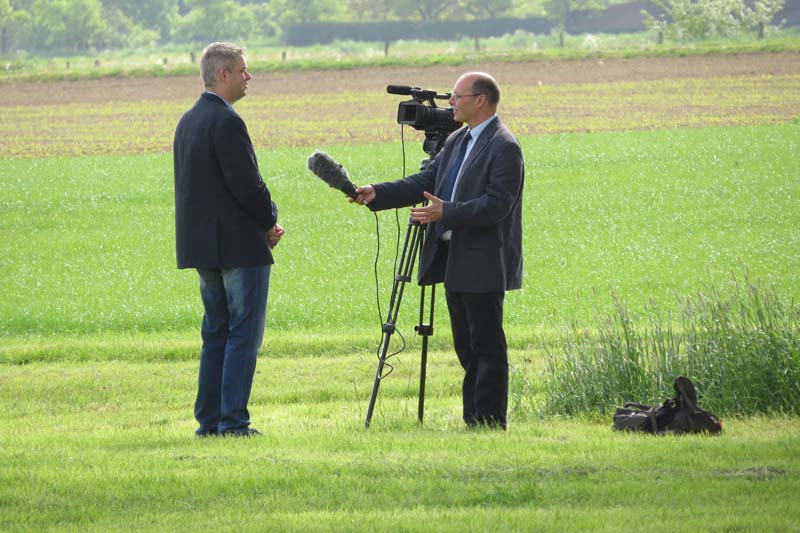
IMG_6396Volker Schürmann being interviewed by British Forces Broadcasting Service reporter, Rob Olver.

IMG_6388Items from the wreckage of AJ-E, found locally by Marcel Hahn. (Pic: Wim Govaerts)

IMG_6462Welcome from Bernhard Uebbing, Chair of Heimatverein Haldern, the local history society. (Pic: Wim Govaerts)

IMG_6481Volker Schürmann outlined the background to the project. (Pic: Wim Govaerts)

IMG_6494Charles Foster gave a brief history of the Dams Raid and its historical significance. (Pic: Wim Govaerts)

IMG_6509Trish Murphy, a friend of Norman Barlow’s daughter Adrianne since their schooldays in Melbourne, read from Norman Barlow’s last letters home. (Pic: Wim Govaerts)

Rework_9274Rob Holliday, whose wife Sara is a cousin of bomb aimer Plt Off Alan Gillespie, gave an account of the lives of all the crew members of AJ-E. (Pic: Mitch Buiting)

IMG_6550The first wreath was laid by Group Captain Steve Richards of the RAF. (Pic: Wim Govaerts)

IMG_6553Lt Colonel David Sexstone and a colleague laid the second wreath on behalf of the Royal Canadian Air Force. (Pic: Wim Govaerts)

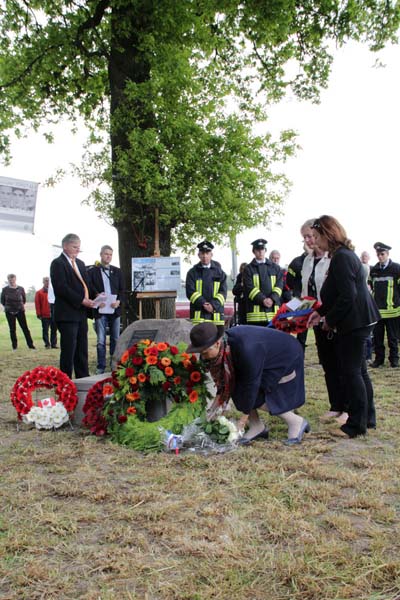
Rework_9289Wreath laid in memory of Norman Barlow by Trish Murphy, with assistance from Jacqui Kelly and Aisling Foster. (Pic: Mitch Buiting)

Rework_9293Wreathes laid in memory of Philip Burgess by Carole Marner, followed by Jenny Rowland. (Pic: Mitch Buiting)

Rework_9298Wreath laid in memory of Alan Gillespie by Sara and Rob Holliday (Pic: Mitch Buiting)

IMG_6558Wreath laid in memory of Charlie Williams by Helen Brown. (Pic: Wim Govaerts)

Rework_9306Wreath laid in memory of Jack Liddell by Patricia and Mike Gawtrey. (Pic: Mitch Buiting)

IMG_6471Music for the occasion was provided by the Haldern Brass Band. (Pic: Wim Govaerts)

IMG_6685A guard of honour was provided by the Haldern Fire Brigade. (Pic: Wim Govaerts)

IMG_6665The five sets of relatives and representatives, joined by Volker Schürmann and Charles Foster. (Pic: Wim Govaerts)

IMG_6678The full RAF and RCAF delegations, photographed after the ceremony. (Pic: Wim Govaerts)

IMG_6583AJ-E, honoured and remembered, 17 May 2015. (Pic: Wim Govaerts)


All set fair for memorial unveiling

AJ-E stone installation

Several hundred people are now expected to attend the unveiling of the memorial to the Dams Raid crew of Lancaster AJ-E, scheduled for 1100 local time on Sunday 17 May at Haldern, near Rees in Germany.
Above, you can see the memorial stone and foundation being installed. It is an impressive piece of work, and we are all much indebted to the local people and traders who have worked so hard to bring the project to fruition.
The good news is that the weather is expected to remain dry, although with a maximum temperature of 16ºC a jacket is probably advisable.

Screen shot weather

Please also note that there will be no parking at the site itself, except for those needing disabled access. Parking will be available approximately 500m away, so be prepared to walk.
If you are visiting the area for the first time, you might also like to know that Reichswald Forest War Cemetery is about 40km away. This is the last resting place of the crew of AJ-E, captained by Norman Barlow, and three other Dams Raid crews – those captained by Henry Maudslay (AJ-Z), Bill Astell (AJ-B) and Bill Ottley (AJ-C).
Finally, if you are there on Sunday and are a reader of Dambusters Blog, come over and say hello. And spread the word to your friends and acquaintances!