Well known Dambuster researcher Alex Bateman has had some thoughts about the recent Gibson furore. Here is part of his long post on the RAF Commands forum:
Many fighter pilots and bomber gunners invented and exagerrated combat claims, some intentional, some confused in the heat of battle. It is possible that the gunners exagerrated the episode, and that it didnt happen as reported. I’ll give an example.
When researching my first book, I included the story of a 617 Squadron rear gunner, who in a history of the Squadron written 20 years or so ago, had apparently downed two Me110s which were following the Lancaster, then a third before the mid upper fired upon a fourth which was later confirmed as having crashed. However, a contemporary report, compiled the day of the action noted that they were ‘…attacked by enemy fighters. Two were claimed shot down by the mid-upper gunner…’, with no mention of the rear gunner at all. You could put this down to post war bravado, or the passage of time. However, the Squadron Commander, Leonard Cheshire kept personal journals, and in that he wrote (the same day) that the rear gunner shot down two JU88s and a possible Fw190. Now, putting the post war recollection aside, we have two reports compiled within 24 hours, one by the IO and the other perhaps after a personal interview with the CO, but the results changing from the MuG getting two, to the RG getting two and possibly three, with the actual aircraft changing from Ju88s, to a pair of Ju88s and a single engined Fw190, to later on, four Me110s. A clear indication of how details are changed or badly compiled.
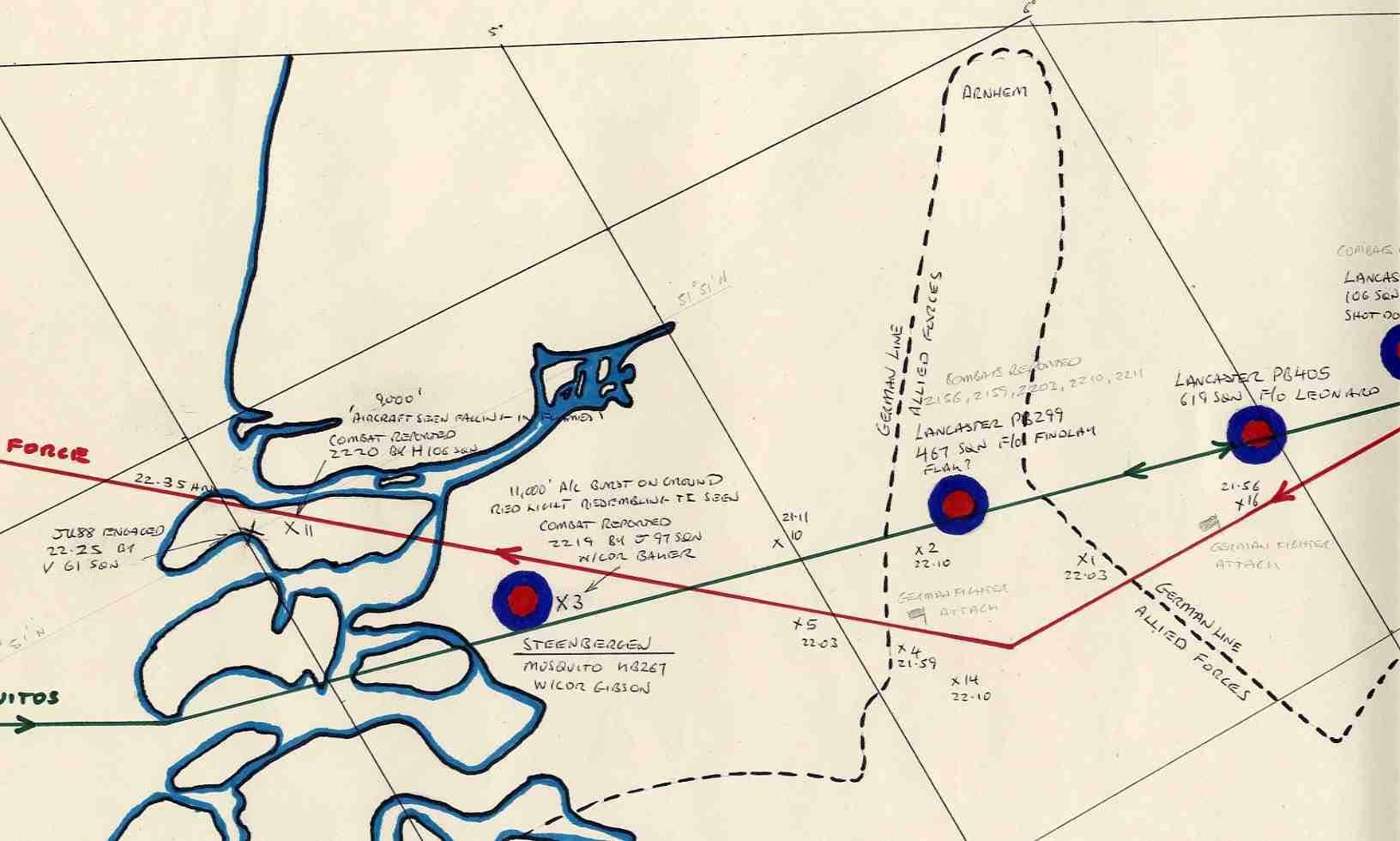
Gibson that night was flying a Canadian built Mosquito BXX, KB267, which was unarmed. As such, no return fire could have been seen by the Lancaster if the aircraft they fired upon was Gibson, but do remember the above. It would also explain how Gibson could have been attacked and downed, as he had no way of defending himself, and could have been mortally wounded in the first action. To me, the combat report is puzzling, as it seems the Bomb Aimer saw the ‘enemy’ aircraft in front and below. For the Mid Upper to have seen him at the same time, he would have had to be quite far ahead, because the wings would have otherwise obscured his view, but apparently the rear gunner then opened up almost at the same time. It would indicate the enemy aircraft was almost standing still to have appeared in front and then very quickly, far enough back for the rear gunner to draw a bead and open fire himself. Perhaps the aircraft in question was severly damaged, and the pilot otherwise occupied?
Paul61 makes a good point when he says that no fighter encounters were reported by our aircraft. That night, 227 Lancasters and 10 Mosquitos were flying, with 4 Lancs lost and the one Mosquito. NO enemy aircraft were lost, and as far as I am aware, no Luftwaffe pilot made a combat claim. Although the gunners of EE176 reported an attack by a JU88, was there any physical damage to the aircraft to substantiate this?
The recorded conversation where McCormack tells the story, was apparently made by his wife without his knowledge, during a reunion, recording his recollections and capturing the story at the same time. Considering my previous knowledge of Mccormack, I was doubtful. For one thing, would you go to such great lengths to name yourself as the killer, albeit accidental, of one of the RAFs greatest heroes? The Squadron ORB says nothing, the crew logs could have been added to later on. But the intelligence report for the night notes an aircraft shot down, with the incident recorded with co-ordinates which are pretty much over the centre of Steenbergen, where Gibson crashed. So we have an aircraft at relatively low level, shot down and seen to crash, but not claimed by any German crew.
It is known that Gibson was the only aircraft carrying red TIs that night, and when the aircraft crashed, it was reported as bursting on the ground in red. The excavation of the Mosquito a few years ago unearthed a burnt TI, confirming that at least one was still abaord when he went in, and seemingly being the aircraft that crashed, as witnessed ‘shot down’ by another Lancaster crew.
We can now, as then, only suppose what may or may not have happened, but if only one twin engined aircraft was lost, with details converging, its highly possible that IOs speculated as to the identity of the aircraft in question. “Was it a JU88, or do you think it might have been a Mosquito?”, they might ask, in an effort to try and establish what aircraft was downed. If any gunners admitted they saw or might actually have downed a Mosquito it would quickly help to establish that Gibson was not coming back, regardless who who did the shooting.
We can never be certain, but for me the new material is rather compelling. Not the taped interview or bragging, but the period documents recently unearthed. As for the sabotage theories and the lack of fuel, these can immediately be dismissed for a number of reasons.
Having read Alex’s explanation, I must admit that I am coming round to his view. I still can hardly believe that Gibson, with all his experience as a night fighter pilot before he went onto bombers, would put himself in such a stupid position, within range of a Lancaster’s guns. But we all make mistakes. It could be that Gibson made a fatal one that night, and paid the price.

 Dambusters Blog