A wizard show: RC Sherriff and The Dam Busters

Say the name RC Sherriff to most people and their instant reaction is likely to be ‘the man who wrote Journey’s End.’ He is certainly best known for this, and the popular identification with his first widely produced play will surely grow all the while it remains on the GCSE set text list. The First World War classic was based on his own experiences serving in the trenches as a captain in the East Surrey Regiment.
It could also be argued, however, that Robert Cedric Sherriff deserves to be widely remembered for another reason, as the man who provided Hollywood with the first British ‘stiff upper lip’ characters – archetypes which persist today in the kind of roles given to actors like Colin Firth, Ralph Fiennes and Jeremy Irons.
Journey’s End was a huge success. First produced in late 1928, it then ran for two years in the West End, and went onto Broadway and other parts of the world. It enabled Sherriff to quit his job in insurance, first to go to study at Oxford and then to become a full time writer. He was lured to Hollywood by the legendary producer Sam Goldwyn (‘A verbal contract isn’t worth the paper it’s written on’, ‘Include me out’, etc, etc) where he worked both as a writer of original screenplays and a script ‘doctor’. His original work included The Invisible Man and Goodbye Mr Chips, and his rewrites such wartime classics as Mrs Miniver.
In his BFI monograph, John Ramsden noticed the importance of the timing of his arrival in Hollywood, in the early 1930s.
At exactly the moment when sound films were about to sweep all before them, in 1928, Sherriff captured in Journey’s End the way in which a certain type of British officer and gentleman spoke and behaved. He then carried these manners and forms of expression into his screenplays, was much imitated in doing so, and saw them develop into clichés of cinematic Englishness.
(John Ramsden, The Dam Busters, Tauris, 2003, p.38.)
It’s worth noting that although Sherrif developed this style, he wasn’t himself from an upper middle class background. His father worked in insurance, and the young ‘Bob’ went to a grammar school, Kingston Grammar, not a public school. But his love of rowing and his service in the war as an officer would have brought him in touch with the kinds of people he is famous for depicting.
His understated style of writing is an important characteristic in what could be argued is Sherriff’s second most important work, the screenplay he wrote for The Dam Busters in 1954. There are many examples throughout this script where a character says just a word or two, but this is more than enough to drive the film’s narrative forward:
Gibson: ‘I wanted you for this. You’re the low-flying expert.’
Martin: ‘Low flying? Fine.’
WAAF: ‘Are you flying tonight?’
Pilot: ‘That’s the general idea.’
Wallace: ‘Why don’t you turn in, Gibby?’
Gibson: ‘I have to write some letters first.’
This last exchange is the final piece of dialogue in the film. As the music swells to a great climax, Wallis moves away and Gibson turns and walks back to his office, acknowledging the salute of a passing sergeant. We know that he is about to undertake the commanding officer’s most terrible duty.
Sherriff was nominated for a BAFTA for his script, one of the two nominations he got for this award in 1955. The other was for the lesser known The Night My Number Came Up, which also featured Dam Busters actors Michael Redgrave, Ursula Jeans, Nigel Stock and Bill Kerr. However both were beaten by the classic comedy, The Ladykillers.
By the time The Dam Busters was made, Sherriff was living more or less permanently back home in England, in a large house, Rosebriars, in Esher. Although he was described as a shy and retiring man (see this reference, scroll almost to the bottom of the page) he was still actively involved in rowing, and was a member of several clubs until he died.
This passion for rowing explains a number of references in The Dam Busters – Melvin (‘Dinghy’) Young’s Blue for rowing at Oxford and Henry Maudslay’s feat of being captain of rowing at Eton are both mentioned. Young’s actual Boat Race oar was even used as a prop on the set, A prop made to look like Young’s Boat Race oar features in the sequence after the raid, when the camera zooms in on various reminders of the aircrew who have failed to return. [Updated, January 2013]
Sherriff never married, and died in 1975 without leaving an heir. A trust was established with the money from his estate, and is used still to support arts activities in the borough of Elmbridge. And the boat club at his old school still uses his name for its fundraising and support activities.

Jaw dropping, emotional inflection now an option

If you are a Dam Busters fan and have a Blu-ray player, then you might want to invest in the new Blu-ray edition of our favourite film. The picture quality is much better, apparently:
The recent DVD from Anchor Bay was sharp enough but lacked a proper filmlike grayscale. That image, having very little in the way of midgray tones, appeared overly bright. All has been put right in Optimum’s new Blu-ray, which hardly seems struck form [sic] the same source – and, indeed, may not have been. Sharpness, resolution, and that most important aspect of black & white film, contrast control, are now nothing short of jaw dropping. Dimensionality is palpable, aided by a near absence of edge enhancement, which was somewhat evident on the DVD. There are many scenes against a bright, threatening sky where both foreground characters and sky that now appear in correct proportion and tonal balance. Interior shots have a reach out and touch it quality rare these days; clothing textures are equally realistic.
And the sound is better too:
The audio is LCPM (2.3 Mbps – 48kHz/24-bit), which offers a much appreciated crispness, clarity, nuance and weight to the proceedings. Take for example the first outdoor model test very early on. It takes place at an airstrip, out of the way. On the Blu-ray we can clearly make out background sounds of other airplanes taxiing about as well as other machinery and people out of the frame; also, the sound of walking on wood planks is correctly manifest, where on the DVD we assume the wood only because we can see the people walking on them. Of greatest importance is that the uncompressed audio track permits an emotional inflection of voices utterly absent on the DVD. How else are we able to make sense out of and empathize with Michael Redgrave’s hesitant enthusiasm as he tries to sell his idea for the destruction of the dams, or Richard Todd’s boyish matter of fact delivery of the mission to his men? On the DVD if you close your eyes and just listen to the dialogue, there is very little in their speaking that supports the drama. Next to these improvements, the extra slam we hear from explosives on the Blu-ray is just icing on the cake.
At £7.98 from some stockists, it sounds like a bargain.
Please don’t ask me what some of the techy stuff in this review means because I have no idea!

Unseen stills from ‘The Dam Busters’ film

Over on the Classic British Flight Sim forum (yes, there is such a thing!) member Trevor Clark has posted a wonderful find:

Whilst installing an internet connection at a friend’s house this morning, she asked if I was interested in seeing ‘aircraft photos’ she came across in a box of old photos.
What she showed me, will all be scanned and put up on the internet!!!
Her uncle was Erwin Hillier, the director of photography on the 1954 Dambusters film (as well as many other famous films).
The photographs are wonderful 8×10 B/W production stills, about 20 odd of them… I am not sure if they have ever been in the public domain before??

Calypsos is right. He has now posted all the pictures and I don’t think some have been seen since the 1950s, as they don’t appear to be in the BFI’s collection.

The picture above is particularly fascinating to me, as it shows the ‘crew’ of aircraft AJ-J (played by unnamed extras, who may have been real life RAF servicemen) standing behind actor George Baker, in the role of Flt Lt David Maltby, my uncle. This scene doesn’t appear in the final cut of the film. It would be fascinating to know if any unseen sequences of film remain — no special extras kept for the DVD release in those days!

Erwin Hillier is a giant in 20th century British cinematography, although his name is largely unknown to the general public, and it was his skill, along with that of director Michael Anderson and writer R C Sherriff, which made The Dam Busters such an iconic piece of cinema. I will be writing more about him another time.

UPDATE November 2014: Link to pictures updated. Click here.

Richard Todd, 1919-2009

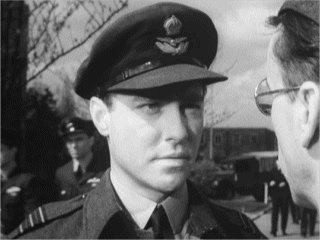
In the early 1950s, Richard Todd was halfway through a seven-year contract with Associated British Pictures when its director of productions, Robert Clark, bought the film rights to Paul Brickhill’s book The Dam Busters. Todd was already an established star, having received an Oscar nomination for The Hasty Heart in 1949, and playing Robin Hood in the Walt Disney movie of the same name. Clark wanted a vehicle for Todd, and the physical resemblance between Todd and the character he was chosen to play, Wg Cdr Guy Gibson, obviously helped him in the choice.
What is perhaps surprising, given that Todd is now remembered for his roles in ‘war’ films, is that The Dam Busters was in fact his first such part. (He was to be seen in naval uniform in The Yangtse Incident (1957) and played various army officers in D Day, Sixth of June (1956), Danger Within (1959), The Long and the Short and The Tall (1960), and The Longest Day (1962) before ‘rejoining’ the RAF and director Michael Anderson in Operation Crossbow (1964).) In The Longest Day, he played the role of Major John Howard, who commanded the glider force at Pegasus Bridge, and had a scene opposite another actor playing himself, an officer in the 7th Light Infantry (Parachute Battalion), who was amongst the first to meet Howard at the bridge. (Todd’s account of his real life role on D Day is here.)
Most of the obituaries (Telegraph BBC) single out Todd’s part in The Dam Busters as the highlight of his career, and he certainly took great pride in being remembered for the role, regularly turning up for reunions, other events and signings. It was, as American critics of the time pointed out, his ‘characteristic British understatement’ which made his portrayal of Gibson so memorable. His own war experiences must have contributed to his decision to play his ‘war’ roles in such a way – he was determined never to demean or trivialise the memory of the actual war and its casualties.
[Information from John Ramsden, The Dam Busters, Tauris 2003.]
Update: Further obituaries Guardian Guardian pictures Times Independent

BFI page on The Dam Busters

The British Film Institute is a treasure trove of material for anyone interested in the history of cinema, and much of it is now online. Check out, for instance, its page on Michael Anderson’s classic film, and you will find links to stills, other stuff about the cast and crew, and a wonderful, slightly sniffy, contemporary review from the BFI’s own Monthly Film Bulletin, which ends:

The film is over-long (the flying sequences include some repetition) and the music score is, regrettably, very blatant; but despite these drawbacks, a mood of sober respect is maintained.

Little did the reviewer know how popular the ‘blatant’ musical score would become.

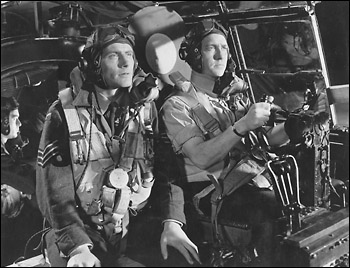
My favourite piece of Dam Busters trivia derives from the scene shown above, showing on the left the great Robert Shaw, later to star in no less a movie than Jaws, where he ends up meeting a spectacularly gory end. Here he plays flight engineer Sergeant John Pulford, which means he gets to sit alongside Richard Todd, playing Guy Gibson, for a large section of the film but has very few words to say. Their on-screen interaction is thought to be a pretty accurate reflection of the real life relationship between Pulford and Gibson.

Professor John Ramsden, RIP

RamsdenbkI was shocked and saddened by the news of the death of Professor John Ramsden, from cancer at the comparatively young age of 62. (Another obituary here.) Just the evening before I had read a chapter of his excellent book about the relationship between Britain and Germany, Don’t mention the war. This is essential reading for anyone who thinks that many Brits need to develop a more mature relationship between ourselves and our German partners and colleagues. Ramsden lists many ways in which the histories of our two countries are intertwined (many pubs called the King’s Head, for instance, are named after Frederick the Great of Prussia) and provides a counterblast to the puerile nonsense frequently peddled by the redtop press and the likes of Jeremy Clarkson.
But it is as the author of the wonderful book on The Dam Busters in the British Film Guide series that Ramsden should be respected and mourned by anyone interested in the subject of this blog. It’s a short book, but an invaluable guide to the film itself, to the times when it was made and to the reaction to it over the half-century since.

Big Brother and the Bouncing Bomb

I don’t know who watches Channel 4’s Big Brother these days – I certainly don’t, and nor do my two teenage children and their friends – but people who do might be intrigued to know that underneath the house is the water tank used in the 1955 film, The Dam Busters. Although various locations around the UK were used in the making of the film, much of it was actually shot on three huge sound stages built at Elstree Studios. One of these was presumably constructed around the tank (although Jonathan Falconer’s useful book, Filming the Dam Busters, is not specific about this). Other important landmarks in cinema history shot here include The Young Ones (Cliff Richard! Robert Morley!!?) and Monty Python’s Meaning of Life (the one with Mr Creosote).

Bill Kerr, back in the hot seat

Australian actor Bill Kerr, a sprightly 86 years old, recently recalled his part playing Flt Lt ‘Mick’ Martin in The Dam Busters. Sitting in the restored Lancaster in the Aviation Heritage Museum in Bull Creek, near Perth, WA, he told a reporter from the West Australian that it had been an honour to play the Australian Dambuster:

“But it took two hours of make up, a wig and a moustache before I really looked like Micky Martin,” he said.
A sprightly Kerr, who calls Perth home, took a trip down memory lane this week sitting in the pilot’s seat of the Avro Lancaster housed at the Aviation Heritage Museum in Bull Creek.
“You know the attention to detail in this Lancaster is incredible — they have done a marvellous job restoring her,” he said. “And the attention to detail in the original film was extraordinary. They even put chocks behind my ears so they stood out to look just like Micky Martin’s.”

Kerr also told the paper that he got the job straight off the boat from Australia when his agent drove him directly to Pinewood Studios for a casting session. However, this might be a slight exaggeration since by 1954 he had already been in a number of films, including the only film about Bomber Command to predate The Dam Busters, the under-rated Appointment in London. This was released in 1952 and starred a young Dirk Bogarde. It was written by John Woolridge, who had served as a flight commander in 106 Squadron when Guy Gibson was its commanding officer. Some commentators think that the Bogarde character is based on Gibson.
Bill Kerr’s role in Appointment in London, according to IMDB, was Flt Lt Bill Brown. The cast included other actors on the cusp of a successful career, including Bryan Forbes, Sam Kydd and Richard Wattis, with the female lead played by the well-established Dinah Sheridan.
John Woolridge not only wrote the script for this film but also, in an unusual combination, its musical score. He was to write more film music over the next few years, before his death in a car crash in 1958. His daughter is the actress Susan Woolridge, well known (in Britain at least) for many TV and film roles.

But it took two hours of make up, a wig and a moustache before I really looked like Micky Martin,” he said.
A sprightly Kerr, who calls Perth home, took a trip down memory lane this week sitting in the pilot’s seat of the Avro Lancaster housed at the Aviation Heritage Museum in Bull Creek.
“You know the attention to detail in this Lancaster is incredible — they have done a marvellous job restoring her,” he said. “And the attention to detail in the original film was extraordinary. They even put chocks behind my ears so they stood out to look just like Micky Martin’s.”

Scientifically speaking

Liz Kingsley is an Australian scientist and film critic who runs a lovely website And You Call Yourself a Scientist! This is mainly devoted to, in her words, “mad scientist’s views on other mad scientists. And mad doctors, monsters, murderers, psychopaths, ghosts, freaks, weirdos and things that go bump all hours of the night and day” and contains dozens of reviews, mainly of “B movies”. It also has no fewer than six pages of “immortal dialogue” culled from endless hours of movie-watching.  One topical example, given the current near-hysteria over so-called Swine Flu, from The Andromeda Strain:

First politician:  The decision on 712 isn’t final. It was just postponed for 48 hours.
Scientist:  By then the disease could spread into a world-wide epidemic!
Second politician:  It’s because of rash statements like that that the President doesn’t trust scientists!

However, the site also contains reviews of some more sensible films, such as The Dam Busters, and has some interesting perspectives on the science involved.

Happy birthday!

dam-busters-lo-resThe man who, unwittingly, set me off on the track of writing a book about the Dambusters was the actor George Baker, whose birthday is today. In an interview on the BBC Radio Today programme in December 2005 he told the story of how he had been cast to play the part of my uncle, David Maltby, in the 1955 film The Dam Busters. During the making of the film Gp Capt Charles Whitworth, the technical adviser, relayed to him the information that David was sometimes so wound up after operations that he released the tension by shooting china plates with his service revolver. This was a story that no one in my family had ever heard before, and it therefore seemed to me to be important to tell more of the family history before time took its inevitable toll on us all. 
In an email to me a few months later he told me how hard casting director Robert Leonard and film director Michael Anderson had worked to ensure the actors looked like their real-life characters. This was sometimes a bit confusing for poor old Charles Whitworth:

On the desk in front of them [Leonard and Anderson] they had a photo of [David Maltby] and one of me and I must admit that there was a considerable similarity. Then when I met Group Captain Whitworth he fell into the habit of calling me Dave, which was really quite disconcerting. 
[Whitworth] would often refer to an incident thinking that I had been there. This is how the story of the plate shooting came to be told, quite obviously the men of the squadron became extremely tense before and after an operational flight but other indications from the Group Captain told me that [David Maltby] was a very funny man and a delightful companion. I feel very honoured to have had the chance to portray him in the film.

Happy birthday, Mr Baker!