This coming Sunday, 16 May, marks the 67th anniversary of the Dams Raid. I will be posting more material about this later this week but thought people in the North West might like to know about the Battle of Britain Memorial Flight’s plans for the day.
The BBMF Lancaster, ‘Phantom of the Ruhr’, has been out of action for the last few days with a faulty fuel cock. Luckily, a replacement has been found (which must have been quite a task for an aircraft in its seventh decade!) and it is undergoing an airtest today.
If all is well, the Lancaster will be marking the centenary of the foundation of the AV Roe company by flying over the site of the factory where it was designed and where more than 7,000 were built during the war – Chadderton, near Oldham. You’ll get a great view at Manchester Airport, where it will dip to an altitude of 100ft.
Great chance to get some good pics – please send me any you take and I may publish them on this blog.
(Special note for real Lancaster buffs – PA474 was actually built by Vickers Armstrong in Chester!)
Tonight at 8
Steady, steady – bomb gone! (part 2)
Flg Off Ray Grayston, RIP
Pic: Lincolnshire Aviation History Centre
I’m sorry to have to report that Ray Grayston died on Thursday 15 April.
Grayston was the flight engineer in Les Knight’s Lancaster, AJ-N, the ninth and final aircraft of the first wave of Operation Chastise, tasked with attacking the Möhne and Eder Dams. Five mines had been used at the Möhne before it had been breached, which left only three for the Eder, as Bill Astell had crashed en route. David Shannon and Henry Maudslay dropped their mines but did not break the dam, so Knight’s weapon presented the last chance for success.
As the engineer, Grayston sat on Knight’s right hand side as the pilot brought the Lancaster down to the required height of 60ft, using the throttles to keep the speed at 220mph. After a dummy run, which was dangerous enough for rear gunner Harry O’Brien to record afterwards that he ‘never thought they would get over the mountain’ on the other side of the dam, Knight brought AJ-N into attack. With a bright moon on the starboard beam, the mine was released, bounced three times and hit the dam wall. Knight climbed steeply and, as the aircraft reached a safe height, saw an explosion which caused a ‘large breach in wall of dam almost 30ft below top of dam, leaving top of dam intact.’
Wireless operator Bob Kellow had his head up in the astrodome, looking backwards. It seemed, he said ‘as if some huge fist had been jabbed at the wall, a large almost round black hole appeared and water gushed as from a large hose.’
The climb after the attack had been hair raising. Bomb aimer Edward Johnson said later that it ‘required the full attention of the pilot and engineer to lay on emergency power from the engines and a climbing attitude not approved in any flying manuals and a period of nail biting from the rest of us not least me who was getting too close a view of the approaching terra firma from my position in the bomb-aimer’s compartment.’
Like many young men of his generation, Ray Grayston was fascinated by flying and volunteered for the RAF at the beginning of the war. In a TV documentary to mark the 60th anniversary of the Dams Raid he described how he loved riding a motorbike at speed, and that this was one of the things which encouraged him into the air force. Initially he served as ground crew but then, along with many others who were mechanically minded, he was selected to train as a flight engineer on the new generation of heavy bombers which needed more personnel.
In late 1942, Grayston teamed up with Knight and the rest of the crew in their final stages of training, and they were part way through a tour of operations in 5o Squadron, stationed at RAF Swinderby, when they were offered the chance to transfer into a new squadron being formed at nearby Scampton for a secret special mission. They went as a group, as Kellow later explained: ‘The offer presented to us sounded interesting and with our faith in each member’s ability we made up our minds there and then that we would accept the offer and move over as a crew to this new squadron.’
Like many Lancaster crews of the time, they were from different countries and walks of life. Knight and Kellow were Australians, the gunners were both Canadian and the rest were British. Knight was an exceptional pilot even though, as Grayston later recalled, he couldn’t ride a bicycle or drive a car.
They didn’t fly over Germany again until September 1943, four months after the Dams Raid when they were sent out with another new weapon, a 12,000lb ‘thin case’ bomb, to attack the Dortmund Ems canal. It was a terrible night, with heavy fog blanketing the heavily guarded canal. Four of the eight crews who took part had already been shot down when Knight, flying at about 100ft in fog, hit some trees and badly damaged both his port engines.
This is one of the stories which Paul Brickhill tells beautifully in his 1951 book, The Dam Busters. With his tailplane and a starboard engine also damaged Knight managed to pull the Lancaster up to about 1,000ft and called his fellow Aussie Mick Martin, who had assumed command after the CO and deputy force head had both come to grief.
‘Two port engines gone. May I have permission to jettison bomb, sir?’ It was the ‘sir’ that got Martin. Quiet little Knight was following the copybook procedure, asking respectful permission to do the only thing that might get him home.Martin said, ‘For God’s sake, Les, yes,’ and as the bomb was not fused Knight told Johnson to let it go. Relieved of the weight they started to climb very slowly…The controls were getting worse all the time until, though he had full opposite rudder and aileron on, Knight could not stop her turning to port and it was obvious that he could never fly her home. He ordered his crew to bale out and held the plane steady while they did. When the last man [who was Grayston] had gone he must have tried to do the same himself,and must have known what would happen when he slipped out of his seat. There was perhaps a slight chance of getting clear in time, but as soon as he took pressure off stick and rudder the aircraft flicked on her back and plunged to the ground. Knight did not get to the hatch in time.
A wizard show: RC Sherriff and The Dam Busters
At exactly the moment when sound films were about to sweep all before them, in 1928, Sherriff captured in Journey’s End the way in which a certain type of British officer and gentleman spoke and behaved. He then carried these manners and forms of expression into his screenplays, was much imitated in doing so, and saw them develop into clichés of cinematic Englishness.(John Ramsden, The Dam Busters, Tauris, 2003, p.38.)
Gibson: ‘I wanted you for this. You’re the low-flying expert.’Martin: ‘Low flying? Fine.’—WAAF: ‘Are you flying tonight?’Pilot: ‘That’s the general idea.’—Wallace: ‘Why don’t you turn in, Gibby?’Gibson: ‘I have to write some letters first.’
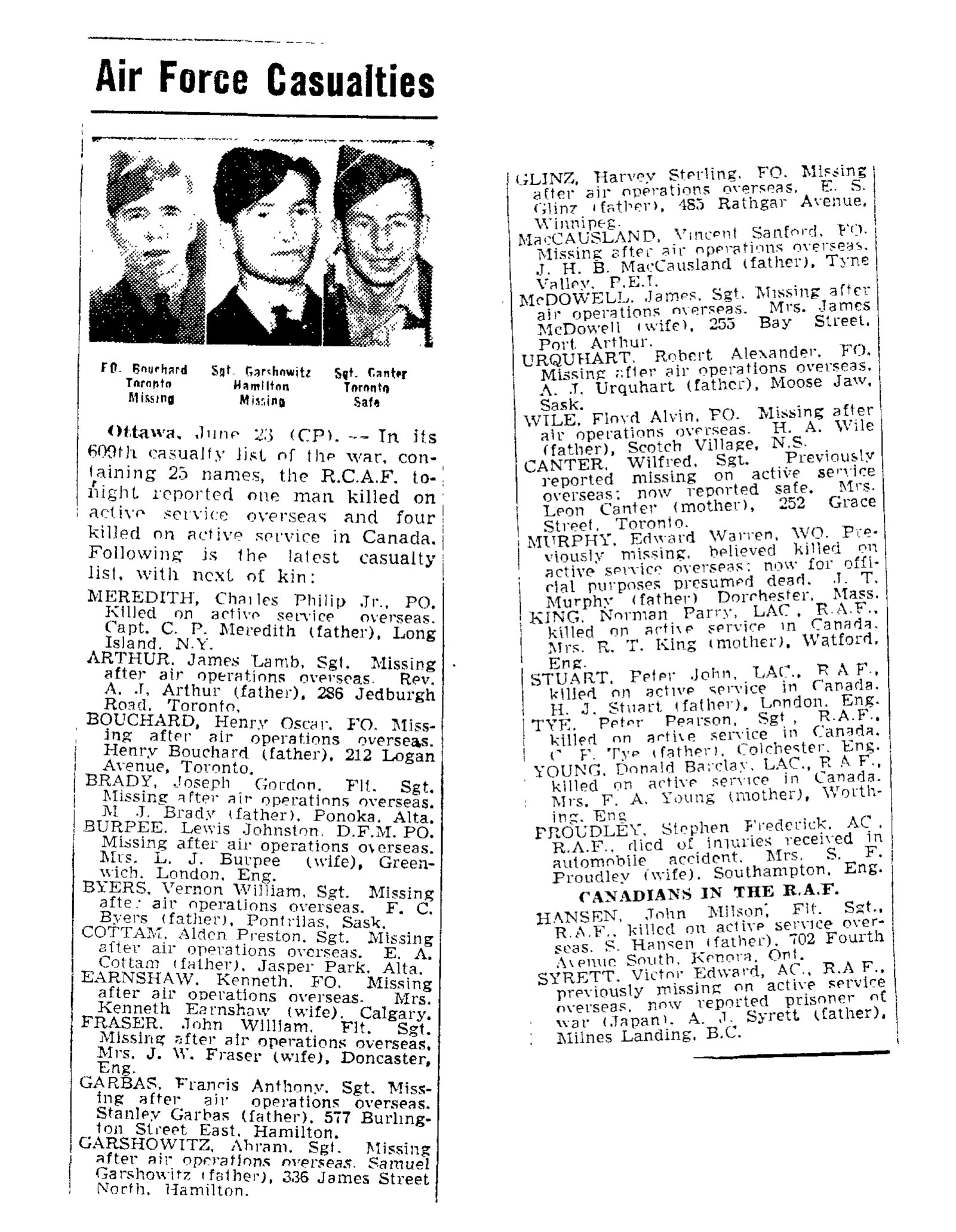
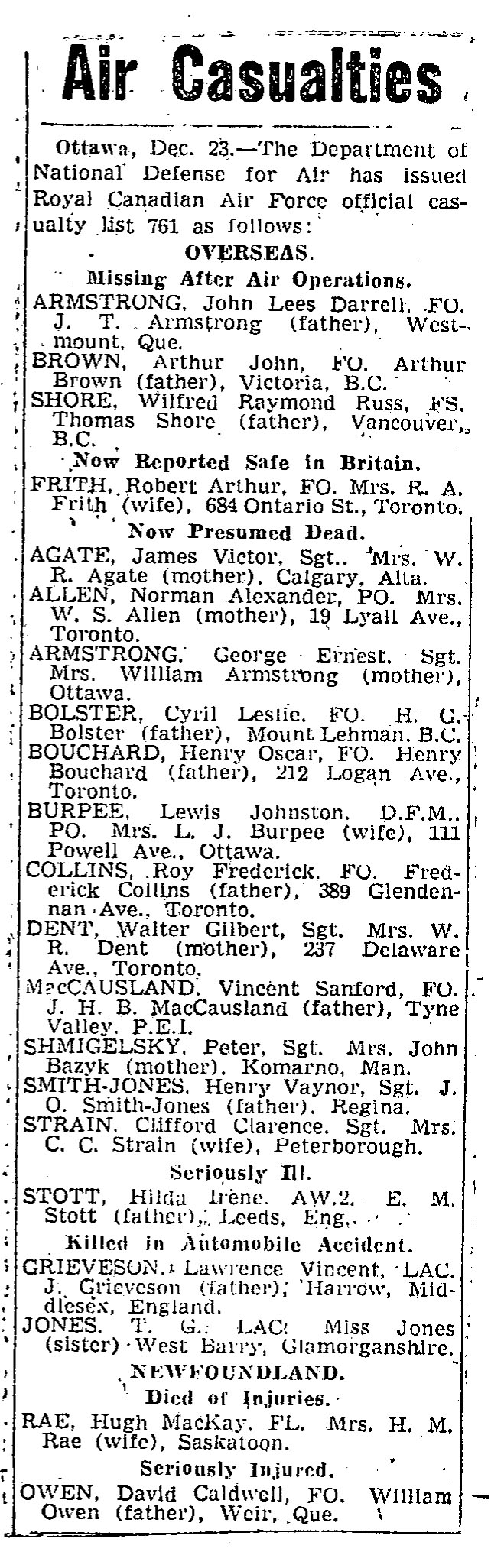
Vincent MacCausland: letters and images
You are perhaps wondering what I am doing here. There is really no need to feel over anxious to know that I am back again for my second tour. I really was due back six months after Sept of 41 and had the privilege of joining a well experienced crew and on aircraft that one dreams about. To tell you the honest truth I would not have taken this on had I believed it was a doubtful move. I came up here a couple of days ago (Apr 14th) and we are on revision and conversion for the next month before going over with a few bundles for the squareheads I know that you will be feeling most anxious during those few months ahead but the time will soon pass and I know that God will be especially with us as were blessed in that first tour. I hope that we shall be writing at least two to three times per week and if you do the same, it will be much happier for us all.
Barnes Wallis in Hendon
Photo by mickb6265
It’s a long time since I’ve had a proper look around the RAF Museum in Hendon, North London. On my last visit I was in a rush to get to the research library upstairs. So I’ve missed the fact that there is a re-creation of Barnes Wallis’s office in the exhibition hall, complete with his real drawing board and other paraphernalia. From this picture it looks as though the famous photograph of the Möhne lake after the dam was broken is hanging in the corner. Wallis brought this to the party in the Hungaria restaurant after the Buckingham Palace investiture ceremony, where it was signed by most of the surviving aircrew who took part in the raid.
Full set of mickb’s pictures are here on Flickr.
Phil Martin – another obituary
Ken Stone, whose own father completed a wartime tour in Bomber Command as a Lancaster pilot, has kindly sent me the full obituary from the West Australian of the “other” Flt Lt Martin, who died recently. This wasn’t available online, so it’s a useful resource. Click here to see in full.
Better late than never
These pictures date back to the 65th anniversary of the Dams Raid in May 2008 (incidentally the month I started this blog!). They show aircraft from the Battle of Britain Memorial Flight in action over the Ladybower reservoir in the Derwent valley, Derbyshire. They are great shots and deserve a mention, even at this late stage. Thanks to Rob McPherson for sending them to me.
Your call is important to us. Please hold. Thankyou for waiting.
Sorry about the absence of posts and the shortage of new material. I have been a bit snowed under by work. I have a small stack of things to report on, and will get round to it very shortly…