Hay spells it out

[Picture from The Dam Busters by Paul Brickhill, Evans Brothers, 1951 edition]

Anyone who has read the later chapters of Paul Brickhill’s book The Dam Busters may recall the chapter devoted to a gadget called the Stabilising Automatic Bomb Sight (SABS). This had been invented in 1941 to enable aircrew drop big bombs more accurately, but for it to work an aircraft had to run straight and level for ten miles in the period immediately before the bomb was dropped. It was claimed that if the sight was used properly a bomb could be dropped from 20,000 feet with an accuracy of under a hundred yards.

617 Squadron’s “Bombing Leader” was Flt Lt Bob Hay, bomb aimer in Mick Martin’s crew. Each squadron had a “Leader” for each of the specialist jobs in an aircrew – Bombing, Signals, Navigation, Engineering and Gunnery. Their job was to co-ordinate specialist training and other matters across the squadron, sorting out problems and schedules, liaising with the Flight Commanders and so on.

Hay therefore had to deal with the man Brickhill calls “Talking Bomb”, a Sqn Ldr Richardson who arrived at Coningsby to train the crews in the use of the SABS. It was hard work and required intense practise, but eventually the crews got quite good at its use, with Hay himself setting the standard with an average deviation of just 64 yards.

Hay was therefore called upon to write an article for the 5 Group’s internal newsletter, 5 Group News, in order to spread the word amongst other squadrons in the group. This article has recently come to light, and the text has been reproduced  on the Stirling Aircraft Forum website. You can read the full article there, but here is a short extract:

The Secret of 617 Squadron’s High Standard of Practise Bombing – the S.A.B.S. Pilot/Navigator/Air Bomber Team (By Flt Lt Hay)

The excellent results gained by crews of 617 Squadron using the S.A.B.S. have only been achieved by the fullest, most practical use of the ‘bombing team’. Before any bombs are dropped, some 4 hours training on the specially adapted A.M.B.T. are carried out by the pilot and air bomber to give manipulation practise to the latter and to familiarise the pilot with the B.D.I. (Bombing Direction Indicator).

The SABS was used successfully on a number of raids but sadly Bob Hay was not around long enough to share in any glory. He was killed in February 1944, when Martin’s aircraft was badly damaged by anti-aircraft guns on an attack on the Antheor viaduct in Italy France [Thanks Tim, see comment below], and is buried in Sardinia. He was the only member of Martin’s Dams Raid crew who did not survive the war.

[Hat tip: PAFG, SAS Forum]

Vincent MacCausland – new pictures

I last wrote about Vincent MacCausland some eighteen months ago, and reported on some letters and pictures which had been found in Canada by Joel Joy. Joel has now pulled everything together in a Flickr page, and added some more pictures which he has come across.
Joel is doing a grand job researching the lives of the Canadian Dambusters, and we can expect more material as and when he unearths it.

Dambuster pictures from the Bomber County

Deep in the heart of Lincolnshire lives Anna Haworth, photographer extraordinaire. She has a particular fascination with all things aeronautical, and most especially the Dambusters. There are loads of pictures on her Flickr page, which you can see here. And here is the link to her Dambusters collection, which contains stunning shots from trips over the Derwent dam, atmospheric pictures from the Petwood Hotel, the collections at Metheringham, East Kirkby, Scampton and Coningsby, to name just a few. Plus some other oddities that she has come across, such as the decorated scooter shown above.

The race to smash the German dams

James Holland’s film, shown on BBC2 last Tuesday night, is available for UK viewers to watch again on iPlayer until Saturday 19 November. Follow this link.

So far, I can’t find any reviews posted online, but I have come across an interesting preview article in the New Statesman in which Guy Walters argues that Holland completely counters the “revisionist” view that the Dams Raid actually achieved very little. According to Walters:

The raid was in fact a triumph, and did an enormous amount of damage. After studying the German archives, Holland shows that: “…not only were two major dams completely destroyed, so too were seven railway bridges, eighteen road bridges, four water turbine power stations and three steam turbine power stations, while in the Ruhr Valley alone, eleven factories were completely destroyed and a further 114 damaged, many severely. Vast tracts of land had also been devastated by the tidal waves that had thundered up to eighty miles from the dams.”
Such damage can hardly be considered “little of substance”.
Furthermore, Holland completely skewers the argument that as the dams were quickly rebuilt, the damage was therefore not that great. The whole point of their swift reconstruction “underlines just how important they were to Germany”, and the men and material required had to be diverted from elsewhere.
Holland also argues that the destruction of the dams struck a huge psychological blow against the Germans, as these were structures that were venerated as triumphs of the country’s might and technical knowhow. In short, the raid was indeed a catastrophe for Nazi Germany, and a triumph for the British.
Holland’s analysis will no doubt draw its detractors, perhaps inspired by a politically fashionable thinking that seeks to denigrate just about every British success during the Second World War. Of course, there was much that we got wrong, but we also got many things spectacularly right.

In my view, Holland’s programme was a well researched and presented documentary. There were interviews with three of the four surviving Dambusters – Les Munro, Grant McDonald and George “Johnny” Johnson – and a good use of far flung written source material, such as Charlie Williams’ letters, which are in archives in Queensland, Australia.

Perhaps the point that came across most strongly was the airmanship involved. Flying a 30 ton aircraft a thousand miles through hostile territory just 100 feet above the ground required enormous concentration, exceptional skill and tremendous luck. When you consider the odds it is no real surprise that eight of the 19 aircraft failed to return. And no surprise, either, that this tactic was only used sparingly in the rest of the war.

With so much already written and broadcast about the Dams Raid it is not surprising that little new information emerged. But that shouldn’t detract from what was a thorough film, mercifully lacking most of the frills and tricks which many documentary directors nowadays feel it necessary to add. Catch it again on iPlayer while it is still available!

Dambusters remake: quiet progress

Pic: Natasha Baucas

Sources tell us that some quiet progress is being made on filming the remake of The Dam Busters.

(A brief recap for those not familiar with the project. This story has been going on since 2006, when David Frost bought the rights to remake the 1955 original, which was directed by Michael Anderson and starred Richard Todd and Michael Redgrave. Peter Jackson of Lord of the Rings fame became the producer, announced that it would be called Dambusters and made in New Zealand, under the direction of Christian Rivers with a script by Stephen Fry. A full size model Lancaster bomber was built, and unveiled to the press in 2009. However, Jackson is now busy filming The Hobbit, so is obviously not giving the Dambusters project his full attention.)

Sources have told us that some CGI and special effects work is now being undertaken in workshops in New Zealand. Some of this involves models – one of the spinning bomb in the bomb bay – and some is completely generated on computers. This kind of work is laborious and time-consuming and is essential if the project is to meet the high standards of a Jackson-helmed production.

No actual casting has yet been announced, so the date when real life filming will begin is still a matter of speculation. I said at the time I started this blog, in 2008, that 2011 would be the earliest possible date that the film would appear. It now looks as though it could be 2013 or 2014. May 2013 will be the seventieth anniversary of the Dams Raid, so this could be a date which the producers will aim for.

Dambuster mothers in 1955

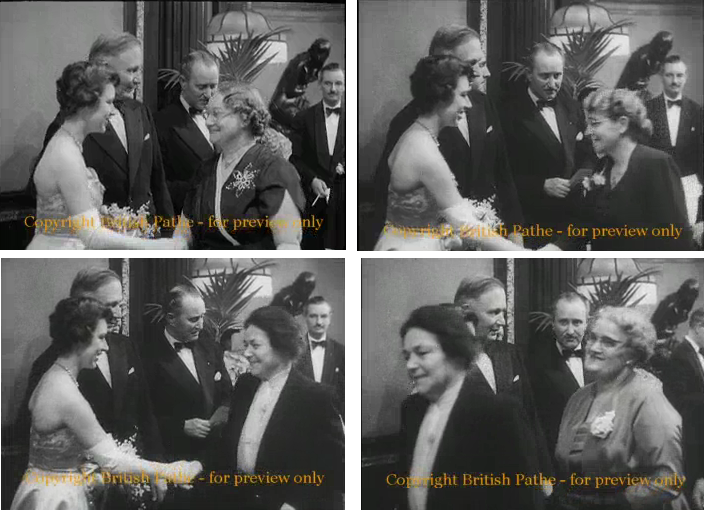
I mentioned in an earlier post the Pathé newsreel shot at the premiere of The Dam Busters in 1955. Four middle-aged women are shown being presented to Princess Margaret, and are identified only as the mothers of four aircrew who died on the Dams Raid. I’ve now done a screengrab of each of these, in the hope that someone out there may be able to identify a grandmother or great aunt.

Please get in touch if you recognise any of these.

Another date for the diary

BBC2 is to screen yet another documentary about the Dams Raid next Tuesday, 8 November at 9pm. Subtitled “The Race to Smash the German Dams”, this promises to be a less superficial film than last autumn’s effort, which was fronted by an actor rather than a historian.

The writer and presenter James Holland would appear to have done a lot of research, even flying to New Zealand to interview Les Munro, and has only just finished the final editing, according to this entry on his blog.

The two main thrusts of the film would seem to be the speed at which the operation was put together – something which is covered well in John Sweetman’s seminal book on the raid – and the fact that not all the crews were as experienced as some accounts would suggest. The myth that Gibson “hand picked” the crew is something that has crept into the story from his book, Enemy Coast Ahead, but as this section of the book is based on an article in the Sunday Express which was ghost written for him, it is not a reliable account.

In fact, many of the pilots were pretty experienced, having done a full tour or the best part of one. But their crews may not have been. David Maltby, for example, had just come back to 97 Squadron to start a second tour, and had been allocated a new crew, not long out of training. They then moved as a unit to 617 Squadron, and for some, including navigator Vivian Nicholson, the Dams Raid was their first operation.

James Holland has also posted a transcript of his interview with Les Munro on his website. It is a very rough transcription, full of mishearings and typing errors, but interesting if you want to hear Les’s words first hand.

Gibson’s final flight: James Cutler replies

James Cutler has sent me a long response to the earlier posts about the final flight of Guy Gibson on 19 September 1944. He rebuts some of the other explanations for Gibson’s crash, and explains why he believes that the archive documents show how Gibson was shot down by so called friendly fire.

Three RAF crews independently reported a shooting down (one is a combat report by QR-V of 61 Sqn, the other two are reports of aircraft seen shot down, of which one by 106/H is 4.5 miles from the combat report’s location and the other by 97/J  is Steenbergen town centre) at locations  within 16 miles or 3.8 minutes flying time of each other and at times within 6 minutes of each other.

If people have seen these in the past and thought that they refer to more than one plane shot down they are mistaken. The recently discovered full Luftwaffe records for the night show in the words of Theo Boiten that “the 3 JD report clearly states ‘no own losses’; there is no Namentliche Verlustmeldung (Loss Card) of any German NJG loss for this night; and there is not a single piece of evidence  that a German night fighter was lost in the SW part of The Netherlands. All crash locations on land in The Netherlands have been carefully documented  over the last decades, and I have found nothing about an unidentified crash  or even a German night fighter crash in the Provinces of Brabant/Zeeland on 19/20 September 1944.”   Clearly if anyone can prove that another aircraft fell in the QR/V / 106/H area on that night  this would be the only evidence that could  cast real doubt on the friendly fire by QR-V explanation (though it would still leave 97/J’s report that Gibson was definitely shot down at Steenbergen and would not rule out friendly fire from another Lancaster whose crew did not report the fact). However there is absolutely no evidence of that and suggesting that some unidentified, unrecorded aircraft – maybe one of Hitler’s secret flying discs?- crashed without trace in the area on that night is really flying in the face of all the facts.

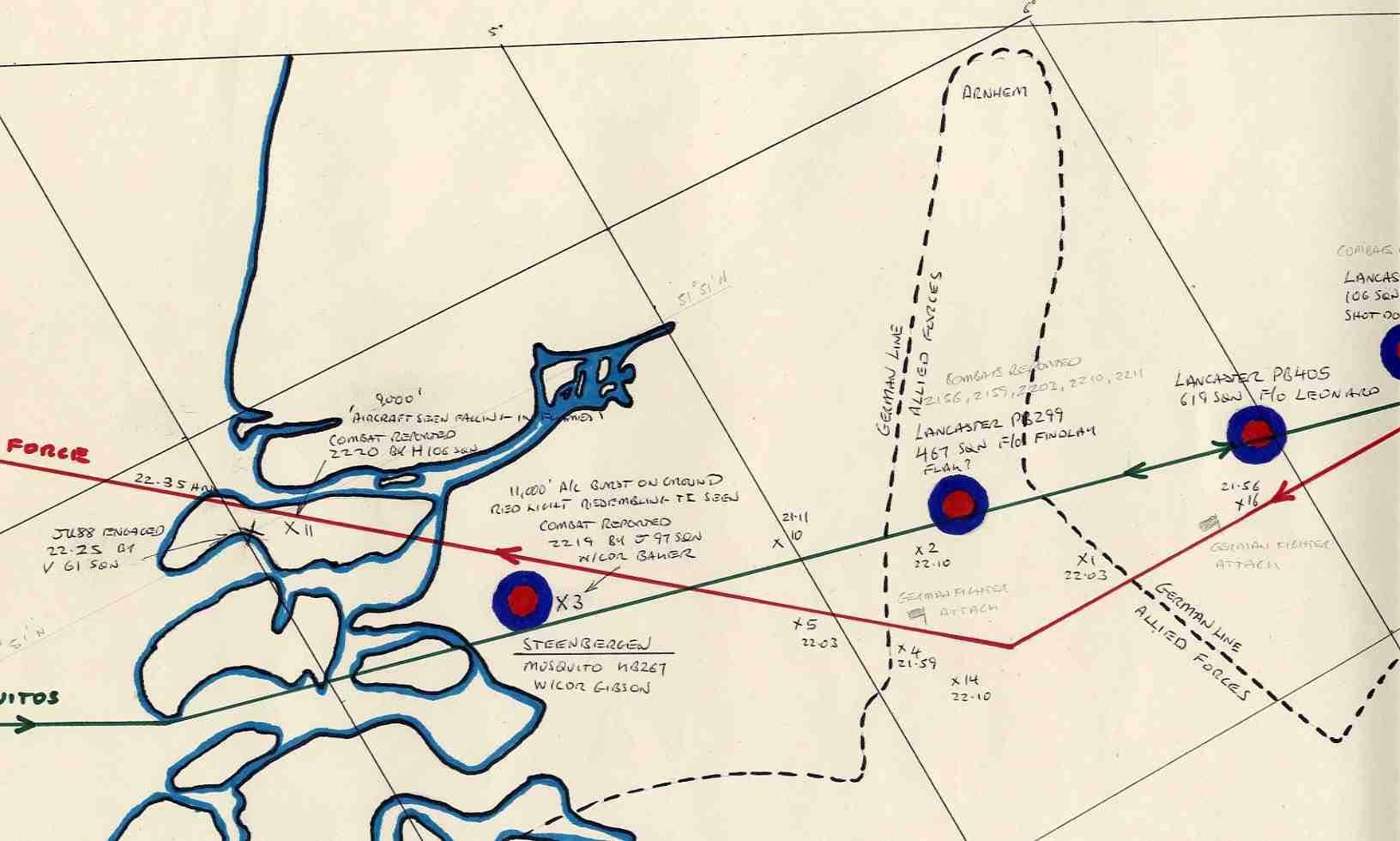
Simon Parry who has over the last 30 years studied hundreds of such reports of air combats and analysed very many crashes and shootings down and Theo  Boiten who is the world’s greatest authority on the Luftwaffe’s night fighter war, both agree that, in the absence of any other plane shot down in the area, the three RAF reports are typical multiple sightings of the same event despite the discrepancies in times and locations noted down in the heat of battle. Indeed there is an example of a typical  non controversial multiple sighting of a Lancaster being shot down on the same night from the same Z report . The map shown below, drawn by Simon Parry, shows all the crash sites of RAF planes on Sept 19th 1944 with the “Aircraft seen shot down ” reports’ times and locations plotted against them.

If you look at the crash site of  Lancaster PB299  of 467 Sqn you can see that reports X1, 2, 4, 5, 10, and 14 refer to this loss with times from 21.56 to 22.11. So there’s a time variance of 15 minutes and although there isn’t a scale given on Simon’s map as supplied, simple measurements show that sightings x 10 (106 H again) and x 4 are in fact almost as far away from the crash site as 61/V’s combat report and 106/H’s ‘seen shot down’ report are from Steenbergen where Guy Gibson crashed.

The three RAF crews’ reports, made independently of each other and submitted within hours of the event from almost contemporaneous notes are much better evidence than the recollections of the Dutch civilians on the ground who were not interviewed until some seven weeks later after the Allies took Steenbergen. The Dutch witnesses are contradictory and in some aspects implausible – one says he could see the pilot and navigator in the cockpit at 3000 ft – over half a mile away.

The ground at the time was “solid clay” . The crash site excavation of Gibson’s aircraft in 1985 found engine parts and other parts at a depth of 3 metres suggesting the plane fell straight down from a considerable height and certainly did not crash at low level.

In reply to Alan Wells: The details of the sighting of the supposed “Ju88” in the QR-V  combat report could well refer to the “JU88 ” crossing below the Lanc on a diagonal then getting shot at and possibly hit by the mid-upper gunner as it appeared “on the starboard beam down” and because of damage  “dropped back” behind the Lanc. Simon Parry says that “a German night fighter would not get right behind a bomber at the same height. He would drop below, then pull up the nose to rake the bomber from end to end hitting it in the wing tanks in plan form. He would not fire at the small ‘end on’ profile, which would also expose him to return fire. The pilot would also get away immediately he was fired upon, because he knew the crew was alerted to him.”

I accept that the report of the “Ju 88” firing is, on the face of it, problematical.  However, Simon Parry suggests  from his research in documents and at crash sites  and from talking to hundreds of aircrew that it could be a typical confusion . Alex Bateman has a good example of fog of war stuff from 617 Sqn which  has been posted on the Dambusters weblog. Given that the Luftwaffe pilots over-claimed about combats and downings at the target that night ( 7 Luftwaffe claims at the target Rheydt /Munchengladbach  – 4 Lancs lost) and given that fired ammunition would have to be accounted for, one would think that if a Ju 88 had actually fired at and been damaged by QR-V, a combat report would be there in the very complete Luftwaffe records that Theo Boiten has for that night.  As for Mosquitoes,  they were a prized claim above all others and were extremely over-claimed by Luftwaffe pilots accordingly.

The QR-V combat report also records that the supposed Ju 88 had its navigation lights on . Theo Boiten says:
“During my research of the Nachtjagd, I have never come across any reference in German records, nor in interviews/diaries etc of German Nachtjagd veterans that the above tactics (using lights as decoys to entrap RAF bombers) were in fact used – I agree that Bomber Comand crews often returned home with eye witness stories of German night fighters ‘burning (amber) lights’ but I have never found any piece of evidence that this was indeed a tactic used by the German night fighters,  neither in controlled GCI night fighting, nor in the freelance night fighting.”

However, I have seen a 106 Sqn ORB entry that describes RAF bombers putting their navigation lights on to cross the channel as there was no moon (as on 19th Sept 1944) – presumably to avoid collisions . There are reports of the same practice by RAF aircraft on D Day.  Gibson would have been about to cross the sea. Or he might have put his lights on to try to identify himself to a plane whose path he had just inadvertently crossed. Certainly I am not suggesting  that he put the lights on as a prank (as he describes doing to a fellow RAF night fighter crew in Enemy Coast Ahead.)

Sadly, friendly fire was commonplace. Gibson describes several occasions in Enemy Coast Ahead where he was shot at by FF.  Indeed one of the Lancaster crews from 44 Sqn on the Munchengladbach raid reports that, 20 minutes before Gibson was shot down, another Lancaster attacked them:  ” Lanc. — about 300yds above  — moved to starboard beam and opened fire from mid upper turret about 3 second burst. Own aircraft corkscrewed. Attacking Lanc. disappeared.”

Another point is to reply to the theory expressed by some people  who have suggested that Gibson didn’t use the outer wing fuel tanks at all, taking off on the main tanks and using them throughout. However these tanks would have held  enough fuel to fly to the target, hang around there for the time that he did and then return to Lincolnshire.

Finally I should say that I would never rely on anecdotal evidence such as the tape of Bernard McCormack alone – it simply alerted me to an intriguing possibility which resulted in me contacting Simon Parry and then Theo Boiten and other experts. One thing that I was always keen to know was whether any surviving members of 61 Squadron had ever heard such a story circulating at the time. Since the article that evidence does seem to have now come to light. I will keep you posted.

News Chronicle report on Dams raid

Dom Howard has kindly sent me another contemporary newspaper report of the Dams Raid, this time from the News Chronicle of 20 May 1943. It’s interesting to read the amount of detail the Air Ministry revealed on the days after the raid – there was a tremendous public appetite to find out how this one operation had dealt such a blow to the heart of the Nazi war machine.

You can see all the reports on Dom’s Photobucket pages here .


Steady on chaps, ladies present

Fun and games at the latest production from English Touring Opera, Handel’s Xerxes. This has been reimagined as a Second World War drama, apparently inspired by The Dam Busters. Some confusion about the aircraft they flew, however, with a Spitfire on stage, rather than a Lancaster. But no matter – Xerxes sings the famous aria “Ombra mai fu” to the Spitfire before sending it off to fight in his continental campaign. According to the Guardian, his brother and rival Arsamenes is based on Guy Gibson, Ariodates is Barnes Wallis and the Hellespont becomes the Ruhr Dams. The Independent’s critic swooned over the performance of Julia Riley (that’s her above) in the title role – “no praise can be too high” for her – and said that Covent Garden “would count itself lucky to host a Baroque show of this calibre”.

The show is touring in London, Buxton, Cambridge, Lincoln (how apt!), Harrogate, Aldeburgh, Exeter and Malvern from now until 25 November, so if you get a chance to see it, go along!