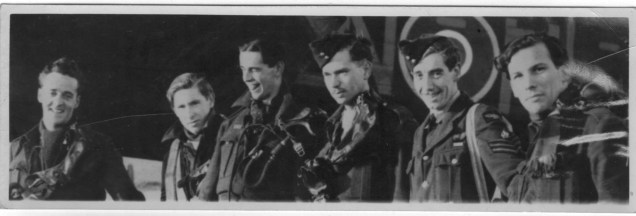
New picture of Lewis Burpee and three other Dambusters

Burpee sqd106 smal

Joel Joy continues to unearth interesting new material about the Canadian Dambusters. He has recently got permission from the family of Plt Off Lewis Burpee to publish this picture of his crew, taken while he was on 106 Squadron.
Alex Bateman has kindly identified all the personnel present:

Left to right:
Sgt Joe Brady (Rear Gunner)
Sgt Bill Long (Mid Upper Gunner)
Sgt Guy Pegler (Flight Engineer)
Flt Sgt Lew Burpee (Pilot)
Flt Sgt Eddy Leavesley (Wireless Op)
Sgt George Goodings (Bomb Aimer)

The photo was taken on 106 Squadron at Syerston, on 18 January 1943 after a night trip to Berlin.  The Lancaster is W4842 ‘ZN–H’.

Brady, Long, Pegler and Burpee went on to 617 Squadron in March 1943, and were four of the crew of AJ-S on the Dams Raid. They were all killed when they were shot down near Gilze Rijen in Holland, and are buried together in Bergen Op Zoom war cemetery. There are full details of Burpee’s 26 previous operations on the Air Force Association of Canada website. (In alphabetical order, scroll down to Burpee.)

Peter Jackson speaks: December 2012 update

Jackson Hobbit
Much respect, Ali P(lumb). While every other film journalist has kept to Middle Earthy subjects in their recent questioning of Peter Jackson, Empire Magazine’s finest video interviewer slipped in a query about a much more important subject (to readers of this blog, at least).

Plumb: “What is the current state of the Dambusters project?”
Jackson: “Dambusters is on hold waiting for me to finish The Hobbit. The Hobbit wasn’t something I intended to get involved in [as much] as I did, so there was an option at one stage I’d be shooting The Dambusters while Guillermo [del Toro] was shooting The Hobbit, but as things ended up going, The Dambusters has just had to sit on the sidelines.”
“But it’s there. The Lancasters are built. We’ve got ten Lancs built for us sitting in storage. And it’s ready to go as soon as we possibly can.”

So there we have it. The one person who can decide when the Dambusters remake will proceed has given a firm commitment that it will happen. One day.
When I started this blog four and a half years ago one of my first posts predicted that we would have to wait to ‘at least 2011’ to see the remake on our screens. Foolish me! The film world has its own logic and moves at its own pace. But at least we now have it on the best authority possible — the Dambusters remake is on, and will appear some time. Exactly when? I suspect no one knows.

Classifying the Dambusters

R Morris article page 1 lores

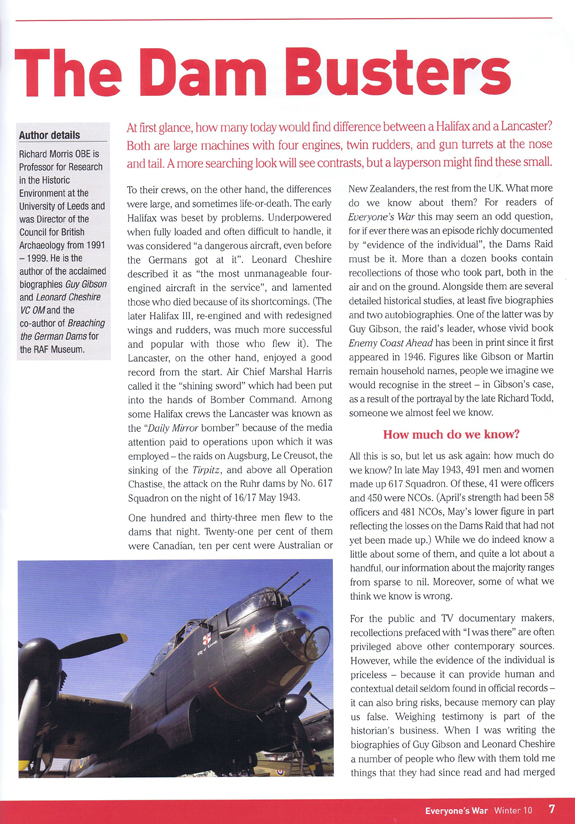
One of the most eminent professional historians studying the Dambusters is Professor Richard Morris, now working at the University of Huddersfield. Back in 2010, he wrote an article in an edition of Everyone’s War about the background history of the Dambusters.

For copyright reasons, I can’t include the whole article here, but another version appeared in the newsletter of the 617 Squadron Association, Apres Moi, which is available online (scroll to page 7).

In it, Morris writes:

One hundred and thirty three men flew to the dams on the night of 16/17 May 1943. Twenty-one per cent of them were Canadian, ten per cent were Australian or New Zealanders, the rest from the UK…
While we do indeed know a little about some of them, and a fair bit about a handful, our information about the majority ranges from sparse to nil. Moreover, some of what we think we know is wrong. For historians, personal witness is both priceless – because it captures human detail not found in written records – and treacherous, because memory often plays us false. Thus when Gibson tells us in Enemy Coast Ahead that his flight engineer John Pulford was a Londoner, he is wrong: Pulford came from Hull. There are other such slips, for instance that Young had been to Cambridge, whereas in fact he was an Oxford man, or that Young was an American, when in fact he was British. Taken individually, such errors seem trivial, and to draw attention to them seems pedantic. I do not do so in criticism – there are plenty of mistakes in my own books, all of which were written with the luxury of access to references and sources, and none of which are half as compelling as Enemy Coast Ahead. But history is in part built up from detail, and it is not for us to say where the boundary between triviality and significance may lie. If we don’t care about accuracy in tiny things then the cumulative picture may itself be affected…
Historians have a way of dealing with [these questions]. It is called prosopography – the analysis of data about social groups whose members are difficult to approach as individuals through available historical sources. It concerns itself with the micro-histories of ordinary people.

If you are interested in the social history of the Dambusters (and if you read this blog, you surely must be!) then it’s worth looking at the whole thing.

70th anniversary of the Dams Raid

Check the Dambusters 70th anniversary category for the latest information

2013 will see the 70th anniversary of the founding of 617 Squadron and the Dams Raid, and a number of events are being lined up to commemorate it. Those organised by the 617 Squadron Association have still to be confirmed, but they are likely to include a tribute by the Battle of Britain Memorial Flight Lancaster at Derwent Water reservoir in Derbyshire, one of the UK reservoirs used by the Dambusters for training in the run up to the raid. This is provisionally scheduled for Thursday 16 May, the anniversary of the raid itself.

Derwent reservoir was the scene of a Lancaster flyover at the Ladybower Dam on the 65th anniversary in 2008, shown here in a terrific panoramic photograph by Rob McPherson.

There are also likely to be events at both RAF Scampton and RAF Coningsby, and the laying of a wreath at the 617 Squadron memorial in Woodhall Spa.

The BBMF’s Lancaster, PA474, has already been given a new nose art and identity to mark the 70th anniversary of the founding of 617 Squadron. It is now to be called DV385, Thumper Mark III, to match the identity of one of the Lancasters posted to the squadron in November 1943, to replace those lost on both the Dams Raid and the disastrous September attack on the Dortmund Ems Canal.

And further celebration of the anniversary comes from the RAF Museum, who have published their must-have Christmas present in the shape of a 2013 calendar.

More information on 2013 events will be posted here as soon as we get it.

Filming “The Dam Busters” – two new pictures

This is the second post running featuring the son of a member of the RAF who took part in the filming of “The Dam Busters” in 1954. This time it is Jan Kmiecik, whose father was Flt Sgt Joe Kmiecik, a Second World war veteran who was by then a pilot in 83 Squadron. Jan has kindly sent me these two photos.

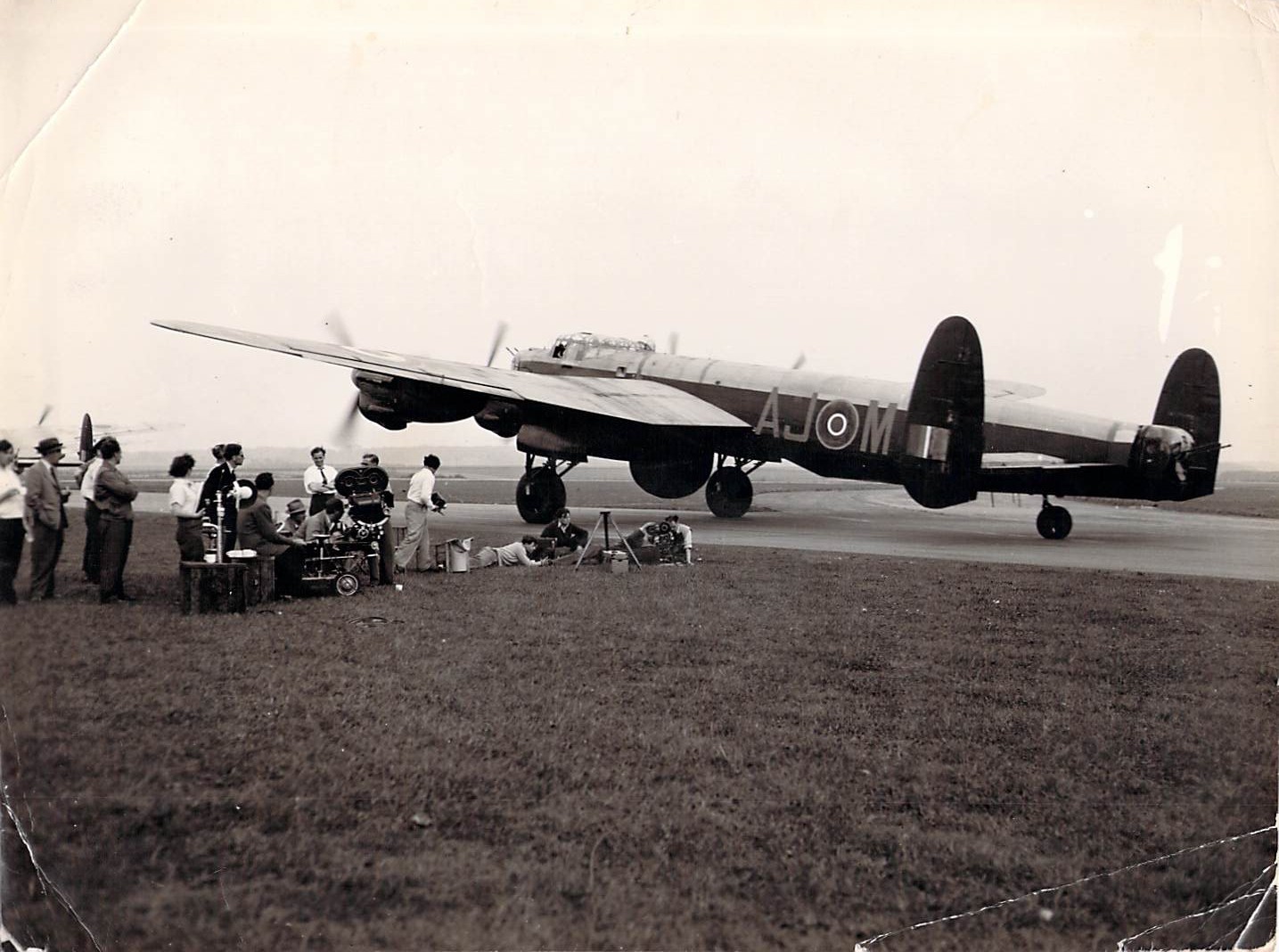
The first shows ground level filming of one of the two Lancasters which was modified for the film to resemble the “real” Dambuster aircraft more closely, with its mid upper gun turret and bomb bay doors removed. It has also had its squadron code changed to AJ-M, the code of the aircraft flown on the actual raid by Flt Lt John Hopgood.

The second picture shows the three Lancasters used in the film flying together probably for the last time. This was taken at a Battle of Britain Day tribute in Cumbria. The caption on the reverse says that this was taken at Silloth, but in Jonathan Falconer’s Filming the Dam Busters, this is mentioned as taking place at nearby Anthorn. (If anyone can confirm which airfield this is, please let me know. Cumbria resident Dom Howard reckons that it is Silloth– see this link .)
Note in the picture that only two of the aircraft have been modified to the “Dambuster” configuration. The central one must be NX782, which was left as standard and used in an early sequence where Gibson is completing his final flight as CO of 106 Squadron.
Note also how low the three Lancasters are flying, and how close they are to the members of the public wandering across the runway. Modern air displays have much stricter health and safety rules!

Filming “The Dam Busters”: a navigator’s logbook

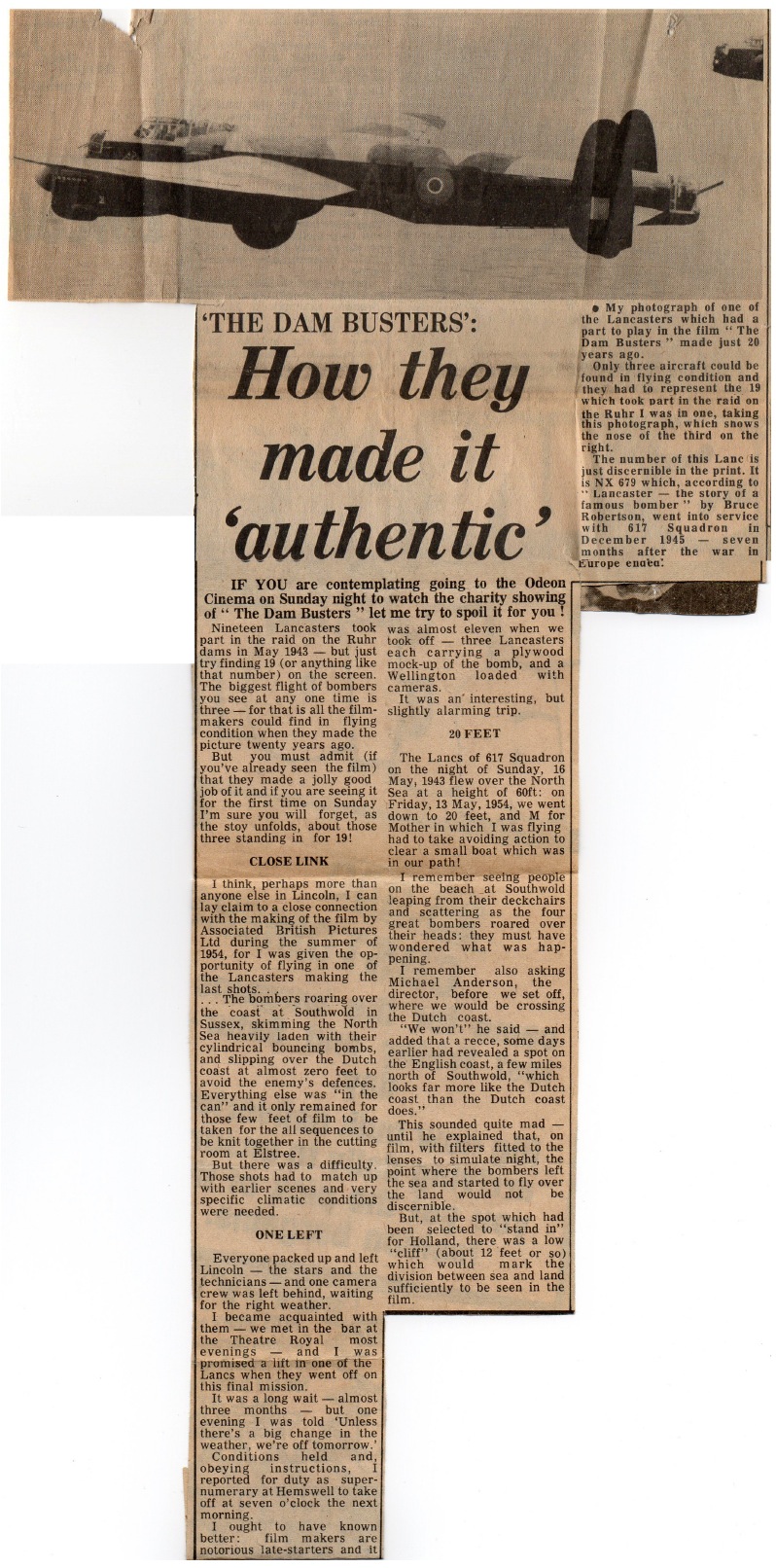
William Hill was serving as a Navigator in 83/150 Squadron after the war when he was called on to be part of the crews put together to fly the three working Lancasters used in making the 1955 film. With only three operational aircraft left, various subterfuges were used so that they looked like more, including painting different squadron call signs on each side.
William’s son Stephen has kindly sent me a cutting from an unknown newspaper published some 20 years later, which recalls the writer’s memories of the film shoot, and also the relevant pages from his father’s logbook.

No memorial at Wickhambreaux in 2012

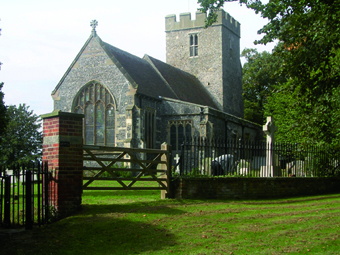
I am sorry to have to report that there will not be a graveside tribute to Sqn Ldr David Maltby and his crew this year. David Maltby is buried in St Andrew’s church in Wickhambreaux, Kent (pictured above). His body was the only one recovered after their aircraft crashed into the North Sea on 15 September 1943, after an operation to bomb the Dortmund Ems canal was called off.

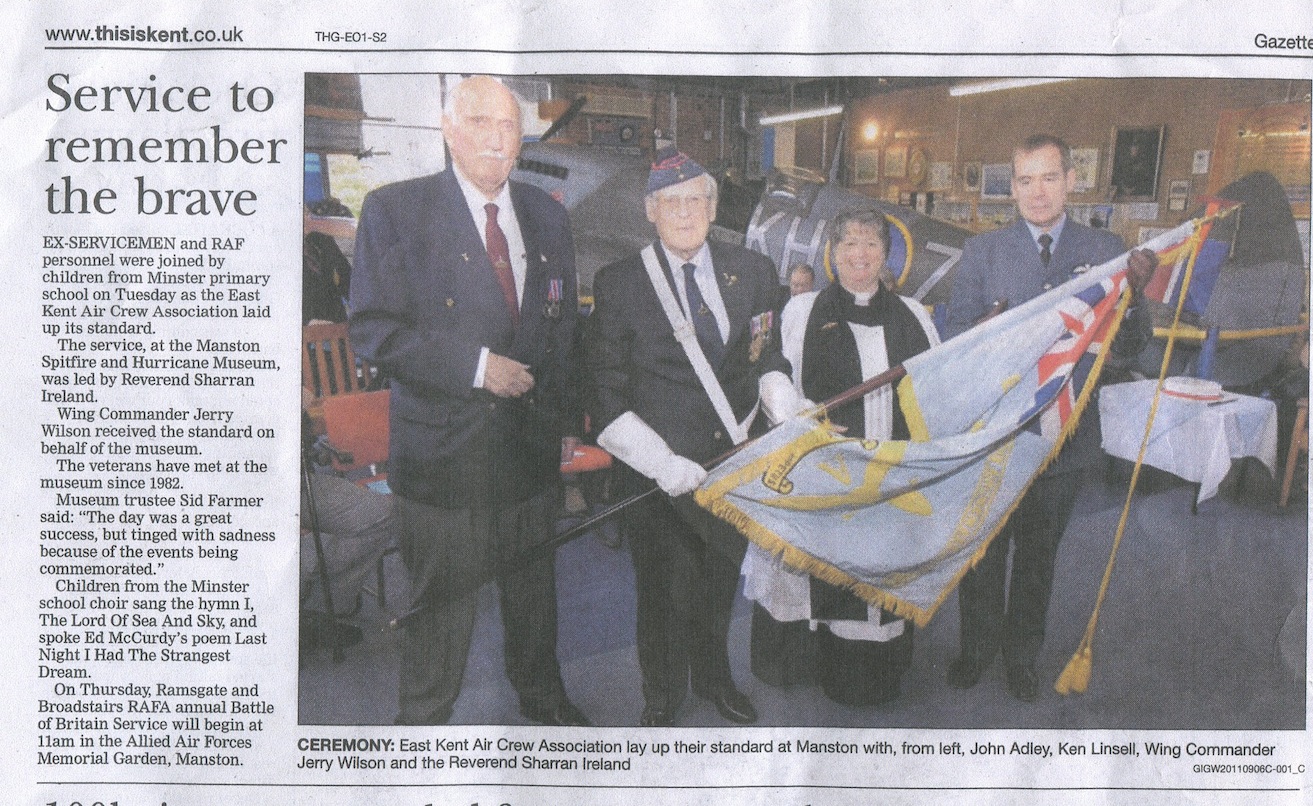
For many years the tribute was organised by the East Kent branch of the RAF Aircrew Association, with the support of local members of the Maltby family. However, this branch has now been disbanded, with their standard being laid up at the Spitfire and Hurricane Museum in Manston (see newspaper cutting below). The Maltby family is very grateful to them for leading the tribute over the last many years, and sends every best wish to the individual members.

Regular readers of this blog will recall that last year’s tribute by the RAF’s last flying Lancaster to David Maltby and his crew had to be called off because of adverse weather conditions. We very much hope that the Lancaster will fly over Wickhambreaux in September 2013, the 70th anniversary of their final flight.


Sounds familiar as Queen and Bond fly in

Well, it wouldn’t have been a true celebration of Britishness without some reference to the Second World War’s most famous tune – and this duly turned up in what was probably the most Wow Factor moment. Check the soundtrack between 2.30 and 4.30 on the video link below, and marvel again at the wit and vision of Danny Boyle and his colleagues in producing the most stunning Olympic opening ceremony ever. [Hat tip: Jane!]

BBC IPlayer link for UK readers

Try this link if you are outside the UK : TheNextWeb.com

Dams Raid navigation log for AJ-T

This is part of the navigation log for Joe McCarthy’s aircraft AJ-T, filled in by Flt Sgt Don MacLean during the Dams Raid. It was kindly sent to me by his son, Bill.
Joe McCarthy was due to lead the second wave of five aircraft, tasked with attacking the Sorpe Dam, and should have taken off in Lancaster ED923 which had been given his favourite call sign Q for Queenie, from Scampton at 2127. However this developed a coolant leak, and the crew hurriedly transferred to the only spare available, ED825, call sign AJ-T. This turned out to be missing its all-important compass deviation card, which meant another dash for McCarthy, off to the flight offices. AJ-T finally left the ground at 2201, as you can see from the second picture above. Note in the first picture how MacLean has crossed out ‘Q’ and written ‘T’. He has also misspelt rear gunner Dave Rodger’s name as ‘Ridgers’.
Flying as fast as he could, McCarthy made up 13 or 14 minutes by the time he reached the Sorpe at 0015, to discover that he was the only one of the second wave to reach the target. Barlow and Byers had been shot down, Rice and Munro had returned to base.
The Sorpe Dam was a different construction from the Möhne and Eder Dams, which meant that bouncing the Upkeep mine towards it would not work. So the plan was to attack it by flying very low along its length and then release the mine in the middle. This would roll down the dam’s face and explode below the waterline. AJ-T’s bomb aimer George ‘Johnnie’ Johnson has told the story many times how his colleagues were less than impressed by the fact that it took no fewer than ten dives along the dam to get the line and height right. However, at 0046 he released the mine and it exploded perfectly, but it failed to destroy the dam, although the crew saw some crumbling at the top of the wall.
Their journey back to Scampton saw a certain amount of deviation from the designated route, so in the end they simply backtracked along their outbound course. They landed rather precariously at 0323, as a flat starboard tyre called for a deft bit of piloting by McCarthy.
The whole crew survived the war, and most were regular attenders of various reunions. Below, courtesy of Alex Bateman, is a picture of Don MacLean with two other Dambusters, Tammy Simpson and Danny Walker, taken at a Bomber Command dinner in London in 1987.

Pic: Alex Bateman