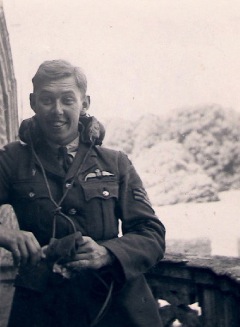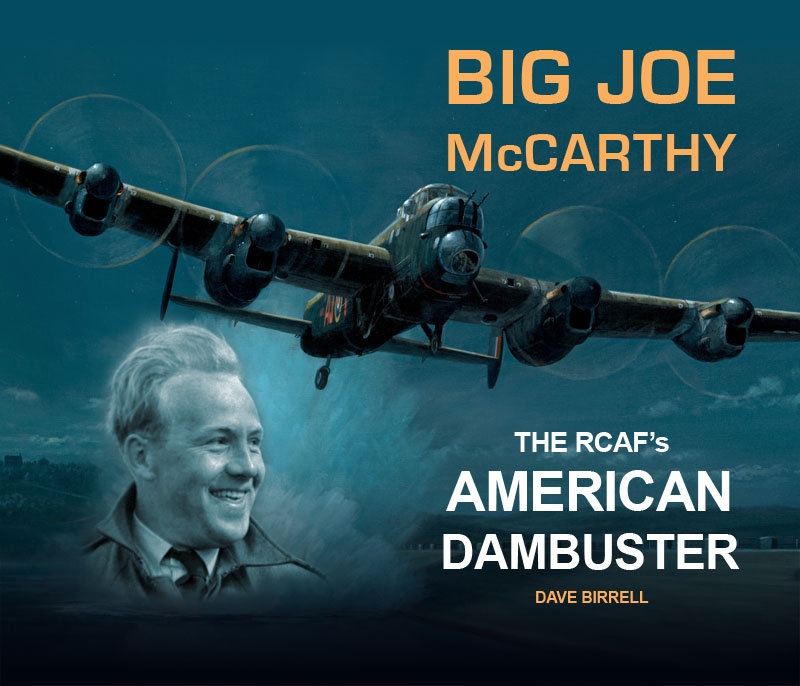
Tall, blond and good looking, Joe McCarthy was the image of an all-American war hero. A New Yorker with Irish roots, he became a champion swimmer and baseball player, and worked as a life guard at Coney Island. In his late teens, he and his friend Don Curtin became interested in flying and took lessons at Roosevelt Field, the busiest airfield in the USA.
When the war started, Joe made several attempts to join the US Air Corps but was rebuffed because he didn’t have a college degree. By May 1941, he was getting frustrated and so he and Don decided to take an overnight bus up to Ottawa in Canada, and became two of the almost 9000 American citizens who joined the Royal Canadian Air Force. Soon after Christmas they were qualified pilots and, with their new wings stitched on their uniforms, were on board a ship bound for Liverpool.
Joe’s story has now been told in a terrific new biography, Big Joe McCarthy: The RCAF’s American Dambuster by Dave Birrell. It is splendidly illustrated with many photos from the McCarthy family collection and other sources, and is a welcome addition to the growing number of biographies of individual Dambusters.
We learn about Joe’s time in 97 Squadron where by March 1943 he had completed a tour of 33 operations. How Guy Gibson phoned to ask him personally to join the new squadron he was setting up for a special secret operation. The low level training and the briefing where the crews were finally told what were their targets. And the shambles of his delayed take off on the raid, when his original aircraft was discovered to have a coolant leak.
Joe had been tasked to lead the section of five aircraft to attack the Sorpe Dam, and his replacement Lancaster was the only one which actually reached it. Despite his successful attack, and one later that night by fellow Canadian Ken Brown from the third wave, the dam was not breached but they were able to divert past the Möhne Dam on the way home and observe their colleagues’ successful work.
Joe was to fly an astonishing 67 operations before he was taken off active flying a month after D Day, along with Leonard Cheshire and Les Munro. All three protested, but the authorities were adamant. After the war, he went back to Canada and in order to stay in the RCAF took Canadian nationality. He finally retired in 1968.
Joe was a fine pilot and his logbooks recall that over his career he flew nearly 70 different types of aircraft. But he wasn’t only a flyer – he was a big man with a big sense of humour and a relaxed way of commanding those who served under him. His many exploits are well recorded here. The Verey cartridges dropped down a chimney into Cheshire’s fireplace and the horse ridden between into both the Sergeants and Officers Messes on a New Year’s Day after the war are two particular highlights.
Dave Birrell was a founding director of the Bomber Command Museum in Nanton, Alberta, and is an expert on the tremendous contribution of Canadian aircrew during the Second World War. Few deserve more praise than the big guy from New York.
Big Joe McCarthy by Dave Birrell is published by Red Kite and distributed by Wing Leader.
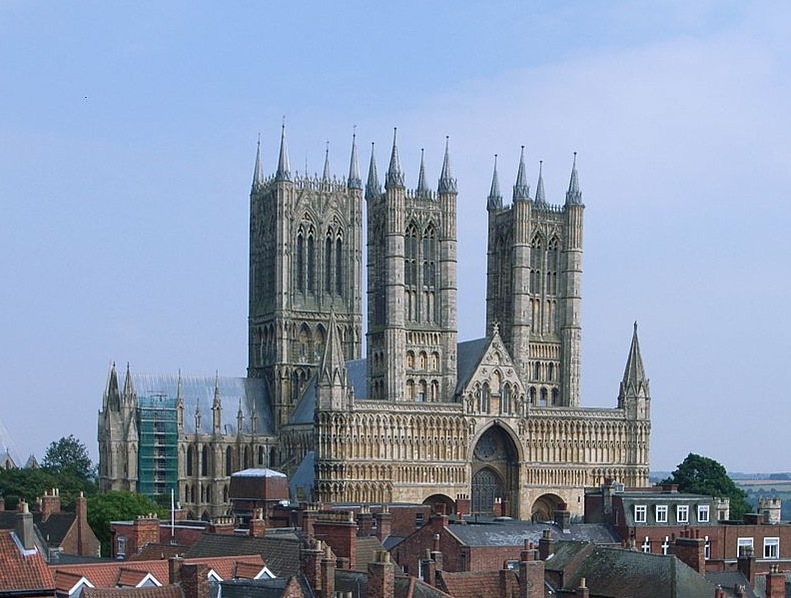
Lincoln Cathedral to mark Dams Raid anniversary
There will be a Dam Busters Commemoration in Lincoln Cathedral on the afternoon of Friday 17 May 2013 with the added bonus of a fly past by the Lancaster from the Battle of Britain Memorial Flight. This event is entry by ticket only and there are 1000 free tickets available to the public to apply for (two only per household).
Tickets can only be applied for by post, and are on a first come, first served basis. Write to the address below enclosing a stamped addressed envelope and your contact details (telephone number/email address).
Write to
Dam Busters Cathedral Event
Lincolnshire Archives
St Rumbold Street
Lincoln LN2 5AB
Please do not call or email to reserve tickets. Only postal requests with stamped addressed envelopes will be processed, due to the high demand expected. Tickets will be sent out in March and will include further details of the event.
See the Lincolnshire Aviation Heritage website for more details.
The Telegraph view
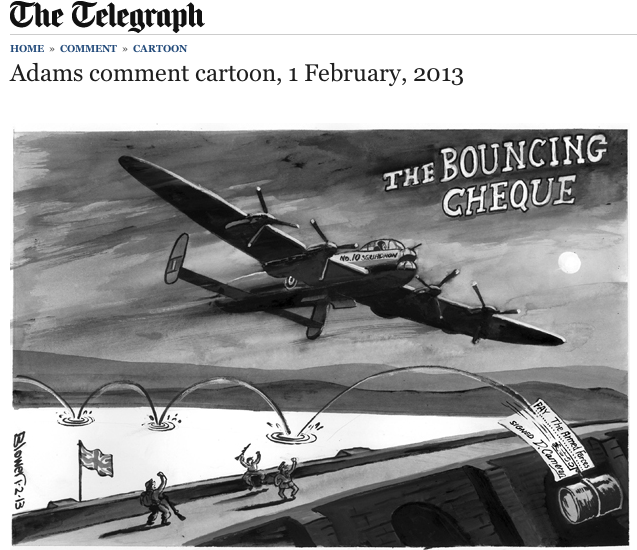
Today’s Daily Telegraph cartoon would appear to be a comment on this story.
Amid accusations that defence policy is now a shambles, Downing Street attempted to “clarify” an apparent promise by David Cameron that overall spending on the military would rise in 2015-16.
On Wednesday Mr Cameron said that he would stand by a pledge he made in 2010 to provide “year-on-year real-terms growth in the defence budget in the years beyond 2015.” The Prime Minister’s renewal of that promise raised the hopes of military insiders over the coming Spending Review. Commanders had feared the review would mean yet more cuts in 2015-16 as George Osborne, the Chancellor, squeezes the ministry’s budget again.
However, the Government’s position descended into confusion on Thursday as No 10 attempted to argue that Mr Cameron’s commitment to increase spending “beyond 2015” does not apply to the 2015-16 financial year.
The Prime Minister’s references to spending beyond 2015 “means starting in 2016”, Downing Street said on Thursday. “He was referring to the financial year starting in 2016,” a spokesman said.
Thanks to Dick Budgen, who also comments that “the drawing is more accurate than one would usually expect”.
More on the oar
Pic: David Young via Arthur Thorning
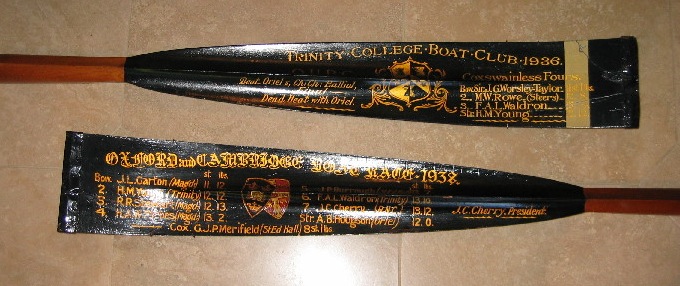
Following my post from last month, I was recently sent a new picture, shown above, of the real oar used by Melvin (“Dinghy”) Young in the University Boat Race in 1938. The oar belongs to a member of the Young family who lives in California. Shown in the same picture is another souvenir oar used by Melvin when he rowed for his college, Trinity, in 1936. The picture was supplied by Arthur Thorning, Young’s biographer.
There are a number of differences between this oar and the mystery oar shown on the BBC Antiques Roadshow on 6 January, as can be seen when you look at the two side by side.
1. The shafts are on different sides: Young oar (YO) on the right, Antique Roadshow oar (ARO) on the left.
2. The colours are different. YO is dark (Oxford) blue, ARO is grey-blue (a colour that doesn’t belong to either Oxford or Cambridge).
3. YO has the full initials for H.A.W. Forbes, F.A.L. Waldron and G.J.P. Merifield, ARO has shortened these to H.A. Forbes, F.A. Waldron and J.P. Merifield.
4. YO has the President’s name on the right, ARO on the left (not seen in picture above but visible earlier in the video.)
However, there are some similarities between the two, which makes me think that the ARO may have been copied from the YO, or perhaps from a photograph (as Young’s oar was almost certainly already in the USA when the film was made.) These are principally in the abbreviations used and the style of the lettering. The college abbreviations are exactly the same (Magd., B.N.C., St. Ed. Hall) and the crew weights are also identical. A ‘blackletter’ (sometimes wrongly called Old English) font has been used for the heading and a serif font (in both roman and italic styles) for the remainder.
Comparison of the ARO with a still from the 1955 film The Dam Busters has convinced me that it is either a prop from the film, or a copy based on the film (although the whole oar is never shown in the film). The lettering looks identical, and as the film was shot in black and white, it would not have mattered that it was not an exact Oxford blue.
After the original Antiques Roadshow programme was transmitted, I contacted the production team and was sent a copy of a response by Paul Atterbury, the expert who assessed the oar:
Our recent Dambusters item has provoked a large response, which doesn’t surprise me. What does is the variety of responses, ideas and information we have received, implying a certain lack of agreement about this story. As a regular Roadshow specialist working in the miscellaneous section, I have to deal quickly, and as accurately as I can, with a wide and very unpredictable range of things brought in by the public. We have no advance knowledge of what is going to come in on the day, and only very limited time to carry out any research before something is filmed. We have to assume that the background information supplied by the owners is straightforward. In the case of the oar, it seemed to me a genuine blade, rather than something constructed as a film prop. Over the years I have seen plenty of them. The colours, and style of painting implied the right period, and the condition the right patina of age. Obviously, the names could have been added later to an existing blade, but it would seem an unnecessarily complicated, obscure and not particularly valuable copy or fake. Equally, the film company could have painted an existing oar, but that again seems an elaborate and expensive process for a few seconds of filming in black and white. As I said in the item, there was no guarantee this was Young’s blade, as there would have been seven others at the time, and it could have come from any of those families.
Any further information would be gratefully received!
See Baywatch Barnes on 19 May
It now looks as though there will be a number of events in May to commemorate the 70th anniversary of the Dams Raid. I am collating a list at the moment, but in the meantime I will be happy to advertise things as and when they are notified to me.
Here is some news from Herne Bay in Kent, the nearest town to Reculver, which was the site of several test drops of the “bouncing bomb” by the RAF in 1943. These took place under the active supervision of Barnes Wallis, and he is now remembered by a statue on the seafront, shown above. There will be a “full town” commemoration on Sunday 19 May. The organisers are hoping that the BBMF Lancaster will be able to participate, as it did in a similar event ten years ago, but this is not yet confirmed.
Dinghy’s oar? Or not?
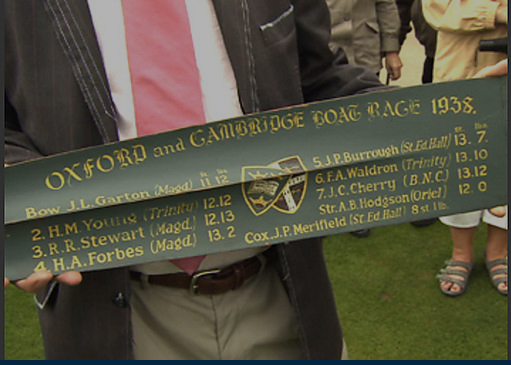
Last Sunday’s BBC Antiques Roadshow came up with an interesting artefact which had a Dambuster connection. A viewer brought in the blade of an oar which she said her husband had found in a skip in Bletchley.
As can be seen from the screengrab above, this is inscribed with the names of the Oxford University eight who had taken part in the 1938 Boat Race. (For the benefit of non-UK readers: this is a race between Oxford and Cambridge University Boat Clubs, which takes place every spring on the River Thames between Putney and Mortlake.)
Roadshow expert Paul Atterbury was quick to note the possible significance of one of the names. The No. 2 oarsman is listed as H M Young (Trinity), weighing 12st 12lb, who later became famous as Melvin (‘Dinghy’) Young, pilot of AJ-A on the Dams Raid.
Paul Atterbury went on to give a brief summary of Young’s role: how he caused the initial breach in the Möhne Dam, then completed by David Maltby’s attack, and his tragic end, shot down over Holland on the way home.
However, a comparison with a picture of the genuine oar, shown above, which appears in Arthur Thorning’s 2008 biography, The Dambuster who Cracked the Dam, quickly shows that the Bletchley skip oar is not Young’s. Although the full oar isn’t shown in Thorning’s picture there are many obvious discrepancies between the style of lettering and the punctuation in both pictures. In fact, it doesn’t look at all like the work of a professional signwriter. Thorning also states that the oar was in the possession of relatives in California, along with other of Young’s rowing souvenirs.
Which leads us to a mystery. If this is not Young’s real oar, what is it? It could, of course, have belonged to one of the other seven oarsmen in the 1938 Oxford boat. Many, if not all, would have done what Young obviously did – had it inscribed as a souvenir.
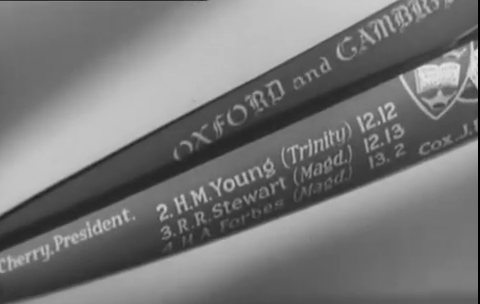
But there is another intriguing possibility. One of the many stories told about the making of the 1955 film, The Dam Busters, is that the Young family lent the producers the actual oar. In one of the film’s last sequences, the camera shows some of the things which signify the crews who went missing – empty chairs in the mess, a ticking alarm clock, and poignantly, the name of H M Young on an oar.
Here is a screengrab from this scene. Although this is not of the highest quality, it’s plain that the lettering is consistent with that on the oar from the Bletchley skip. So it would seem that even if the film’s props department had a loan of the original oar, they decided it wasn’t suitable and made another one. They thereby caused yet another of The Dam Busters myths to be wrong. So, this could be the prop, created for the film and now left in a skip.
However, there’s one more thing, as Lt Columbo used to say. It’s possible that the oar from the Bletchley skip was not even used in the film. If you look carefully at the screengrab above, you can’t see the name of the Bow oarsman J L Garton at all, and there seems to be a larger gap between the centre spine of the blade and Young’s name than appears on the Antiques Roadshow picture. Is it possible that when director Michael Anderson and cinematographer Erwin Hillier came to shoot the actual scene, they discovered that Garton’s name got in the way and so a new prop without his name was created and used in the actual sequence?
Paul Atterbuy gave a valuation of somewhere between £200 and £500 if this had been the real Young oar. This seems a bit on the conservative side to me, given that people have paid considerably more than this for Gibson autographs and signed first editions of Paul Brickhill’s book. How much it would be worth as a film prop is probably anyone’s guess, even coming from a film as famous as The Dam Busters.
John (Tommy) Thompson, 1920-2012
Every year, the number of aircrew who served in the RAF during the Second World War sadly declines, and 2012 saw the passing of one wartime pilot who I came across when researching my book about David Maltby.
John (Tommy) Thompson was going through pilot training at the same time as David, and they met at the School of Air Navigation at Cranage in Cheshire. Tommy had a car and at one point, when they managed to scrounge enough petrol coupons, they shared a trip down south so that they could get home to their respective parents for a weekend’s leave. When I interviewed him in 2007, Tommy remembered that they put their navigation skills to the test on this trip, using charts from their course to compensate for the lack of signposts on the roads. They went on together to an Operational Training Unit at Upper Heyford in Oxfordshire, but their paths deviated at the end of this course with David being posted to final training on Hampdens and Tommy to Blenheims.
Tommy went onto operations with 18 Squadron, flying on a series of low level shipping strikes and high level Circus Raids along the Dutch and Belgian coastline until August 1941. The Blenheim squadrons suffered exceptional losses during this period.
He was then posted to Overseas Aircraft Departure Unit at Watton to collect new aircraft to ferry out to the Middle East Blenheim Unit. On 27 August 1941, on his way out to the Middle East, he suffered a forced landing at Aviero in Portugal, a neutral country. He had to land on the beach and then set fire to his plane, which was full of fuel in the outer wings and packed with incendiary devices in the fuselage. He escaped from Portugal with the assistance of the Royal Navy to Gibraltar and returned to the UK in October of that year.
He was then posted to the Test Flight at 13 Maintenance Unit at Henlow. During the rest of the war, he flew in various air gunnery schools, air sea rescue flights, maintenance units, glider delivery units and air transport auxiliary units.
After the war, he carried on flying, at one point as a civilian pilot for the Red Devils parachute team. In 1968 he joined Hawker Siddeley in Hatfield as Flight Operations Officer and visited many parts of the world including making several deliveries into China.
After he retired, Tommy spotted an advert in an aviation magazine from a young Portuguese journalist requesting information about planes and crews who had made forced landings in Portugal during the second World War. He was able to help the author by providing not only information on his own forced landing in August 1941, but also researching and answering many other questions. He was subsequently invited to Portugal to launch the book and awarded a pair of Portuguese Air Force wings in a special ceremony.
[Thanks to Tommy’s son, Roger Thompson, for the picture, and help with this article.]
Jackson’s model Lancaster in close up
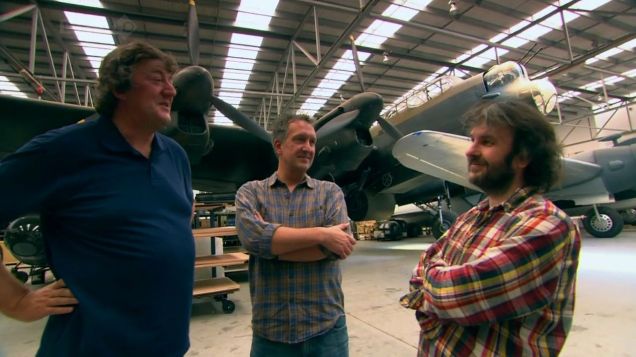
I can’t believe that I missed this, more than three years ago! When filming their Last Chance to See natural history TV programme, Stephen Fry and Mark Carwardine interviewed Peter Jackson in New Zealand. And there, right in the hangar, was one of the full size model Lancasters built for the Dambusters remake.
A very perceptive recent visitor to this blog has sent me these screen shots, taken from the programme which was first broadcast in 2009:
From these pictures, the level of detailing on the model seems extraordinary.
In recent interviews, Jackson has said that ten models have been built. It is noticeable, however, that only one seems to have been on show here.
By the way, this edition of Last Chance to See became notorious for a film clip showing the very rare kakapo flightless parrot attempting to mate with Mark Carwardine’s head. Far be it from me to suggest that you amuse yourselves by watching it again on Youtube.
Season’s Greetings from the Dambuster blog!
Unseen Burpee letters released
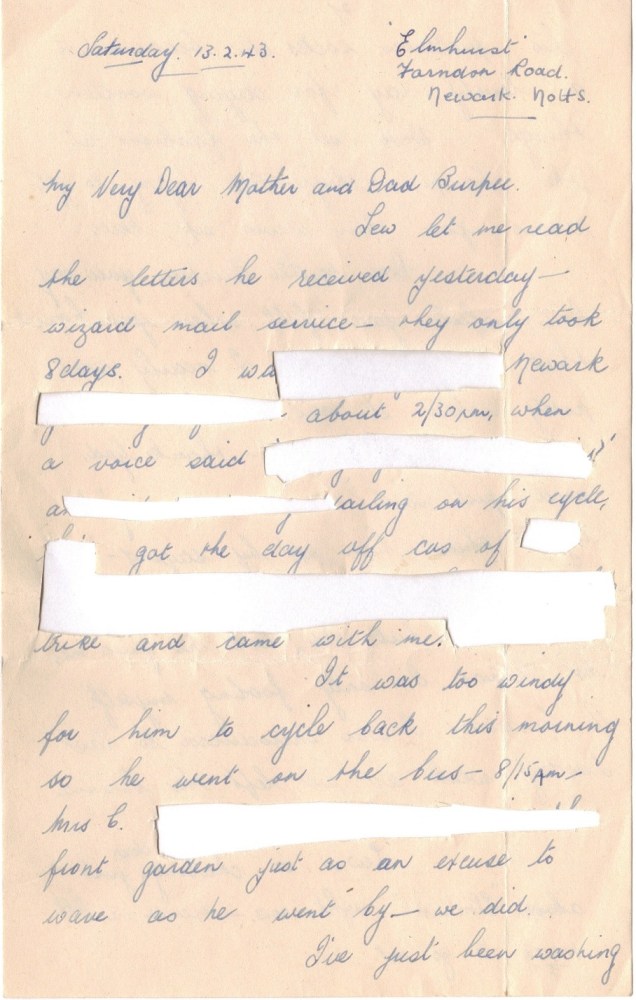
Almost 70 years after the Dams Raid, the Burpee family in Canada have now put some of their correspondence into the public domain. The first of these was sent to Lewis Burpee’s parents by his wife Lillian on 13 February 1943, while Lewis and his crew were still serving in 106 Squadron. Lillian, who was pregnant, was living in Newark while Lewis was serving at RAF Syerston. Note the chunks cut out by the censor!
On the Dams Raid, Burpee and his crew were part of the mobile reserve, five aircraft which left Scampton after midnight, They were to be given instructions as to which dam to attack when the results from the first and second waves had been assessed. In fact, he was shot down less than 2 hours after his take off and crashed on the edge of the heavily protected airfield at Gilze-Rijen in Holland.

This letter from Guy Gibson was sent to Mrs Burpee on 20 May 1943. It follows the standard format for letters of this kind, offering the chance that he had been captured, but pointing out that it was seen to crash, which led them to fear the worst.
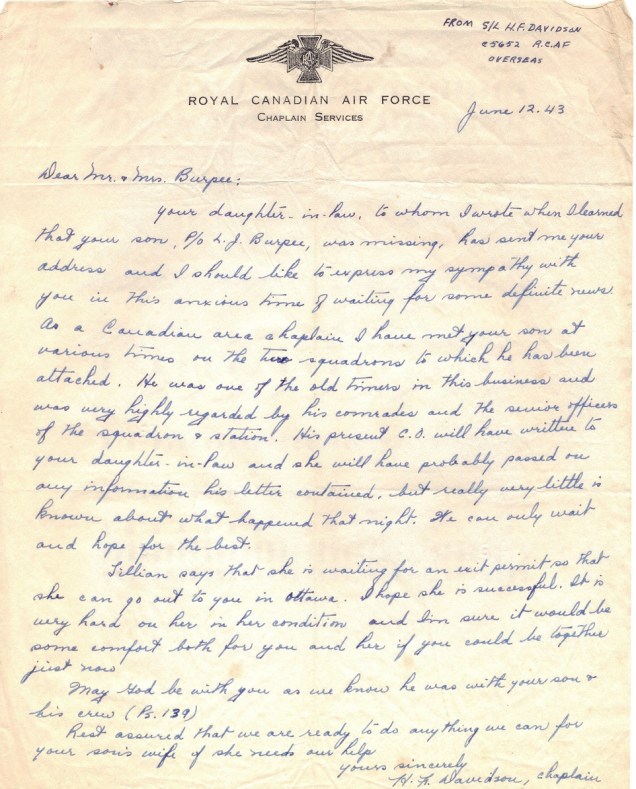
This is followed by a letter to Burpee’s parents from an RCAF Chaplain. He refers to Lillian wanting to get posted back to Canada before her baby was born.
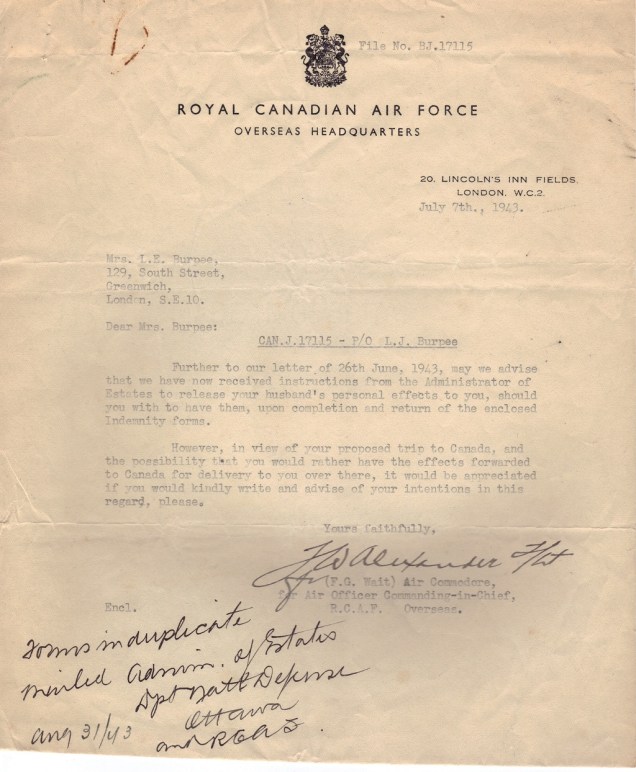
The final letter, sent in July, from the RCAF concerns Lewis’s “personal effects” and asks whether Lillian wants them forwarded directly to Canada, as by then it seems her trip back had been finalised.