
A piece of good news to cheer us all at this festive season. This blog’s good friend Volker Schürmann has recently informed us that the appeal for funds to erect a permanent memorial at the site where Norman Barlow and his crew crashed on the night of the Dams Raid has succeeded. The stone for the memorial is now being quarried and the plaque is being designed. The memorial will be officially unveiled at a ceremony at 11.00am on Sunday 17 May 2015, the 72nd anniversary of the Dams Raid, and the crash.
The crash occurred on farmland, a few kilometres from Haldern, a small community in Rees in the state of North Rhine Westphalia. Lancaster ED927, code name AJ-E, had been the first aircraft to take off on Operation Chastise, leaving RAF Scampton at 2128 on Sunday 16 May 1943. Just over two hours later, flying at about 100 feet, it struck a pylon. It may have been hit by flak a few moments before. The crew of seven were all killed, and are now interred in Reichswald Forest War Cemetery. They were:
Flt Lt Norman Barlow DFC (pilot)
Plt Off Leslie Whillis (flight engineer)
Flg Off Philip Burgess (navigator)
Flg Off Charles Williams DFC (wireless operator)
Plt Off Alan Gillespie DFM (bomb aimer)
Flg Off Harvey Glinz (front gunner)
Sgt Jack Liddell (rear gunner)
It is thought that members of the families of at least four of the crew will be attending the unveiling of the memorial.
More details will follow. Members of the public will be welcome to attend.
Many thanks are due to Volker Schürmann and his colleagues for organising the memorial.
Dambuster of the Day No. 85: Geoffrey Rice
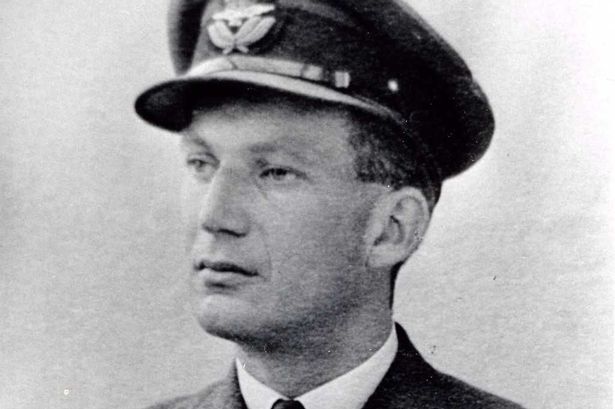
Plt Off G Rice
Pilot
Lancaster serial number: ED936/G
Call sign: AJ-H
Second wave. Aircraft badly damaged and mine lost, flying low over sea on outward flight. Returned to base.
Geoffrey Rice was born on 4 January 1917 in Hinckley, Leicestershire, the son of Frederick and Anne Rice. He went to Hinckley Grammar School and was then apprenticed in the hosiery trade. Rice joined the RAF in 1941 and was selected for pilot training, which he undertook in Canada. He qualified as a pilot in February 1942 and was commissioned.
He was posted to 19 Operational Training Unit at RAF Kinloss in July where he crewed up with three of the men who would make up his Dams Raid crew, Richard Macfarlane, Bruce Gowrie, and John Thrasher. They moved on to 1660 Conversion Unit at RAF Swinderby in October 1942 to complete heavy bomber training. Here, Edward Smith and Thomas Maynard joined the crew.
On 9 December 1942, the crew was posted to 57 Squadron at RAF Scampton to begin their operational career. This started on New Year’s Eve, 31 December 1942. On 15 March, after the crew had undertaken nine operations, they were transferred to the squadron’s new C Flight, under the command of Sqn Ldr Melvin Young.
By 25 March the flight comprised five crews, captained by Melvin Young, Bill Astell, Geoff Rice, George Lancaster and Ray Lovell. It was decided to post the whole flight over to the new squadron being formed at the same base to undertake training for a special mission. Rice and his crew had actually gone on leave the day before, and they did not find out about the transfer until they returned to base on 1 April. Rice and his crew protested at the transfer, but to no avail.
However the crew had gelled as an effective unit and the training for the secret operation went well. They achieved impressive scores in bomb aiming exercises and were chosen to fly in the second wave, tasked with attacking the Sorpe Dam.
AJ-H took off from Scampton at 2131 and all went well for the first hour and a half of flying time. They crossed the narrow neck of Vlieland at 2259 flying very low and exactly on track. Past the danger point, Rice gained altitude briefly to check position and then went low again to turn south-eastwards towards the Ijsselmeer. The bright moon shining on the water made height difficult to judge and flight engineer Edward Smith was about to warn Rice that the altimeter was reading zero when there was a huge jolt. Instinctively Rice pulled upwards and felt another ‘violent jolt’.
AJ-H had hit the water twice. The first impact had torn the mine free and sprayed water up through the bomb bay. The second had forced the fixed tail wheel up through the fuselage and demolished the Elsan lavatory just in front of the rear turret. A revolting mixture of its contents, disinfectant and sea water had poured into the turret and immersed gunner Stephen Burns up to his waist. His shout of ‘Christ, it’s wet back here!’ was pretty understandable.
Everyone else was shaken up, but by some miracle the aircraft and crew had survived. Rice flew on for a minute or two while the damage was assessed and it was confirmed that the mine had been lost. Then he turned for home. The anti aircraft batteries on both Vlieland and Texel were waiting for him and sprayed flak across the gap between the two islands but he sped underneath the fire.
There was nearly another tragedy as they reached Scampton. The hydraulic fluid in the undercarriage had been depleted, so it had to be manually lowered with an air bottle. This took 20 minutes during which time Rice was circling the airfield at 1000 feet. Uncertain whether the flaps would then work, another warning message was sent to the control tower, and the crew prepared for an emergency landing. Rice and Smith remained in their seats while the rest sat with their backs to the main spar, facing aft. They were just about to make their approach when suddenly Les Munro’s AJ-W, which had lost its radio, flew in below them and landed on the main runway. Rice held off, and touched down a few minutes later.
The next day, Gibson quizzed him over the cause of the loss of his mine, but took no further action. He knew from his own experiences in training how difficult it could be to judge an aircraft’s height when flying low over water.
Rice flew on the operations to Italy in July and August, and was then selected for the very dangerous attack on the Dortmund-Ems canal with the new 10,000lb ‘thin case’ bomb in September 1943. Of the eight pilots who flew on that raid, only Geoff Rice, Mick Martin and David Shannon survived. In appalling weather conditions, Rice spent 70 minutes searching for the target but was eventually ordered home by Martin, who had taken over temporary command of the operation. He jettisoned his giant bomb over the Waddensee.
On 11 November he took part in an attack on the Antheor viaduct, and later that month was awarded the DFC. The citation singled out his work at the Dortmund-Ems canal, praising his ‘great determination and courage.’
On 20 December, eight 617 Squadron crews, led by the new CO Leonard Cheshire, were sent on an operation to attack an armaments factory in Liège in Belgium. Geoff Rice and his Dams Raid crew were amongst them. The target marking wasn’t visible so Cheshire ordered the crews to return with their bombs. However, Rice and his crew were unlucky and were shot down by night fighter pilot Hauptmann Kurt Fladrich 14,000ft above Merbes-Le Chateau. The last thing Rice remembered was giving the order to bale out. Unfortunately, there wasn’t time and the aircraft exploded.
Rice appears to have been thrown clear, protected by the pilot’s armoured seat. Somehow he had deployed his parachute. However, all his colleagues died as the aircraft crashed. Their bodies were found near the crash site, but Rice regained consciousness in a wood, his parachute snagged in a tree, and with a broken wrist. The first people he met were three farm labourers, who took him to the Resistance. His wrist was set in plaster by a friendly doctor, and he spent the next five months on the run.
Unfortunately, he was then betrayed to the secret police and became a PoW, ending up at the notorious Stalag Luft III, scene of the Great Escape. As the Russian army approached, the prisoners were forcibly moved, but were eventually liberated by the Americans.
Rice was repatriated after the war, and left the RAF in 1947. He went on to work for Shell BP and was very active in setting up the 617 Squadron Association. He died in Taunton, Somerset on 24 November 1981 and was cremated at Taunton crematorium. His ashes were buried in the churchyard in the village of Aller, where he had lived for a number of years.
More about Rice online:
Report in Leicester Mercury about the awarding of a ‘green plaque’.
Survived war. Died 24.11.81
Rank and decorations as of 16 May 1943.
Sources:
Nigel Press, All My Life, Lancfile Publishing 2006
Richard Morris, Guy Gibson, Penguin 1995
John Sweetman, The Dambusters Raid, Cassell 2002
John Sweetman, David Coward and Gary Johnstone, The Dambusters, Time Warner 2003
Chris Ward, Andy Lee and Andreas Wachtel, Dambusters: The Definitive History, Red Kite 2003
The information above has been taken from the books and online sources listed above, and other online material. Apologies for any errors or omissions. Please add any corrections or links to further information in the comments section below.
 Further information about Geoff Rice and the other 132 men who flew on the Dams Raid can be found in my book The Complete Dambusters, published by History Press in 2018.
Dambuster of the Day No. 84: James McDowell

Pic: Bomber Command Museum of Canada
Flt Sgt James McDowell
Rear gunner
Lancaster serial number: ED934/G
Call sign: AJ-K
Second wave. Shot down on outward flight and crashed into sea.
James McDowell was the third Scottish-born member of the crew of AJ-K. He was born in Glasgow on 13 August 1910, the son of John and Agnes McDowell. His father was killed in the First World War, so in 1924 his mother, grandmother and the five McDowell children emigrated to Canada, and took up residence in Port Arthur, Ontario.
McDowell worked first for the Coca Cola company in Port Arthur and was also involved in a local pipe band. He married Dorothea Edna Craig in 1932, and they had two daughters, Darleen and Marilyn. They then moved north of Port Arthur where he found work as a gold miner, ending up at the MacLeod Cockshutt mine in Geraldton between 1935 and 1941.
Jimmy McDowell joined the RCAF in 1941 and moved back to Port Arthur. After training as an air gunner, he was sent to England and underwent further training before being crewing up with fellow Canadian Vernon Byers, and being posted to 467 Squadron in February 1943.
The crew’s first operation together was “Gardening” in the Silverthorne area on 9 March, and they would undertake just two further operations before transferring to 617 Squadron on 24 March.
When the crew was given some leave in early May 1943, McDowell and Byers, the two Canadians, travelled to Antrobus in Cheshire, to spend it with the family of their crewmate John Wilkinson. They were all there for Wilkinson’s 21st birthday on 2 May.
Two weeks later, they had just flown over Texel island on the way to the Sorpe Dam when a shot from behind brought down their aircraft, and it crashed into the Waddenzee, 18 miles west of Harlingen. The wreckage has never been located but James McDowell’s body was eventually released by the elements from its rear turret and on 22 June 1943 it was found floating in the Vliestrom channel south of Terschelling, near buoy No. 2. He was buried the next day in Harlingen General Cemetery, and remains there today. His comrades are all commemorated on the Runnymede Memorial.
[Thanks to Darleen and Mike Taylor for their help with this article.]
More about McDowell online:
Entry on Commonwealth War Graves Commission website
Page about Byers crew on Aircrew Remembered website
KIA 16.05.1943.
Rank and decorations as of 16 May 1943.
Sources:
Richard Morris, Guy Gibson, Penguin 1995
John Sweetman, The Dambusters Raid, Cassell 2002
Robert Owen, Steve Darlow, Sean Feast & Arthur Thorning, Dam Busters: Failed to Return, Fighting High 2013
The information above has been taken from the books and online sources listed above, and other online material. Apologies for any errors or omissions. Please add any corrections or links to further information in the comments section below.
Further information about James McDowell and the other 132 men who flew on the Dams Raid can be found in my book The Complete Dambusters, published by History Press in 2018.
Dambuster of the Day No. 83: Charles Jarvie
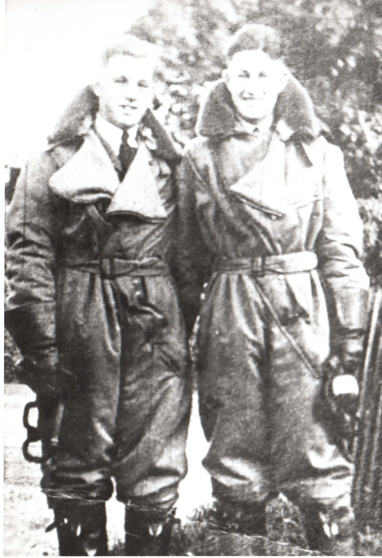
Charles Jarvie, on right, photographed with his crewmate John Wilkinson, wireless operator in AJ-K on the Dams Raid. Photograph probably taken between February and May 1943. [Pic: Wilkinson family]
Sgt C McA Jarvie
Front gunner
Lancaster serial number: ED934/G
Call sign: AJ-K
Second wave. Shot down on outward flight and crashed into sea.
Charles McAllister Jarvie was born in Glasgow on 9 May 1922, one of the two children of Charles and Nellie Jarvie. He joined the RAF around the time of his 18th birthday in July 1940. After a long period awaiting training, he was finally selected for aircrew and underwent gunnery training in September 1942.
He was posted to the new 467 Squadron at RAF Bottesford about the time of its formation in early November 1942 and was crewed up with pilot Sgt Herbert Vine, along with bomb aimer Neville Whitaker.
The Vine crew’s first operation was the usual “gardening” (mine-laying) operation in the Deodars area on 12 January 1943. Jarvie flew with Vine that night and on four further missions, the last being the bombing of Lorient on 13 February. Whitaker flew on one further trip, also to Lorient, with Vine but then a straight swap of two crew members between Vine’s crew and the newly arrived crew of Vernon Byers took place. Bomb aimer Whitaker and mid upper gunner Jarvie were exchanged for Sgt John McKee and Sgt Robert Haslam respectively. Why this happened remains something of a mystery. It was a bad move for McKee and Haslam since on their very first operation with Vine, on 19 February, they fell victim to a German night fighter and crashed into the North Sea.
Jarvie however would survive another couple of months. He flew with the Byers crew on the three operations which they flew in 467 Squadron on 9, 11 and 22 March. Then, on 28 March, the whole crew was posted to 617 Squadron.
Charles Jarvie was in the front gun turret of AJ-K when it was hit by flak just after it had passed over Texel island on the Dutch coast. Like five of his colleagues, his body was never recovered and he is commemorated on the Runnymede Memorial.
More about Jarvie online:
Entry on Commonwealth War Graves Commission website
Page about Byers crew on Aircrew Remembered website
KIA 16.05.1943.
Rank and decorations as of 16 May 1943.
Sources:
Richard Morris, Guy Gibson, Penguin 1995
John Sweetman, The Dambusters Raid, Cassell 2002
Robert Owen, Steve Darlow, Sean Feast & Arthur Thorning, Dam Busters: Failed to Return, Fighting High 2013
The information above has been taken from the books and online sources listed above, and other online material. Apologies for any errors or omissions. Please add any corrections or links to further information in the comments section below.
Further information about Charles Jarvie and the other 132 men who flew on the Dams Raid can be found in my book The Complete Dambusters, published by History Press in 2018.
Dining with a Dambuster
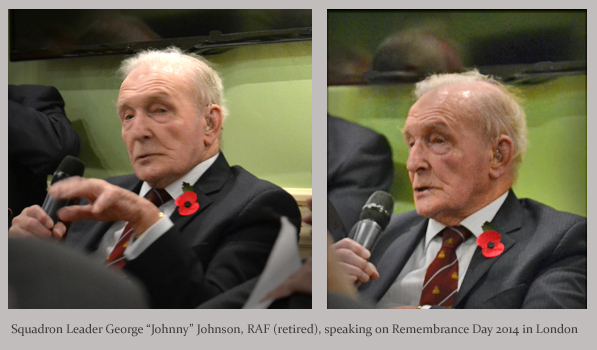
Pics: Edwina Towson
On Remembrance Day, Tuesday 11 November, Sqn Ldr George “Johnny” Johnson was the guest of honour at a Lord’s Taverners charity event at Langan’s Brasserie in London. Dambusters Blog reader Edwina Towson was one of the guests, and has written this report:
It’s a long way from a farm-labourer’s cottage in Lincolnshire to Langan’s Brasserie in Mayfair – 93 years long in Johnny Johnson’s case.
But there he was, AJ-T’s bomb-aimer and lately author of an autobiography “The last British Dambuster” (Ebury Press), the guest of honour at a supper event at Langan’s hosted by the Lord’s Taverners charity, on Remembrance Day 2014.
After the supper plates were cleared away, Squadron Leader George “Johnny” Johnson was introduced by Con Coughlin, Defence Editor of the Daily Telegraph, in case any of the company was unaware of the distinguished credentials of the speaker.
The speaker greeted us first in his native dialect as, mindful of his own journey and the Lincolnshire theme, the dams story began. He gave the context for his return to Lincolnshire through his selection for 617 Squadron, which had been wholly due to his American pilot, Joe McCarthy. Johnny hadn’t thought much of American aircrew before meeting Joe (“just couldn’t stand them,” he said!), so it was good to hear that the pilot’s steady demeanour and skill had completely won the sceptical bomb-aimer’s confidence by the time that his crew was asked to move to Scampton.
And it was from Scampton that we really took off with Johnny. In spirit, he had left the room and was muffled in his flying kit, watching the fields that he had known as a child speed underneath him during the intense six week training for the dams raid.
He talked about having mixed feelings as their low flying flattened the tulips in the fields round Spalding: he felt sadness for the broken flowers, but also some amusement at knowing how the canniness of the farmers would result in very inflated claims for compensation!
Unprompted, and choosing quite detailed episodes from memory to give an impression of his experiences, he recounted the primitive and unreliable state of the equipment in those days and how the entirely novel and experimental nature of the mission meant that the crews had to fathom what it was that they needed as they went along. Having the combative, driven and demanding Gibson as commander clearly helped in getting what was required; we heard the story of Gibson being told that some key equipment couldn’t be supplied in time and how he pestered Group HQ, Bomber Command HQ, Air Ministry HQ and any other HQ with a telephone in an obstinate escalation of protest until the squadron indeed got what it needed. “That was Gibson to a T,” said the former 617 Sergeant with mixed wariness and appreciation.
How narrow the chances of survival were came over strongly in many of Johnny’s recollections, whether in spotting, themselves, by accident a ditched Beaufighter crew, just because the practice navigation over the North Sea had taken them over the frantically waving figures, or whether in the ground crew showing them on landing how the wing of the Lancaster had been holed by a shell which missed the petrol tank by a squeak and then lodged on the fuselage just above the navigator’s head.
The focus of the evening was inevitably the dams raid itself and it was a moving and slightly eerie experience for us to hear a first-hand participant recall, unscripted and with all the deep-felt immediacy of a participant, the arrival of the unrecognizable bomb (“just like a glorified dustbin”), the unfamiliarity for the pilots in following orders from the bomb-aimer on direction to target, orders from the flight engineer on speed and orders from the navigator on the convergence of spotlights for height accuracy and then the unfamiliarity for all of them as the special briefing took place with so many important people (even the Group AOC) present for the revelation of the targets.
AJ-T was given the Sorpe dam as a target which, as Johnny wryly explained, meant that the crew used little of the special training techniques in tackling the considerable difficulties of the awkward terrain, the parallel approach required and the eventual bomb drop from 30 feet. The bomb drop was made effectively but the impact was not adequate to breach the dam, even though the water spout was estimated by the rear-gunner to be 1,000 feet tall.
They found a little consolation in passing over the Möhne dam some half an hour after it had been attacked and witnessing the aftermath: “it was just like an inland sea – there was water everywhere”.
Despite a punctured starboard tyre, AJ-T landed well and, still at our supper tables, we all came to a standstill, slightly stunned by what we had heard as “passengers” in the dams adventure. We were immediately invited to put questions, which elicited answers on the range of ages of the various crews, the fortunes of 617 after the dams raid and the total focus required for crew members to feel confident in each other’s performance. Finally, there was the obligatory question about Guy Gibson as a personality on the squadron. From his sergeant’s perspective and as a lucky survivor of the unique, unprecedented and highly dangerous attack, Johnny gave his judgement on the raid commander’s contribution: “in attack, yes, he was absolutely first class. He was a bit difficult to get on with outside of that but, in doing the job, he really did it properly. ”
After that, Con Coughlin looked round at the hundred or so invited guests and gave a short speech of collective thanks for the speaker’s willingness to keep the awareness of the dams raid fresh in the medium of living speech. After signing copies of his autobiography and rising to leave, the Sqn Ldr (retired) walked steadily for the exit, congratulated along the way by a number of the table-waiting staff who had been standing spellbound round the edges of the function room.
Outside it was raining and dark. The guests dispersed into a Remembrance Day evening unlike any other and unlikely, by them at least, ever to be forgotten.
© Edwina Towson
Dambuster of the Day No. 82: Neville Whitaker

Pic: Whitaker family
Plt Off A N Whitaker
Bomb aimer
Lancaster serial number: ED934/G
Call sign: AJ-K
Second wave. Shot down on outward flight and crashed into sea.
Arthur Neville Whitaker, known to his family as Neville, was born in Blackburn, Lancashire on 8 September 1909, the son of James and Edith Whitaker. He went to Blackburn Grammar School and then studied accountancy. After qualifying as a chartered accountant, he went to work for a firm of musical instrument dealers in Blackpool.
When the war started, shortly before his 30th birthday, he enlisted in the army, joining the local Blackpool Regiment but then in May 1941 he switched to the RAF. After training at Air Observers School he qualified as a bomb aimer. He was posted to 467 Squadron about the time of its formation in early November 1942 and was crewed up with pilot Sgt Herbert Vine. Charles Jarvie was also allocated to this crew. Sgt Vine appears to have had a somewhat chequered career, and had been cautioned for low flying. On one occasion, ground crew had to remove foliage from his undercarriage.
The Vine crew’s first operation was the usual “gardening” (mine-laying) operation in the Deodars area on 12 January 1943. Whitaker flew with Vine that night and on five further missions, the last being the bombing of Lorient on 16 February. At that point, a straight swap of two crew members between Vine’s crew and the newly arrived crew of Vernon Byers took place. Bomb aimer Whitaker and mid upper gunner Jarvie were exchanged for Sgt John McKee and Sgt Robert Haslam repectively. Why this happened remains something of a mystery. It was a bad move for McKee and Haslam since on their very first operation with Vine, on 19 February, they fell victim to a German night fighter and crashed into the North Sea. Conversely, it bought a few months more for Whitaker, and he went on to fly with the Byers crew on the three operations which they flew in 467 Squadron on 9, 11 and 22 March. On 28 March, they were posted as a complete crew to 617 Squadron.
The Byers crew seemed to have impressed in training for the Dams Raid, and were selected to attack the Sorpe. At the briefing for bomb aimers and navigators on the afternoon of Sunday 16 May 1943, Whitaker wrote down some of the key route co-ordinates on the back of an envelope, perhaps before transferring them to an official log for the flight. The envelope was found in his personal effects when they were sent to the family after his death.

Neville Whitaker’s notes written on the day of the Dams Raid. [Pic: Whitaker family]
Neville Whitaker died when AJ-K was hit by flak just after it had passed over Texel island on the Dutch coast. Like five of his colleagues, his body was never recovered and he is commemorated on the Runnymede Memorial.
Thanks to Gary Whitaker for help with this article.
More about Whitaker online:
Entry on Commonwealth War Graves Commission website
Page about Byers crew on Aircrew Remembered website
KIA 16.05.1943.
Rank and decorations as of 16 May 1943.
Sources:
Richard Morris, Guy Gibson, Penguin 1995
John Sweetman, The Dambusters Raid, Cassell 2002
Robert Owen, Steve Darlow, Sean Feast & Arthur Thorning, Dam Busters: Failed to Return, Fighting High 2013
The information above has been taken from the books and online sources listed above, and other online material. Apologies for any errors or omissions. Please add any corrections or links to further information in the comments section below.
Further information about Neville Whitaker and the other 132 men who flew on the Dams Raid can be found in my book The Complete Dambusters, published by History Press in 2018.
Dambuster of the Day No. 81: John Wilkinson

Pic: Wilkinson family
Sgt J Wilkinson
Wireless operator
Lancaster serial number: ED934/G
Call sign: AJ-K
Second wave. Shot down on outward flight and crashed into sea.
John Wilkinson was born on 2 May 1922 in the village of Antrobus, near Northwich in Cheshire. His father Thomas was a farmer, and he had an older brother and sister. His mother Ethel died of TB when he was only one year old. He went to Antrobus School, and left at 14 to work on the family farm.
He joined the RAF as soon as he turned 18. His older brother signed up for the army but was refused because, as a farmer, he was in a reserved occupation.
Wilkinson qualified as a wireless operator/air gunner in the summer of 1942. He was posted to 29 OTU in September, where he appears to have met up with pilot Vernon Byers and others in his crew. Together, they went to finish their training in 1654 Conversion Unit in December 1942 and were posted to 467 Squadron in February 1943.
Byers flew on two operations as second pilot, but the crew’s first operation together was “Gardening” in the Silverthorne area on 9 March, and they would undertake just two further operations before transferring to 617 Squadron on 24 March. Towards the end of the training period in 617 Squadron the crew was given some leave, and Wilkinson travelled home to the family farm in Antrobus in time to celebrate his 21st birthday on 2 May. The two Canadians in his crew, pilot Vernon Byers and rear gunner James McDowell, who presumably had no close family in the UK who they could visit, went with him.
Exactly two weeks after this birthday, on Sunday 16 May 1943, Wilkinson was in his seat in the body of AJ-K when a lucky shot fired from behind brought it down just after it had crossed the island of Texel on the Dutch coast. John Wilkinson’s body was never found and he is commemorated on the Runnymede Memorial, along with five of his colleagues.
Thanks to June Morris for help with this article.
More about Wilkinson online:
Entry on Commonwealth War Graves Commission website
Memorial in Arbutus Church
Page about Byers crew on Aircrew Remembered website
KIA 16.05.1943.
Rank and decorations as of 16 May 1943.
Sources:
Richard Morris, Guy Gibson, Penguin 1995
John Sweetman, The Dambusters Raid, Cassell 2002
Robert Owen, Steve Darlow, Sean Feast & Arthur Thorning, Dam Busters: Failed to Return, Fighting High 2013
The information above has been taken from the books and online sources listed above, and other online material. Apologies for any errors or omissions. Please add any corrections or links to further information in the comments section below.
Further information about John Wilkinson and the other 132 men who flew on the Dams Raid can be found in my book The Complete Dambusters, published by History Press in 2018.
Dambuster of the Day No. 80: James Warner
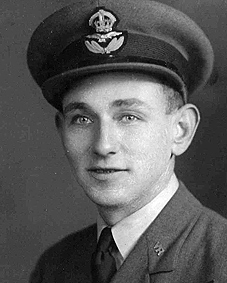
Pic: Warner family
Flg Off J H Warner
Navigator
Lancaster serial number: ED934/G
Call sign: AJ-K
Second wave. Shot down on outward flight and crashed into sea.
James Herbert Warner was born on 19 May 1914 in the small Lincolnshire town of Horncastle. This is in the heart of the area which would become the home of many Second World War airfields, and not far from the village of Hameringham where George “Johnny” Johnson was born seven years later. He was the older of the two sons of Harry and Janetta Warner.
He joined the RAF in 1940 and although initially selected for pilot training was eventually transferred to the observer scheme, from which he qualified in September 1942. He received a commission on completing his training.
By December 1942, he was undergoing the final phase of heavy bomber training at 1654 Conversion Unit, and was crewed up with Vernon Byers and the rest of his crew. They all moved together to 467 Squadron on 5 February 1943. Their first operation was “Gardening” in the Silverthorne area on 9 March, and they would undertake just two further operations before transferring to 617 Squadron on 24 March.
As a Flying Officer, James Warner was the senior member of the Byers crew by rank. Byers himself was recommended for a commission on 17 April, and bomb aimer Neville Whitaker also received one posthumously.
All seven of the crew were lost when a lucky shot fired from behind brought down AJ-K just after it had crossed the island of Texel on the Dutch coast. Along with five of his colleagues, James Warner’s body was never found and he is commemorated on the Runnymede Memorial.
More about Warner online:
Entry on Commonwealth War Graves Commission website
Page about Byers crew on Aircrew Remembered website
KIA 16.05.1943.
Rank and decorations as of 16 May 1943.
Sources:
Richard Morris, Guy Gibson, Penguin 1995
John Sweetman, The Dambusters Raid, Cassell 2002
Robert Owen, Steve Darlow, Sean Feast & Arthur Thorning, Dam Busters: Failed to Return, Fighting High 2013
The information above has been taken from the books and online sources listed above, and other online material. Apologies for any errors or omissions. Please add any corrections or links to further information in the comments section below.
Further information about James Warner and the other 132 men who flew on the Dams Raid can be found in my book The Complete Dambusters, published by History Press in 2018.
Dambuster of the Day No. 79: Alastair Taylor
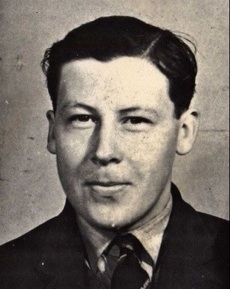
Pic: Taylor family/Aircrew Remembered
Sgt A J Taylor
Flight engineer
Lancaster serial number: ED934/G
Call sign: AJ-K
Second wave. Shot down on outward flight and crashed into sea.
Alastair James Taylor was born in Alves, Morayshire on 19 December 1922. He was the eldest of the five children of Stephen and Sarah Taylor. His brother Charles also served as a flight engineer in the RAF, and his sister Phyllis was in the WAAF. His home farm of Kirkhill was just a few miles from two locations – Kinloss and Lossiemouth – which would become very familiar to the personnel of Bomber Command in the war years. He went to Elgin Academy.
He joined the RAF as an apprentice at RAF Halton in January 1939, and served in ground crew until selected for flight engineer training at No 4 School of Technical Training at RAF St Athan in the summer of 1942. After qualification, he was posted to 1654 Conversion Unit in December 1942, where he crewed up with Vernon Byers and his colleagues. The last time he saw his family was the night before he was leaving Kinloss. He borrowed a bike and rode it approximately 5kms to Kirkhill to surprise his family for an hour. The crew arrived at Bottesford to join 467 Squadron on 3 February 1943, and had flown on just three operations by the time they were posted to 617 Squadron at the end of March.
The rigours of life in the new squadron didn’t prevent Taylor persuading his pilot to fly low over his family home when they flew to Morayshire on a training run in early May. He wrote to his mother shortly after: ‘I hope we didn’t scare you too much last Monday. I saw you and Aunt Julia just in front of the house but I could not pick dad out anywhere, so thought he would probably be at a pig sale.’
‘Beating up’ family houses was quite common in wartime. If they had a close relative in the RAF the occupants would listen out for aircraft. They would then rush outside if one flew over very low. It was usually a sign from the relative that everything was OK.
The wave from the cockpit was probably the last time that Taylor and his mother saw each other. A few days later AJ-K set off on its fateful flight on the Dams Raid, and was shot down even before it reached the Dutch coast. Like five of his colleagues, Alastair Taylor has no known grave, and is commemorated instead on the Runnymede Memorial.
More about Taylor online:
Entry on Commonwealth War Graves Commission website
Page about Byers crew on Aircrew Remembered website
KIA 16.05.1943.
Rank and decorations as of 16 May 1943.
Sources:
Richard Morris, Guy Gibson, Penguin 1995
John Sweetman, The Dambusters Raid, Cassell 2002
Robert Owen, Steve Darlow, Sean Feast & Arthur Thorning, Dam Busters: Failed to Return, Fighting High 2013
The information above has been taken from the books and online sources listed above, and other online material. Apologies for any errors or omissions. Please add any corrections or links to further information in the comments section below.
Further information about Alastair Taylor and the other 132 men who flew on the Dams Raid can be found in my book The Complete Dambusters, published by History Press in 2018.
Dambuster of the Day No. 78: Vernon Byers

Pic: Fighting High
Plt Off V W Byers
Pilot
Lancaster serial number: ED934/G
Call sign: AJ-K
Second wave. Shot down on outward flight and crashed into sea.
Vernon William Byers was born in Star City, Saskatchewan on 24 September 1919. He was a keen sportsman at school. When he left, he worked on a farm, in construction and then as a miner in the interestingly named town of Flin Flon, Manitoba.
In March 1941 he enrolled with the Canadian Army, where he was assessed as ‘a healthy appearing young man desirous of transferring for active service with the RCAF’. He managed this transfer on 8 May 1941, enlisting with the RCAF in Winnipeg. He was determined to become a pilot, and received his wings in March 1942, with his final report concluding that he was a ‘dependable average pilot in all phases of work.’
He arrived in the UK in May 1942 and finished his training over the next few months. The final stage was at 1654 Conversion Unit at Wigsley, which he joined on 8 December 1942. Here he built up a full crew, of whom four would later take part in the Dams Raid. These were Sgt Alastair Taylor, flight engineer; Plt Off James Warner, navigator; Sgt John Wilkinson, wireless operator, and Flt Sgt James McDowell, air gunner, the only other Canadian in the crew. Along with bomb aimer Sgt John McKee and air gunner Sgt Robert Haslam they were transferred to 467 Squadron at RAF Bottesford on 5 February 1943 to begin active operational duties.
467 Squadron was notionally an Australian squadron under RAF command. However its personnel came from all parts of the Commonwealth, as well as Britain. It had been founded in November 1942, but its first operational flying took place on 2 January 1943. One of the squadron’s new crews was piloted by Sgt Henry Vine, and it contained Neville Whitaker as bomb aimer and Charles Jarvie as mid-upper gunner. The Vine crew had undertaken a handful of operations by the time the Byers crew arrived in February at which time, for some reason, these two swapped with McKee and Haslam. This was a bad move for McKee and Haslam as exactly a fortnight after they had arrived at Bottesford they were lost when Vine’s aircraft was shot down on an operation targetting Wilhelmshaven.
According to the Vlieland website (scroll down) they were probably the victims of a German nightfighter pilot, and crashed into the North Sea ironically not far from the coastal island of Texel where Byers and his crew would be shot down three months later.
Meanwhile, Byers and his crew were preparing for their first operation as a crew. In preparation, Byers himself flew as ‘second dickey’ on two operations with other crews. On 28 February, he flew with Flg Off Graeme Mant to bomb St Nazaire and on 5 March he accompanied Flt Lt ‘Jimmy’ Thiele to Essen. On 9 March, Byers and his crew took off on their first operation. As was customary at the time, this was a mine-laying sortie (‘gardening’ as it was called) in the Silverthorne area. Two nights later, the crew was sent on its first bombing operation, to Stuttgart. Twenty miles away from the target the rear turret lost power, meaning that James McDowell could only operate the swivelling mechanism by hand. Despite this, Byers pressed on and successfully dropped his bombs from 16,000 feet. A few days later, on 22 March, the crew carried out their third and final operation in 467 Squadron, bombing St Nazaire.
At around this time, 467 Squadron’s CO, Wing Cdr Cosme Gomm, must have been asked to nominate a crew for the new as yet unnamed squadron to be set up at Scampton for a top secret mission. The memo sent to the AOC 5 Group on 17 March said that the operation for which they would be training would not, ‘it is thought, prove particularly dangerous, but will undoubtedly require skilled crews.’ However it appears that Byers was not the first choice. Gomm first offered the place to Sgt Frank Heavery, whose crew had at the time completed 12 operations. He gave him 24 hours to think about it until Heavery had talked it over with his crew. The crew were split evenly – three for, three against, so Heavery had the casting vote and he decided to stay. Gomm had talked to Heavery about keeping his experienced crews to help the new crews who would be arriving soon, and that he could use this as an argument with Cochrane should he object. Cochrane must have accepted this argument, and Vernon Byers was selected instead. (Tony Redding, Flying for Freedom, Mulberry 2008, p1.)
Heavery and his crew survived the war, so you could argue that he made the right decision. Meanwhile, Byers and his crew, with their record of just three operations, plus Byers’s two second dickey trips, would shortly find themselves en route to Scampton, and a place in history. Their transfer is noted in the 467 Squadron Operations Records Book on 24 March 1943.
Byers may not have had much experience as a pilot, but he obviously had a ‘press-on’ attitude and this along with the skills he exhibited during training must have impressed Guy Gibson. On 17 April he was recommended for a commission, with Gibson noting that he was: ‘A good type of NCO who is fully capable of holding down a commission. He keeps his crew in order, is punctual, and understands discipline. Recommended.’ The commission came through a few days before the Dams Raid.
And so the new Pilot Officer Byers lined up Lancaster ED934/G, code number AJ-K, as he prepared for take off a minute after Les Munro. Everything seems to have gone smoothly and he left Scampton at 2130 but then, as the official records recorded at the time, nothing more was heard from him.
Crew members in Munro’s aircraft, ahead of Byers, and in Geoff Rice’s, a minute behind, both appear to have witnessed Byers’s last moments. Jimmy Clay saw an aircraft on its starboard side, heading towards Texel island, rather than Vlieland, the prescribed route. Having crossed the island, he then seemed to climb to about 450 feet, according to a post war Dutch report. Rice’s crew saw an aircraft shot down by flak at 300 feet ‘off Texel’ at 2257. Despite the fact that he was off course, and had crossed Texel which had more anti-aircraft defences than its neighbour Vlieland, it seems that he was very unlucky. The German guns could not depress low enough in order to hit an approaching aircraft flying at just 100 feet but having crossed the island Byers rose a little and it must have been a speculative shot from behind which did for AJ-K, and sent it down into the Waddenzee, 18 miles west of Harlingen. Two German units stationed on Texel were credited with the kill. This point is disputed by author Andreas Wachtel, who thinks that it was more likely 3/Marine Flak 246 unit on the western end of Vlieland which was responsible. (Ward, Lee and Wachtel, Dambusters: Definitive History, Red Kite 2003, p64.)
Byers and his crew were the first to be lost on the Dams Raid and, like the Barlow crew, died before midnight on 16 May 1943.
The bodies of Byers and five of his crew have never been found. That of rear gunner James McDowell must have been detached from the wreckage at some time as it was found floating in the Waddenzee, in the Vliestrom channel, south of Terschelling near buoy No. 2 on 22 June 1943. He was buried the next day in Harlingen General Cemetery, and remains there today.
After the war, this fact allowed a final memorandum to be added to Vernon Byers’s file. ‘As the body of F/S McDowell was washed ashore off the Coast of Holland it is assumed that the aircraft was shot down over the sea. Classified. Lost at Sea. Case Closed.’ Vernon Byers and his five comrades are all commemorated on the Runnymede Memorial.
Note: Some sources have wrong information about Byers. The Commonwealth War Graves Commission states that he was 32 years old. In some books he is said to have already completed a full tour of operations before being transferred to 617 Squadron. I have however examined his personnel file from the Canadian National Archives and verified his date of birth and service record. As indicated above, his only operations as pilot were the three mentioned above, all undertaken in 467 Squadron in March 1943.
Thanks to Max Williams for help with this article.
More about Byers online:
Listing at Commonwealth War Graves Commission
Page about Byers crew on Aircrew Remembered website
KIA 16.05.1943.
Rank and decorations as of 16 May 1943.
Sources:
Robert Owen, Steve Darlow, Sean Feast and Arthur Thorning, Dambusters: Failed to Return, Fighting High 2013.
Richard Morris, Guy Gibson, Penguin 1995
John Sweetman, The Dambusters Raid, Cassell 2002
The information above has been taken from the books and online sources listed above, and other online material. Apologies for any errors or omissions. Please add any corrections or links to further information in the comments section below.
Further information about Vernon Byers and the other 132 men who flew on the Dams Raid can be found in my book The Complete Dambusters, published by History Press in 2018.
 Dambusters Blog