Dambuster of the Day No. 120: William Townsend

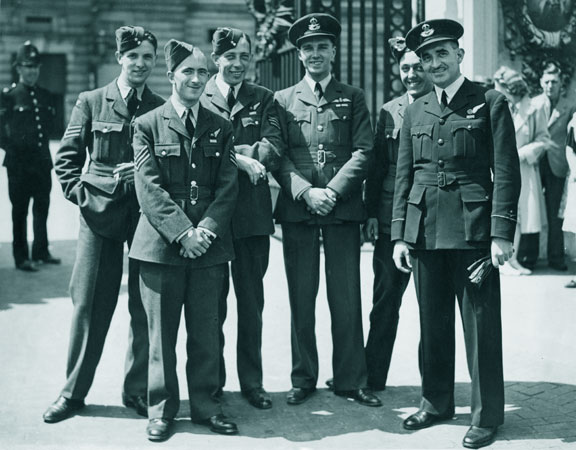
Townsend CrewbigBill Townsend and five of his crew, outside Buckingham Palace in June 1943. Left to right: Ray Wilkinson (rear gunner), Douglas Webb (front gunner), Charles Franklin (bomb aimer), Bill Townsend, Jack Grain (who had been the wireless operator in Townsend’s crew in 49 Squadron but did not transfer to 617 Squadron), Lance Howard (navigator). Note that Townsend is now wearing an officer’s uniform, having received a commission earlier in the month. [Pic: Yahya El Droubie]

Flt Sgt W C Townsend DFM
Pilot

Lancaster serial number: ED886/G

Call sign: AJ-O

Third wave. Only aircraft to attack Ennepe Dam. Mine dropped successfully, but failed to breach dam.

William Clifford Townsend was born on 12 January 1921 in Gloucestershire, the son of William and Kathleen Townsend. He went to Monmouth School. Shortly after the war started he joined the army, but then managed to transfer into the RAF in May 1941.

He was selected for pilot training, qualified as a pilot early in 1942 and in June of that year was posted to 49 Squadron. He undertook two “gardening” operations during September 1942, and his first bombing trip was to Wismar on 1 October.

By the end of March 1943, Townsend had completed 26 operations and been recommended for a DFM. His regular crew included five of the men who would fly with him on the Dams Raid: flight engineer Denis Powell, navigator Lance Howard, bomb aimer Charles Franklin, and air gunners Doug Webb and Ray Wilkinson. The crew therefore fitted precisely into the category from which 617 Squadron’s crews were supposed to have been selected. Quite why 49 Squadron chose to add the far less experienced Cyril Anderson and his crew to the transfer is not known.

Townsend’s regular wireless operator Jack Grain declined the opportunity to transfer to 617 Squadron, as he was getting married, so when the crew arrived at Scampton they did not have anyone to fill this position. However, George Chalmers, a Scot who had already done a full tour in 35 Squadron, had arrived at the station without a crew, and was fitted in.

Training went ahead throughout April and early May, but dummy Upkeep weapons were in short supply, so Townsend never actually dropped one before the raid. Instead, he flew as second pilot with Les Munro on one test flight at Reculver. Munro flew so low that when the weapon was dropped the resultant splash damaged the rear turret.

So it was that Townsend took his place in the mobile reserve, taking off from Scampton at 0014. He had some difficulty getting the heavily-laden AJ-O into the air, just crawling over the boundary hedge. As they approached the Dutch coast, they saw flak far ahead on their port side, probably that which shot down Lewis Burpee and his crew. Turning correctly at the tip of Schouwen, they crossed the coast at 0131.

At 0145, they received another warning about flak at Dülmen and almost immediately were caught in a searchlight. According to Lance Howard’s account Townsend “threw that heavily-laden Lancaster around like a Tiger Moth and we flew out of it.” Several more incidents followed in the next few minutes and at one point they flew along a firebreak in a forest, below the level of the trees.

With all this activity, it is perhaps not surprising that AJ-O did not receive radio messages from Group HQ about the breaching of the Möhne and Eder. However, a message sent at 0226 was acknowledged. This ordered AJ-O to proceed to the Ennepe Dam. At about the same time, Ottley and Anderson were ordered to attack the Lister and Diemel Dams respectively.

With hindsight, it would seem to be a tactical error by Group HQ not to have concentrated attacks by the mobile reserve on the most important remaining target, the Sorpe Dam. Indeed, a second message was sent to Ottley to change to this target but he had already been shot down.

When AJ-O reached the Ennepe Dam, the crew found the target obscured by mist. Also, when they started spinning their Upkeep mine it made the aircraft judder alarmingly. However, after three attempts, they managed to drop it at 0337. Although it bounced twice, it exploded short of the dam which remained intact. Townsend hung around for a while waiting to see if others would arrive, but then set off for home. On the way they passed over the Möhne and saw for themselves the extent of the devastation already wreaked.

In his authoritative account of the Dams Raid, John Sweetman discusses the theory that Townsend and his crew actually attacked the Bever Dam, which has a similar shape to the Ennepe, and is nearby. It was not on the list of Operation Chastise targets. The Bever has an earth core, similar to the Sorpe, and was therefore not suitable for a head-on attack. (John Sweetman, The Dambusters Raid, pp 221-224.)

With dawn breaking, AJ-O had an eventful journey back to base. As they approached Texel on the Dutch coast the Germans depressed a heavy flak gun on them and deliberately bounced shells off the water, a tactic which Lance Howard later described as ‘hardly cricket’. Townsend and George Chalmers later both recalled seeing the shells actually bouncing over them.

Townsend turned to starboard and flew back towards Germany, before turning to port once more and finding a new track through the danger. On the way back across the North Sea an oil gauge showed that one engine was faulty and it was shut down. They finally landed at 0615, the last crew to return from Operation Chastise. They were met on the hardstanding by a group of Bomber Command’s most senior officers, including AOC ‘Bomber’ Harris, whom the exhausted Townsend failed to recognise and pushed past. It was however, as front gunner Doug Webb later recalled, a piece of ‘superb flying’ which had brought them home.

Townsend was awarded the CGM for his role in the Dams Raid. Five of his crew were also given medals, making them the second most decorated Dams Raid crew after Gibson’s. He flew on just two further operations in 617 Squadron, both in July 1943 when the squadron was sent on raids on Italian targets with a stopover in Blida, Algeria. He had by then completed a full tour, and in September he was posted to a training role. He remained in the RAF until 1946.

Bill Townsend married his wife Eileen in 1947 and they had three children. At one point he and his wife owned a pub in Oxford, but he later worked as a civil servant, including a spell in the Department of Employment in Bromsgrove, Worcestershire.

Bill Townsend died in Bromsgrove on 9 April 1991. His funeral took place in Lickey Church, Bromsgrove, on 15 April and he was then cremated at Redditch crematorium.

More about Townsend online:
Copy of logbook held in RAF Museum
Page on 49 Squadron website

Survived war. Died 9 April 1991.

Rank and decorations as of 16 May 1943.
Sources:
Richard Morris, Guy Gibson, Penguin 1995
John Sweetman, The Dambusters Raid, Cassell 2002

The information above has been taken from the books and online sources listed above, and other online material. Apologies for any errors or omissions. Please add any corrections or links to further information in the comments section below.
Further information about Bill Townsend and the other 132 men who flew on the Dams Raid can be found in my book The Complete Dambusters, published by History Press in 2018.

Dambuster of the Day No. 119: Grant McDonald

McDonald

Flt Sgt G S McDonald
Rear gunner

Lancaster serial number: ED918/G

Call sign: AJ-F

Third wave. Second aircraft to attack Sorpe Dam. Mine dropped successfully, but failed to breach dam.

Grant Stuart Vincent McDonald was born in Grand Forks, British Columbia on 20 July 1921, the second youngest of the seven children of William and Florence McDonald. His father worked as a carpenter. He went to school in Grand Forks. By the time he left, the war had already started and he applied to join the RCAF. At that stage it was not accepting new recruits, so he went first into the Canadian army, but was able to transfer to the air force a few months later.

After training in Canada as an air gunner, he crossed the Atlantic on a troopship in May 1942. After more training at a gunnery school near Stranraer, he was posted to No 19 Operational Training Unit at Kinloss, where he first crewed up with fellow Canadians, Ken Brown and Stefan Oancia, and then the Britons Dudley Heal and Harry Hewstone.

Their first operations were a number of anti-submarine patrols from St Eval in Cornwall, but they were then transferred to a Heavy Conversion Unit for Lancaster training. Here a full crew of seven was formed, with flight engineer Basil Feneron and gunner Don Buntaine joining them. They were posted to 44 Squadron in February 1943 and had only completed a handful of operations before being transferred to the newborn 617 Squadron at the end of March.

They were directed to the Sorpe Dam, and attacked it at 0323. After flying across the width of the dam, they dropped their mine in the middle and it exploded satisfactorily, sending a waterspout many hundreds of feet into the air. The dam, however, remained intact. Before leaving the area, AJ-F took a detour to the rapidly-emptying Möhne Dam and were impressed by the damage that their comrades had done a couple of hours earlier. One of the anti-aircraft guns was still operating, however, and McDonald opened fire on it, ‘really giving him hell’ as Brown later recalled. McDonald himself thought that his .303 guns might not have had enough firepower to cause permanent damage. Thanks to Brown’s skilful low flying they finally landed safely at Scampton at 0533.

McDonald flew with the Brown crew on all its subsequent operations in 617 Squadron, leaving when the crew was broken up in March 1944. He was then posted as an instructor to an OTU in the summer of 1944.

On being demobbed at the end of the war, he joined the Canadian customs service in Vancouver, the same occupation as his sometime crewmate, Dudley Heal. He married Margery Warrian on 30 July 1948. They had no children.

As one of the last surviving Dambusters, Grant McDonald participated with courtesy and dignity in a number of events in both Canada and Britain as the various anniversaries of the Dams Raid came about, but he died three days before its 69th anniversary, on 13 May 2012 in Vancouver.

Thanks to Karen and Bryce Ramlo for help with this article.

More about McDonald online:
Transcript of 2011 interview by James Holland

Survived war. Died 13 May 2012.

Rank and decorations as of 16 May 1943.
Sources:
Richard Morris, Guy Gibson, Penguin 1995
John Sweetman, The Dambusters Raid, Cassell 2002

The information above has been taken from the books and online sources listed above, and other online material. Apologies for any errors or omissions. Please add any corrections or links to further information in the comments section below.

Further information about Grant McDonald and the other 132 men who flew on the Dams Raid can be found in my book The Complete Dambusters, published by History Press in 2018.

Dambuster of the Day No. 118: Daniel Allatson

Daniel Allatson 1941 small

Daniel Allatson, centre, at a family wedding in 1941, with, left, his cousin Bridget Fowler, née Childs and, right, Irene [surname unknown]. [Pic: Fowler family]

Sgt D Allatson
Rear gunner

Lancaster serial number: ED918/G

Call sign: AJ-F

Third wave. Second aircraft to attack Sorpe Dam. Mine dropped successfully, but failed to breach dam.

Daniel Allatson was born on 7 November 1923 in Eastwood, Essex. His birth name was Daniel Louis Alberts, and his parents were Frederick and Maude Alberts. He was adopted almost immediately after birth by Samuel and Dorothy Allatson who lived nearby in Southend. Samuel Eli Allatson transferred from the Royal Navy to serve in the newly formed RFC during the First World War. He held the rank of Serjeant-Mechanic, and was awarded both the DFM and the French Medaille Militaire.

Perhaps inspired by his father’s service, Daniel Allatson joined the RAF shortly after the start of the war. His brother also joined the RAF. Daniel Allatson qualified as an air gunner, and was eventually posted to 57 Squadron at RAF Scampton as part of the crew piloted by Sgt Bill Divall. This crew flew on a number of operations together in February 1943.

At the end of March, five crews were posted from 57 Squadron – its entire C Flight, which was made up of those skippered by Melvin Young, Bill Astell, Geoff Rice, Flt Sgt Ray Lovell and Flt Sgt W Lancaster. However, Lovell’s crew “did not come up to the standard necessary” for the new squadron and on 9 April they returned to 57 Squadron. In their place came Bill Divall and his crew, joining 617 Squadron the following day. As they were already based at Scampton the transfer was of course relatively easy.

Despite completing the training successfully, shortly before the raid Divall himself suffered a knee injury, so his crew were resigned to not participating. But then Ken Brown’s front gunner, Don Buntaine, also reported sick, so Allatson was quickly drafted in as his replacement. Allatson’s name appears on the “Night Flying Programme” which was typed on the morning of Sunday 16 May 1943, the day of the raid, so the substitution must have been made by then.

Allatson acquitted himself well in what was undoubtedly the most intense operation he had yet undertaken. He then returned to the Divall crew, and took part in the operations undertaken by 617 Squadron in the summer of 1943. These involved attacks on various Italian targets, flying on to Blida in Algeria for refuelling and rearming.

In September 1943, Divall and his crew were detailed for the attack on the Dortmund Ems Canal, using a new “thincase” 12,000lb bomb. The crew was augmented by an extra gunner brought in from another squadron, Sgt G S Miles. Allatson was stationed in the rear turret. The operation became the most catastrophic undertaken by 617 Squadron throughout the war, with five of the eight aircraft involved shot down or crashed. Weather conditions were very poor: heavy mist blanketed the canal making it impossible to see the culverted area which was the intended target. Divall’s aircraft dropped its bomb on another section of the canal, but then crashed almost immediately afterwards, with a further explosion. Allatson’s turret was blown clear of the aircraft, and his body was found in a field near a farmhouse, with a bruise on his forehead the only external sign of injury.

Daniel Allatson and his colleagues were buried by the Germans in the churchyard at Bramsche. Their bodies were exhumed after the war, and reinterred in Reichswald Forest War Cemetery.

 Thanks to Mark Fowler and Susan Paxton for help with this article.

More about Allatson online:
Entry at Commonwealth Graves War Commission

KIA 16.09.43

Rank and decorations as of 16 May 1943.
Sources:
Richard Morris, Guy Gibson, Penguin 1995
John Sweetman, The Dambusters Raid, Cassell 2002
Chris Ward, Andy Lee and Andreas Wachtel, Dambusters: the Definitive History, Red Kite, 2003

The information above has been taken from the books and online sources listed above, and other online material. Apologies for any errors or omissions. Please add any corrections or links to further information in the comments section below.

Further information about Daniel Allatson and the other 132 men who flew on the Dams Raid can be found in my book The Complete Dambusters, published by History Press in 2018.

Dambuster of the Day No. 117: Stefan Oancia

Canadians+GibsonSome of the Canadians decorated for their role in the Dams Raid, filmed with Guy Gibson outside Buckingham Palace on 22 June 1943. Second from left is Ken Brown and fourth from left, just behind Gibson, is Steve Oancia. [Pic: University of South Carolina]

Sgt S Oancia
Bomb aimer

Lancaster serial number: ED918/G

Call sign: AJ-F

Third wave. Second aircraft to attack Sorpe Dam. Mine dropped successfully, but failed to breach dam.

Stefan Oancia was born on 5 March 1923 in Stonehenge, Saskatchewan, Canada, one of the nine children of Demitru and Katie Oancia. The family had emigrated from Romania to Canada to take up grain farming. Stonehenge is a small community in the southern part of the province of Saskatchewan, near the American border and Oancia went to the local Twelve Mile Lake school.

He joined the RCAF in 1941 and qualified as an observer. On arriving in England, he undertook further training and was then posted to an Operational Training Unit, where he teamed up with fellow Canadians Ken Brown and Grant McDonald, and two Englishmen Dudley Heal and Harry Hewstone. They were posted as a crew to Coastal Command for a few weeks to undertake anti-submarine sweeps.

After final training on heavy bombers, Don Buntaine and Basil Feneron joined them, and the crew was posted to 44 Squadron. Just over a month later and after only six operations, they were sent to 617 Squadron. “I do not recall volunteering for this transfer,” he later remarked.

Each bomb aimer on Operation Chastise made their own decision on what aiming device suited them best. Oancia was planning to get the correct dropping point for his mine from a set of chinagraph marks which he had made on his window to align with the towers on the dam. These were made redundant when they received a signal while in flight to proceed to the Sorpe Dam, which they had to attack by flying along its length.

Like Johnny Johnson in AJ-T before him, Oancia had to call a number of dummy runs before Ken Brown hit on the idea of marking the approach to the dam with a line of flares. This succeeded, and at 0314 Oancia dropped the mine in the centre, and it rolled down the dam wall and exploded as planned. After what “seemed ages”, he recorded seeing a large waterspout silhouetted against the moon and falling slowly back into the lake. The crew noticed further crumbling to the surface of the dam wall, but no apparent breach.

For his successful part in the operation, Oancia was awarded the DFM and travelled to London on 22 June to receive it at Buckingham Palace. He continued in Ken Brown’s crew after the raid until it was disbanded in March 1944, and served the rest of the war training other crews. He was commissioned in 1944.

After the war, he returned to Canada and took a degree in civil engineering at the University of Alberta. One of the projects he worked on in later life was, ironically, a large dam in Quebec.

He married Ruth Griffith in 1953, but they had no children. Oancia died on 6 May 1999 in Carleton, Ontario.

Thanks to Marianne Oancia Wyatt and Daniel Wyatt for help with this article.

More about Oancia online:
Two 2014 blog posts by his cousin, Daniel Wyatt. Part One. Part Two.

Survived war. Died 6.5.1999.

Rank and decorations as of 16 May 1943.
Sources:
Richard Morris, Guy Gibson, Penguin 1995
John Sweetman, The Dambusters Raid, Cassell 2002

The information above has been taken from the books and online sources listed above, and other online material. Apologies for any errors or omissions. Please add any corrections or links to further information in the comments section below.

Further information about Stefan Oancia and the other 132 men who flew on the Dams Raid can be found in my book The Complete Dambusters, published by History Press in 2018.

Dodgy “Guy Gibson” cup for sale

Ebay silver cup

UPDATE: 29 June 2015, 16.35
This item has now been withdrawn! The seller has informed me by email that they are now going to get the item “properly examined by an expert” and will “reoffer it for sale with his findings”.
I am leaving the posting below as it was published, as it contains important information about modern engraving techniques.

Another item which claims a wartime Dambuster connection has just turned up on eBay. This is a silver cup which is said to have been given to Guy Gibson in 1940 in order to mark the award of his first DFC. It is being sold by a Sawbridgeworth antique dealer who would seem to have some perfectly legitimate material on his website, which makes it all the more peculiar that he is apparently selling this item without checking its provenance.
What is even odder is the eBay heading for the item. As can be seen from the screenshot above, it reads: “Old Silver Plate Cup Inscribed To D.Bader”. The photograph, however, quite clearly shows that the inscription is dedicated to “G.Gibson”. The seller has added a later note: “It is actually to g.gibson not d.bader. Sorry.”
The lettering has obviously been generated by a modern computer-aided machine engraving program. The giveaway is the superscript “th” after the number 9 in the date. This happens by default in Microsoft Word, as can be seen below, but would have been very uncommon in any engraving done in wartime:

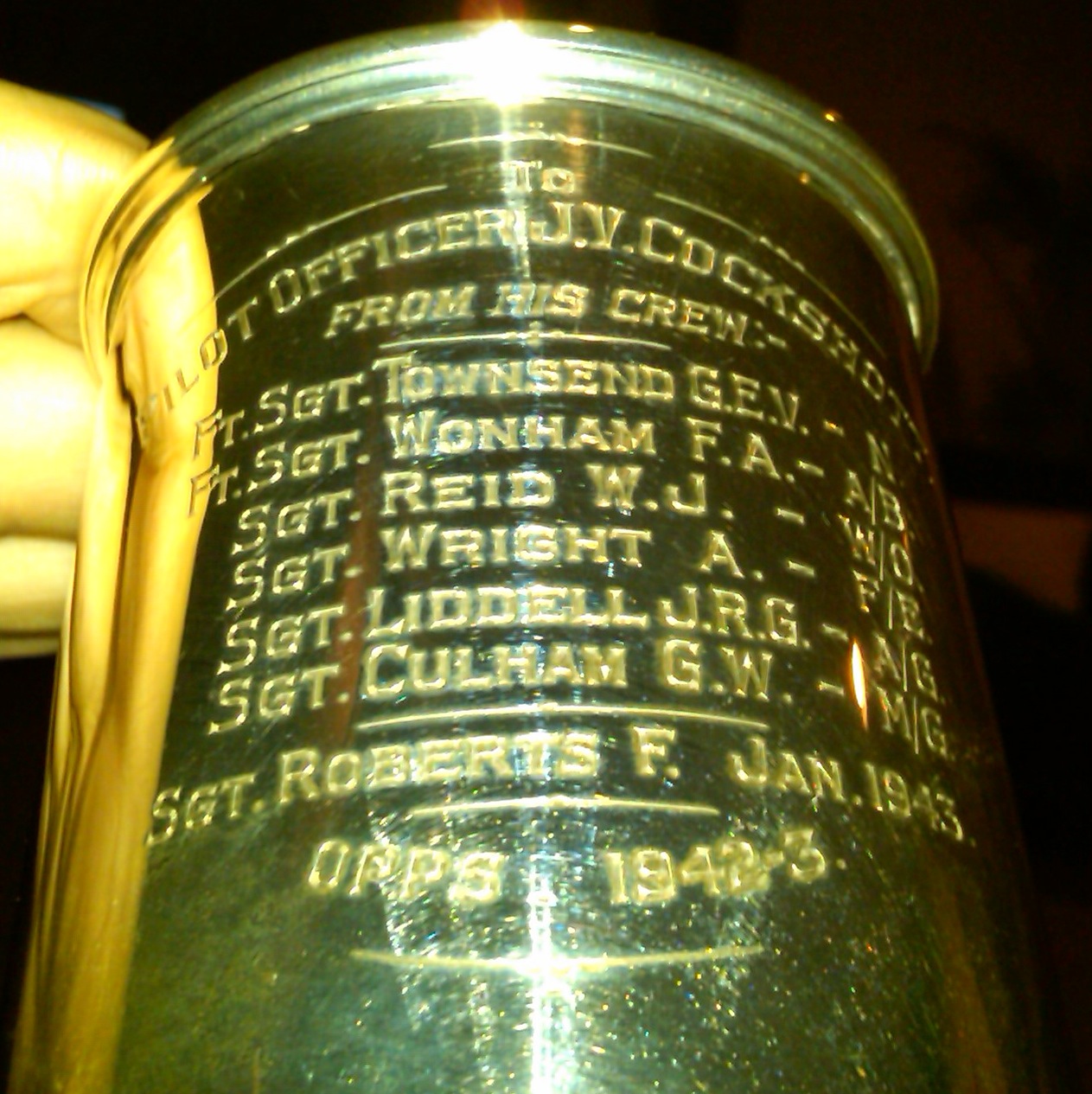
Guy Gibson lettering.docIn the 1940s all engraving was done by hand so each letter was slightly different. This is very obvious on genuine engravings of the period, for example on this silver tankard engraved during the war for Plt Off John Cockshott:

Cockshott IMG-20130509-00046Unfortunately, there is a market for Second World War artifacts given a fake Dambuster connection. In December 2014, a dealer paid £17,000 back to a collector when the collector produced evidence that more than 20 items he had purchased had been “enhanced” with fake names and provenances. Last month, a telegram supposedly sent by “Bomber” Harris about the death of Guy Gibson was withdrawn from auction after it was shown to be a fake.
Glassware and tankards with engravings which supposedly have 617 Squadron connections have also sometimes appeared, but they too have had modern computer-aided machine engraving.
At the time of publishing, someone (1***7 in eBay language) has bid £102 for this cup. More fool them. And there are just over five days to go before bidding closes. It will be interesting to see what transpires over that time.


Dambuster of the Day No. 116: Herbert Hewstone

Hewstone brothersHerbert Hewstone (left) and his brother Joe Hewstone. Both served in the RAF during the Second World War. [Pic: Gordon L Hewstone.]

Sgt H J Hewstone
Wireless operator

Lancaster serial number: ED918/G

Call sign: AJ-F

Third wave. Second aircraft to attack Sorpe Dam. Mine dropped successfully, but failed to breach dam.

Herbert John Hewstone was born on 24 July 1909 in Stepney, London. He was one of the seven children of George and Lydia Hewstone. The family owned a general store in the area. Hewstone was generally known as Bert to his family, but in the RAF he went by the nicknames of both “Harry” and “Hewie”.

He joined the RAF at the start of the war, but it wasn’t until 1942 that he began aircrew training, qualifying as a wireless operator/air gunner in June 1942. He was posted to 19 OTU in Kinloss at the end of August, and quickly crewed up with Ken Brown, Steve Oancia, Grant McDonald and Dudley Heal. They were posted together first to Coastal Command and then after final heavy bomber training on to 44 Squadron at Waddington in February 1942. By this time, Don Buntaine and Basil Feneron had joined them.

After six operations, Brown’s crew were posted to 617 Squadron for training on a secret operation. Before leaving 44 Squadron, they were told how important their role would be in their new posting, and that they would be the “backbone”of the new squadron. After taking a look around at some of the other new recruits, Hewstone said to his captain: “Skip, if we’re the backbone of this squadron, we must be damn close to the ass end.” [Although as a Londoner, he is more likely to have said “arse” than “ass”.]

Hampered by mist, Brown and his bomb aimer Steve Oancia found it difficult to get the correct line of attack at the Sorpe Dam until Brown remembered a similar situation during training, trying to land at RAF Wigsley. He had solved the problem by dropping flares at pre-arranged intervals, then using them on the next approach. Hewstone was given the task of dropping them, and the tactic worked.

Hewstone went on to fly on all of the Brown crew’s subsequent operations in 617 Squadron until it disbanded in March 1944. He was posted to 26 Operational Training Unit, where he served as an instructor for the remainder of the war. He was promoted to Flight Sergeant before being demobbed.

Herbert Hewstone had married Rose Jones in 1938, and they had two children. He died in Havering on 28 May 1980.

Thanks to Gordon L Hewstone for help with this article.

Survived war. Died 28 May 1980.

Rank and decorations as of 16 May 1943.
Sources:
Richard Morris, Guy Gibson, Penguin 1995
John Sweetman, The Dambusters Raid, Cassell 2002

The information above has been taken from the books and online sources listed above, and other online material. Apologies for any errors or omissions. Please add any corrections or links to further information in the comments section below.

Further information about Herbert Hewstone and the other 132 men who flew on the Dams Raid can be found in my book The Complete Dambusters, published by History Press in 2018.
Dambuster of the Day No. 115: Dudley Heal

DPHeal loresPic: Heal family

Sgt D P Heal
Navigator

Lancaster serial number: ED918/G

Call sign: AJ-F

Third wave. Second aircraft to attack Sorpe Dam. Mine dropped successfully, but failed to breach dam.

Dudley Percy Heal was born on 5 August 1916 in Portsmouth, one of the three sons of Edward and Ellen Heal. He went to Weymouth Grammar School. In 1936 he started working for HM Customs and Excise, and at the time of the outbreak of war was working in the Waterguard branch in Southampton Docks.

Customs officers were exempt from conscription, but Heal was determined to serve in the RAF as aircrew and therefore volunteered. He was worried that as an asthmatic he might not pass the medical, but in the event he got through it and was finally enlisted in May 1940.

He was selected for pilot training, but it wasn’t until the following year that this actually began. He was sent first to Canada and then on to Pensacola, Florida. Despite undertaking some solo flying he was eventually ‘washed out’ and returned to Canada. When he remustered as a navigator he was then sent back to Pensacola. He discovered an aptitude for this, and passed out in the top six of his class. This earned him the privilege of flying back from Canada to the UK in an RAF-bound Lockheed Ventura with a ferry pilot.

More training in an Advanced Flying Unit took place, and Heal did even better this time, coming top of the class. This was noted when he was then posted to 19 OTU in Kinloss, where he was expected to crew up. Shortly after arriving, he met a group of three Canadians who seemed to know who he was:

“Your name Heal?” asked the pilot, a tall, well-built chap. “Yes,” I said. “Then you’re going to be our navigator,” he said. I looked questioningly at him. “Who says so?” I asked. “I’ve just been to the Navigation Office,” he said. “You were top of your course at AFU so we want you to be our navigator.” I looked at the other two who were obviously in complete agreement with him. I liked the look of all of them and if I considered it all my reaction would have been that here was someone who was interested in survival, which couldn’t be bad. I agreed to join them without further ado. His name was Ken Brown. We shook hands; he introduced the bomb-aimer, Steve Oancia, and the rear gunner, Grant McDonald, and off we went to the NAAFI for a cup of tea. I can honestly say that I never regretted that decision. We then acquired a wireless operator, Hewie Hewstone and from that time on, our being together as a crew was everything.
Dudley Heal, Dudley’s War, unpublished manuscript, c.1993

Instead of being posted to Bomber Command the five man crew were sent to 434 Squadron in St Eval, Cornwall, for two months. Their task was to conduct anti-submarine sweeps in Armstrong Whitley aircraft. In early 1943, this posting came to an end and they went to a conversion unit for the final stage of heavy bomber training. At this point, gunner Don Buntaine and engineer Basil Feneron joined the crew. They were finally posted to an operational squadron in February 1943, joining 44 Squadron in Waddington.

To give him operational experience, Heal was given a first trip with a seasoned pilot, Sgt Forman, on 18 February to Wilhelmshaven. This passed without incident, and on 9 March the Brown crew set off on their first operation together, to Munich. Somehow, they went off course and arrived at the target 45 minutes late and were even later by the time they got home safely. A rather frosty interview with the Navigation Leader followed, but he escaped any retribution.

Less than three weeks later, however, the crew were shocked to be told that they were being posted to a new squadron to take part in a secret operation. Heal’s logbook reveals that he flew on 18 training flights over the next six weeks, all except one with Ken Brown as pilot.

On the Dams Raid itself, Heal found that AJ-F was tending to drift off track, so he had to adjust the courses he was giving to his pilot. But they found no real difficulty in finding their eventual target, the Sorpe Dam. Failing to breach it was a disappointment, but this was mitigated when their return journey took them past the Möhne, and they saw the damage their comrades had caused.

AJ-F’s flight back was eventful, but safely carried out. Even though his compartment was curtained off, Heal could plainly see how dazzling the searchlights were as they faced their final hurdle on the Dutch coast. And later, when he and Brown examined the damage they saw how the fuselage had been extensively holed, just above head height. If Brown hadn’t flown so low, they would have been dead.

Heal received the DFM for his role on the Dams Raid and travelled to Buckingham Palace to receive it. Afterwards he flew on all of the Brown crew’s subsequent operations until it broke up in February 1944. Brown himself had developed hearing problems, and was being sent for medical tests. Heal opted to go to a training post rather than switch to another pilot and crew.

This lasted for a few months, but then early in 1945, he was offered the chance to join 214 Squadron, flying American Fortresses specially equipped for radio counter measures, mainly the “jamming” of German radio signals. All went well for seven operations but then on the eighth, their aircraft suffered engine problems, dropped to 8000 feet and was hit by flak. The crew baled out. Heal and a few others survived and were captured. They were dealt with correctly but some of their crewmates were captured and taken to the village of Huchenfeld, near the town of Pforzheim, which had been severely bombed shortly before. Local civilians, members of the Hitler Youth, broke into the cellar where they were being held, dragged them to a cemetery and shot them.

Heal was held as a prisoner for about two months, and was in a group who were forcibly marched away from the approaching American forces. They were eventually rescued, and made their way to an airbase which was flying PoWs home.

After the war, Heal went back to work for the Customs and Excise service and retired in 1978. He married Thelma Davies and had two daughters. They lived in Southampton.

Dudley Heal died on 7 February 1999, and was cremated at Southampton Crematorium on 16 February 1999.

Thanks to the Heal family for help with this article, and for use of the unpublished manuscript.

More about Heal online:
Dudley Heal – the Hampshire Dambuster, tribute on Waterguard site
214 Squadron site, article about the Huchenfeld incident (scroll down)
214 Squadron site, further information about the Huchenfeld incident

Survived war. Died 7 February 1999.

Rank and decorations as of 16 May 1943.
Sources:
Dudley Heal, Dudley’s War, unpublished manuscript, c.1993
Richard Morris, Guy Gibson, Penguin 1995
John Sweetman, The Dambusters Raid, Cassell 2002

The information above has been taken from the books and online sources listed above, and other online material. Apologies for any errors or omissions. Please add any corrections or links to further information in the comments section below.

Further information about Dudley Heal and the other 132 men who flew on the Dams Raid can be found in my book The Complete Dambusters, published by History Press in 2018.

Dambuster of the Day No. 114: Basil Feneron

feneron_113

Sgt H B Feneron
Flight engineer

Lancaster serial number: ED918/G

Call sign: AJ-F

Third wave. Second aircraft to attack Sorpe Dam. Mine dropped successfully, but failed to breach dam.

Harry Basil Feneron was born in London on 14 May 1920, the older of the two sons of Harry and Edith Feneron. His father ran an electrical business, where he and his brother both worked after leaving school. Feneron joined the RAF in 1940 and served in ground crew, before taking the opportunity offered in 1942 to train as a flight engineer. He qualified in October 1942 and was then posted to 1654 Conversion Unit, where he joined up with Ken Brown and his crew. He would go on to fly with Brown for the rest of both their operational careers.

The crew were posted together to 44 Squadron on 5 February 1943 and completed six operations between 9 and 27 March. They were then posted again as a unit to 617 Squadron on 29 March.

The relationship between Brown and Feneron was closer than it was between some of the other pilots and flight engineers on the Dams Raid, with Feneron having more like an assistant pilot role. In the low flying training before the raid, Feneron did an important job looking out for high tension wires and other obstacles, calling out to his skipper as soon as he saw them. They split the responsibility for forward vision, with Feneron taking the starboard half of the windscreen and Brown the port side.

This spirit of partnership could well have been the reason why they survived the testing low level flight to the Dams and back, while others didn’t make it. Feneron saw Burpee’s crash and afterwards concluded that they had been shot down because they weren’t low enough.

When they reached the Sorpe Dam, he worried that if they rose too high after their attack they might fall prey to a night fighter. However, none arrived and after dropping their mine the crew of AJ-F set course for home. Their route took them past the Möhne, where they were shocked to see the damage caused earlier in the night. They then nearly came to grief on two occasions, near Hamm and at the final obstacle, the Helder peninsula on the coast, where Feneron crouched on the floor as Brown flew as low as he dared.

When they were safely over England, Brown handed over the controls to his engineer for a time while he went aft to examine the extensive damage which AJ-F had endured. He was back in the pilot’s seat in time to land at Scampton and Feneron went through his customary ritual of kissing the ground – on this occasion probably with more fervour than usual. He was then able to see the damage for himself, including a large hole a few inches behind where wireless operator Herbert Hewstone had been sitting.

Feneron went on to fly on nine more operations in 617 Squadron before being commissioned and then in March 1944 being transferred into a training unit. He carried out various instructional roles for the rest of the war before being demobbed in 1946. He returned to work in the family business in London, where he stayed until he retired. Basil Feneron died on 18 November 1993 at his home in Gerrards Cross, Buckinghamshire, where he had lived with his wife, Jean, for 30 years. He had two children.

Thanks to Mrs Jean Feneron for help with this article.

More about Feneron online:
Obituary in The Times

Survived war. Died 18.11.1993

Rank and decorations as of 16 May 1943.
Sources:
Richard Morris, Guy Gibson, Penguin 1995
John Sweetman, The Dambusters Raid, Cassell 2002

The information above has been taken from the books and online sources listed above, and other online material. Apologies for any errors or omissions. Please add any corrections or links to further information in the comments section below.

Further information about Basil Feneron and the other 132 men who flew on the Dams Raid can be found in my book The Complete Dambusters, published by History Press in 2018.

Dambuster of the Day No. 113: Kenneth Brown

Brown+KingKen Brown meeting the King on the royal visit to Scampton on 27 May 1943. [Pic: IWM]

Flt Sgt K W Brown
Pilot

Lancaster serial number: ED918/G

Call sign: AJ-F

Third wave. Second aircraft to attack Sorpe Dam. Mine dropped successfully, but failed to breach dam.

Kenneth William Brown was born on 20 August 1920 in Moose Jaw, Saskatchewan, Canada. He enlisted in the RCAF in 1941 and was selected for pilot training. He was recommended for fighters but after arriving in England, he was posted to a bomber training unit in Kinloss. There he crewed up with navigator Dudley Heal, bomb aimer Stefan Oancia, wireless operator Herbert Hewstone and gunner Grant McDonald, all of whom would stay with him for much of the rest of his career. Their first active posting was however to Coastal Command, flying Whitleys out of RAF St Eval on Channel patrols.

Brown was then selected for heavy bomber training at 1654 Conversion Unit, where one of his instructors was Mick Martin. The low flying specialist was reportedly impressed by his pupil’s abilities in this challenging activity. Brown also formed a complete crew at this unit when engineer Basil Feneron and gunner Don Buntaine joined him. The seven were then posted to 44 Squadron to begin operations on 5 February 1943.

On 11 February, Brown flew as second pilot on a raid to Wilhelmshaven in an aircraft captained by Sqn Ldr R G Whitehead DFC. He then had to wait for nearly a month until 9 March to fly his own crew on their first operation, to the tough target of Munich. The trip was a fierce baptism, with their aircraft coned by searchlights which meant Brown had to perform a corkscrew in order to escape.

Four more operations followed and then on 27 March they were briefed for their first trip to Berlin. Before they left, Brown was pulled aside for a meeting with the squadron CO, Wg Cdr John Nettleton VC.

He said, “You are transferred to a new squadron.”
I wasn’t too happy about that. I said, “Sir, I’d rather stay here and finish my tour with Forty-four.”
He explained in his very curt manner. This was impossible. It was a name transfer and he could do nothing about it.
So we went to Berlin and on our return we got packed up and off we went to No. 617. But before we went, the Wing Commander wished me well and said, “Do you realize Brown, you’re going to be the backbone of this new squadron.”
Well, we arrived over at Scampton and we started to look around as to who was there. There were an awful lot of DFCs, not so many DFMs. We realized that perhaps we weren’t really all what we were set up to be.
My wireless operator sauntered up to me and said, “Skip, if we’re the backbone of this squadron. We must be damn close to the ass end.” I began to wonder how I’d got there.
[Source: Speech at Bomber Command Museum of Canada]

Because the new squadron had been formed so quickly, there was a shortage of aircraft on which the crews could train. Brown and his crew, however, were relatively lucky and did a low level cross country flight on 31 March, two days after their arrival. Training went on apace for six more weeks and during it the pugnacious Brown had some run-ins with his new CO, Guy Gibson, who he regarded as a staunch disciplinarian. Once, after Brown was accused with being late for a briefing, Gibson made him wash all the windows of the briefing room. But the CO recognised his skills as a pilot, especially at low flying, and demonstrated his playful side by one day pushing him into the water when they met by chance in the public swimming pool in Lincoln.

Brown and his crew were allocated to the mobile reserve. Some time the day before, his regular gunner Don Buntaine had reported sick. Divall’s crew had been taken off the flying schedule as someone else was ill, so Daniel Allatson was hastily reallocated to the front turret of AJ-F.

Brown was due to take off third. At dispersal, he smoked his usual two cigarettes and then was shaken when Lewis Burpee came up to him and took his hand. “Goodbye Ken,” was all he said.

Grant McDonald saw this and said to Brown: “Skip, you know those guys aren’t coming back, don’t you?”

“Yeah, I know,” Brown replied. All McDonald could say then was “Well, damn it!”

Two hours later, Brown and his crew witnessed Burpee’s fate, as he strayed too close to Gilze-Rijen airfield, and was shot down.

AJ-F pressed on, keeping so low that at times they were below treetop level. They shot up a train which travelled across their path and just avoided crashing into a castle. Having received the signal that both the Möhne and Eder Dams had been destroyed, they diverted towards the Sorpe.

On their arrival, they found that the mist which had hampered the only previous attack, by McCarthy two and a half hours previously, had thickened considerably. Working out a line of attack was difficult, and they made several abortive attacks. One of these nearly ended in disaster when they flew into a valley, but quick thinking by Brown and a stall turn got AJ-F out of trouble. Eventually they hit on a plan of marking a circuit with flares, and they dropped their mine successfully at 0314. They had cleared the hill beyond the dam and turned to port when the explosion occurred. Steve Oancia noted a large waterspout, and the crew observed crumbling of the crown of the dam. But no breach had occurred.

Flying back over the Möhne, they saw the extensive damage but were themselves fired on by the one gun emplacement still active. McDonald returned fire with gusto, and was pleased to see that the flak went silent. 
With dawn approaching, Brown got down as low as possible and in Basil Feneron’s words “opened up the taps”. AJ-F came through intensive fire at Hamm and at the last danger point, the Helder peninsula on the Dutch coast. The cockpit was flooded with light from searchlights and flak crashd through the perspex. Feneron crouched as low as possible, and could see Brown above him to his left, hunched over the instruments.

Somehow, they had all survived, and landed at Scampton at 0533 in an aircraft full of holes. Debriefing followed, with Arthur Harris sitting in. Although there was an impromptu party going on in the Officers Mess, the all-NCO crew in AJ-F seem to have had a quieter celebration. But they were up and about early enough in the morning for a series of photographs. The pilots were all pictured outside the Officers Mess, and then Brown, Oancia and McDonald took their place in the shot of the Canadian survivors.

When the decorations were announced, all the officer pilots who dropped their mines successfully were awarded DSOs. Ken Brown and Bill Townsend, both Flight Sergeants at the time, were given the rarely-awarded Conspicuous Gallantry Medal. Stefan Oancia and Dudley Heal both got DFMs.

Brown was commissioned in June 1943 and went on to fly on another nine operations in 617 Squadron before being posted out in May 1944. He spent the rest of the war in instructional roles. After the war he stayed on in the RCAF, rising to the rank of Squadron Leader. He retired from the service in 1968, but carried on flying in the Canadian Department of Transport.

He had married an Englishwoman, Beryl Blackband, in 1944 and she accompanied him to Canada, where they had five children.

Ken Brown died in White Rock, British Columbia on 23 December 2002.

Awarded CGM for his part in the Dams Raid.

More about Brown online:
Interview with Ken Brown in 2000. This is hosted on his son Brock’s company website. The same page has a number of links to other material about Brown, including an obituary in the Toronto Globe and Mail.
Speech made by Brown on 50th anniversary of Dams Raid at the Bomber Command Museum of Canada.
Obituary in Daily Telegraph.

Survived war. Died 23 December 2002.

Rank and decorations as of 16 May 1943.
Sources:
Kevin Wilson, Bomber Boys, Weidenfeld & Nicolson 2005
Richard Morris, Guy Gibson, Penguin 1995
John Sweetman, The Dambusters Raid, Cassell 2002

The information above has been taken from the books and online sources listed above, and other online material. Apologies for any errors or omissions. Please add any corrections or links to further information in the comments section below.

Further information about Ken Brown and the other 132 men who flew on the Dams Raid can be found in my book The Complete Dambusters, published by History Press in 2018.

Dambuster of the Day No. 112: Gordon Brady

JosephBrady01Pic: Burpee family

Wrt Off J G Brady
Rear gunner

Lancaster serial number: ED865/G

Call sign: AJ-S

Third wave. Crashed on outward flight.

Joseph Gordon Brady, known to his family as Gordon, was born in the small town of Ponoka, Alberta, Canada, on 16 April 1916. Ponoka lies in the middle of the province, between Edmonton and Calgary. His parents, Michael and Anna Brady, were both born in the USA, but had moved to Canada and become naturalised. Brady was one of four children and attended the local schools, before taking up employment working in a drug store in 1934. When the war came, after a period as a field ambulance truck driver, he volunteered for the RCAF, and joined up in March 1941. He was selected for air gunner training, and eventually arrived in Britain a year later.

After more training, he was posted to 16 OTU at Upper Heyford in Oxfordshire, and arrived on the same day, 23 June 1942, as Lewis Burpee. The two Canadians were quick to crew up together. Brady was one of the crew on board when Burpee had an accident in a Wellington on 27 August. His starboard engine seized and he made a poor forced landing at Church Lawford, but avoiding numerous construction obstacles. He was criticised for his choice of emergency airfield, but exonerated over the accident itself.

Burpee and Brady were posted to 106 Squadron together, and had been joined by Guy Pegler in the latter stages of training. Their first operational trip together as a crew was on a “Gardening” operation to the Silverthorn area on 16 November 1942.

Thereafter Brady flew on every single trip made by Burpee, and was promoted to Flight Sergeant in December 1942 and Warrant Officer in February 1943. He would have had no hesitation in going along with his skipper on the transfer to 617 Squadron, even though they were both very near the end of their tours.

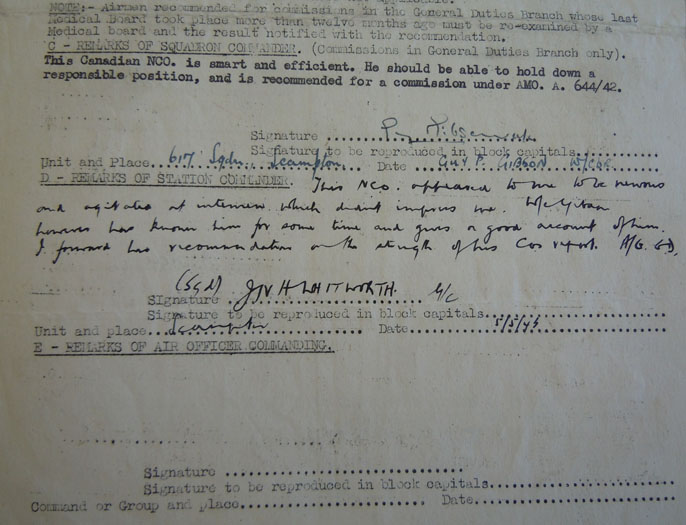
Brady had also been noticed by Guy Gibson, who recommended him for a commission on 10 May 1943, describing him as “smart and efficient”. By contrast, Scampton station commander Gp Capt Charles Whitworth, whose recommendation was also needed, was not so impressed. Brady had been “nervous and agitated at interview”. However, he went along with Gibson: “W/C Gibson however has known him for some time and gives a good account of him. I forward his recommendation on the strength of his CO’s report.”A week later, it was all too late, and a note on Brady’s file merely says “Recommendation cancelled”.

Brady commission DSCN0060 lores
The recommendation for a commission on Brady’s RCAF file. [National Archives of Canada]

Gordon Brady died along with his comrades when AJ-S came down in flames on the edge of Gilze-Rijen airfield on 17 May 1943. As was often the case in these kind of crashes, a witness noticed that his body had been thrown out of the rear turret by the impact, and didn’t appear to have any sign of serious injury. He was scantily dressed, wearing thin uniform trousers and lace up shoes with holes in the soles. (Helmuth Euler, The Dams Raid through the Lens, After the Battle, 2001, p.106.)

After the crash, only the bodies of Burpee, Brady and Weller were positively identified. The other four were buried in a communal grave. They were first interred by the Germans at Zuylen Cemetery, Prinsenhage, but after the war all seven bodies were exhumed and reburied in Bergen-op-Zoom War Cemetery.

More about Brady online:
Entry at Commonwealth War Graves Commission
Aircrew Remembered page about Burpee crew

KIA 17.05.43

Rank and decorations as of 16 May 1943.
Sources:
Richard Morris, Guy Gibson, Penguin 1995
John Sweetman, The Dambusters Raid, Cassell 2002

The information above has been taken from the books and online sources listed above, and other online material. Apologies for any errors or omissions. Please add any corrections or links to further information in the comments section below.

Further information about Gordon Brady and the other 132 men who flew on the Dams Raid can be found in my book The Complete Dambusters, published by History Press in 2018.