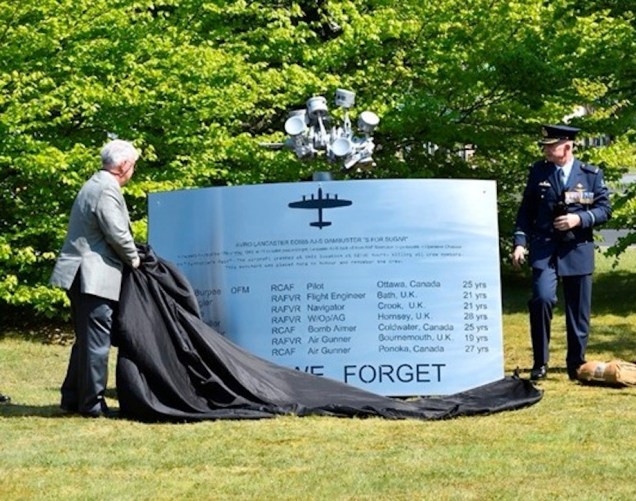
Burpee and Arthur families at AJ-S memorial unveiling

Lewis Burpee Jr unveiling the memorial to the crew of AJ-S, killed on the Dams Raid, on 17 May 1943. Pic: Peter van Kaathoven

A memorial to the Dams Raid crew piloted by the Canadian Lewis Burpee was unveiled on Friday near the site where they crashed at Gilze Rijen airfield in the Netherlands. It was attended by a number of local dignitaries and representatives of the RAF, as well as members of the families of Lewis Burpee himself and of his bomb aimer, James Arthur. The BBMF Lancaster PA474 flew over the memorial before landing at the airfield as part of its goodwill tour of the Netherlands.

Burpee was a Canadian, born in Ottawa on 5 March 1918. He had two other Canadians in his crew, rear gunner Gordon Brady from Ponoka, Alberta, and bomb aimer James Arthur from Toronto. Arthur had only joined Burpee’s crew in his previous squadron in March 1943, and had flown on just one operation with his skipper. He was one of the four children of the Rev Alfred and Dora Arthur. His father was an Anglican priest, with a parish in the Toronto suburbs.

The memorial is made up of a large piece of crankshaft from one of the crashed Lancaster’s engines. It has seven pistons, once for each of the AJ-S crew, and is faced with an engraved plaque. It was unveiled on Friday by Burpee’s son, also called Lewis Burpee, who was born on Christmas Eve 1943, seven months after his father’s death.

After the unveiling this group gathered near PA474, seen in the background. Above, left to right: Sander van der Hall, organiser of the memorial appeal; Maureen Burpee; Lewis Burpee Jr; Rev Dom Luke Bell, nephew of James Arthur; Sqn Ldr Andy Millikin, OC BBMF; Air Cdre Chris Lorraine, retired RAF officer; Jonathan Bell and Julian Bell, nephews of James Arthur. Pic: Peter van Kaathoven

More details on the memorial’s Facebook page.

Taking off on the Dams Raid

IWM Collections CH18006

This is one of the pictures in my new book, The Complete Dambusters. It is a photograph taken by official Air Ministry photographer Flg Off W. Bellamy of a Lancaster taking off on the Dams Raid on the night of 16 May 1943. As it is a single aircraft, it is probably one from the Second Wave, possibly the first to leave the ground: Norman Barlow and his crew in AJ-E.

There has been some discussion on the veracity of this picture, since there is no sign of the Upkeep weapon underneath the Lancaster as it leaves the ground. However, it is likely that either the photographer or a darkroom operative was instructed to paint out the weapon for security reasons. At the angle from which this picture was taken, the weapon would have appeared between the struts of the undercarriage. The painting out has been done rather crudely – if there was nothing underneath the aircraft, daylight would be visible through the struts. (You can see an example of this in this picture of a parked Lancaster, left.)

Bellamy’s ‘dope sheet’ (his handwritten list of shots taken that day which was sent to his bosses at the Air Ministry) actually lists two pictures: ‘One of the “Lancs” taking off for the raid as night falls’ and ‘A “Lanc” takes off as night falls’. It’s not known which of these two shots this is. The dope sheet itself is in the Imperial War Museum’s photographic archive, and was reproduced in Herman Euler’s book The Dams Raid through the Lens, After the Battle 2001, p210.

It’s here: Complete Dambusters on sale from 8 May

Great excitement at Blog HQ in the last few days when an advance copy of my new book The Complete Dambusters arrived! As I write, fleets of lorries are travelling across Europe bringing stock to bookshops far and wide, so expect to see copies on the shelves (or in your favourite online shop) sometime next week.

I will be in the Lincolnshire area from Saturday 12 to Monday 14 May, so if you would like to get a copy direct from me, then please get in touch. I will also be at the Royal Albert Hall for the gala screening of The Dam Busters on the night of Thursday 17 May, and will have copies of the book available. Families of Dams Raid veterans who are coming to this event are invited to meet up in the Berry Bros and Rudd bar (near Albert Hall Door 1) from 6pm. (A few tickets for this event are still available and can be booked via the Albert Hall box office.)

To whet your appetite, here are a couple of spreads from the book:


The aura of the Dams Raid

A number of publications are producing special editions or features to mark the 75th anniversary of the Dams Raid. Amongst these are the monthly magazine Britain at War, whose April number 2018 devoted some 24 pages to the event.

Much of the text covers familiar ground, but there was a slightly different angle in an article by an academic from the University of Hull, Victoria E Taylor. In it she discussed how the ‘iconic operation’ has become ‘woven into the fabric of British folklore’. This has given it a slightly unfortunate position in popular culture, she argues. ‘… the gung-ho, “Boy’s Own” narrative of the Dams Raid – while valid and understandable – is not always sensitive to the immense sorrow that the operation provoked. The psychological distress of certain “Dambusters” over the 53 Allied airmen killed (and three captured) is not often fully considered. The same can particularly be said of the 1294 victims of the resulting floods.’

These are valid points, and ones which should be considered by those who are often tempted to treat the raid as some sort of game (going to an England football match dressed in a fake RAF uniforms and singing Ten German Bombers, for instance). These days, there is much better understanding of the effects of war on its participants, whether ‘winners’ or ‘losers’, so it should come as no surprise that some of those who took part in the Dams Raid suffered from mental stress later on in their lives.

To their credit, the organisers of most of the official events which will commemorate the 75th anniversary recognise this, and there won’t be much mindless triumphalism. And it is significant that there will also be an event in Germany itself, at the Eder Dam, which will bring together people from the nations which opposed each other in the war itself. Also significant is the ongoing interest by the people of Haldern in the memorial at the crash site of Norman Barlow and his crew.

The April 2018 edition of Britain at War, which includes Victoria Taylor’s article, is still available online.

[Victoria Taylor has asked me to point out that she was not responsible for the captions on the photographs which accompany her article. In particular, the one which identifies the unmistakeable figure of Les Munro, with a New Zealand flash on his shoulder, as Joe McCarthy!]


Lancaster will fly over Ladybower Dam on Dams Raid 75th anniversary – official


The BBMF Lancaster flying over the Ladybower Dam in 2008. [Pic: MoD/Wikimedia]

The worst-kept secret of the events to commemorate the 75th anniversary off the Dams Raid is out! It has been officially confirmed today that the BBMF Lancaster will perform a flyover at the Ladybower Dam in the Peak District’s Derwent valley on Wednesday 16 May at approximately 12.05pm. In April and May 1943, the reservoir and dam were one of the training locations used by 617 Squadron in the run up to the Dams Raid.

The Lancaster will fly over RAF Scampton and then move on to the Derwent valley. It will perform two passes over the dam before going on to fly over Chatsworth House, the Rolls Royce plant in Derby and the Eyebrook reservoir in Leicestershire.

The authorities are keen to inform you that this event is of course weather-dependent, and in the event of cancellation due to inclement conditions there will not be another date.

Traffic congestion is expected to be very high, and members of the public are urged to use public transport if possible as private car parking will be very restricted. Previous events at the dam have resulted in traffic jams lasting up to six hours. Note that the nearest rail station is at Bamford, 2 miles from the dam (wear walking boots).

Check this information from the Peak District National Park and this from Derbyshire County Council.

There is more information on the BBMF Facebook page. This does not say which base the Lancaster will be using on the day, but it is likely to be its home station of RAF Coningsby.

Michael Anderson dies at 98

It’s sad to have to report that the film director Michael Anderson died on Wednesday night, at the age of 98. He was best known to readers of this blog as the director of the 1955 film, The Dam Busters, but this was just part of his long career in the film business. At the time of his death he was the oldest living Oscar nominee for best director.

Anderson was born in London on 30 January 1920, and started work before the war as a runner and office boy at Elstree studios. He worked as an assistant director on several films, including Noel Coward’s In Which We Serve, where he also acted in a small role. He then served in the Royal Signals. When peace came, he returned to the film business and gained a reputation for being able to work with some of the industry’s ‘difficult’ characters, such as Peter Ustinov and Robert Newton.

By the early 1950s, he was under contract as a director to Britain’s biggest film studio, Associated British Pictures, for whom he would eventually produce five films. ABP had bought the rights to Paul Brickhill’s best-selling book, The Dam Busters and commissioned a script from the writer of Journey’s End, R C Sherriff. Anderson was selected as director. ABP also had one of the country’s famous actors, Richard Todd, under contract and his physical resemblance to Guy Gibson made him an obvious choice for the part. Many other actors were also chosen for their similarity to their real-life counterparts, including the other main star of the film, Michael Redgrave, who was handed the part of Barnes Wallis.

Anderson chose to tell the story in a straightforward documentary style, reflecting the script which Sherriff had written with his usual understated economy. Brickhill’s original 1951 book had been prevented by government censors from revealing how Barnes Wallis’s weapon really worked. But four years later, the censors permitted the bouncing bomb to be shown on screen. This led to Barnes Wallis’s actual films being used in the scenes where he is trying to convince service and Air Ministry chiefs that his idea will work. A collective ‘Wow’ must have swept through the nation’s cinemas as the general public saw for the first time the big secret behind the successful attacks.

What is not widely known, however, is that the film was nearly scuppered by a contractual dispute with Guy Gibson’s widow, Eve, after the shooting was completed. She maintained that Brickhill had used material sourced from her husband’s book Enemy Coast Ahead in his own book The Dam Busters without permission. ABP were furious that their film project was at risk and demanded that Brickhill sort it out, and if he didn’t they would sue him for all the production costs.

The production company’s records are lost, so exactly how the matter was settled is not clear. It appears that Brickhill never paid any money to Eve Gibson but it was agreed that Enemy Coast Ahead would be credited in the opening sequence. More remarkably, it appears that it was also agreed that two more short sequences would be shot to appear in the final film. These are the cockpit scenes which take place after Gibson’s AJ-G has crossed the Dutch coast. In the original edited version of the film, all that Richard Todd as Gibson says here is ‘Stand by front gunner, we’re going over.’ This is allowed by a scene where Wallis, Bomber Harris and others are shown waiting tensely. But in the final cut, instead of going on to show the progress through Holland, two rather odd scenes then follow. The first shows the cockpit of Melvin Young, leading the second group of three in AJ-A. His navigator then says ‘Enemy Coast Ahead’. An external shot is then followed by a scene in Henry Maudslay’s AJ-Z, where the pilot fastens his oxygen mask and says ‘Enemy Coast Ahead.’

The double use of the title of Gibson’s book seems to have been enough to placate Eve Gibson, and she called off her legal action. More importantly the overwhelmingly positive reaction to the film ensured that The Dam Busters took a permanent place in British cinema history. Anderson was always proud of the film and its continuing influence. In a 2013 TV interview he described the first time that he had heard composer Eric Coates play the Dam Busters March and knew instantly that this was the music for the film. He also praised R C Sherriff’s script, a ‘masterpiece of understatement’, something that he was keen to preserve in his direction. And he confessed that he was still moved by the final scene, where Gibson tells Barnes Wallis, distraught at the loss of 56 men, that even if all the men had known that they wouldn’t be coming back, ‘they’d have gone for it just the same. I knew them all and I know that’s true.’

To the wider world, Anderson is known for his direction of the winner of the 1956 Oscar for best film, Around the World in Eighty Days, where he was also nominated for best director. He went on to direct several more war films, and a host of other features.

Time has not been kind to some 1950s British war films. However, this is not the case with The Dam Busters, which many critics have now taken to re-evaluating. It appears regularly in lists of important British films (No. 68 in the one published by the BFI) and is widely seen as an important influence (in Star Wars, George Lucas based the sequence showing the attack on the Death Star on The Dam Busters.) It will remain Michael Anderson’s greatest legacy, and for that alone, he should be saluted.

The new high definition print of The Dam Busters will be shown at the Royal Albert Hall on Thursday 17 May, the 75th anniversary of the Dams Raid, and simulcast in more than 300 cinemas nationwide.

Sources:
John Ramsden, The Dam Busters, Tauris 2003
Stephen Dando-Colins, The Hero Maker, Vintage Australia, 2016

Obituary in The Times (paywall)

Obituary in Daily Telegraph
Fred Sutherland unveils portrait in Alberta

Great to see a new photograph of Fred Sutherland, looking well. Last Thursday, in his home town of Rocky Mountain House in Alberta, Canada, Fred unveiled a new portrait of himself, painted by Dan Llewelyn Hall. This is one of the 133 portraits painted by Dan to honour all the men who took part in the Dams Raid.

On the raid, Fred Sutherland was the front gunner in AJ-N, piloted by Les Knight, and was thus in a prime seat when the Eder Dam was breached by his aircraft’s mine.

All the portraits in Dan’s series will be unveiled at the International Bomber Command Centre in Lincoln at 2.00pm on Sunday 13 May. All are welcome to this event. The exhibition will then move to London and will be on display at Prospero World, 4 Farm Street, London W1J 5RB from 16-20 May. Admission is free. although a donation to the four charities benefitting from the exhibition will be appreciated.

Report from BBC in Canada about the unveiling
Report from Canadian broadcaster CBC 

Dams Raid 75th anniversary: updated calendar of events

Here is a list of events organised to commemorate the 75th anniversary of the Dams Raid in May. It will be updated again nearer the time of the actual anniversary, which falls on 16/17 May.

Friday 4 May 2018, 12.30pm. Gilze-Rijen Air Base, Netherlands. Unveiling of memorial to the crew of AJ-S, piloted by Plt Off Lewis Burpee, which was shot down on the edge of this airfield on the Dams Raid. The crew are buried in the nearby Bergen-op-Zoom war cemetery. Weather permitting, there will be a flypast by the BBMF Lancaster at a time to be confirmed.
More details here.

Saturday 12 May 2018. Woodhall Spa. The 617 Squadron Association Annual Dams Dinner will be held at the Petwood Hotel, Woodhall Spa, for members of the Association and invited guests.

Sunday 13 May 2018, 10.00am. Woodhall Spa. 617 Squadron Association Annual Wreath-laying Ceremony and Service, 617 Squadron War Memorial, Royal Square, Woodhall Spa. Members of the public welcome.

Sunday 13 May 2018, 11.30am. Woodhall Spa. Service of dedication and unveiling of the new Airfields of Britain Conservation Trust memorial at the former airfield at RAF Woodhall Spa. Service taken by Air Vice Marshal Venerable Robin Turner CB DL, retired Chaplain-in-Chief of the RAF. The memorial will be unveiled by Wg Cdr John Bell MBE DFM Ld’H, President of 617 Sqn Association, who flew with both 619 and 617 Sqns from the airfield in 1943/44.

Sunday 13 May 2018, 2.00pm. International Bomber Command Centre, Canwick Hill, Lincoln. Unveiling by Dambuster family members of the 133 portraits ‘Dambusters Reunited’ by Dan Llywelyn Hall. More details here.

Wednesday 16 May, 9.28pm to Thursday 17 May, 6.15am. RAF Cosford, Shropshire.  University of Birmingham Air Squadron (UBAS) charity march around RAF Cosford airfield. Nineteen teams of seven, representing the nineteen Lancaster bombers and their crew, will walk laps of the airfield overnight between 9.28pm on 16 May and 6.30am on 17 May – the first take-off and last landing times of the raid. Other volunteers, supporters and participants are welcome and encouraged to join in and do as little or much as they choose. In aid of the Royal Air Force Benevolent Fund and organised by UBAS. More details here.

Thursday 17 May 2018, 8.30am. The Royal Aeronautical Society, 4 Hamilton Place, London W1J 7BQ. Time to be confirmed. A symposium to review the origin, preparation, execution and achievements of Operation Chastise. Speakers will include Paul Stoddart, Dr Peter Caddick-Adams, Seb Cox, Eric Grove, Dr Robert Owen, David Jordan and Paul Strong. More details here.

Thursday 17 May 2018, 12.30pm. Ladybower Inn, Bamford, Derbyshire. Charity lunch in aid of The Barnes Wallis Foundation on the 17 May at The Ladybower Inn. Speaker: Peter Rix. The Inn is adjacent to the Howden, Ladybower and Derwent Dams where the squadron trained. Tickets are £35 per head and must be purchased in advance from the Ladybower Inn on 01433 651241.

Thursday 17 May 2018, 6.00pm. Hardwick Avenue, Chepstow, Gwent. Unveiling of blue plaque memorial at childhood home of Dams Raid pilot Bill Townsend DFM. Event organised by Chepstow Town Council. At the conclusion of this event, and if the weather permits, the BBMF Lancaster will perform a flypast at about 6.40pm. This will be one of the few public events where the Lancaster can be observed over the anniversary.

Thursday 17 May 2018, 7.15pm. Royal Albert Hall, London SW7 2AP. Commemorative evening paying tribute to 617 Squadron. Introduced by Dan Snow. Guests will include family members of Dams Raid crew members, former members of 617 Squadron, historian Paul Beaver, plus a ‘bouncing bomb’ experiment and music from the Glenn Miller Orchestra. This event will culminate with a screening of the 1955 film The Dam Busters, directed by Michael Anderson and starring Sir Michael Redgrave and Richard Todd, on a 40ft screen in 4K definition. This event is in support of the Royal Air Force Benevolent Fund. More details here.
The film is also being simulcast at 300 UK cinemas. Tickets for your local showing can be purchased here.

Friday 18 May, 11.00am. Castricum-aan-Zee, Netherlands. Unveiling of the memorial to the crew of AJ-A, the Dams Raid aircraft piloted by Sqn Ldr Melvin Young, which was shot down just off the Dutch coast on its return journey from the Eder Dam. The crew are buried in the nearby Bergen cemetery. More details here.

Further events are expected to be announced between now and May 2018. This list will be updated when these occur. For the latest version of this list click on this link on the blog.

Eder Dam to host international memorial on 75th anniversary

Herr Oliver Köhler of the Dambusters Museum Germany, situated at the Eder Dam, pictured on the dam wall in 2013. [Pic: Harry Foster]

One of the most significant events to commemorate the 75th anniversary of the Dams Raid will take place at the Eder Dam in Germany on 17 May. This is being organised by the local Dambusters Museum Germany which is run by local historian Herr Oliver Köhler.

The event will begin at 1100 local time on the wall of the dam, and will be attended by local dignitaries and political leaders, and representatives from the embassies of Britain, Canada, Australia, New Zealand, the USA and France. The state of Hesse will be represented by the Minister of Justice, Ms Eva-Kühne Hörmann.

Forty-seven people died in the Eder valley when the dam was breached on the night of 16/17 May 1943. There was a much larger number of casualties in the Möhne region: 1294 people died, including 749 ‘foreigners’ of whom 493 were Ukranian women labourers, ordered back to their camp for safely when the air raid warnings were sounded.

Fifty-three men from 617 Squadron died during the raid.

On 17 May 2018, we will remember them all.

Further information from the Dambusters Museum Germany website.

Dutch group seeking funds for memorial at AJ-S crash site

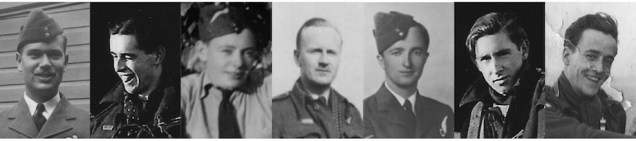
The crew of AJ-S. Left to right: Lewis Burpee (pilot), Guy Pegler (flight engineer), Thomas Jaye (navigator), Leonard Weller (wireless operator), James Arthur (bomb aimer), William Long (front gunner), Gordon Brady (rear gunner). 

At 0011 on 17 May 1943, the night of the Dams Raid, Plt Off Lewis Burpee and his crew left RAF Scampton at 0011, but never made it as far as the German border. While still over Holland, and approaching the gap between the heavily defended airfields at Gilze Rijen and Eindhoven, the aircraft strayed off course. It climbed slightly, probably in an effort to determine its exact position, but was then caught in searchlights and hit by flak. At 0200, it crashed on the edge of Gilze Rijen airfield, six miles south west of Tilburg. Its mine exploded on impact, demolishing a large number of buildings and doing damage estimated at 1.5 million guilders.

The demise of the Burpee crew was seen by both Stefan Oancia, bomb aimer in AJ-F, a minute or so behind, and Douglas Webb, still further back in the front turret of AJ-O. Their last minutes were also seen by a German witness, a Luftwaffe airman based at Gilze Rijen called Herbert Scholl, interviewed after the war by the author Helmuth Euler. He was of the opinion that AJ-S was in fact not hit by flak at all, but was dazzled by a searchlight beam hitting it horizontally. The pilot tried to fly even lower, and then hit some trees.

The next morning, Scholl went to the crash site and saw that it was a total wreck. Only the rear turret and tail unit were intact, and he saw rear gunner Gordon Brady’s body, which didn’t appear to have any sign of injury. He noticed that Brady was scantily dressed, wearing thin uniform trousers and lace up shoes with holes in the soles. (Helmuth Euler, The Dams Raid through the Lens, After the Battle, 2001, p.106.)

After the crash, only the bodies of Burpee, Brady and Weller were positively identified. The other four were buried in a communal grave. They were interred by the Germans at Zuylen Cemetery, Prinsenhage. After the war, all seven bodies were transferred to the War Cemetery at Bergen-op-Zoom.

For many years, the crash site has been barred to the public, as Gilze Rijen airfield is still in active use by the Royal Netherlands Air Force. However, a local group, headed by local campaigner Sander van der Hall, has now secured permission to build a memorial, and are seeking crowd-funding to help with the project.

The memorial will be unveiled on 4 May, and the Battle of Britain Memorial Flight Lancaster, PA474, will perform a flypast.

Please help the campaign group by making a donation at its crowd-funding page. (Please note that the organisers are changing the picture on this page, which shows another crew!) Further information on this page (mainly in Dutch).