Fleet St editorial standards slipping (part 109)

Mail Johnson

Another example, this time from the Daily Mail.

The last of the Dambusters has spoken for the first time how he celebrated the squadron’s heroic raid – with a nice cup of tea.

I’m happy to say that there are three Dambusters still with us: George ‘Johnny’ Johnson in England, Les Munro in New Zealand and Fred Sutherland in Canada. George Johnson has told his story a number of times.

Almost 70 years after the night-time bombing attacks, Squadron Leader George ‘Johnny’ Johnson, 91, told of the daring raid over occupied territory that dealt a decisive blow that crippled the Nazi war effort.
George was festooned with a raft of medals including a Distinguished Flying Medal for his part in 617 Squadron’s daring 1943 blitz on the Nazi-controlled dams along the Ruhr Valley in Germany, destroying their hydro-electric source of power.

George’s ‘raft of medals’ are for his war service as a whole. He was awarded the DFM for his part in the attack on the Sorpe Dam. The concept of any one airman getting more than one decoration for a single operation is ridiculous. It did occasionally happen that an airman got more than one decoration for an operation, but it was very rare (see comment below).

Widower George, who lives in Bristol, was a sergeant at the time of the raids, conducted under the name Operation Chastise, which smashed the Mohne, Sorpe and Eder dams.
He said: ‘We were about half an hour late because our plane had a hydraulic leak and we had to swap.

The Sorpe Dam was attacked, but remained intact. It was not ‘smashed’.

‘We took off at 22.01, and flew in over Sorpe dam in brilliant moonlight. We had to get the aim right – we went in six or seven times and I’d shout ‘Dummy Run’.
‘It was a totally different dam from the other dams. It was impossible to fly low over, so it had to be a drop, not a spinning bomb.’
Piloted by Joe McCarthy, the plane nicknamed ‘T for Tommy’ was one of five planes that made it to the dam, which was the most difficult of the three targets to crack.

Three aircraft made it to the Sorpe Dam. Only two aircraft bombed the Sorpe Dam (see comment below). T for Tommy was not a nickname for the aircraft piloted by Joe McCarthy. It was its call sign.

It took bombardier George and his crew nine attempts to fly at a perilous 30ft, before the bomb, codenamed Upkeep, was finally loosed, seconds before they had to pull up to avoid smashing into the hillside behind the dam.

Bombardier is an American term for what the RAF called ‘air bombers’ early in the war. By 1943 they were usually referred to as ‘bomb aimers’.

He said: ‘I could see where to drop and shouted ‘Bomb Gone’ to cheers of ‘Thank Christ’ from the crew who were yelling for me to get the bomb out.
‘At 00.46 on May 17 we dropped our bomb with 8,500lb of explosives.’
George added: ‘There was a spout of water 1,000ft high. We circled and the dam crumbled about 10 yards wide.
‘But it didn’t seem as if the other five aircraft had been there. We needed six bombs to crack the dam and the water would do the rest.’
After smashing the dam, the heroic airmen flew their Lancaster bomber over the Mohne Dam, which had been blown by another plane in the same daring raid.
The Sorpe dam was badly damaged by the daring night-time raid, orchestrated by wing commander Guy Gibson and bouncing bomb inventor Barnes Wallace.

Some confusion in the last two paragraphs here. Was the dam ‘smashed’ or ‘badly damaged’? Oh, and it’s Barnes Wallis, not Wallace.

George said: ‘I will never forget the sight. It was like an inland sea with all that water overflowing.
‘It gave us a lot of satisfaction when we heard over the radio that the Eder had been breached as well.’
It was only when they flew back to RAF Scrapton in Lincolnshire that the brave crew realised they had been hit several times by an armoured train on their way to the dams, and the pilot’s chair was pockmarked with bullet holes.

It’s Scampton, not Scrapton.

He said: ‘I was tired and exhausted – I went to the mess and had bacon and powdered scrambled egg and a cup of tea. It tasted good.’
The five-hour raid came at a heavy price – 53 of the 133 brave airmen, hand-picked for the secret mission, did not come home.
George said: ‘The waitresses in the sergeants’ mess were all in tears as so many places were empty.’
The brave airman married sweetheart Gwyn, a phone operator in the Women’s Royal Air Force, days before the sortie, after being given special permission from chiefs despite all leave being cancelled.
After narrowly avoiding death on an eye-watering 50 missions during his 22 years’ service with the RAF, George became a teacher.

Did the Second World War really last 22 years? George’s ‘eye-watering 50 missions’ were of course confined to his war time service between 1940 and 1945. He stayed on in the RAF until 1962, and rose to the rank of Squadron Leader.

Great-grandfather George, who became a widower when Gwyn died of cancer in 2005, is helping Lord of the Rings filmmaker Peter Jackson with his scheduled remake of the classic 1955 Dam Busters film.
He said: ‘I feel honoured and proud to have been lucky enough to take part in that raid.
‘It proved to Hitler and the Germans what they thought was impregnable could be destroyed by the RAF.’

Amen to that.

Dams Raid navigation log for AJ-T

This is part of the navigation log for Joe McCarthy’s aircraft AJ-T, filled in by Flt Sgt Don MacLean during the Dams Raid. It was kindly sent to me by his son, Bill.
Joe McCarthy was due to lead the second wave of five aircraft, tasked with attacking the Sorpe Dam, and should have taken off in Lancaster ED923 which had been given his favourite call sign Q for Queenie, from Scampton at 2127. However this developed a coolant leak, and the crew hurriedly transferred to the only spare available, ED825, call sign AJ-T. This turned out to be missing its all-important compass deviation card, which meant another dash for McCarthy, off to the flight offices. AJ-T finally left the ground at 2201, as you can see from the second picture above. Note in the first picture how MacLean has crossed out ‘Q’ and written ‘T’. He has also misspelt rear gunner Dave Rodger’s name as ‘Ridgers’.
Flying as fast as he could, McCarthy made up 13 or 14 minutes by the time he reached the Sorpe at 0015, to discover that he was the only one of the second wave to reach the target. Barlow and Byers had been shot down, Rice and Munro had returned to base.
The Sorpe Dam was a different construction from the Möhne and Eder Dams, which meant that bouncing the Upkeep mine towards it would not work. So the plan was to attack it by flying very low along its length and then release the mine in the middle. This would roll down the dam’s face and explode below the waterline. AJ-T’s bomb aimer George ‘Johnnie’ Johnson has told the story many times how his colleagues were less than impressed by the fact that it took no fewer than ten dives along the dam to get the line and height right. However, at 0046 he released the mine and it exploded perfectly, but it failed to destroy the dam, although the crew saw some crumbling at the top of the wall.
Their journey back to Scampton saw a certain amount of deviation from the designated route, so in the end they simply backtracked along their outbound course. They landed rather precariously at 0323, as a flat starboard tyre called for a deft bit of piloting by McCarthy.
The whole crew survived the war, and most were regular attenders of various reunions. Below, courtesy of Alex Bateman, is a picture of Don MacLean with two other Dambusters, Tammy Simpson and Danny Walker, taken at a Bomber Command dinner in London in 1987.

Pic: Alex Bateman

Tonight at 8

Just a quick note to say that UK residents with access to Channel Five can see the documentary ‘Last of the Dambusters: Revealed’ again tonight at 8pm. It features one of the (now only four) surviving Dambusters, George ‘Johnny’ Johnson and his trip to France as a team of aircraft excavators dig up the Lancaster in which he flew on the Dams Raid. Later, he travels to the Sorpe Dam to see how the area has changed in the 65 years since the raid. He also meets people from the surrounding villages.
I’ve blogged about this programme before, when it was first shown in 2008 and when it was posted on Youtube.

Only original part from Dambuster Lancaster goes on display

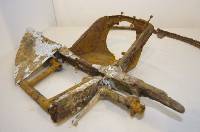
TH1_2392009409093 K486Pic: Grantham Journal

I might be wrong, but I think this is the only original part of a Dambuster Lancaster on public display anywhere in the world. Eleven Lancasters got back from the original Operation Chastise but those that survived the rest of the war were all scrapped in the late 1940s. This bit of rusty twisted metal is the gunner’s mount and hatch from the rear of Lancaster ED825, which was flown by Joe McCarthy on the Dams Raid. Almost seven months later it was being piloted by Flt Lt George Weeden on an operation to send ammunition and supplies to the French resistance when it was shot down near Doulens in France.
The story of its excavation, by a team which included Dams Raid expert Alex Bateman, was told in the Channel Five documentary, misleadingly titled The Last of the Dambusters, shown on British screens last year. Sqn Ldr George (Johnny) Johnson, bomb-aimer in McCarthy’s crew, accompanied the team on their journey.
The hatch will join the other Dambuster exhibits – many of them from the collection of 617 Squadron adjutant Harry Humphries – on display at the Grantham Museum. Well worth a visit!

‘Last of the Dambusters’ on Youtube

I posted about this interesting (although misleadingly titled) documentary last year, when it was shown on British terrestrial TV. It shows the journey made by Sqn Ldr George (Johnny) Johnson, bomb aimer in Joe McCarthy’s AJ-T, to visit the site in Germany at which his Dambuster Lancaster crashed six months after the Dams Raid. Here it is on Youtube, in five parts.

Part 1
Part 2
Part 3
Part 4
Part 5

Enjoy!

Last of the Dambusters, not

I managed to see a recording of the Channel Five documentary ‘Last of the Dambusters’ the other night. (As I live in Ireland, I can’t get Channel Five, even though we get all the other British channels on our cable service.) This has been quite extensively reviewed (see here and here) and discussed on various forums (see here and here) so I shan’t say too much more.

The programme featured George (Johnny) Johnson, who is fast becoming a national treasure. Although he is not the ‘last of the dambusters’ (I don’t know why the programme was given that confusing title when five or six men who took part in the Dams Raid are still alive) he is the only one based in the UK who regularly does media appearances. He treated the programme makers and everyone else in the film with his usual courtesy, and it was very interesting seeing his reactions to meeting people who lived near the Sorpe Dam which he had tried to destroy 65 years before.

The other inaccuracy in the programme concerned the Sorpe Dam itself. The impression was given that Joe McCarthy’s crew, in which Johnson was the bomb aimer, was the only crew to reach and attack the Sorpe. It is true to say that they were the only one of the five crews in the second wave to get that far (Munro and Rice had to turn back after their aircraft were damaged, Barlow and Byers crashed on the outward flight). But Ken Brown in AJ-F, from the reserve wave, made it all the way, dropped his mine successfully at 0314 and returned to Scampton safely.

Hindsight tells us that sufficient thought had not been given as to how to attack the Sorpe. With its earth core construction the dam could not be attacked head on like the concrete-built Möhne and Eder, so the ‘bouncing’ technique could not be used. Instead, both McCarthy and Brown flew along the length of the dam and dropped their mines in the centre, causing them to roll down into the water before the hydrostatic fuse exploded. Perhaps if five aircraft had got through the cumulative effect would have succeeded, but we will never know.

Looking over the interwebnet today for reviews of the programme, I came across this other oddity – a review by the romantic fiction writer Jessica Blair. It turns out that Ms Blair is not all she seems, being the nom de plume of a gentleman called Bill Spence, who flew 36 wartime operations as a Lancaster bomb aimer in 44 Squadron, and turned to writing in 1960. What an interesting life!

Dams Raid Lancaster crash site on TV

This is not the crash site of one of the eight Lancasters lost on Operation Chastise (those have all been excavated years ago) but is where Lancaster AJ-T (ED825/G) crashed on the night of 10 December 1943 near Doullens in France. It was still being used by 617 Squadron, and that night was being flown by a crew captained by Flt Lt Gordon Weeden. All seven of the crew were killed.

AJ-T had been designated the ‘spare’ aircraft for Operation Chastise, and was hurriedly pressed into service when Flt Lt Joe McCarthy found a fault in his favourite AJ-Q (Q for Queenie). There is a lot of detail about McCarthy’s habit of calling all his aircraft Queenie, and his predilection for ‘nose art’ here.

Channel Five is screening a documentary about the search for AJ-T next Tuesday, 17 June at 2000 BST. More than ten years after its launch, Channel Five is still not available to everyone in the UK, so I’m sure in due course that the film will be made available on DVD.

The documentary features one of Britain’s last ‘active’ Dambusters, George (Johnny) Johnson, who, of course, was the bomb aimer in McCarthy’s crew, and therefore dropped a bomb from the aircraft on the Sorpe Dam during the Dams Raid. The latter part of the film shows his trip back to the Dams, and his memories of that night.

Here’s what Channel Five say about the film:

Revealed (Documentary)

Last of The Dambusters.

Historical documentary focusing on the famous Second World War Dambusters raid. George Johnson – a bomb aimer in one of the raid’s Lancasters and one of only two British Dambusters alive today – sets off on a final mission to rediscover his past. He finds and digs up his old Dambuster bomber, before travelling back to the giant German dams that he once attacked.